
- Digital marketing for plumbers is not posting everywhere. It is making sure the right local homeowner can find you, trust you, call you, and get booked.
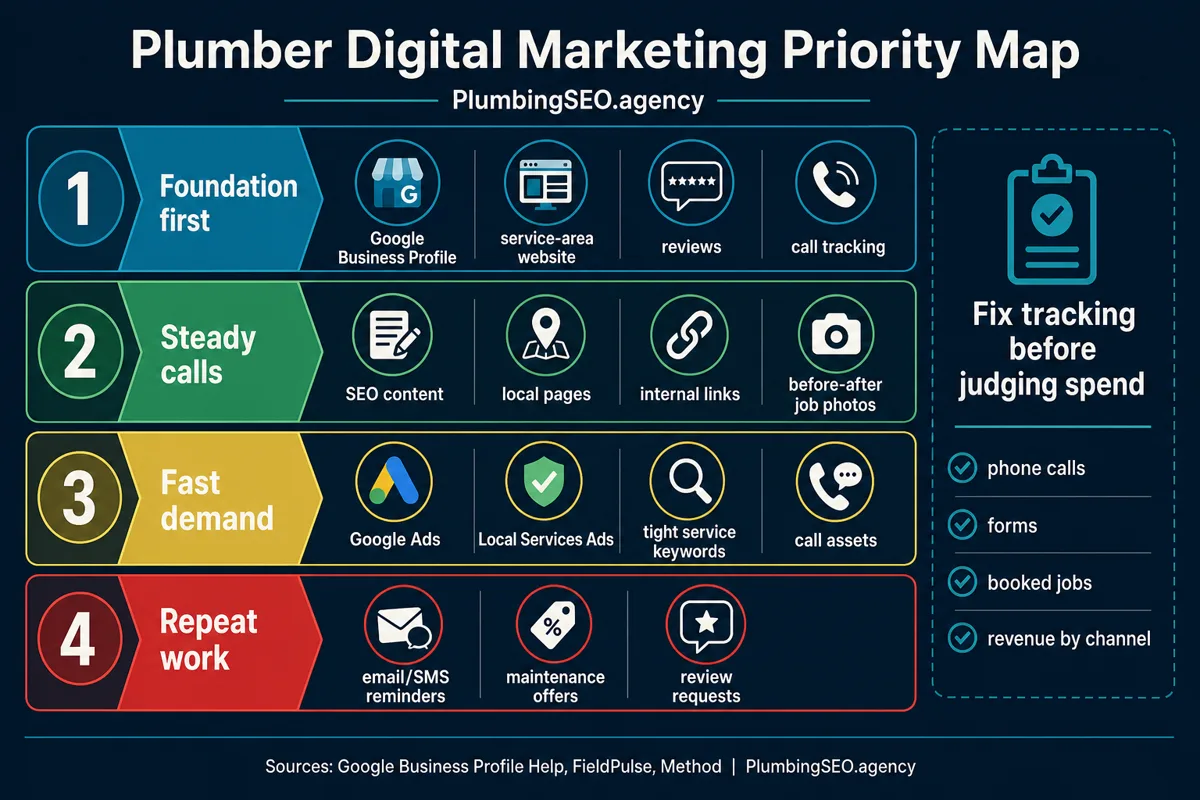
- Fix the foundation first: Google Business Profile, service pages, reviews, call tracking, and a website that works on a phone.
- Use paid ads for fast demand, SEO for steady demand, and tracking to decide what deserves more budget.
If the phone is quiet on a Tuesday, digital marketing can sound like a fancy way to spend money you do not have. For a plumbing company, it should be simpler than that. It should help a homeowner find you when the water heater quits, trust you enough to call, and give your office enough information to book the job.
The way I see it, digital marketing for plumbers is not one channel. It is the whole path from search to scheduled work. Your Google Business Profile, website, reviews, SEO, Google Ads, email reminders, and call tracking all touch that path. If one piece leaks, the report may look fine while the board stays light.
That is what generic marketing articles miss. They explain SEO, PPC, social media, and email like every business sells the same thing. Plumbing is different. You are dealing with urgent calls, service areas, dispatch routes, office handoffs, and customers who often pick from the first few names they trust.
What digital marketing means for a plumbing company
For plumbers, digital marketing means using online channels to put your company in front of people who need plumbing work in your service area. The important word is need. A homeowner with a burst pipe is not browsing like someone shopping for shoes. They want proof, a phone number, service coverage, availability, and a reason not to call the next company.
A good plumbing marketing system usually has five jobs:
- Get found in Google Search, Google Maps, paid search, and local directories.
- Build trust with reviews, photos, clear service pages, licenses, and local proof.
- Make contact easy with click-to-call buttons, forms, booking prompts, and fast mobile pages.
- Track the source so you know whether SEO, ads, GBP, referrals, or repeat customers drove the call.
- Turn leads into booked work with office follow-up, dispatch notes, and missed-call recovery.
That is why a plumber should not start by asking, Should we do SEO or ads? The better question is, Where are calls leaking right now? If nobody can find you on Maps, fix local visibility. If people find you but do not call, fix the website and trust signals. If calls come in but nobody knows which channel produced booked jobs, fix tracking first.
What the top results usually miss
The current search results cover the usual list: Google Business Profile, a website, SEO, PPC, social media, email, and reviews. Those are valid. FieldPulse points out common problems like high local competition, inconsistent lead flow, low search visibility, outdated websites, and unclear strategy. Method's plumber guide frames digital marketing around search, social, email, mobile, and lead tracking.
Here is the problem. A list of channels does not tell an owner what to fix first. If you try everything at once, you can spend a month posting, boosting, redesigning, blogging, bidding, and buying tools without knowing what moved the phone. That is not growth. That is noise with a receipt.
For most plumbing companies, the order matters more than the menu. A paid ad campaign pointed at a weak landing page wastes money. A good blog post on a site with no service-area pages may not pull local calls. A nice Google profile with no call tracking leaves you guessing. A marketing report with clicks but no booked-job data is like a pressure gauge nobody installed on the line.
The plumber-first channel order
Start with the parts that make every other channel work harder. Then add the channels that create demand.
| Channel | What it does | Fix this before spending more |
|---|---|---|
| Google Business Profile | Helps local customers find you in Search and Maps. | Correct category, service areas, phone number, hours, photos, services, and review process. |
| Website and service pages | Turns searchers into calls by proving you handle their problem in their area. | Mobile speed, click-to-call, city/service pages, trust proof, and clear next steps. |
| Local SEO | Builds steady visibility for service and city searches over time. | Service-page structure, internal links, reviews, citations, and useful local content. |
| Google Ads and LSAs | Creates faster demand when you need calls now or want to test a service area. | Tight keywords, negative keywords, call assets, landing pages, and booked-job tracking. |
| Email and SMS | Brings past customers back for maintenance, seasonal work, and referrals. | Clean customer list, permission, useful timing, and simple offers. |
If local SEO is the main leak, use our SEO for plumbers guide as the broader foundation, then go deeper with the advanced local SEO checklist. The goal is not more pages for the sake of pages. The goal is to help Google and homeowners understand what you do, where you do it, and why you are the safe call.
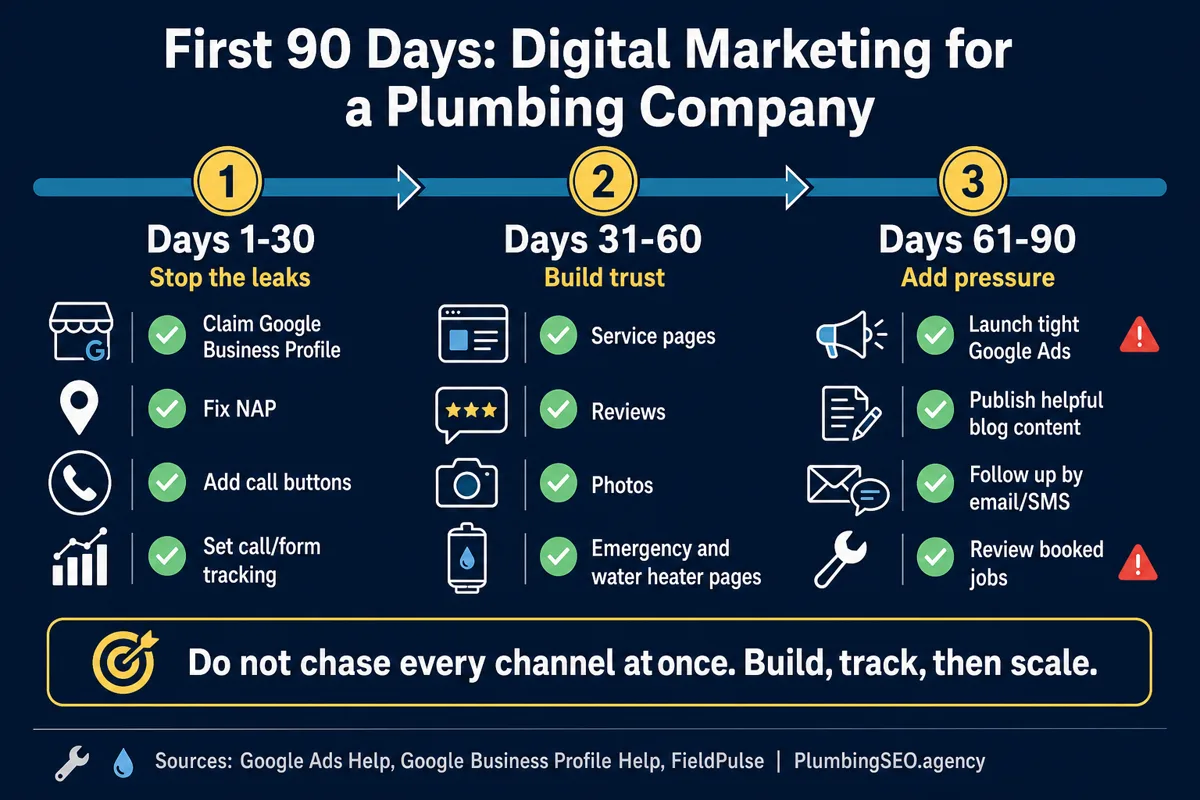
A simple 90-day implementation plan
Do not try to build the whole machine in one week. You still have trucks to run, calls to answer, payroll to meet, and customers who do not care that Google changed another screen in the dashboard.
Days 1 to 30: stop the obvious leaks
Claim and clean up your Google Business Profile. Make sure the business name, phone number, hours, categories, service areas, website link, and main services are right. Add real photos. Set up call and form tracking before judging channels. Check the top pages on your website from a phone, not just a desktop screen in the office.
This is also where you make the phone obvious. If a homeowner has to pinch, zoom, hunt, or think, you are making the emergency harder than it needs to be.
Days 31 to 60: build trust and local relevance
Create or improve the pages that match your money services: emergency plumbing, drain cleaning, water heaters, sewer line repair, leak detection, and the cities you actually serve. Add proof from real jobs, review language, service-area details, and photos that feel local.
This is where many shops underinvest. They want rankings but have thin pages that could belong to any contractor in any city. Google may crawl those pages, but homeowners can smell generic copy faster than a tech can spot a bad wax ring.
Days 61 to 90: add pressure with paid and repeat work
Once the foundation can catch the demand, test Google Ads or Local Services Ads around the services and areas you can actually handle. Google Ads guidance emphasizes relevance, strong assets, call assets, and measurement. It also notes that improving responsive search ad strength from poor to excellent has produced more clicks and conversions on average in Google internal data, and that business logo and name assets can lift conversions in eligible Search ads.
At the same time, build a simple follow-up system for past customers. Seasonal reminders, maintenance checks, review requests, and we are still here if you need us messages are not glamorous, but they can keep work moving without buying every call from scratch.
What to measure so you do not fool yourself
Rankings matter. Traffic matters. Impressions matter. But a plumbing owner cannot pay the crew with impressions. The scorecard has to connect marketing to calls, booked jobs, and revenue by service type.
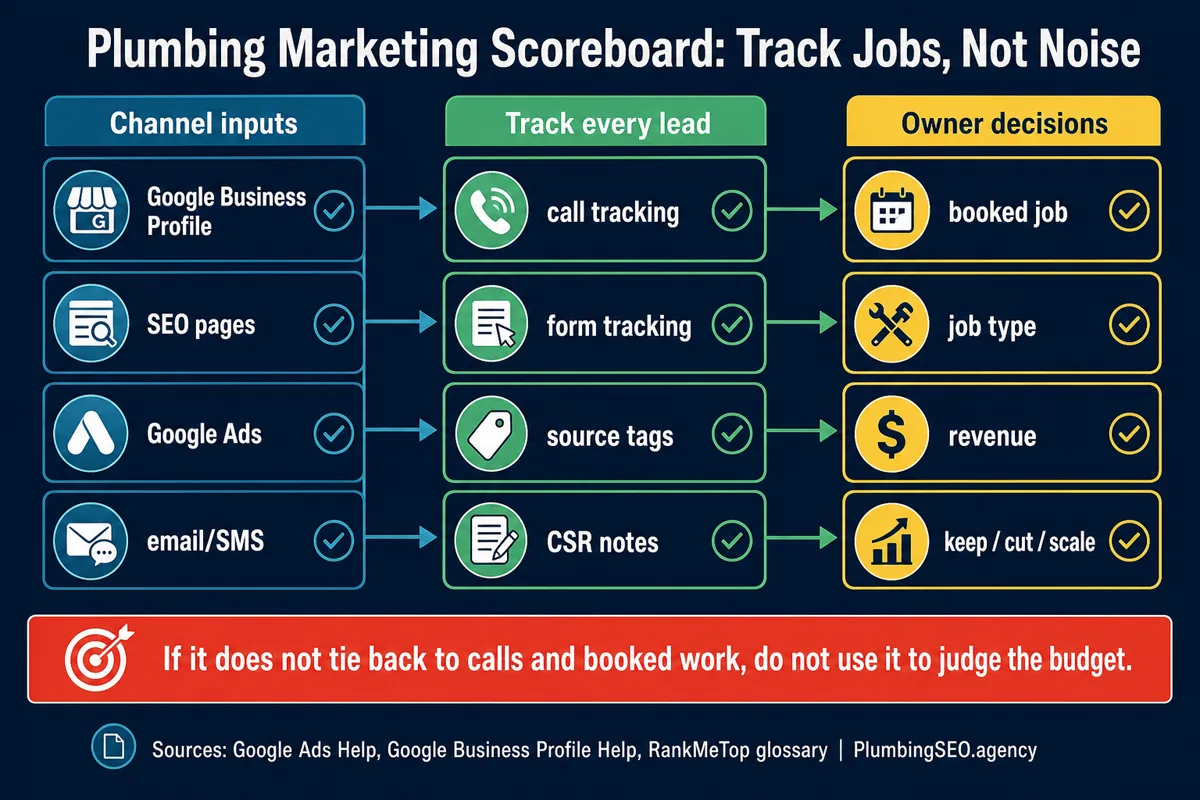
Here is the minimum monthly scorecard I would want before making budget decisions:
- Calls by source: Google Business Profile, organic website, Google Ads, LSAs, referrals, repeat customers.
- Forms and booking requests by source.
- Missed calls and after-hours calls.
- Booked jobs by source, not just raw leads.
- Job type and service area for each booked job.
- Cost per booked job for paid channels.
- Review count, review recency, and owner responses.
- Pages that generated calls, especially service and city pages.
Once you have that, your decisions get cleaner. If Google Ads sends calls but few booked jobs, tighten the keywords, ad copy, schedule, or landing page. If SEO brings fewer calls but higher-value work, protect that channel. If GBP calls are strong but reviews are stale, build review requests into dispatch. If nobody answers after hours, marketing may not be the main leak.
Common digital marketing mistakes plumbers make
Buying channels before fixing the counter
Sending more visitors to a weak website is like sending more customers to a supply counter with nobody standing there. Fix mobile usability, phone visibility, service pages, trust proof, and tracking before you pour more money into traffic.
Judging SEO too early and ads too late
SEO usually needs time to build authority, local relevance, and content depth. Ads can bring data faster, but they can also waste money quickly if nobody watches search terms, lead quality, and booked jobs. Use both with different expectations.
Posting on social because everyone says to
Social can help trust and repeat customers, especially with real job photos and community presence. But for many plumbing companies, it should not come before Maps visibility, service pages, reviews, and tracking. A clean truck photo is useful. A dancing wrench video is optional.
Letting reports hide the real problem
A report can show clicks, impressions, and traffic while the phones stay slow. Push every vendor, tool, or internal marketer to connect work back to calls and booked jobs. The phone tells the truth.
When should plumbers hire help?
You can handle some of this yourself if you have time, patience, and someone who will keep it moving every month. Claiming your profile, asking for reviews, adding job photos, and checking your own website on a phone are owner-level basics.
Hire help when the work starts touching technical SEO, page architecture, analytics setup, Google Ads waste, local content strategy, structured data, or competitive markets where the top shops are not sleeping. If you want a second set of eyes, contact us or start with a free audit. We will show you the leaks before we ask you to buy anything.
Digital Marketing for Plumbers FAQs
It helps the right local customers find, trust, and contact your company when they need plumbing work. The useful version connects Google Business Profile, SEO, ads, reviews, website conversion, and call tracking back to booked jobs.
Plumbers can handle basics like profile updates, job photos, review requests, and simple website checks. Hire help when you need technical SEO, local page strategy, Google Ads management, analytics, or consistent monthly execution.
Paid ads can show lead data quickly once tracking is set up. SEO and Google Maps improvements usually take longer because trust, relevance, content, links, and reviews build over time. Judge each channel by the right timeline.
Start with Google Business Profile accuracy, mobile website usability, service pages, reviews, call buttons, and tracking. Those basics help every other channel perform better.
SEO is better for building steady local visibility and trust over time. Google Ads is better for faster testing and demand when you need calls now. Many plumbing companies need both, but only after tracking can show which calls turn into booked jobs.
Want to Know Where Your Plumbing Marketing Is Leaking?
We will review your Google profile, website, service pages, tracking, and local visibility so you can see what to fix before spending more on ads or another redesign.
Run My Free SEO Leak Check