
- Advertising usually gets calls faster because Google Ads, Local Services Ads, and paid social can begin running as soon as tracking and landing pages are ready.
- SEO usually wins the long game because organic and Maps visibility can keep producing calls without paying for every click.
- The strongest plan uses both: ads cover short-term demand while plumber SEO builds a lower-cost call engine.
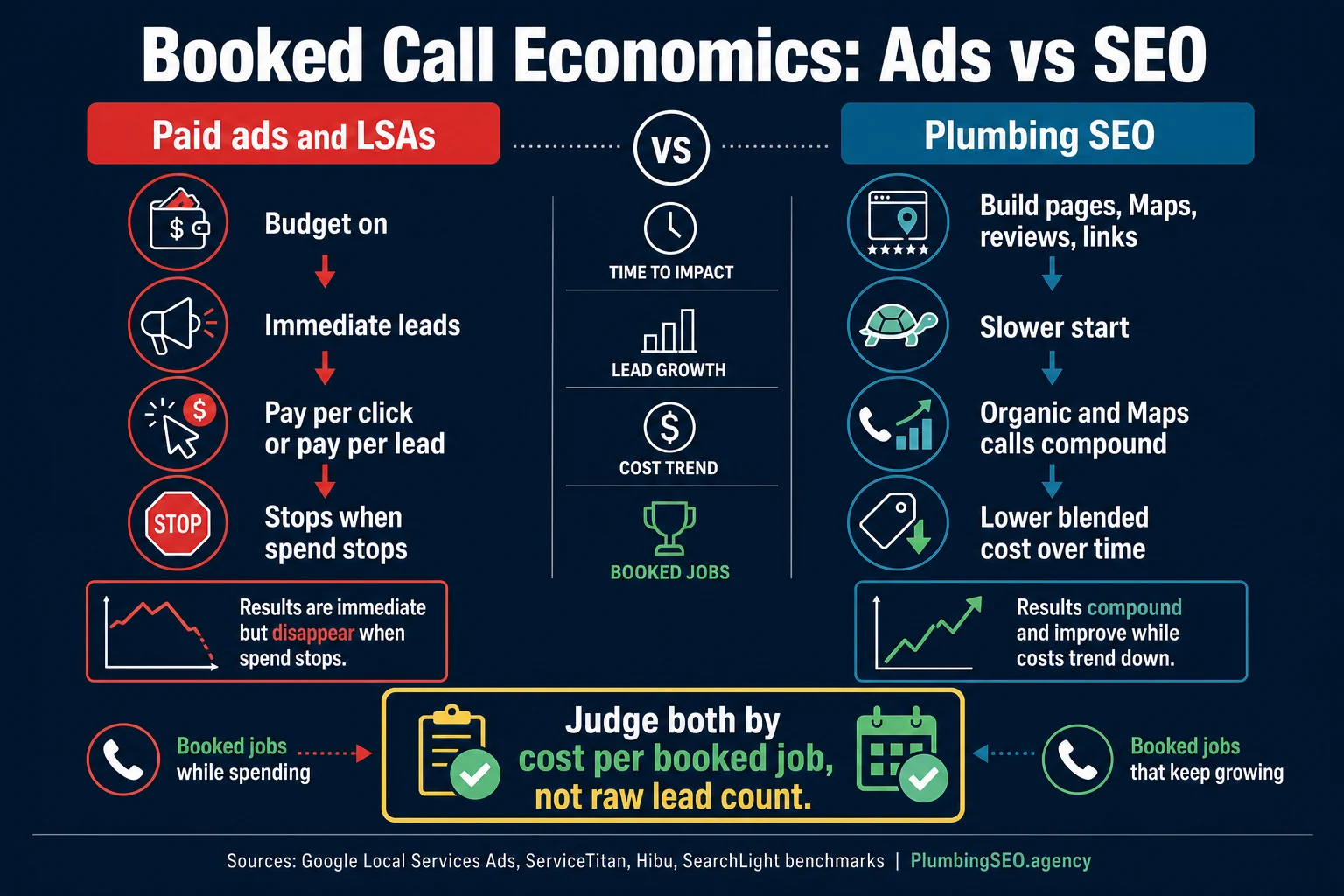
If your plumbing company needs the phone to ring this week, advertising is the fastest lever. If you want a more durable source of booked jobs, SEO is the asset that compounds. The practical answer is not a permanent fight between plumber advertising and SEO. The real question is how much urgency you have, how much waste your paid campaigns carry, and whether your site is building call equity every month.
This comparison focuses on calls that can become booked plumbing jobs, not vanity traffic. A campaign that creates 70 calls with weak booking quality may be worse than an organic channel that creates 30 calls with higher close rates and better average tickets.
What counts as plumber advertising?
Plumber advertising includes paid channels such as Google Search Ads, Local Services Ads, paid Maps visibility, retargeting, paid social, display ads, directory placements, sponsorships, and local media. These channels are useful when you need immediate exposure in a defined service area or want to test demand before investing in a larger content plan.
The drawback is dependency. Advertising is rented attention. When spend stops, the call flow usually slows down. Paid costs can also rise when competitors bid more aggressively, weather drives emergency demand, or your targeting allows low-fit searches to leak into the campaign.
Google Local Services Ads sit in the middle of the conversation because they are not traditional pay-per-click ads. Google describes them as a way to pay when potential customers contact you through the ad, with calls, messages, or bookings as the action. For a plumber, that can be useful, but it still needs call quality checks. A paid lead is only useful if the job is in your service area, fits your license and crew, and actually gets booked.
What counts as plumber SEO?
Plumber SEO is the work that helps a plumbing business earn visibility in organic search and local map results. It includes technical site health, service pages, local content, Google Business Profile improvements, review strategy, internal linking, local citations, and conversion improvements.
SEO takes longer because Google has to crawl, evaluate, and trust the site and local entity. Once it works, it can produce calls from emergency, repair, replacement, and research searches at a lower marginal cost than paid campaigns. If you need a baseline first, start with a free plumbing SEO audit.
Which gets more calls?
Advertising can get more calls at the start. SEO can get more calls after it has enough authority, content depth, review strength, and local relevance. The winner depends on timeline, budget, market competition, and tracking quality.
Paid advertising
- Can begin creating demand shortly after launch.
- Works well for emergencies, promos, new service areas, and open schedule capacity.
- Needs tight targeting, negative keywords, call recording, and strong landing pages.
- Call volume usually falls when spend pauses.
Plumber SEO
- Builds organic and Maps demand over time.
- Can reduce cost per booked job after rankings mature.
- Improves brand trust before the customer calls.
- Needs patience, publishing discipline, technical health, and local proof.
Speed, cost, and call quality compared
Speed matters, but profit matters more. A channel that creates a high number of wrong-fit calls can waste dispatch time. The scoreboard should compare qualified calls, booked jobs, average ticket, and cost per booked job.
| Factor | Advertising | SEO | What plumbers should do |
|---|---|---|---|
| Time to first calls | Fastest once campaigns are live | Usually slower, often months | Use ads if the schedule needs immediate demand. |
| Long-term cost curve | Cost continues as long as calls depend on paid clicks | Improves as rankings and local authority mature | Invest in SEO while ads cover short-term gaps. |
| Call quality | Depends heavily on targeting and landing pages | Often stronger when searchers compare trusted local results | Track booked jobs, not just raw calls. |
| Control | Budget, geography, keywords, and hours can change quickly | Less instant control, but broader durable coverage | Use ads for tactical coverage and SEO for market share. |
Realistic timelines for plumbing companies
A paid campaign can create measurable traffic quickly, but good campaign management still needs testing. Search terms, ad copy, phone recordings, landing pages, and dispatch outcomes should be reviewed weekly at first.
SEO usually needs a longer runway. Industry SEO references commonly frame meaningful organic traction in the 6 to 12 month range, and local plumbing results can move faster or slower depending on competition, existing authority, reviews, and how thin the website is today. For budget planning, compare this with how much a plumbing company should spend on marketing.
When advertising is the better first move
Choose advertising first when you need calls this week, have a new crew to fill, are opening a new service area, or need to protect revenue during a slow season. Ads also help test which services, cities, and offers convert before you build a full SEO plan around them.
Advertising is especially useful for emergency plumbing, drain cleaning, sewer work, water heater replacement, and other high-intent searches where the customer is ready to call now. The caution is that plumbing clicks can be expensive, so every campaign should use call recording, location filters, service filters, negative keywords, and dedicated landing pages.
When SEO is the better first move
Choose SEO first when your company already has enough near-term demand but wants lower-cost calls, stronger Maps visibility, and more control over long-term lead flow. SEO is also the better foundation when paid ads are getting clicks but customers still compare you against organic competitors before calling.
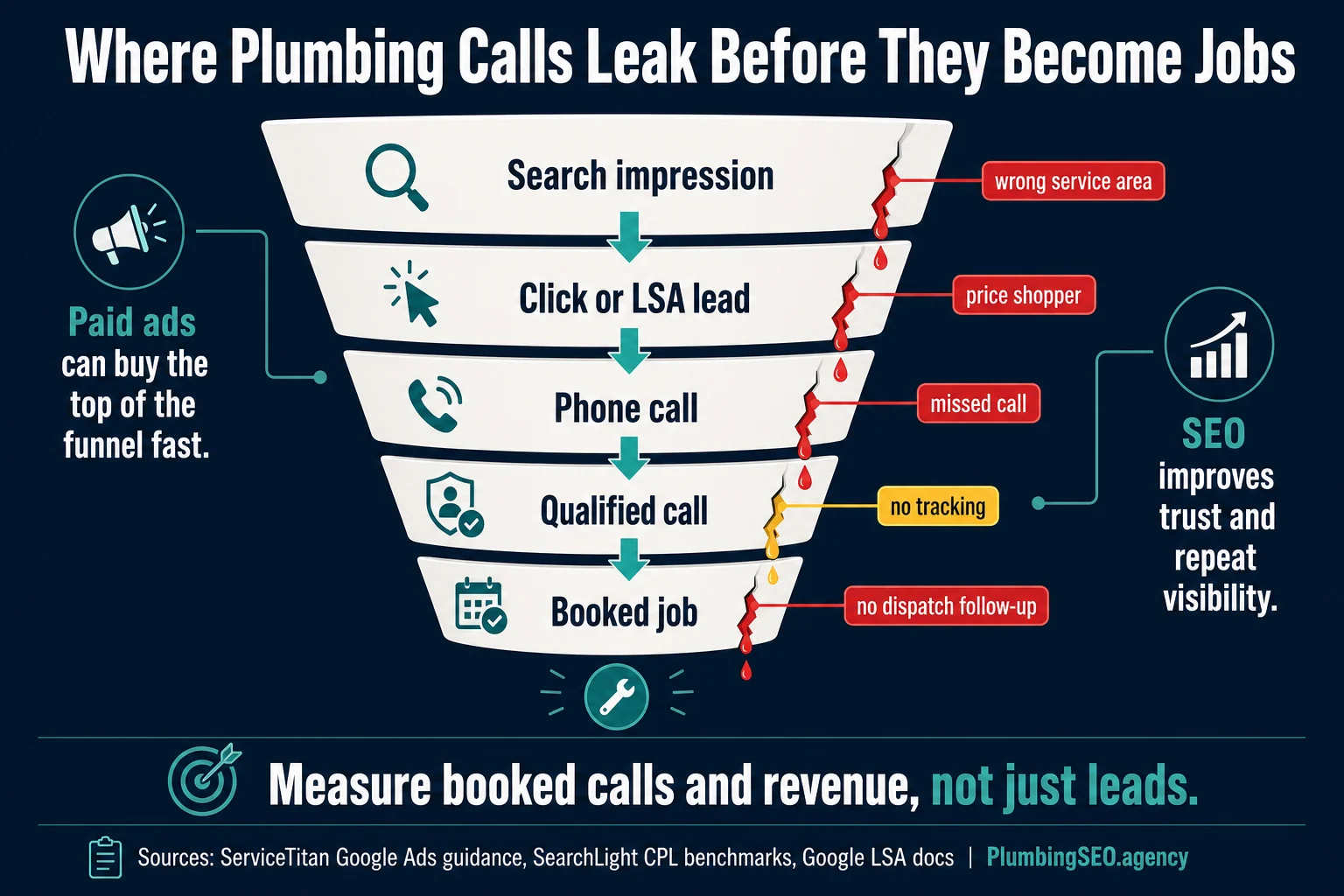
A plumbing company with weak service pages, a thin Google Business Profile, poor internal links, and limited local proof will keep overpaying for attention. Fixing those assets can improve both organic performance and paid conversion rates. That is why plumbing SEO pricing should be evaluated against booked jobs and lifetime value, not just monthly deliverables.
The best call-growth mix
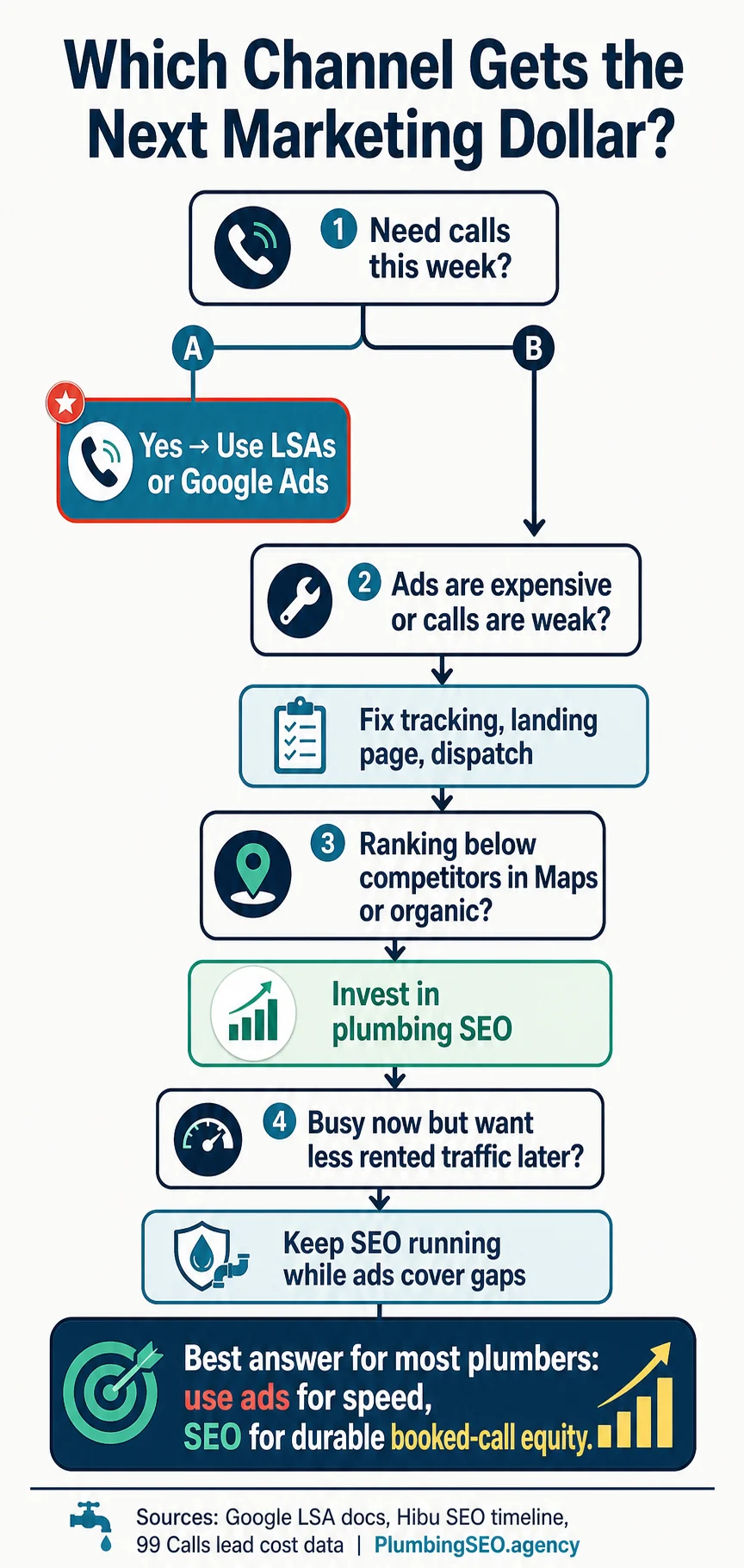
Most plumbing companies should not pick one channel forever. Use a staged mix:
- Start with tracking. Separate phone numbers or dynamic number insertion should attribute calls to ads, organic search, Maps, and referrals.
- Use ads for immediate coverage. Run tightly targeted campaigns for the cities, services, and hours where your schedule has capacity.
- Build SEO assets in parallel. Improve service pages, publish helpful local content, earn reviews, fix technical issues, and strengthen internal links.
- Shift budget by booked revenue. If organic calls begin booking cheaper jobs at scale, reduce wasteful ad groups and keep only the profitable paid campaigns.
How to measure which channel gets better calls
Raw call count is not enough. A channel that creates 80 calls but only 8 booked jobs can be worse than a channel that creates 35 calls and 20 booked jobs. Use the measurement approach in our plumber marketing ROI guide and review these numbers every month:
- Total calls by source.
- Qualified calls by source.
- Booked jobs by source.
- Average ticket and gross revenue by source.
- Cost per booked job.
- Repeat customers and memberships created by source.
Google explains that Business Profile local visibility is influenced by relevance, distance, and prominence. That means reviews, local proof, categories, services, and website signals all affect whether SEO and Maps can win call share in your market.
What to do if you already run Google Ads
If you are already spending on Google Ads, do not shut everything off just because SEO is the long-term play. First, compare campaign calls against organic and Maps calls. Then cut waste, protect profitable terms, and use SEO to lower dependency on the most expensive searches.
For a deeper paid search comparison, read SEO vs Google Ads for plumbers. If you want a broader paid media view, compare this with PPC for plumbers vs SEO.
Recommended budget split
A simple starting point is to allocate more budget to ads when you need immediate demand and more budget to SEO when the schedule is stable enough to invest. In a very competitive city, the first 90 days may lean heavier on ads. In months 4 through 12, shift more attention toward SEO assets that keep earning calls without increasing spend every time a competitor bids higher.
If the company has no reliable tracking, invest in measurement before increasing either channel. Better tracking often reveals that the real problem is not lead volume. It is poor call handling, bad service fit, weak follow-up, or a landing page that attracts the wrong jobs.
Final verdict: advertising buys calls, SEO builds call equity
Plumber advertising is the fastest lever for calls. Plumber SEO is the stronger long-term asset. The company that wins is usually the one that uses advertising to keep trucks busy while SEO builds the organic and Maps presence that lowers cost per booked job.
If you want help deciding the next dollar, get a free plumbing SEO audit. We will look at your current visibility, paid dependency, local competitors, and conversion gaps so you can decide whether ads, SEO, or both should carry the next stage of growth.
- SearchLight Digital HVAC and plumbing Google Ads cost per lead benchmarks
- Google Local Services Ads pay-per-lead overview
- ServiceTitan on Google Ads and job booking for plumbers
- 99 Calls Google Ads lead cost data for plumbers
- Hibu on why plumbing SEO takes longer than ads
- Google Business Profile local ranking factors
Frequently asked questions
Want to know which channel should get the next dollar?
Get a plumber-specific audit of your organic visibility, paid dependency, and call conversion leaks.
Run My Free SEO Leak Check