
- A healthy plumbing marketing budget usually starts around 5% to 8% of revenue for maintenance, then moves closer to 8% to 12% when you are trying to grow.
- Do not spend another dollar until you can track calls, booked jobs, and revenue by channel. Raw leads are not the same as good plumbing work.
- For most shops, the base spend belongs in Google Business Profile, service pages, reviews, tracking, and local SEO. Paid ads help when the numbers prove the phones turn into booked jobs.
If the phones are quiet, it is tempting to ask a simple question: how much should a plumbing company spend on marketing?
The honest answer is not a neat number from an agency brochure. A one-truck owner trying to protect referrals does not need the same budget as a five-truck shop opening a second service area. A company with clean call tracking can spend more confidently than a shop that has no idea whether last month's leads became jobs, estimates, or tire-kickers.
Still, you need a starting point. For most plumbing companies, a practical marketing budget falls into three bands:
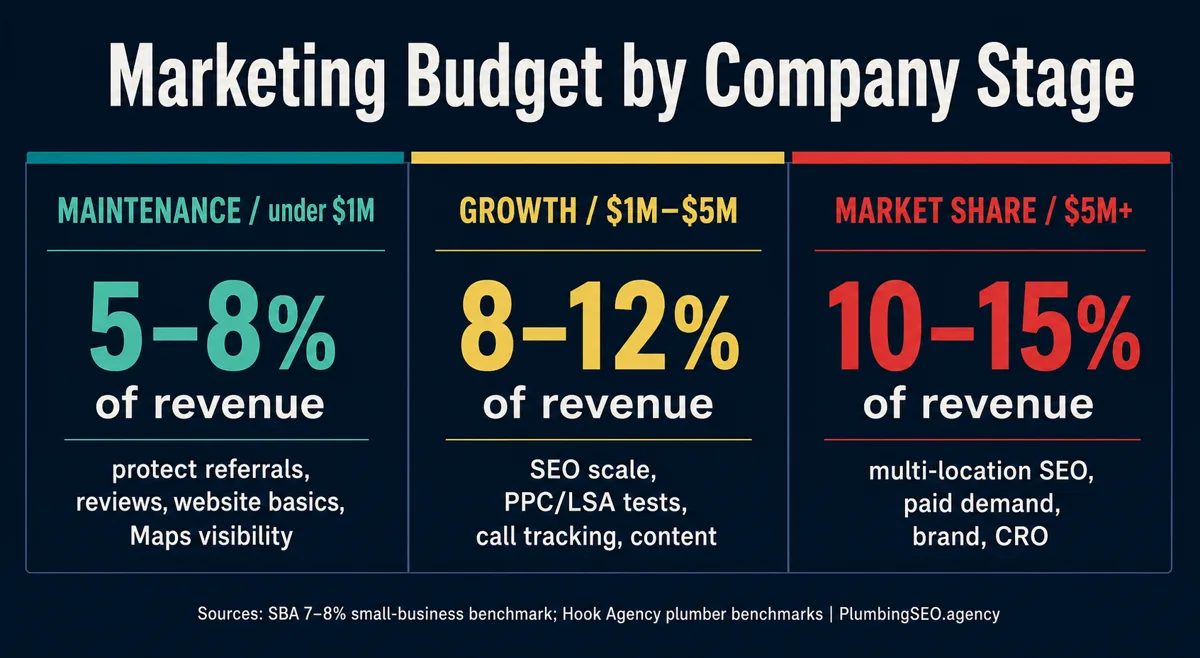
The U.S. Small Business Administration has long used the 7% to 8% range as a common small business benchmark. Plumbing-specific guidance from Hook Agency puts the maintenance-versus-growth split in plain terms: around 5% to maintain, closer to 10% when you want to grow.
That matches what I would tell an owner at the shop table. If you are doing $1 million a year and just want to protect your name, reviews, maps presence, and basic website, $50,000 to $80,000 for the year is a reasonable planning range. If you are trying to add trucks, enter a new suburb, or stop letting the same three competitors sit above you in Google, the range goes up.
Start with revenue, then adjust for the stage of the company
A percentage is useful because it keeps your spend tied to the size of the company. It stops a small shop from copying a big-shop budget and stops a bigger shop from starving the pipeline while payroll keeps growing.
| Company situation | Planning range | What the money should protect |
|---|---|---|
| Referrals are steady, growth is not urgent | 5% to 8% of revenue | Reviews, local listings, website trust, Maps visibility, basic content updates |
| You want more trucks booked consistently | 8% to 12% of revenue | SEO base, paid search tests, call tracking, service pages, conversion fixes |
| You are expanding service areas or fighting for top share | 10% to 15% of revenue | Multi-location SEO, stronger content, brand demand, ads, CRO, reporting |
The biggest mistake is treating the percentage like a permission slip to spend blindly. A plumbing company can waste 10% of revenue just as easily as it can waste 3%. The difference is tracking, channel mix, and whether the plan fits the jobs you actually want.
Use this quick plumbing marketing budget calculator
Move the sliders below to get a rough annual and monthly budget range. This is not a quote. It is a gut check before you sign a contract, raise ad spend, or decide the truck wrap is somehow going to fix Google Maps. Spoiler: it will not.
Do not pick channels until call tracking is clean
Here is where most budgets leak. The owner asks, "Should I spend this on SEO, Google Ads, LSAs, Facebook, postcards, or a new site?" That is the wrong first question.
The first question is: can you tell which source created a booked job?
If the answer is no, fix that first. Marketing without tracking is like dispatching trucks with no address. You might be busy, but you are not in control.
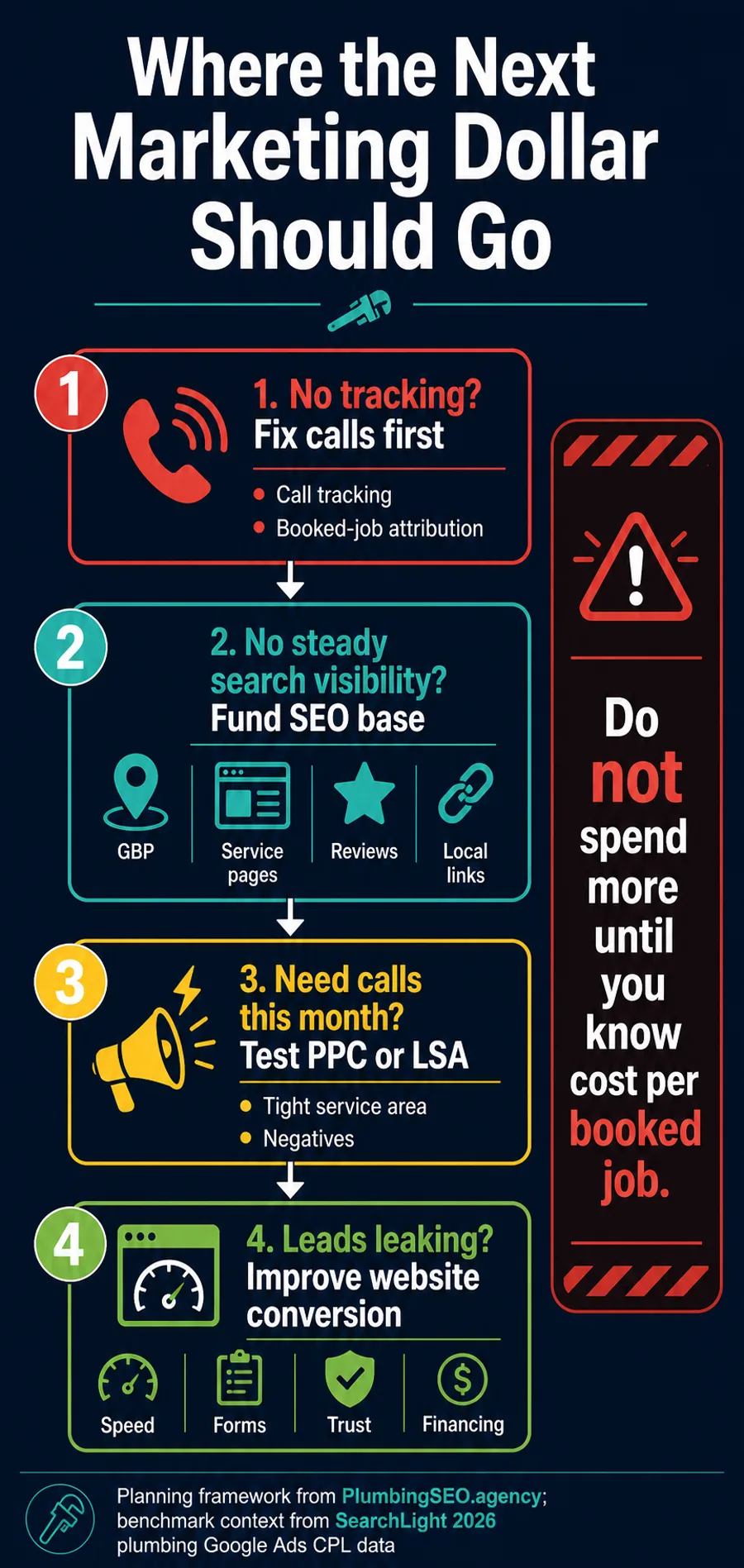
A good budget has a sequence. First, make sure calls are tracked. Second, make sure your Google Business Profile, reviews, service pages, and local signals are not embarrassing you. Third, use paid channels when you need speed and can measure booked jobs. Fourth, improve the website so more visitors call, submit forms, and trust you before they compare three more companies.
What should a plumbing marketing budget include?
A real budget is not one line labeled "marketing." That is how money disappears into vendor invoices and nobody knows what worked. Break the budget into jobs that each have a purpose.
- Google Business Profile cleanup and posting
- Review generation and response process
- Service page improvements for profitable work
- Local citations, NAP cleanup, and internal links
- Technical SEO basics, speed, indexing, redirects, schema
- Google Ads for urgent service searches
- Google Local Services Ads where available
- New suburb or service-line pages
- Call tracking, CRM fields, booked-job attribution
- Conversion testing for landing pages, forms, offers, and trust blocks
If you are not sure whether your site foundation is solid, start with a free plumbing SEO audit. If you already know the site is weak and want a service plan, compare our plumbing SEO pricing before you budget the year.
How much should go to SEO versus paid ads?
SEO and paid ads do different jobs. SEO is the base layer that helps the right customers find and trust you over time. Paid search is the lever you pull when you need calls faster or want to test a service area before building a long-term campaign around it.
In my opinion, most plumbing companies should not let paid ads eat the whole budget unless the tracking is excellent and the gross profit supports it. Ads can be useful. They can also hide sloppy math because the dashboard says "leads" while the office says "those were not good jobs."
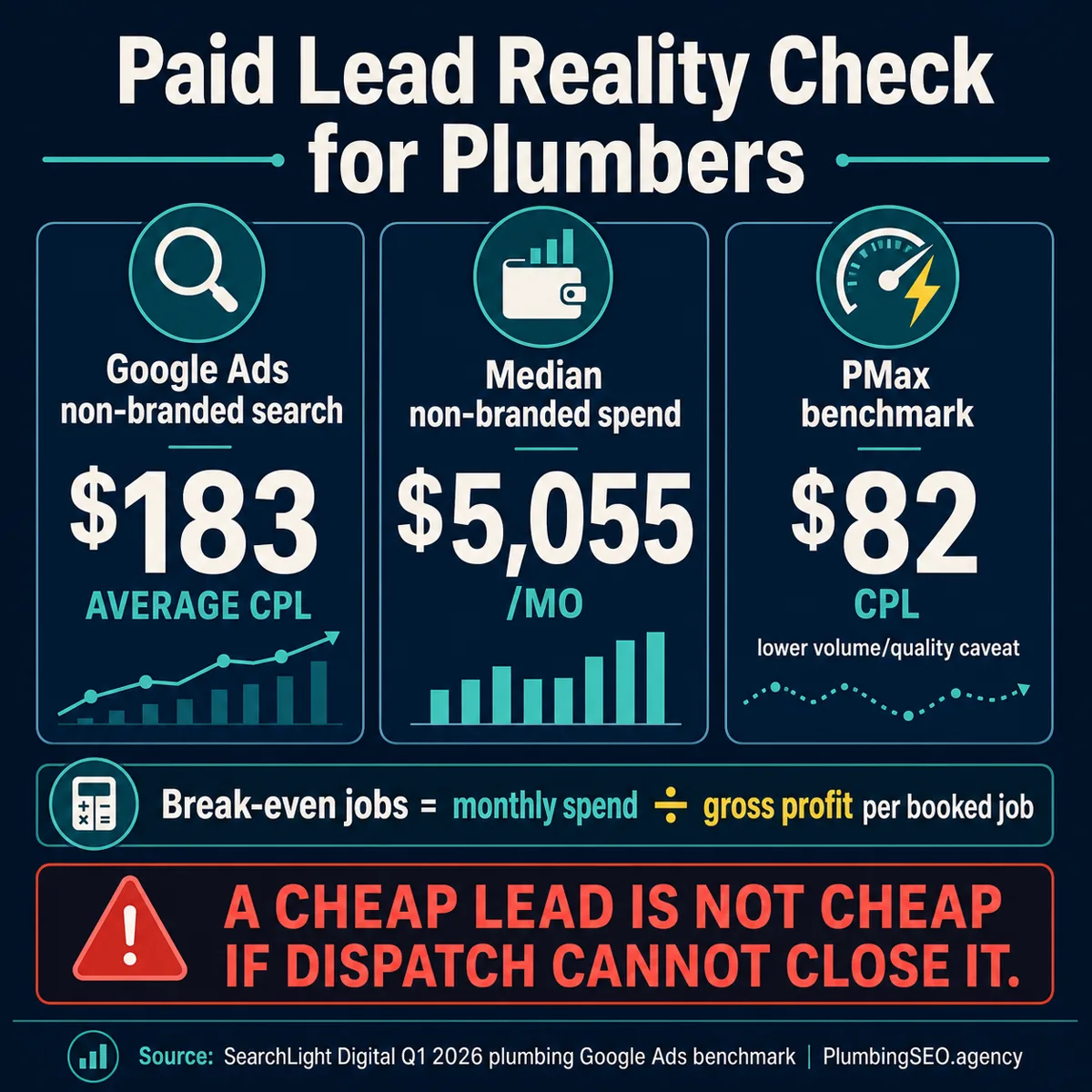
SearchLight Digital's Q1 2026 plumbing Google Ads benchmark reports a $183 average non-branded search CPL, a $5,055 median monthly non-branded spend, and an $82 Performance Max CPL with quality and volume caveats. Those numbers are useful, but they are not the finish line. The finish line is gross profit per booked job after ad spend, missed calls, dispatch time, and close rate.
The report may look good, but the phone tells the truth. If paid search creates calls your office cannot answer or your techs cannot close, the budget is leaking before the job board sees it.
Budget examples by company size
Here is how I would think about the ranges in the real world. These are planning examples, not guarantees. Local competition, average ticket, emergency volume, financing, reviews, and seasonality can all move the number.
| Annual revenue | Maintenance range | Growth range | Owner-side note |
|---|---|---|---|
| $500,000 | $25,000 to $40,000 per year | $40,000 to $60,000 per year | Protect reputation first. Do not buy a complex ad setup before calls and reviews are handled. |
| $1,000,000 | $50,000 to $80,000 per year | $80,000 to $120,000 per year | Build a steady SEO base, then test paid search only where the math is clear. |
| $3,000,000 | $150,000 to $240,000 per year | $240,000 to $360,000 per year | At this size, weak reporting becomes expensive fast. Track by service line and service area. |
When should you spend less?
Sometimes the smartest marketing move is to slow down and fix the plumbing in the marketing system. I would spend less or hold spend steady when:
- You cannot tell how many calls became booked jobs.
- Your Google Business Profile has old categories, weak photos, or poor review velocity.
- Your website has thin service pages for the work you want most.
- The office misses calls during busy times and nobody follows up quickly.
- Your ads reach towns you do not want to serve.
- Your CRM does not show lead source, job type, estimate status, booked status, and revenue.
That does not mean stop marketing. It means stop pouring more water into a bucket with holes in it. Fix the holes, then scale.
When should you spend more?
You can justify a bigger budget when the business can handle the work and the numbers support the spend. Good reasons include:
- You added a truck and need the schedule filled without discounting everything.
- You are entering a nearby service area where search demand is real.
- You have strong reviews but competitors outrank you in Maps and organic results.
- Your tracking shows one or two channels already produce profitable booked jobs.
- Your average ticket or gross profit gives you room to pay for acquisition.
If your goal is more organic calls, the budget should support the work that compounds: better service pages, stronger local content, internal links, technical cleanup, reviews, and GBP activity. Our plumbing SEO services page explains that base layer in more detail.
A simple allocation model for plumbers
If you forced me to sketch a starting allocation for a growth-minded plumbing company, I would keep it simple:
That model changes if your website is broken, your ads are already profitable, or your review profile is behind the market. But it keeps the budget from turning into a single vendor bet. Plumbing companies do better when the plan has a base, a test budget, and a clear scoreboard.
The practical answer
So, how much should a plumbing company spend on marketing? Start with 5% to 8% of revenue if you are maintaining visibility. Use 8% to 12% if you are trying to grow. Consider 10% to 15% only when the company can handle the leads, the market is competitive, and the tracking is strong enough to show cost per booked job.
Then make the budget earn its keep. Track calls. Track booked jobs. Track service area. Track gross profit. Keep what works, cut what leaks, and do not let a pretty report outrank the phone.
FAQ: Plumbing Marketing Budget
Most plumbing companies can use 5% to 8% of revenue as a maintenance range and 8% to 12% as a growth range. Competitive markets, new locations, and aggressive truck growth can push the range higher, but only if tracking proves the spend creates booked jobs.
A $500,000 plumbing company might plan roughly $2,100 to $5,000 per month depending on whether it is maintaining visibility or trying to grow. The right number depends on revenue, service area, average ticket, competition, and whether calls are tracked to booked jobs.
SEO should usually be the base because it supports Google Maps, service pages, reviews, and long-term visibility. Google Ads can be useful for faster demand, emergency services, and market tests, but the campaign should be measured by booked jobs and profit, not lead count alone.
Include call tracking, Google Business Profile work, review generation, local SEO, service page content, technical website fixes, Google Ads or LSAs where profitable, conversion improvements, and reporting. The budget should separate foundation work from growth tests.
A budget is too high when the company cannot answer the calls, track the source, book the work, or prove gross profit after marketing cost. Even a normal percentage of revenue can be wasteful if it is spent on the wrong channel or measured with weak reporting.
Track calls, forms, booked jobs, service area, job type, estimate status, revenue, and gross profit by source. Rankings and traffic matter, but the scoreboard that matters most is profitable plumbing jobs on the board.
Not sure where your marketing budget is leaking?
Start with the plumbing SEO audit. We will look for the gaps that waste budget first: weak service pages, missed local visibility, tracking blind spots, and trust leaks that cost booked calls.
Run My Free SEO Leak Check