
- Not every call deserves the same follow-up. Score by service intent, urgency, job value, location, and whether the call booked.
- Emergency leaks, sewer backups, water heaters, repipes, and in-area booked appointments are worth more than DIY advice or out-of-area price shoppers.
- Track cost per booked job, not just cost per lead. A cheap call that never books is not cheap. It is a leak in the budget.
If your phone rings 40 times this week, it is tempting to call that a win. But a plumbing owner knows better. One call is a burst pipe from a homeowner three miles away. Another is a vendor, a DIY question, or somebody outside your service area asking for a ballpark price at 10:47 p.m.
Those calls do not belong in the same bucket.
Lead quality scoring is the habit of ranking plumbing calls by how likely they are to become profitable booked jobs. It helps you see which marketing channels bring real work, which campaigns bring noise, and which calls need to hit dispatch right now.
The point is not to make the report look smarter. The point is to protect the trucks, the ad spend, and the schedule. If you are investing in plumber digital marketing, lead quality scoring is how you stop paying attention to vanity call volume and start watching the calls that keep the board full.
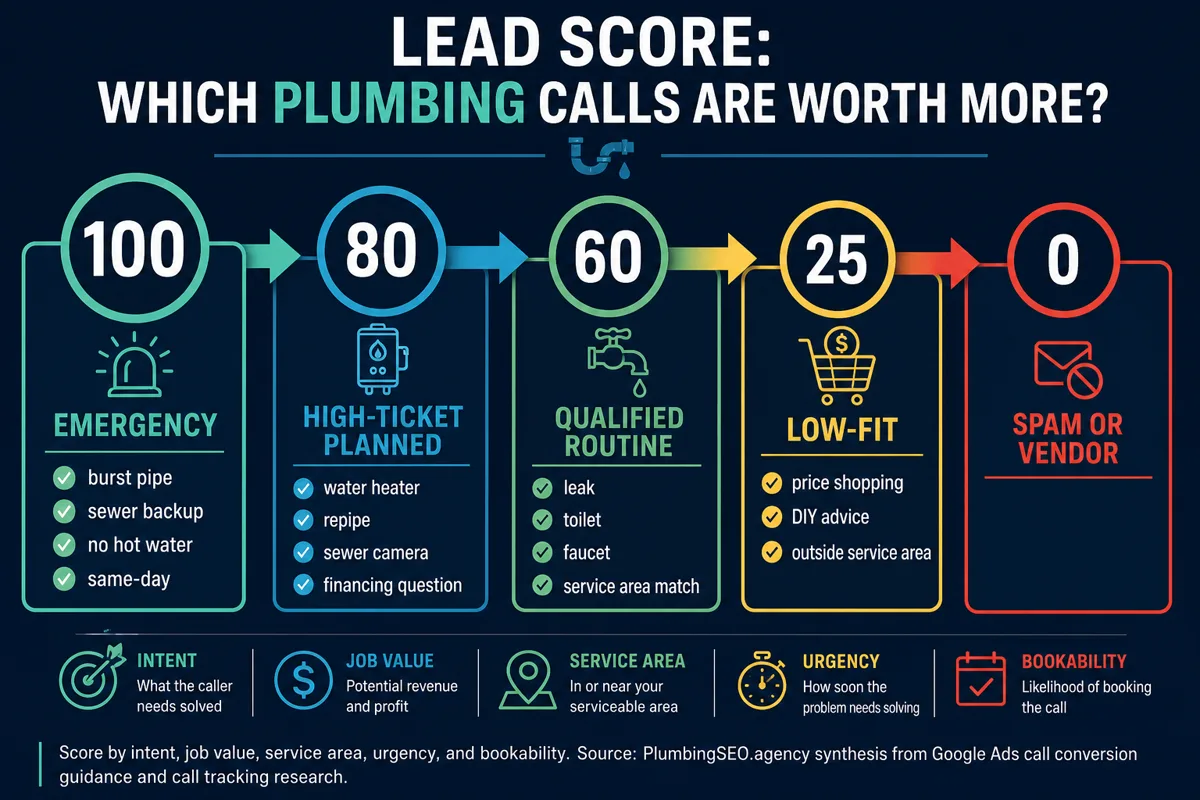
What lead quality scoring means for a plumbing company
In plain English, lead scoring means assigning value to a lead based on what the customer needs, how ready they are to act, and whether your company can actually serve them. Salesforce defines lead scoring as ranking potential customers by assigning values based on behavior, fit, and engagement. For plumbers, the model needs to be much more practical than a software sales funnel.
A plumbing call should be scored on five owner-side questions:
- Intent: Did the caller name a real plumbing problem or are they browsing?
- Urgency: Is this same-day, emergency, or scheduled work?
- Job value: Is it likely to be a small repair, a diagnostic visit, or a larger replacement?
- Location fit: Is the job inside your profitable service area?
- Booking outcome: Did the call become an appointment, estimate, or follow-up task?
That last point matters. A caller who says "sewer backup" is high intent. But if nobody answers, nobody books, or nobody tags the source, the marketing report is still leaking.
The calls that are usually worth more
Every market is different, but the pattern is usually the same. Calls with urgent, specific, in-area problems are more valuable than broad research calls. Calls tied to replacement work are usually worth more than small advice calls. Calls that book on the first conversation are worth more than calls that require three callbacks and a prayer.
| Call type | Why it scores higher | Dispatch action |
|---|---|---|
| Emergency leak, burst pipe, sewer backup | High urgency, clear need, low shopping window | Live answer or on-call route |
| Water heater replacement, repipe, sewer camera | Higher job value and strong buying intent | Book estimate, ask ownership and timing questions |
| Routine leak, toilet, faucet, drain issue | Good fit when in service area and bookable | Schedule normal route, tag source |
| DIY advice, outside area, vendor, wrong number | Low or no revenue fit | No-score, referral, or exclude from lead count |
This is also where plumber cost per lead can fool you. A $45 call that never books is worse than a $180 call that becomes a $1,200 job. The report may look good, but the phone tells the truth.
Build a simple scoring model your office can actually use
You do not need a giant CRM build to start. You need a clear way for the person answering the phone to tag what happened. If the system is too fussy, it will die by Wednesday lunch.
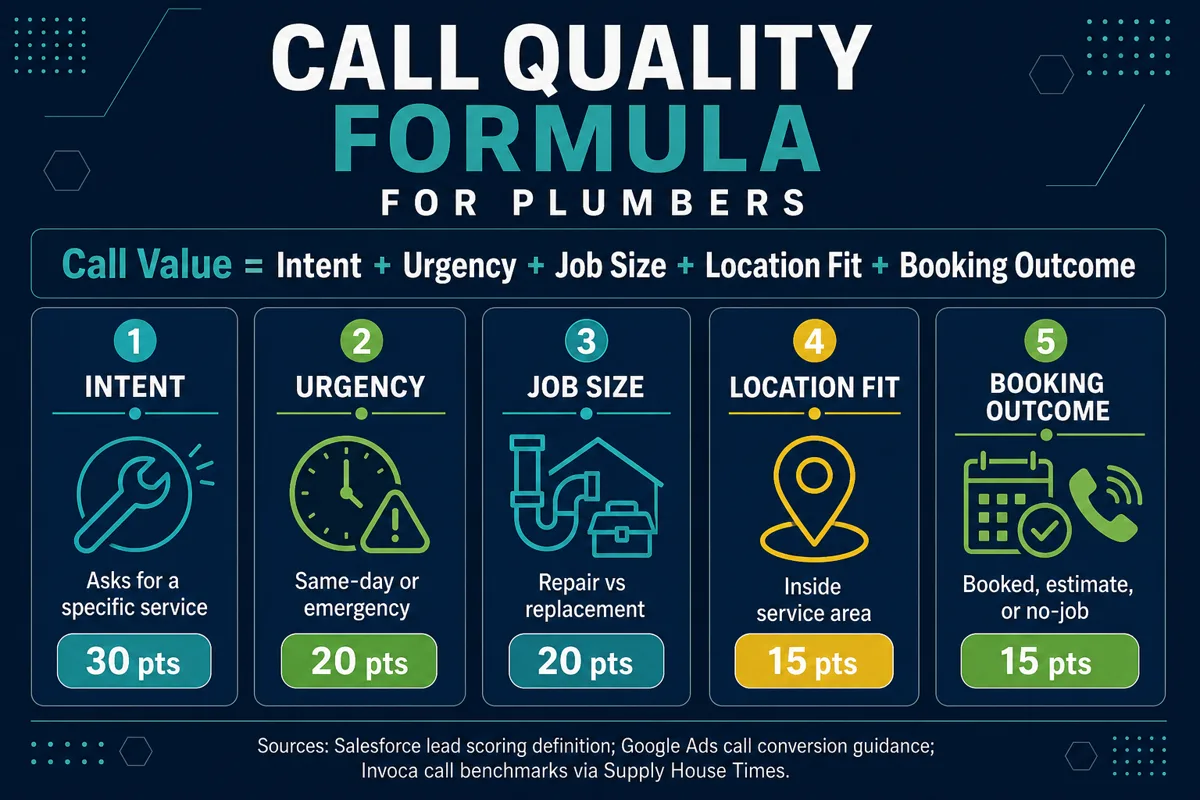
Start with 100 possible points. Keep the math simple enough that your CSR, office manager, or owner can explain it without opening a spreadsheet the size of a sewer map.
Service intent
The caller names a real service: water heater, leak detection, drain cleaning, repipe, sewer backup, gas line, sump pump, or emergency plumbing.
Urgency
Same-day, active leak, no hot water, sewage, flooding, gas smell, or a customer who says they need someone now.
Job value
Replacement, camera inspection, excavation, repipe, high-ticket repair, commercial work, or an issue likely to produce more than a trip fee.
Service area fit
The customer is inside the profitable service area, not a far edge route that eats half the day and sends your tech across town twice.
Booking outcome
The call becomes a scheduled job, estimate, dispatch note, or real follow-up. If it did not book, tag why.
Do not over-score vanity signals. A long call is not automatically a good call. A form fill is not automatically worse than a call. A cheap lead source is not automatically profitable. The scoring has to follow the job board.
Use call tracking, but do not stop at call duration
Call duration is a useful filter. It can remove obvious spam, wrong numbers, and hang-ups. But if call duration is the only thing you score, you will miss the point. A long call about a job outside your area is still a bad fit. A short emergency call that books fast may be gold.
Google Ads call conversion guidance notes that call conversions can be measured with call recording quality signals or with a minimum call duration when recordings are unavailable. That is a good starting point. For a plumbing company, it should be paired with service type, location, and booking outcome.
Call tracking platforms can help assign numbers by channel and connect calls back to campaigns. The practical owner question is still simple: which source produced booked jobs we actually wanted?
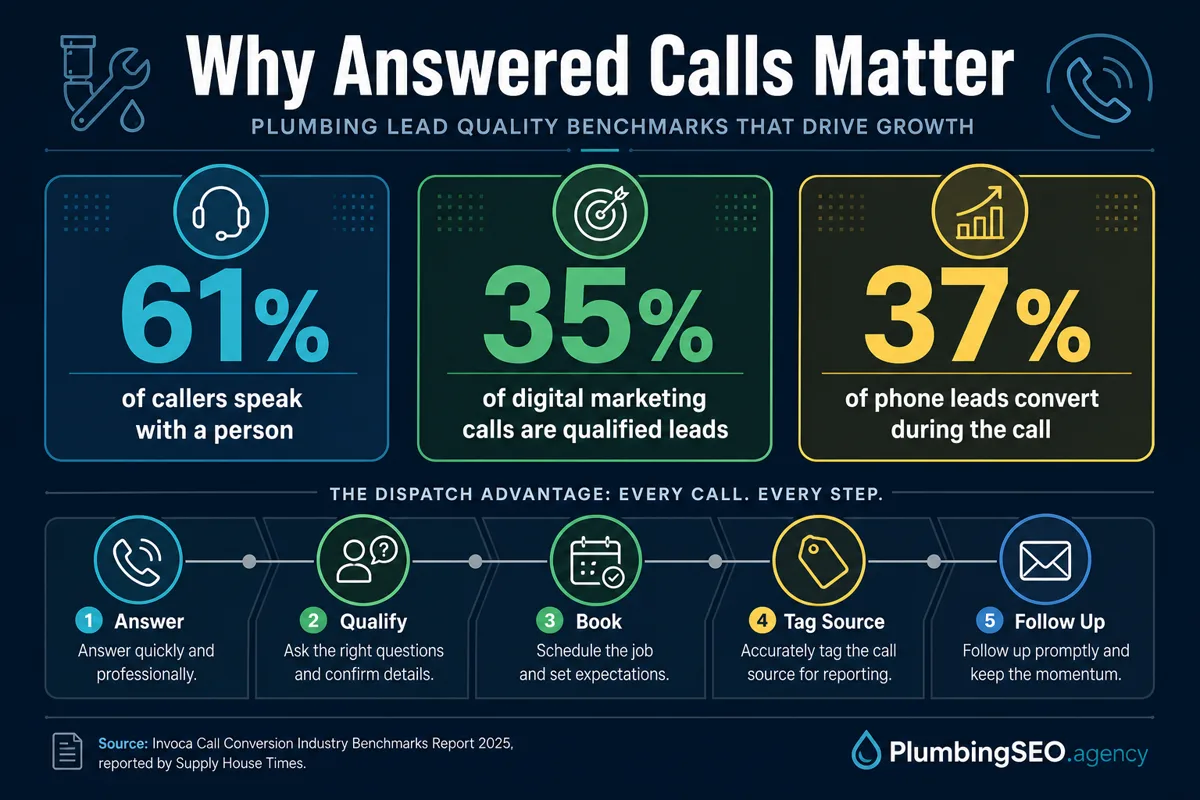
Invoca's 2025 call benchmark report, reported by Supply House Times, found that 61% of callers speak with a person, 35% of digital marketing calls are qualified leads, and 37% of phone leads convert during the call. For a plumbing owner, that means the answer desk is part of marketing. It is not separate from it.
Score by booked job, not raw lead count
Lead count is easy to sell. Booked-job quality is harder to fake. A campaign that produces 80 calls and 10 booked jobs may be worse than a campaign that produces 30 calls and 14 booked jobs, especially if the second group has better tickets and fewer wasted routes.
This is why the best tracking view is not just "leads by source." It is:
- Calls by source.
- Qualified calls by source.
- Booked jobs by source.
- Revenue or estimated value by source.
- Rejected or no-fit calls by source.
If you already use a plumbing lead CRM, build these tags into the intake workflow. If you do not, start with a shared sheet and a weekly owner review. Crude and used beats fancy and ignored.
Try the quick call value calculator
Use this as a rough shop-floor check. It is not a full attribution model. It simply shows why call quality matters more than call volume when the booked-job rate and average gross profit change.
Change the qualified call rate by a few points and watch the job count move. That is the owner-side reason to clean up targeting, negative keywords, service-area settings, landing page promises, intake scripts, and after-hours routing. The quieter leak is often not traffic. It is bad-fit calls and missed-fit calls.
Route high-scoring calls before they leak away
Scoring only helps if somebody acts on it. Emergency calls should not sit in the same queue as a price-shopping faucet question. Replacement calls should not be handled like a generic inquiry. After-hours calls should not disappear into voicemail if you paid to make the phone ring.
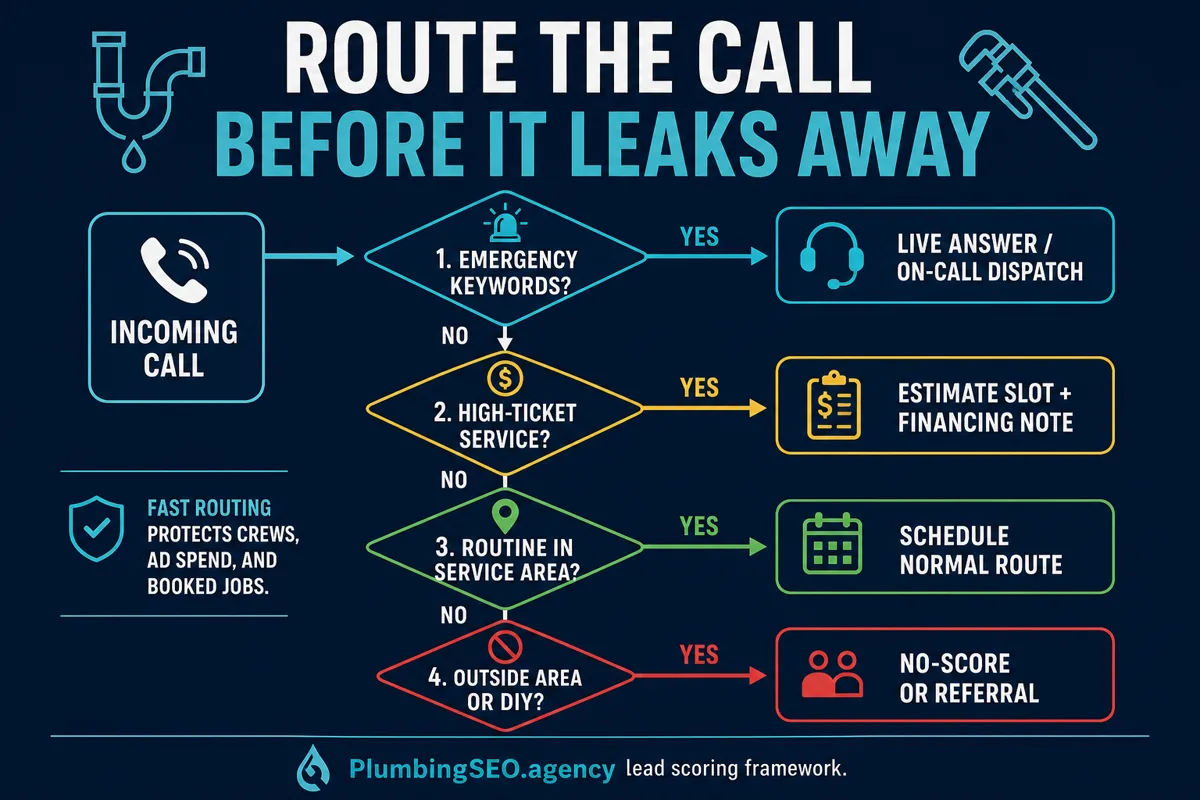
This is where lead scoring connects to missed call recovery. A high-value call that goes unanswered is not a lead. It is a job you donated to whoever answered next. Nobody puts that in the brochure, but it is usually true.
At minimum, create three routing rules:
- Emergency words route live. Burst, flooding, sewer backup, gas smell, no hot water, active leak, and similar terms should trigger immediate response.
- High-ticket words get context. Water heater, repipe, sewer line, excavation, financing, and commercial calls should capture property type, timing, location, and decision-maker status.
- No-fit calls get tagged. Outside service area, DIY, vendor, job seeker, warranty-only, and wrong-number calls should not count as real leads.
What to review every week
Once a week, review a small sample of calls from each channel. You are looking for patterns, not perfection. Ask these questions:
- Which source brought the highest-scoring booked jobs?
- Which source brought a lot of low-fit calls?
- Which service line produced the best tickets?
- Which calls were missed, and why?
- Which keywords or pages promised the wrong thing?
- Which CSRs or scripts helped customers book faster?
If PPC is producing low-score calls, tighten targeting and negative keywords. If SEO is producing high-score calls, build more pages around those service lines. If Local Services Ads bring urgent work but weak tracking, fix the intake notes. A good LSA vs PPC vs SEO split depends on job type, not agency preference.
The practical takeaway
Lead quality scoring is not about making dispatch fill out paperwork. It is about knowing which calls keep the trucks moving and which ones quietly drain the budget.
Start simple. Score calls by intent, urgency, job value, location, and booking outcome. Review the sources weekly. Spend more where booked jobs come from. Fix or cut the sources that bring noise. That is how marketing becomes a tool for the company, not another invoice on the desk.
FAQ: Lead quality scoring for plumbers
Lead quality scoring ranks plumbing calls by intent, urgency, job value, service-area fit, and booking outcome. It helps owners see which calls are worth follow-up and which marketing sources produce booked jobs instead of noise.
Emergency leaks, sewer backups, no-hot-water calls, water heater replacements, repipes, sewer line work, and in-area booked appointments usually score higher because they combine urgency, clear need, and stronger job value.
No. Wrong numbers, vendors, job seekers, outside-area calls, and DIY advice calls should be tagged separately. Counting them as leads makes marketing look better than it really is.
Call duration helps filter spam and hang-ups, but it is not enough by itself. Plumbers should also score service type, urgency, location, and whether the caller booked an appointment or estimate.
Review a sample of calls weekly. Look for sources that bring high-scoring booked jobs, sources that bring low-fit calls, missed calls, weak scripts, and service lines worth more SEO or ad budget.
Cost per booked job is usually more useful than cost per lead. A low-cost lead that never books is wasted spend, while a higher-cost call can be profitable if it becomes the right job.
Want to know which plumbing calls are actually worth more?
We can review your pages, tracking, and lead sources so your marketing follows booked jobs instead of raw call volume.
Run My Free SEO Leak Check