
- Use five steps: detect the missed call, acknowledge it by text, qualify the job, route or book it, and record the outcome.
- Give urgent replies a named human owner. A text without an alert or callback path only moves the leak to another screen.
- Review source, response time, urgency, service area, and booked outcome every week so you can fix the part that loses jobs.
Missed call recovery for plumbers is a five-step workflow: detect the unanswered call, send a useful text, qualify the job, route or book the caller, and record the result. It keeps a missed ring from disappearing into voicemail while the homeowner calls the next company.
If your plumbing SEO is working, the phone should ring. The trouble is what happens after the ring. A homeowner may find you because the water heater quit, the basement floor is wet, or the kitchen sink is backing up before dinner. You may be under a sink, driving between jobs, or already helping another customer.
The 5-step missed call recovery workflow
| Step | Expected response | What the shop should see |
|---|---|---|
| 1. Detect | Mark the call as missed and attach its source, time, and tracking number. | A new lead record with no mystery about where the call came from. |
| 2. Acknowledge | Send a short branded text, normally within the first minute, that asks what happened. | The caller knows the request was received and has an easy way to reply. |
| 3. Qualify | Collect the plumbing issue, service location, urgency, and safest callback number. | Dispatch can separate active leaks and sewer backups from routine estimates. |
| 4. Route or book | Alert the on-call person for urgent work or offer a clear callback window or appointment. | One named person owns the next action instead of assuming someone else handled it. |
| 5. Record | Tag the result as booked, pending, lost, outside the service area, vendor, or spam. | Marketing reports connect calls to jobs instead of stopping at lead volume. |
Treat those times as a starting service target, not an arrival-time promise. The first text should create a next step. It should not promise a technician before dispatch knows the route, crew, and job details.
A 2026 study of 14,354 missed-call text messages across 192 home-service businesses found a 32.7% reply rate, and 74% of replies arrived within five minutes. That is not a guarantee for every plumbing shop, but it shows why the acknowledgment and human handoff need to happen while the caller still has the phone in hand.
That is why missed call recovery belongs in the same conversation as SEO, Google Ads, Local Services Ads, and Google Business Profile work. Ranking higher gets you the chance. Answering, texting back, triaging, and booking turns that chance into work on the board.
The report may show more calls, but the phone tells the truth. If call handling is weak, your SEO can look successful while jobs still leak away.
Why missed calls are an SEO conversion leak
Most plumbers think of missed calls as an office problem. I see it differently. If search, maps, ads, reviews, and service pages create the call, then an unanswered call is part of the marketing system too.
That does not mean the person answering the phone is doing a bad job. Plumbing is not a desk business. Calls come in while someone is soldering, driving, crawling under a house, unloading a water heater, or already helping another customer. Service work is its own animal. The fix is not yelling at the office. The fix is building a system that expects calls to get missed sometimes.
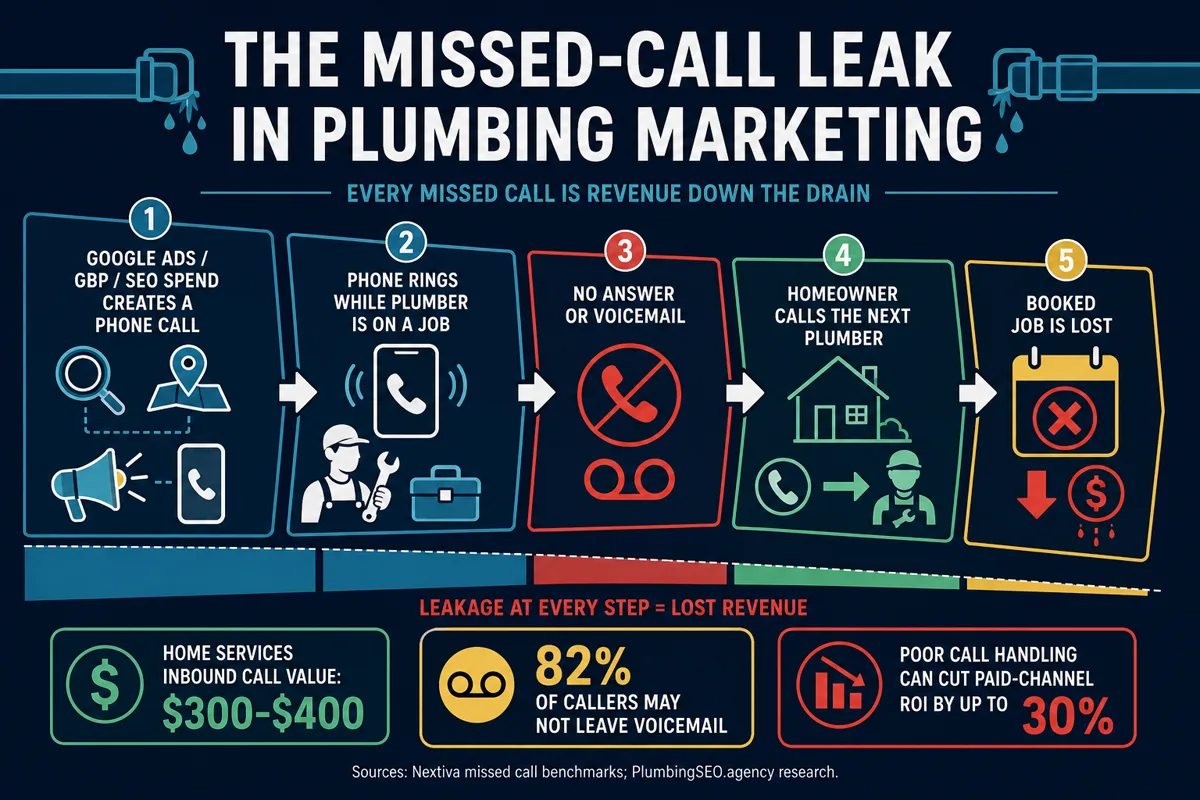
The key is to measure the handoff. A call from Google Business Profile, a drain cleaning page, or a paid ad should not disappear into a generic call log. You need to know whether it was answered, missed, called back, texted, booked, or marked as a bad fit.
Source note: The call-value and voicemail benchmarks above come from Nextiva's missed call analysis. Use them as directional benchmarks, then replace them with your own call tracking data as soon as you have it.
Where the leak usually happens
Missed calls rarely come from one broken piece. They come from small gaps that stack up during busy weeks.
The ranking gap
Your page ranks, but the tracking number is not connected to the page, source, or job result. You see calls. You do not see which pages booked work.
The response gap
The call rings while everyone is already working. The customer reaches voicemail, then starts dialing the next result.
The follow-up gap
Someone calls back later, but there is no text, no triage, no appointment link, and no record of whether the customer already hired another shop.
This is why the answer is not only "get more leads." More leads into a leaky call process can make the week feel busier without making the schedule better. It is like filling a bucket with a hole in it, except the bucket is ringing while you are holding a wrench.
Build each part of the recovery stack
A recovery stack is the simple set of tools and habits that keep a missed ring from becoming a mystery. It does not have to be fancy. It has to be fast, visible, and tied back to booked jobs.
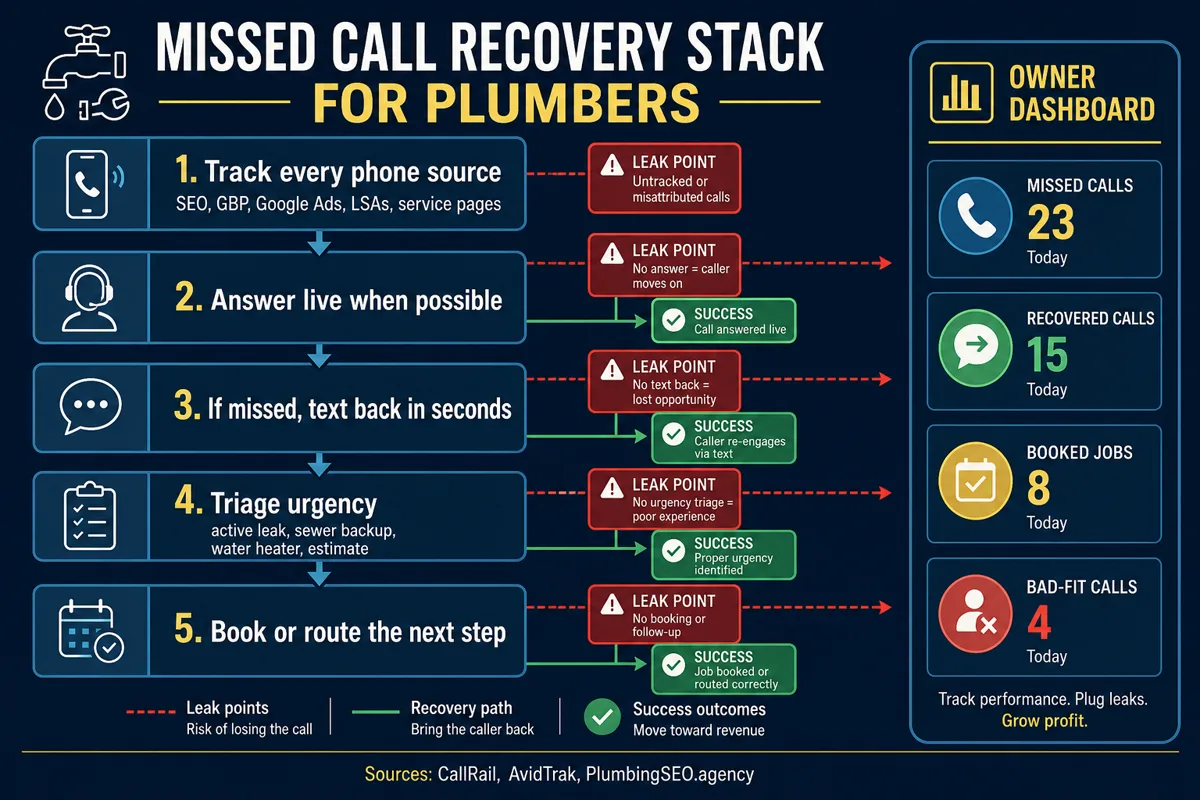
1. Detect the miss and tag its source
Call tracking matters because not every phone call has the same intent. A call from an emergency sewer page is not the same as a vendor, a wrong number, or a price shopper outside your service area. Tools like CallRail and plumbing-focused call tracking platforms can help separate source, answer status, duration, and outcome.
At minimum, track calls from your website, Google Business Profile, paid ads, Local Services Ads, and major service pages. If you are investing in plumber digital marketing, you should not have to guess which channel made the phone ring.
2. Acknowledge the caller when live answer fails
Live answer still wins. If a customer has water on the floor, reassurance matters. But a good system does not assume the phone will always be answered. Build the backup before the busy week hits.
That backup can be office staff, an answering service, an AI phone agent, a text-back workflow, or routing rules. The right setup depends on crew size, service hours, software, and budget. The wrong setup is pretending voicemail will do the selling.
3. Qualify the job with the first useful question
A missed-call text-back should not sound like a robot apologizing into the void. It should move the customer one step closer to help.
Thanks for calling ABC Plumbing. If you have active water, shut off the main valve if safe and reply with your nearest cross streets. We will call you as soon as possible.
Sorry we missed you. Is the clog affecting one fixture or the whole house? Reply with a quick note and we will help you get the next step scheduled.
We got your call. What plumbing project are you looking at, and what city are you in? We will point you to the right appointment slot.
Keep compliance in mind. If you use automated texting, ask your phone, CRM, or legal support how opt-out language, consent rules, and local requirements apply to your setup. That is not the fun part of the job, but neither is fixing a leak twice.
4. Triage urgency and assign one owner
Not all missed calls deserve the same callback order. A slab leak, sewer backup, or no-hot-water call should not sit behind a routine fixture estimate just because it came in later.
| Call signal | What it usually means | Best next step |
|---|---|---|
| "Water is actively leaking" | Emergency or near-emergency | Route to on-call staff and ask about shutoff status |
| "Sewer smell or backup" | High urgency and high anxiety | Call back fast, confirm fixtures affected, and book diagnostic |
| "Water heater not working" | Same-day or next-day opportunity | Ask unit type, age, symptoms, and household need |
| "Looking for a quote" | May be valuable, may be shopping | Confirm service area, job type, and appointment fit |
| Out-of-area or vendor call | Low booking value | Tag it so marketing reports stay clean |
5. Book the next step and record the outcome
The recovery is not finished because the caller replied. Give the customer a concrete next step: an immediate call from the on-call person, a callback window, an appointment choice, or a clear explanation that the address or job falls outside your service area.
Then close the loop in your plumbing lead CRM. Record who owned the lead, whether the customer booked, which service they needed, and why an opportunity was lost. That is how a missed-call system improves dispatch and marketing instead of merely creating more text notifications.
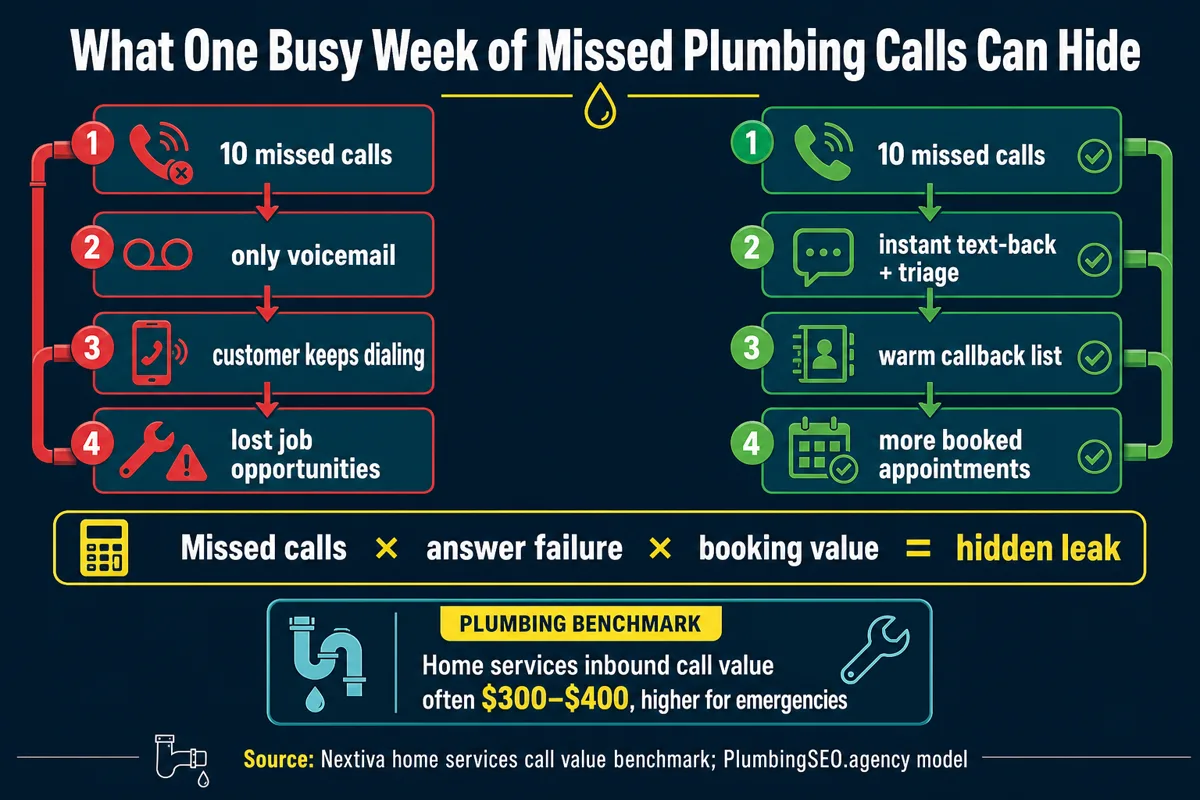
Use this quick leak calculator
The exact numbers should come from your own call tracking. Until then, use this simple model to estimate how much may be hiding inside missed calls.
What to review every week
You do not need a giant dashboard to start. A plumbing owner can learn a lot from a weekly 20-minute call review. Pour coffee, pull the call log, and look for the same questions every Friday.
- Which channels created calls? Separate SEO, Google Business Profile, paid search, Local Services Ads, referral, and repeat customers.
- Which calls were missed? Look at business hours, after hours, dispatch handoff, and days when crews were buried.
- Which missed calls were recovered? Count callers who replied to text, answered callback, booked online, or rescheduled.
- Which calls became booked jobs? A long call is not automatically a good call. Tie calls to jobs, invoices, or at least qualified opportunities.
- Which calls were bad fit? Track spam, vendors, wrong areas, and services you do not offer so they do not make marketing look worse than it is.
This is also where call recordings and transcripts help. AvidTrak's plumbing call tracking overview explains the practical value: source, campaign, keyword, page, call quality, routing, and outcome all need to connect if you want to improve what actually books jobs.
How this ties back to SEO
SEO should not stop at rankings. A good plumbing SEO system should connect the search to the call, the call to the job, and the job to the page or channel that created it.
That is especially true for service pages. A water heater page, drain cleaning page, leak detection page, and emergency plumber page may all create phone calls, but the value and urgency are different. If you track them the same way, you will make muddy decisions.
For example, if your lead tracking for plumbers shows strong call volume but weak bookings, the fix may be call handling, not another blog post. If calls from Google Maps are high-intent but missed after 5 PM, the fix may be routing. If paid ads create calls that do not fit your service area, the fix may be campaign targeting.
Owner-side rule
Do not ask, "Did SEO get us more traffic?" first. Ask, "Did the right people call, did we answer or recover them, and did they turn into jobs?" That question keeps the trucks moving.
Start with the smallest fix that stops the leak
If you try to rebuild the whole phone system in one week, it will probably stall. Start with one leak you can prove.
Week 1
Tag every missed call by source and time of day. Do not fix yet. Just see the leak clearly.
Week 2
Add missed-call text-back for business hours and after hours. Make the message useful, not generic.
Week 3
Route urgent terms like leak, sewer, no hot water, and active water to the fastest human follow-up.
Week 4
Review recovered calls and booked jobs. Keep what worked. Cut what created noise.
Once that is working, connect it to the rest of your marketing. Your plumbing website may not be getting calls because of weak visibility, weak trust, weak offers, or bad call handling. The only way to know is to track the whole path.
The bottom line
Missed calls will happen. Trucks are moving. Techs are working. Customers are impatient. That part is normal.
Leaving those calls invisible is the expensive part. If your plumbing company is paying for SEO, ads, maps work, reviews, service pages, and content, then every serious phone call deserves a recovery path. Answer live when you can. Text back when you cannot. Triage urgency. Track the source. Review booked jobs.
That is not fancy marketing. That is tightening the fittings between search demand and real work.
Frequently Asked Questions
Missed call recovery is the process of tracking unanswered plumbing calls, responding quickly by text or callback, triaging urgency, and measuring whether the caller became a booked job.
SEO creates visibility and phone calls. If those calls go unanswered and are not recovered, the campaign can show activity without producing the booked jobs the owner expected.
Many plumbing companies should test it, especially if the owner or dispatcher misses calls during jobs or after hours. The message should be useful, urgent calls should still route to a human, and the setup should follow applicable texting rules.
Track source, answer status, missed status, callback speed, text reply, urgency, service area, job type, booked outcome, and bad-fit calls. Call volume alone does not show whether marketing created profitable work.
As fast as the business can realistically support. For urgent plumbing calls, seconds or minutes matter because homeowners often call several companies until someone responds. Use instant text-back and escalation rules when live answer is not possible.
Yes. Call tracking helps separate channels that create booked plumbing jobs from channels that create spam, wrong-area calls, price shoppers, or unanswered leads. That makes SEO and ad budget decisions cleaner.
Use the company name, acknowledge the missed call, ask one useful question about the plumbing issue or service location, and state the next step. Keep it short. Do not promise a price or arrival time before dispatch confirms the job.
No. Live answer is still the strongest option when it is practical. Text-back is a safety net for overflow, jobsite, and after-hours misses. Urgent replies still need a named human owner and an escalation path.
Find the calls your marketing is leaking
If your reports show traffic and calls but the schedule still feels thin, we can review the SEO, call tracking, service pages, and conversion path together.
Run My Free SEO Leak Check