
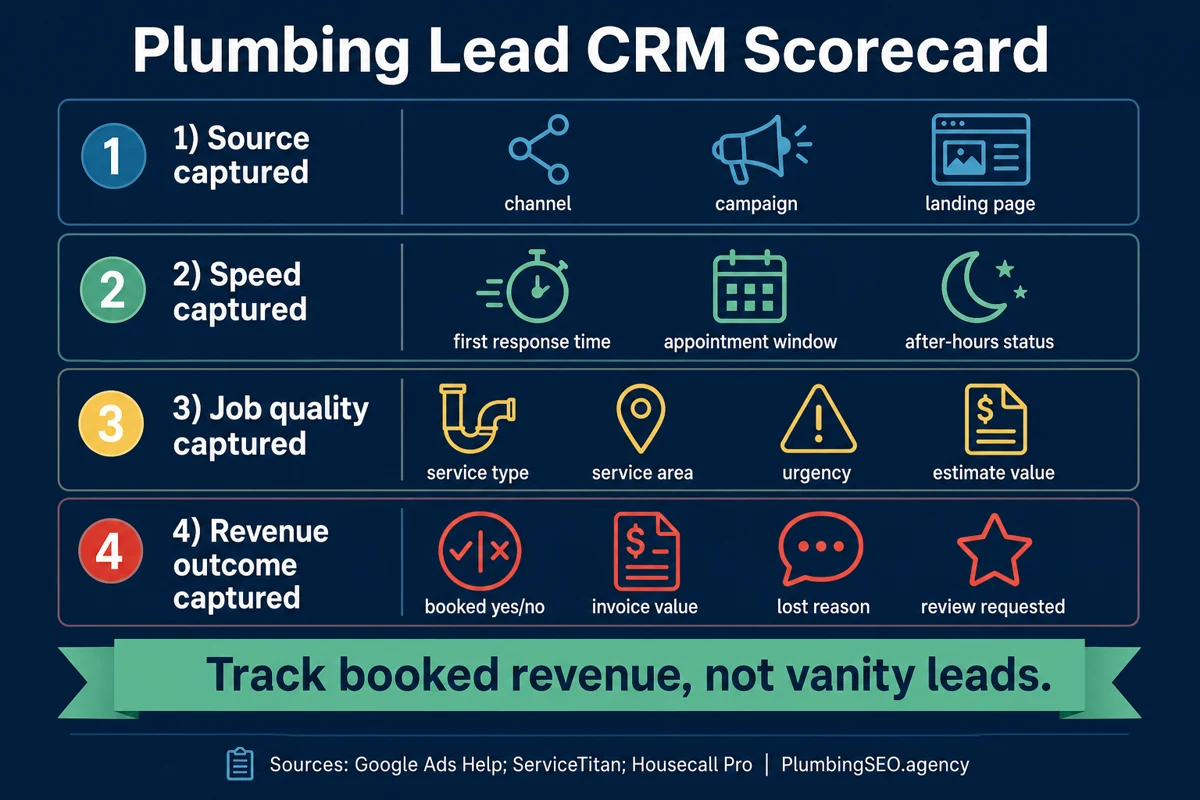
- Track one lead record from source, landing page, call or form, service area, and the customer problem.
- The money fields are response time, estimate value, booked or lost outcome, invoice value, and lost-lead reason.
- Lead count is not the scoreboard. Booked-job revenue tells you which marketing channels deserve more budget.
If the phone rings but nobody can tell which click created the call, which CSR answered it, whether it booked, and what it was worth, your marketing report is missing the part that pays payroll.
A plumbing lead CRM does not have to be fancy. It has to be clean. It should show how a homeowner moved from search, ad, map listing, referral, or email into a call, form, chat, estimate, booked job, invoice, and review request. That is the line between a dashboard that looks busy and a system that helps keep the trucks moving.
This matters because plumbing is response-speed work. CallRail's 2026 home services data says 66% of home services businesses call lead follow-up and conversion a major challenge, and 97% of homeowners say response speed influences who they hire. Harvard Business Review has also reported that many companies respond too slowly to online inquiries. In plain English, the leak is usually not just traffic. It is what happens after the click.
Here is the practical plumbing lead CRM path you want to see:
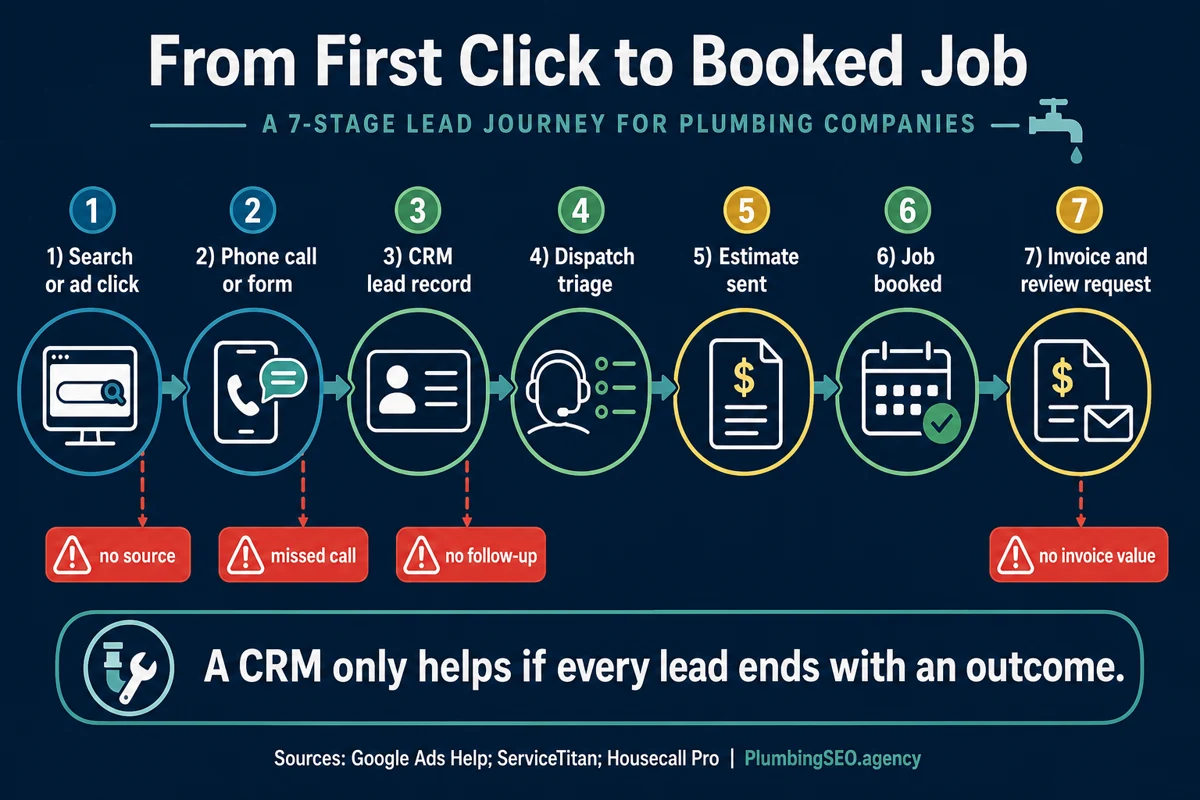
What a plumbing lead CRM should prove
In my opinion, a CRM for plumbing leads should answer four owner questions without making the office dig through five tabs and a notebook by the dispatch desk.
Where did the lead come from?
Track the source, campaign, keyword when available, landing page, and whether the lead came by phone, form, chat, booking widget, or referral.
Did we respond fast enough?
Record the first response time, the owner of the response, and whether the call was answered, missed, texted back, or sent to voicemail.
Was it the right job?
Capture service type, urgency, service area, appointment window, estimate value, and any notes the technician or dispatcher needs.
What happened to the money?
Mark booked, lost, postponed, not a fit, invoice value, payment status, review requested, and repeat-business opportunity.
That last question is where most marketing reports get weak. Leads are useful. Booked jobs are better. Paid invoices tell the truth.
The CRM fields plumbing companies should track
Do not start by tracking everything. That turns into office punishment, and punished offices stop entering clean data. Start with fields that help dispatch book the right job and help ownership see which marketing channels create real work.
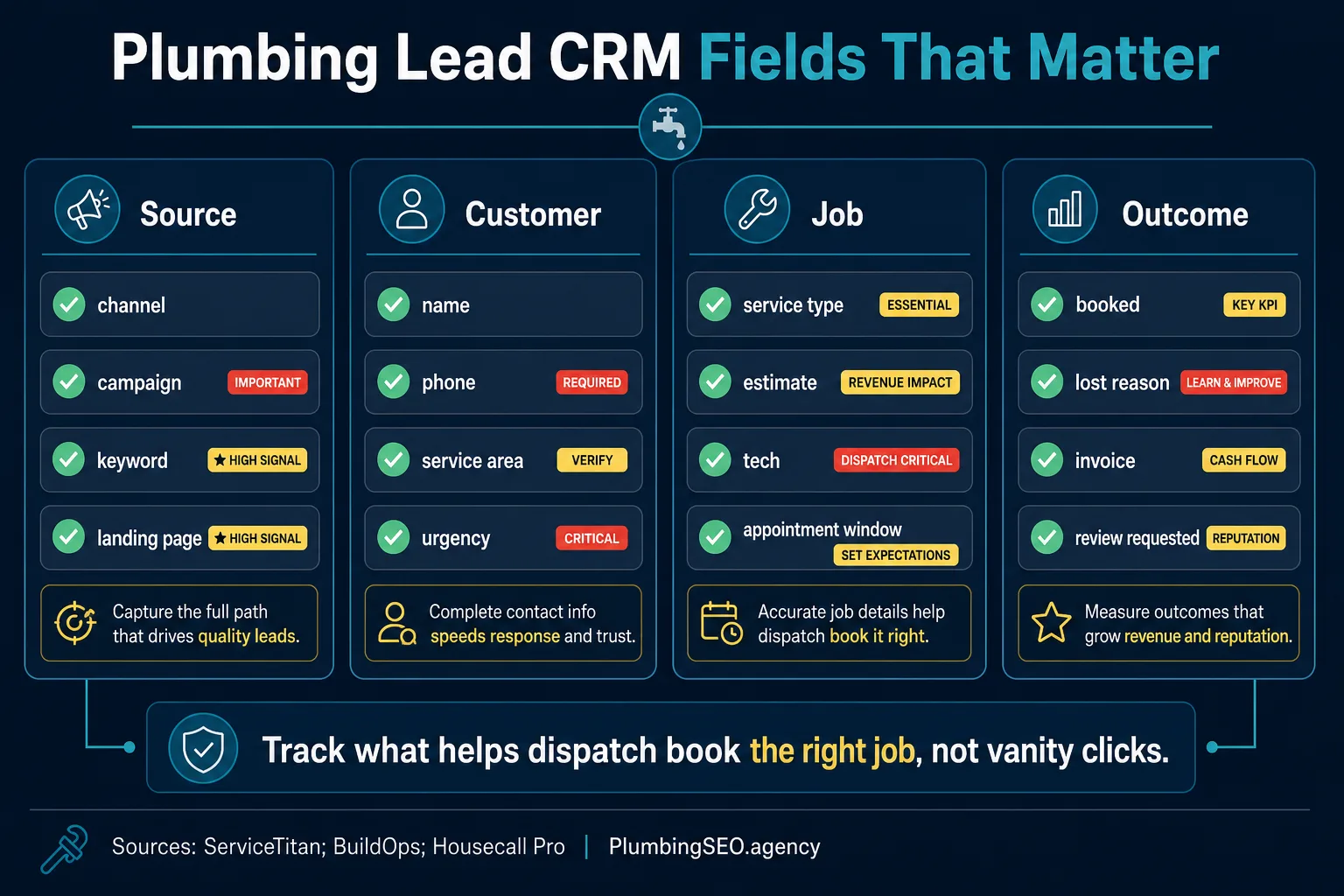
| CRM area | Fields to capture | Why it matters for plumbers |
|---|---|---|
| Source | Channel, campaign, keyword, landing page, tracking number, form page | Shows whether SEO, ads, Maps, referrals, or email are filling the board with real jobs. |
| Contact | Name, phone, email, address, service area, preferred contact method | Lets the office call back fast and avoid chasing jobs outside your route. |
| Job | Service type, urgency, photos, notes, tech assigned, appointment window | Helps dispatch send the right truck, the right tech, and the right expectations. |
| Response | First response time, answered or missed, text-back sent, follow-up count | Shows whether leads are leaking because nobody got to them quickly. |
| Outcome | Booked, lost, lost reason, estimate value, invoice value, review requested | Turns marketing from lead counting into booked-job and revenue tracking. |
Track the handoff, not just the click
Most plumbing owners already know the website, ads, and Google Business Profile matter. The weaker spot is the handoff. A lead comes in hot, then gets passed from marketing to the phone, from the phone to dispatch, from dispatch to the technician, and from the technician back to the office for invoice and review follow-up.
If that handoff is messy, the lead source gets blamed for a problem the CRM could have exposed. Maybe the ad brought the right homeowner. Maybe the form worked. Maybe the page did its job. But the call was missed, the estimate sat too long, or nobody marked whether the job booked.
That is why your plumber digital marketing setup should connect marketing channels with booked-job tracking, not just traffic reports. If the data stops at a form submission, you are trying to run the company with half the gauge covered.
For the phone side specifically, pair this with a clear missed-call process. Our guide to missed call recovery for plumbers explains how text-back, triage, and callback ownership can plug one of the most expensive leaks.
Where plumbing leads usually leak out
Lead leaks are boring until they get expensive. Then they become the thing everyone wishes they had checked sooner.
The most common leaks are simple: unknown source, missed call, slow response, no follow-up after estimate, and no booked-job value recorded. None of those require a giant software project to see. They require discipline, a few required fields, and somebody responsible for keeping the CRM clean.
A weekly CRM review that does not waste Monday morning
Once the fields are in place, review them weekly. Keep it short enough that people will actually do it. Fifteen minutes with clean numbers beats an hour of guessing while everyone waits to get back to real work.
| Weekly question | CRM report to check | Owner decision |
|---|---|---|
| Which source booked the most jobs? | Booked jobs by source and campaign | Move budget toward sources that fill the schedule with good work. |
| Which source created low-quality leads? | Lost reason by source | Fix targeting, landing page copy, service-area filters, or offer language. |
| Where did we respond too slowly? | First response time by channel | Add callback ownership, text-back, after-hours coverage, or routing rules. |
| Which estimates need follow-up? | Open estimates by age and value | Call the best opportunities before they choose the other shop. |
| Which jobs should ask for reviews? | Completed paid jobs without review request | Send the request while the customer still remembers the good service. |
If your site has both forms and click-to-call buttons, the tracking setup should treat them differently. A homeowner with a burst pipe behaves differently than someone planning a water heater replacement next month. We break that down in plumbing website forms vs click-to-call by intent.
How to set this up without making the office hate you
Start small. A CRM field nobody fills out is not a system. It is decoration.
- Pick one owner for lead data. Usually that is the office manager, dispatcher, or owner, depending on shop size.
- Make five fields required. Source, service type, service area, booked or lost outcome, and invoice or estimate value.
- Connect call tracking and forms. Calls and forms should create or update a lead record, not sit in separate inboxes.
- Use lost reasons. Keep the list short: no answer, price, wrong area, competitor, postponed, not a fit.
- Review booked revenue by source. This is where SEO, Google Ads, LSA, Maps, and referrals can be compared fairly.
Once that works, add more detail. Do not build a spaceship when the truck just needs a working gauge.
If you are still building the base tracking stack, start with the broader guide to lead tracking for plumbers. This CRM article is the next layer: what to record after the lead reaches the business.
CRM for Plumbing Leads: FAQs
A plumbing lead CRM is a system for tracking prospects from marketing source through call, form, chat, estimate, booked job, invoice, and follow-up. The goal is to connect marketing activity to real booked jobs, not just raw lead volume.
Track source, campaign, landing page, contact details, service area, service type, urgency, first response time, appointment window, estimate value, booked or lost outcome, lost reason, invoice value, and review request status.
Lead tracking shows volume. Booked-job tracking shows quality. A channel that sends fewer leads can still be more valuable if those leads book larger jobs, pay on time, and become repeat customers.
Call tracking identifies where the phone lead came from. CRM tracking records what happened next: who answered, whether the job booked, what it was worth, and whether follow-up or review requests happened.
The biggest mistake is leaving outcome fields blank. If the CRM does not show booked, lost, lost reason, and invoice value, the owner cannot tell which marketing channels are creating profitable work.
No. A small shop needs a clean system before it needs a complex one. Start with source, contact, service type, response time, booked outcome, and value. Add more fields only when the team can keep them accurate.
Want marketing reports tied to booked plumbing jobs?
We help plumbing companies connect SEO, Google Business Profile, ads, call tracking, forms, and CRM outcomes so the owner can see what actually fills the schedule.
See Plumber Digital Marketing