
- LSA should usually own urgent, trust-sensitive repair calls. PPC should own controlled campaigns where you need targeting and landing-page control. SEO should own researched, repeatable, and high-ticket demand.
- Do not split the budget evenly. Split it by job type, speed, margin, and dispatch reality. A drain backup and a commercial repipe do not need the same channel.
- The best setup is a handoff system. Paid channels keep calls coming now, while SEO builds the pages, reviews, and local authority that lower dependency over time.
A plumbing owner does not need another argument about whether SEO is better than ads. The better question is simpler: which channel should own which job?
If the phone is quiet on a Tuesday morning, you may need paid calls now. If you are tired of paying for every tap, click, and half-qualified lead, you need organic visibility working in the background. If you want water heater replacements, sewer work, and commercial jobs, you need a plan that matches each job type to the way customers actually search.
That is where LSA, PPC, and SEO each earn a place. Local Services Ads are good at quick, trust-heavy contact. Google Ads gives you more control over keywords, service pages, locations, and testing. SEO builds the owned search presence that keeps showing up after the ad spend is paused. The mistake is treating all three like they are fighting for the same job.
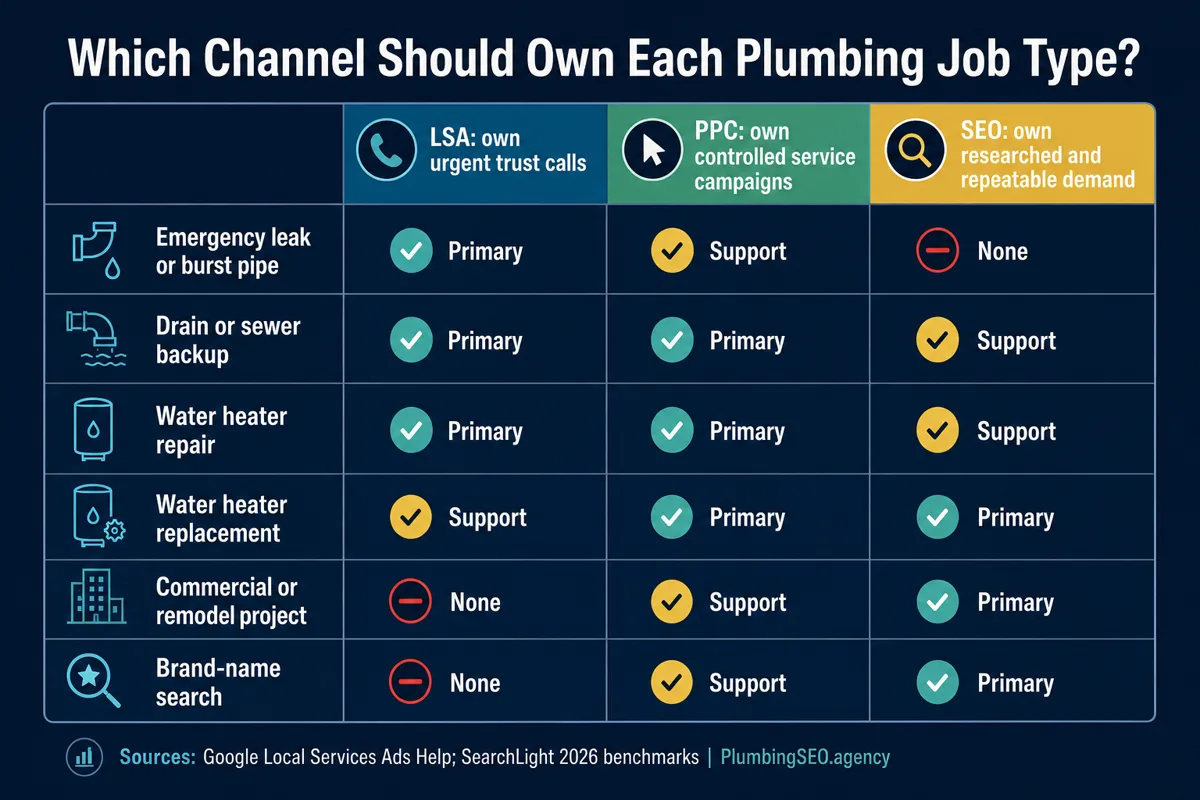
LSA owns urgent trust calls. PPC owns controlled paid campaigns. SEO owns researched demand, high-ticket education, and long-term local authority.
Start with the job, not the channel
Most marketing plans start with budget. That sounds organized, but it skips the thing that matters most: what kind of job you want on the board.
A burst pipe call is not shopping the same way as a property manager planning a tenant buildout. A homeowner with sewage backing up in the tub is not reading three blog posts before calling. A customer comparing tankless water heater options may read, save, ask a spouse, and come back later. If you make one channel responsible for all of that, you will either overspend or under-show.
| Job type | Customer mindset | Best lead owner | Why |
|---|---|---|---|
| Emergency leak or burst pipe | Needs help now | LSA first, PPC support | Trust badge, reviews, fast phone contact, little research time |
| Drain or sewer backup | Urgent but price-sensitive | LSA and PPC together | Paid coverage matters, but negative keywords and dispatch filtering matter too |
| Water heater repair | Fast decision, some comparison | LSA and PPC together | Customer wants same-day help, but PPC landing pages can qualify model, location, and urgency |
| Water heater replacement | Higher-ticket research | PPC and SEO | Needs service pages, comparison copy, financing answers, and proof |
| Commercial or remodel plumbing | Planned buying process | SEO first, PPC support | Searchers need capability, project fit, licensing, and trust before they call |
| Brand-name search | Already knows you | SEO first, PPC defense | Your site, GBP, reviews, and branded ad defense should protect the call |
Where LSA should own the call
LSA is strongest when the customer wants a local provider fast and needs a reason to trust the name on the screen. That is why it fits emergency repair, leak calls, clogged drains, sewer backups, and basic service work.
Google says Local Services Ads let businesses receive leads directly as calls or messages and that advertisers pay only for leads related to the business and services offered. Google also says response behavior can affect ad ranking when businesses fail to answer calls or messages. For plumbing owners, that means LSA is not just an ad account. It is tied to how the office answers the phone.
If your shop misses calls, ignores message leads, forgets to mark booked jobs, or lets reviews sit, LSA can slow down even when the budget is there. That surprises owners who are used to PPC, where raising the budget can often buy more traffic. LSA has more of a trust-and-response gate.
Give LSA the jobs where trust beats explanation
For a backed-up sewer line, the customer is not looking for a ten-point education. They want a company that looks real, answers quickly, and can get a truck moving. LSA is built for that moment.
But LSA should not own every job forever. Some calls are too nuanced. Some need a page that explains the scope. Some need a quote process. Some are too expensive to leave to a small profile card. That is where PPC and SEO pick up the wrench.
Where PPC should own the campaign
PPC should own jobs where control matters. You control the keyword, the location, the schedule, the landing page, the call tracking, the negative keywords, and the offer. That makes PPC useful for specific service lines and seasonal pushes.
The downside is also obvious. You can pay for a click before you know whether the person is in your service area, ready to book, or even looking for a plumber. One plumbing advertiser in a public PPC discussion described paying for expensive clicks that turned into nothing, including a click from outside the service area. That story is common enough that it should change how plumbers set up campaigns.
Good PPC for plumbers is narrow. One service per campaign. Tight geography. Strong negative keywords. A landing page that matches the search. Real call tracking. If you are paying for broad "plumber" clicks across a big radius and sending everyone to the homepage, the budget can disappear faster than a 10mm socket in a truck.
If you are building keyword campaigns now, start with a focused list and then clean it up. Our Google Ads keyword guide for plumbers breaks campaigns into emergency, drain, sewer, and water heater segments. Then use the negative keyword checklist to keep DIY searches, job seekers, parts, and training clicks out of the account.
Use benchmark numbers carefully
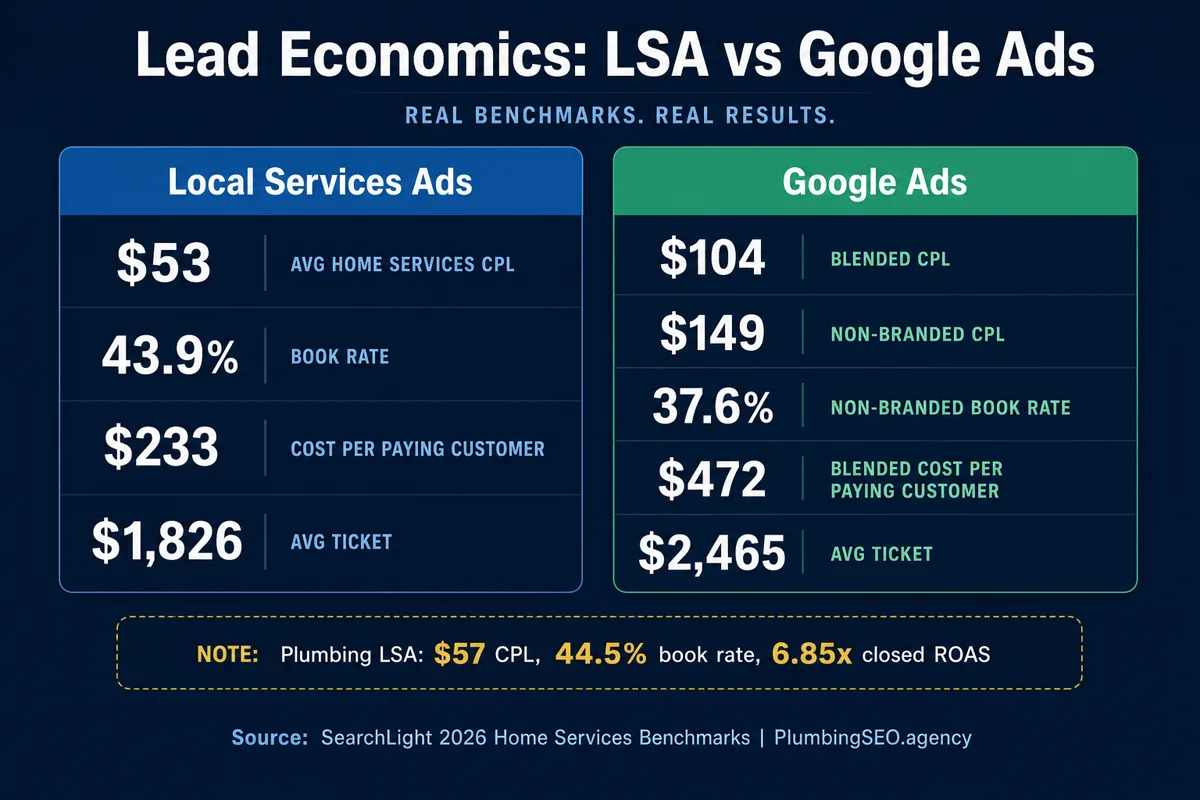
SearchLight's 2026 home services benchmark reported a $53 average LSA cost per lead across home services, a 43.9% LSA book rate, and a $233 cost per paying customer. For plumbing specifically, it reported a $57 LSA cost per lead, 44.5% book rate, and 6.85x closed ROAS. In a companion Google Ads benchmark for HVAC and plumbing, it reported a $104 blended Google Ads cost per lead and a $149 non-branded search cost per lead.
Those numbers do not mean LSA is always better or PPC is always expensive. They mean LSA often wins the first-call economics for urgent service, while PPC may win when the job needs targeting, filtering, and a custom page. A $149 non-branded PPC lead can still be good if it turns into a high-ticket water heater replacement, trenchless sewer job, or commercial project. A $57 LSA lead can still be bad if nobody answers or the call turns into a low-margin job outside the route.
Where SEO should own the market
SEO should own the searches where the customer needs confidence before calling. It should also own the searches you do not want to keep renting forever.
That includes service pages for water heater replacement, tankless water heaters, slab leak repair, sewer line replacement, commercial plumbing, service area pages, and strong Google Business Profile support. It also includes educational content that answers the questions customers ask before they are ready to call.
SEO is slower, but it has a different job. It builds the local proof that paid channels borrow from. When a customer sees your LSA, checks your reviews, searches your name, and lands on a useful service page, SEO is doing work even if the first click came from paid.
For plumbing companies trying to coordinate every channel, the support page for this article is our plumber digital marketing service page. That page is where the bigger system lives: SEO, paid search, tracking, content, and local visibility working together instead of fighting each other.
SEO should not be asked to do emergency work alone
Do not expect SEO to save a slow week by Friday. That is not its job. SEO should be started before you need it. It is the service truck you maintain so it is ready, not the one you try to build after the basement is already full of water.
The right move is usually not LSA or PPC or SEO. It is LSA for speed, PPC for control, and SEO for ownership. The budget shifts by season, market, crew capacity, and the jobs you actually want.
The job-type budget split I would use
There is no honest universal percentage. A two-truck shop in a rural market and a 25-truck company in a crowded metro do not need the same split. But there is a practical starting point.
LSA owns immediate repair demand
Fund LSA enough to capture the qualified calls Google is willing to send, especially emergency, leak, drain, and basic repair work. Keep reviews, response time, and booked-lead tracking tight.
PPC owns controlled pushes
Use PPC for service-specific campaigns where the landing page and keyword control matter. Water heater replacement, sewer repair, and high-value seasonal campaigns fit here.
SEO owns compounding visibility
Build the pages, internal links, reviews, and local content that make the business easier to find without paying for every visit. SEO should support both brand searches and service-line demand.
A 90-day handoff plan
If a plumbing company is starting from scratch or rebuilding a messy account, I would not try to fix every channel at once. I would get calls moving first, then tighten what is profitable, then build the owned search base.
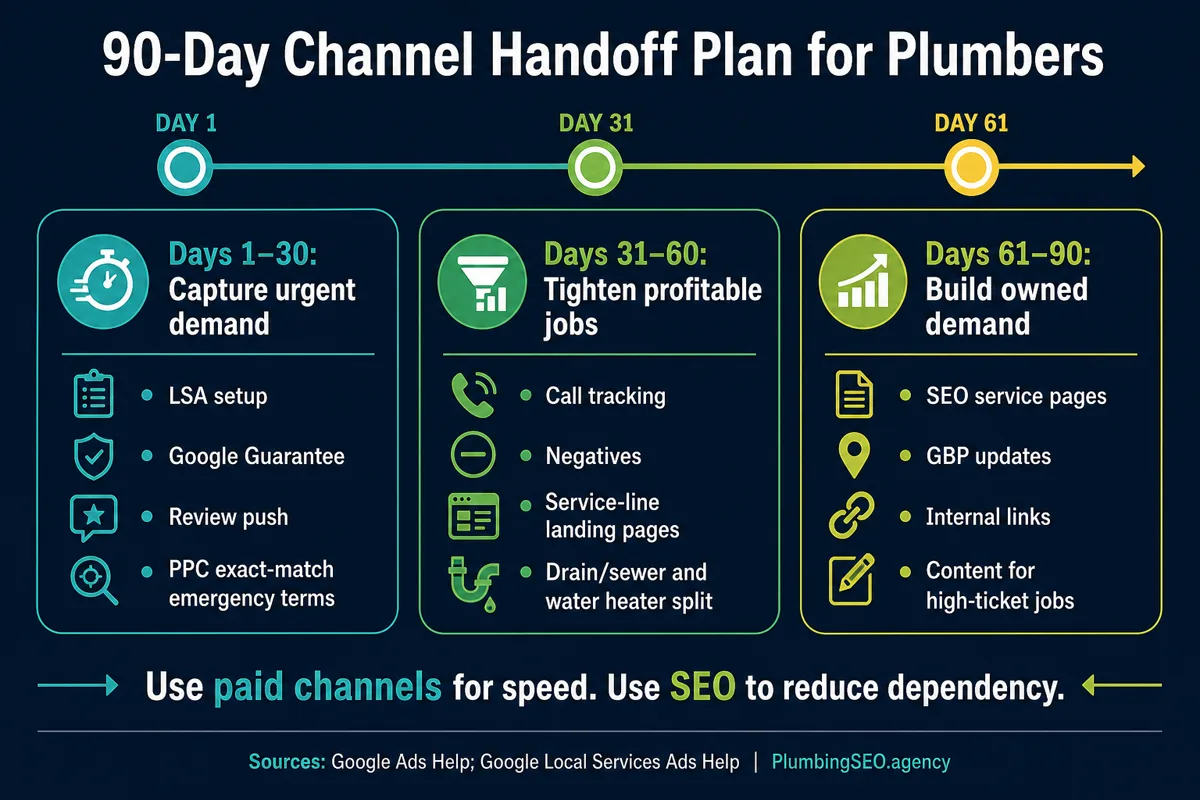
Days 1 to 30: capture urgent demand
Set up or clean up LSA first. Verify categories, service areas, license and insurance details, hours, photos, lead notifications, and review requests. If PPC is running, narrow it to the highest-intent emergency and repair terms. Do not spend the first month chasing every possible keyword.
Days 31 to 60: tighten profitable jobs
Now look at the job board, not just the ad dashboard. Which calls booked? Which ones were outside the route? Which campaign created low-ticket jobs? Which LSA categories look busy but weak? Split drain, sewer, water heater repair, and replacement into cleaner buckets. Add negative keywords. Fix landing pages that do not match the search.
Days 61 to 90: build owned demand
Use what you learned from paid calls to decide what SEO pages deserve priority. If water heater replacement is profitable, build the page. If drain calls are messy but high volume, create better filtering content. If commercial work is the target, build commercial plumbing proof instead of dumping more money into broad repair clicks.
How to decide who owns the next dollar
When the budget is tight, ask these questions before adding spend:
- Do we need calls this week? LSA or PPC gets priority.
- Do we need more control over the service and area? PPC gets priority.
- Are we paying repeatedly for the same researched service searches? SEO gets priority.
- Are calls coming in but not booking? Fix tracking, dispatch, response, and page fit before adding spend.
- Are we trying to grow high-ticket jobs? SEO and focused PPC should work together.
The phone tells the truth. If LSA sends calls but they do not book, it is not automatically a Google problem. If PPC gets clicks but no calls, the landing page, keywords, offer, or geography may be leaking. If SEO brings traffic but the jobs are wrong, the pages may be aiming at the wrong services.
If you want the bigger two-way comparison before building this three-channel plan, read SEO vs Google Ads for plumbers. If LSA is the channel you need to tune first, use our Google LSA guide for plumbers next.
Final take
LSA, PPC, and SEO are not interchangeable. LSA is the fast trust channel. PPC is the controlled paid channel. SEO is the owned visibility channel. A plumbing company needs all three at different times, but each one should have a job description.
Give emergency calls to the channel that earns trust fast. Give controlled service campaigns to the channel that lets you shape the search and page. Give long-term, high-value visibility to SEO. That is how you keep the trucks moving now without renting every call forever.
FAQs About LSA vs PPC vs SEO for Plumbers
If the company needs calls right away, start with LSA and tightly controlled PPC. If the company already has call flow but wants to lower paid dependency, prioritize SEO pages, internal links, reviews, and local content.
LSA is often better for urgent repair calls because it charges per lead and shows trust signals. PPC is better when you need keyword, landing-page, schedule, and location control for specific job types.
SEO should own researched and repeatable demand, including water heater replacement, sewer line replacement, commercial plumbing, service area searches, brand searches, and educational searches that influence higher-ticket calls.
Yes. PPC can still work when campaigns are narrow, tracked, and tied to strong landing pages. A higher cost per lead can be profitable if the campaign brings better-fit jobs or higher average tickets.
Split by job type and business need, not by a fixed percentage. Use LSA for urgent service calls, PPC for controlled service-line pushes, and SEO for high-value pages and long-term local authority.
Track calls, forms, booked jobs, service type, revenue, service area, average ticket, and close rate. Cost per lead is useful, but booked revenue is what tells you whether the channel is pulling its weight.
Want each channel to pull the right jobs?
We can map your LSA, PPC, and SEO around the plumbing jobs you actually want more of, then show where calls are leaking before you add more spend.
Build My Plumbing Marketing Plan