
- Cheap marketing is only cheap if it protects the parts that produce calls: your website, Google Business Profile, tracking, reviews, and service-area pages.
- The biggest red flags are vague reporting, separate ad spend surprises, no ownership of assets, no call tracking, and generic work that could fit any trade.
- A safer budget starts with measurement and control. Then build local trust, tighten the site, and add paid channels only when the numbers are clean.
If your plumbing company is looking at cheap marketing services, I get it. Payroll does not wait. Trucks need fuel. Insurance keeps climbing. When the phone slows down, a $249 or $500 monthly marketing package sounds a lot better than another big retainer.
Here is the problem. A low monthly price can hide the real cost. If the package does not track calls, does not protect your website ownership, ignores your Google Business Profile, or sends low-quality leads from the wrong service area, you are not saving money. You are just moving the leak where it is harder to see.
Cheap marketing services for plumbers are not always bad. A simple design cleanup, a few honest photos, basic citation fixes, or a small local ads test can be useful when the scope is clear. But cheap work becomes expensive when it replaces the basics your company needs to get found, get trusted, and get booked.

What cheap marketing usually means for a plumbing company
In the real world, cheap marketing usually means one of three things:
- A narrow task, such as a landing page, a few citations, or a social posting package.
- A templated program sold to many contractors with little local adjustment.
- A low management fee where the real costs, like ad spend or website rebuilds, sit somewhere else.
The first one can be fine. The second and third need a closer look. Plumbing is not a generic local business. Emergency calls, water heater replacements, drain cleaning, slab leaks, repipes, and commercial work all behave differently. Your marketing has to understand service type, city, urgency, truck availability, and whether the lead turns into a booked job.
Google says local results are mainly based on relevance, distance, and prominence. It also says reviews and positive ratings can help a business stand out. You can read that directly in Google Business Profile Help. That matters because a cheap plan that ignores reviews, service relevance, and local proof is not really a local SEO plan. It is paperwork.
The hidden costs to ask about before you sign
A low monthly fee does not tell you what the plan actually costs. Ask what is included, what is separate, and what you own if you leave. If the answers are fuzzy, slow down.
| Hidden cost | Why it hurts a plumber | Question to ask |
|---|---|---|
| Ad spend is separate | The management fee looks low, but calls still require a media budget. | What is the total monthly cost, including ads? |
| No call tracking | You cannot tell which calls became booked jobs. | Can I see source, call recording, and booking status? |
| Website or domain lock-in | You may lose pages, rankings, or control when you cancel. | Do I own the domain, content, website files, and accounts? |
| Generic service pages | Thin pages do not show local proof or match real plumbing jobs. | Will pages be written around my services, cities, photos, and calls? |
| Reporting without job outcomes | Traffic can rise while the schedule stays empty. | Will reports show calls, forms, and booked jobs? |
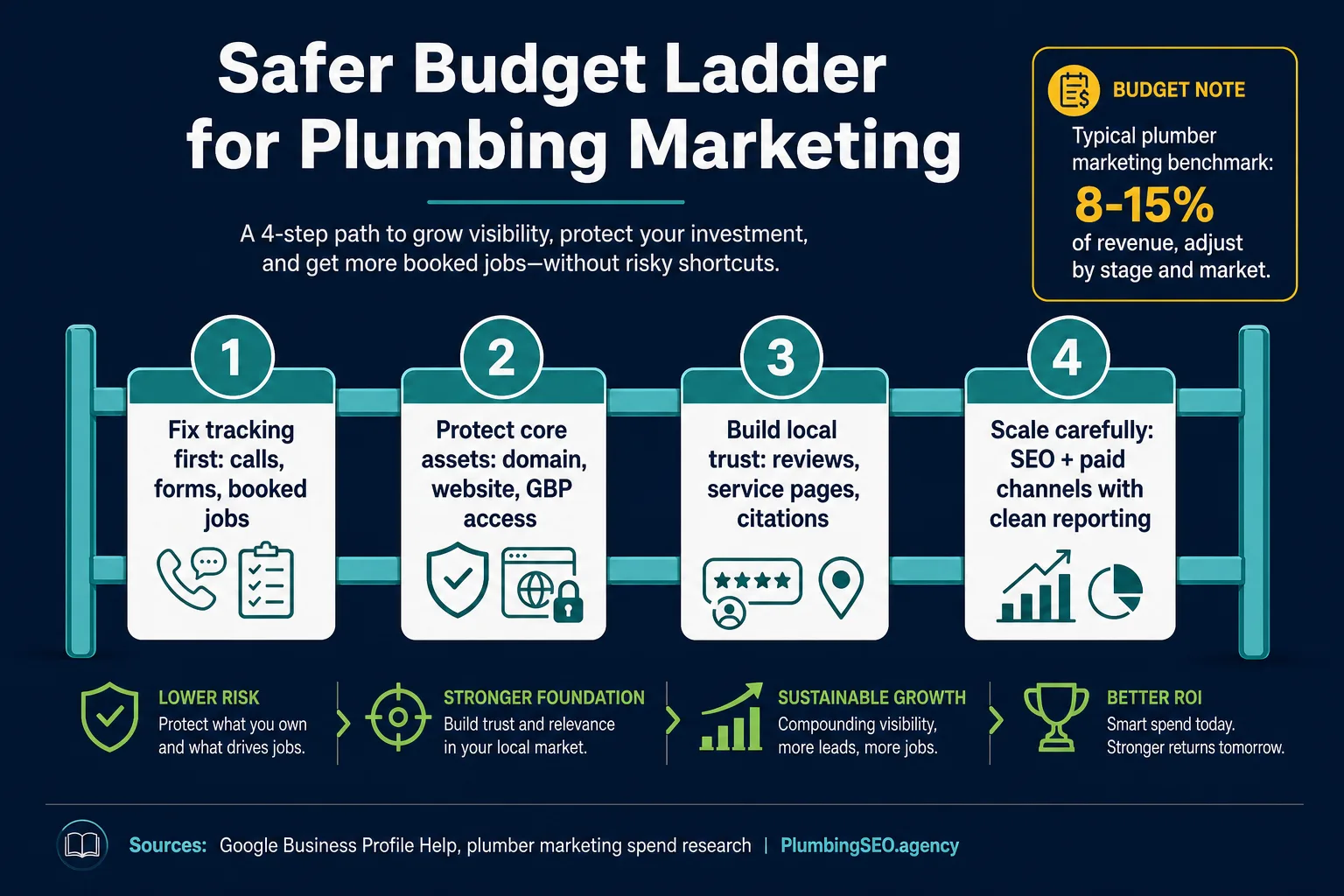
Plumber marketing spend is not one-size-fits-all. Recent contractor marketing research commonly places plumbing marketing budgets around 8 to 15 percent of annual revenue, with smaller shops often starting leaner. That does not mean you must spend that much tomorrow. It means a $300 monthly package should not be expected to carry the whole company if you are trying to win competitive emergency and replacement work.
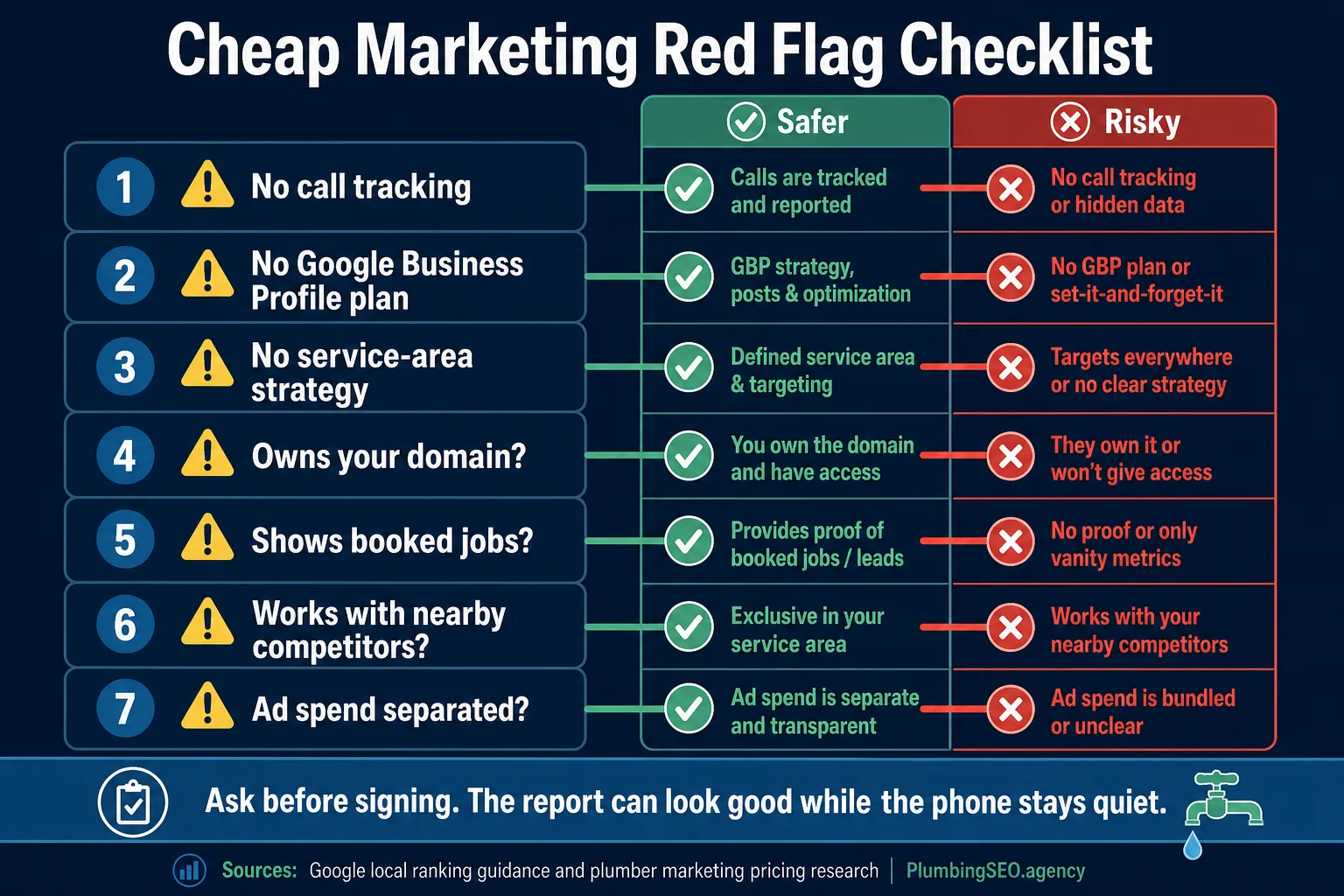
Seven red flags in cheap plumber marketing packages
Here is my practical rule. If a marketing offer cannot explain how it protects your calls, service areas, website ownership, and tracking, it is not ready for your money.
1. They talk about traffic, not calls
Traffic matters, but the phone tells the truth. A plumber does not pay crews with impressions. You need to know which channel produced the call, whether the customer was in your service area, and whether the office booked the job.
2. They skip Google Business Profile work
For many local plumbing searches, Maps is where the fight starts. If the package only includes blog posts or social graphics and never touches categories, services, photos, reviews, Q&A, and location proof, it is missing the jobsite.
If you want the deeper local search checklist, read our guide to advanced local SEO for plumbers.
3. They cannot explain ownership
You should own your domain, your Google accounts, your content, your analytics, and your call tracking data. If canceling the service means losing your site or reports, the low price came with a tow bill.
4. They sell the same plan to every trade
A plumbing company needs different pages and proof than a dentist, roofer, or restaurant. You need service pages for real jobs, city coverage that matches dispatch, review language customers understand, and emergency conversion paths that work on mobile.
5. They hide ad budget and add-ons
A cheap management fee may not include Google Ads, Local Services Ads, landing pages, tracking numbers, CRM setup, reporting software, review tools, or website changes. Ask for one total monthly number before you compare quotes.
6. They promise fast rankings
Fast improvements can happen when obvious leaks get fixed. Guaranteed rankings are another story. Local SEO is affected by your market, competitors, service area, reviews, website quality, and how well calls convert. Anybody promising the top spot like it is a wrench size is selling confidence, not a plan.
7. They do not ask about your business stage
A one-truck shop, a five-truck residential company, and a commercial plumbing contractor should not buy the exact same marketing plan. The right first move depends on cash flow, dispatch capacity, current reviews, website condition, service mix, and how fast you need calls.
Need a second look before signing?
If a cheap marketing quote looks tempting, we can review the scope, ownership terms, tracking plan, and local SEO gaps before you lock yourself into the wrong thing.
Run My Free SEO Leak CheckWhen low-cost marketing is actually useful
I am not against starting lean. A plumbing owner should not spend like a big shop before the basics are stable. Cheap becomes useful when the task is narrow, measurable, and does not put core assets at risk.
Good low-cost starts can include:
- Cleaning up Google Business Profile categories, services, hours, photos, and Q&A.
- Fixing obvious website conversion leaks, such as missing phone buttons or weak service-area copy.
- Setting up call tracking carefully so NAP consistency is protected.
- Building one strong service page instead of ten thin city pages.
- Running a small paid test with clear call and booking tracking.
Those jobs are not glamorous. Neither is checking for leaks under a sink. But if you skip them, the expensive stuff gets messy.
A safer budget ladder for plumber marketing
Instead of asking, “What is the cheapest plan?”, ask, “What should happen first so every dollar after this is easier to measure?” That question keeps you from buying random activity.
Step 1: Fix measurement first
Before paying for more traffic, know what happens to the traffic you already get. Track calls, forms, booked jobs, lead source, and service area. Make sure office staff can tag calls correctly. If you cannot see the leak, you cannot fix it.
Step 2: Protect your assets
Confirm you own your domain, website, Google Business Profile, Search Console, Analytics, ad accounts, call numbers, and content. Put access in company-controlled accounts. This is boring until you need it. Then it is everything.
Step 3: Build local trust
Make the website match the work your trucks actually do. Build useful service pages, show real job photos, improve reviews, keep citations consistent, and make your service areas clear. Our SEO for plumbers process is built around that local trust work, not generic marketing activity.
Step 4: Scale with clean reporting
Once tracking and local trust are in place, SEO, Google Ads, and Local Services Ads are easier to judge. Paid channels can help fill slow weeks. SEO can build long-term visibility. The key is knowing which calls became jobs, not just which dashboard turned green.
Questions to send any cheap marketing provider
Copy these into an email before you sign:
- What exactly is included in the monthly fee, and what is billed separately?
- Do we own the domain, website, content, accounts, numbers, and data?
- How will you track calls, forms, chats, and booked jobs?
- What work will be done on Google Business Profile?
- How will service areas and core plumbing services be handled?
- Do you work with another plumbing company in our service area?
- What does the first 90 days look like, and what should not be expected yet?
If the provider answers clearly, the cheap option might be a useful starter. If they dodge, rush you, or only talk about rankings, keep your checkbook in your pocket.
The practical answer
Cheap marketing services for plumbers can help when they solve a clear, limited problem. They are dangerous when they replace strategy, tracking, ownership, and local trust. The safer move is not always the most expensive agency. It is the plan that shows how your money turns into calls, booked jobs, and a stronger local presence you still own when the contract ends.
Start with the leaks. Fix the tracking. Protect the assets. Then spend into the channels that prove they can keep the trucks moving.
Frequently Asked Questions
No. Low-cost marketing can be useful when the task is narrow, measurable, and does not put your website, Google accounts, or call tracking data at risk. It becomes dangerous when it replaces local SEO strategy, hides costs, or leaves you without ownership.
Ask what is included, what is billed separately, who owns the domain and content, how calls and booked jobs are tracked, what work is done on Google Business Profile, and whether the provider works with nearby plumbing competitors.
It depends on company stage, market competition, cash flow, and growth goals. Many contractor marketing benchmarks place plumbing marketing budgets around 8 to 15 percent of revenue, but smaller shops can start lean by fixing tracking, ownership, GBP basics, and high-impact website leaks first.
Start with measurement and control. Make sure calls, forms, service areas, and booked jobs are tracked. Confirm you own your domain, website, content, Google Business Profile, and analytics. Then improve the highest-impact local SEO and conversion gaps.
Want a safer marketing plan before you spend?
We will review your website, Google Business Profile, tracking, service-area coverage, and reporting so you can see which leaks to fix first.
Run My Free SEO Leak Check