
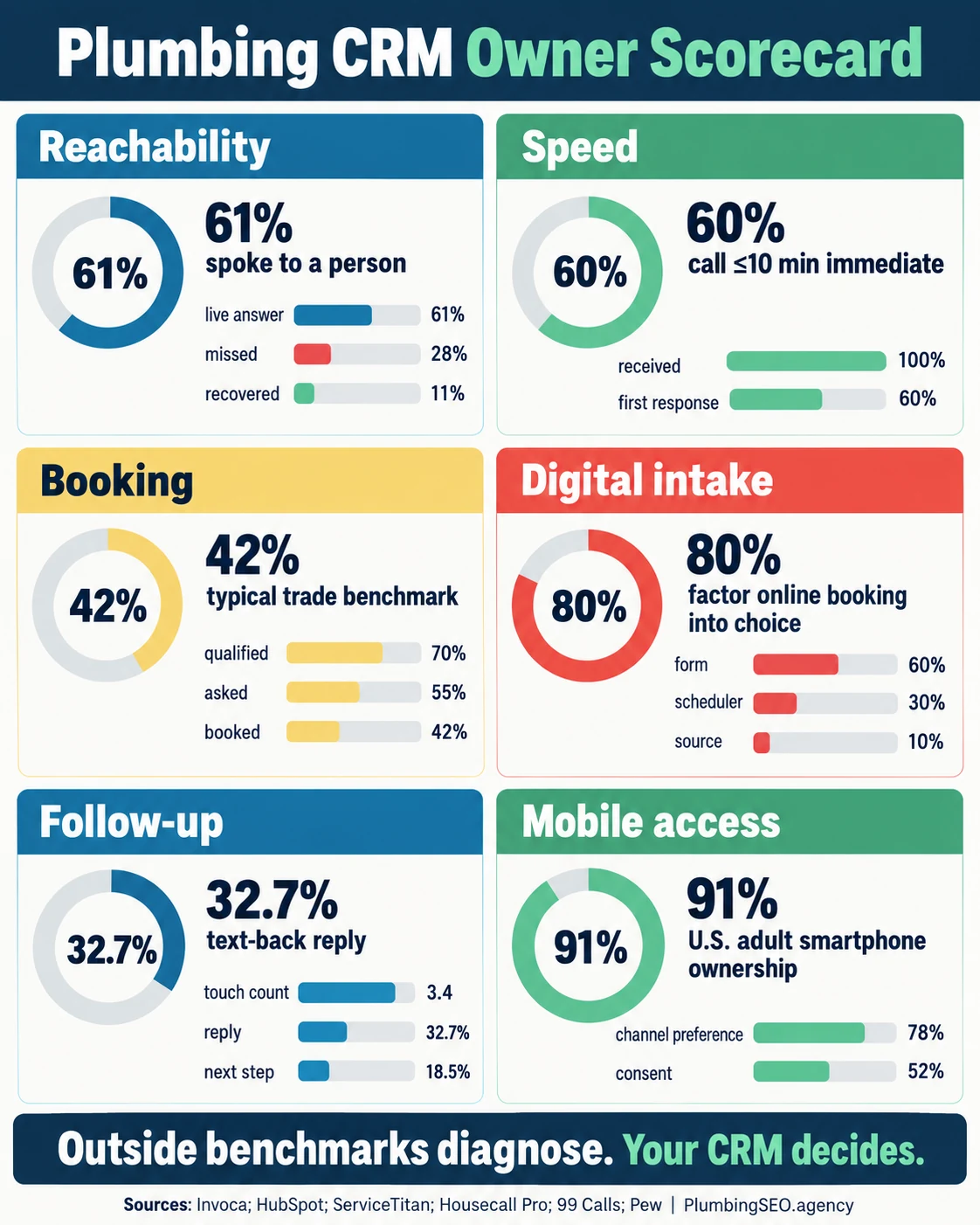
- The CRM cannot fix an unreachable office: only 61% of callers in Invoca's broad dataset spoke with a person, while its home-services phone-lead conversion benchmark was 46%.
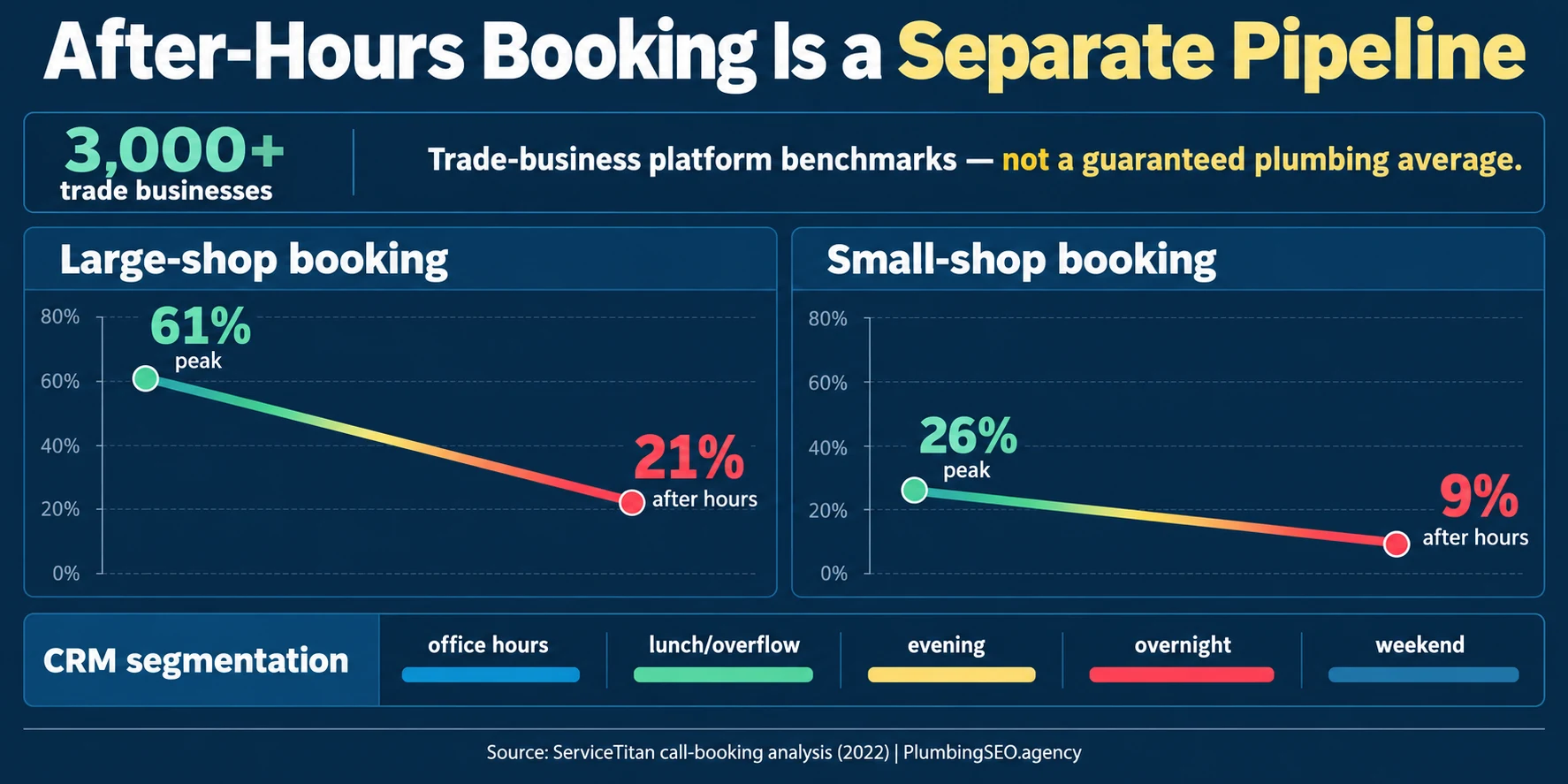
- Booking performance changes by time and shop size: ServiceTitan's trade-business analysis reported a 42% typical booking rate, but large-shop performance fell from a 61% peak to 21% after hours.
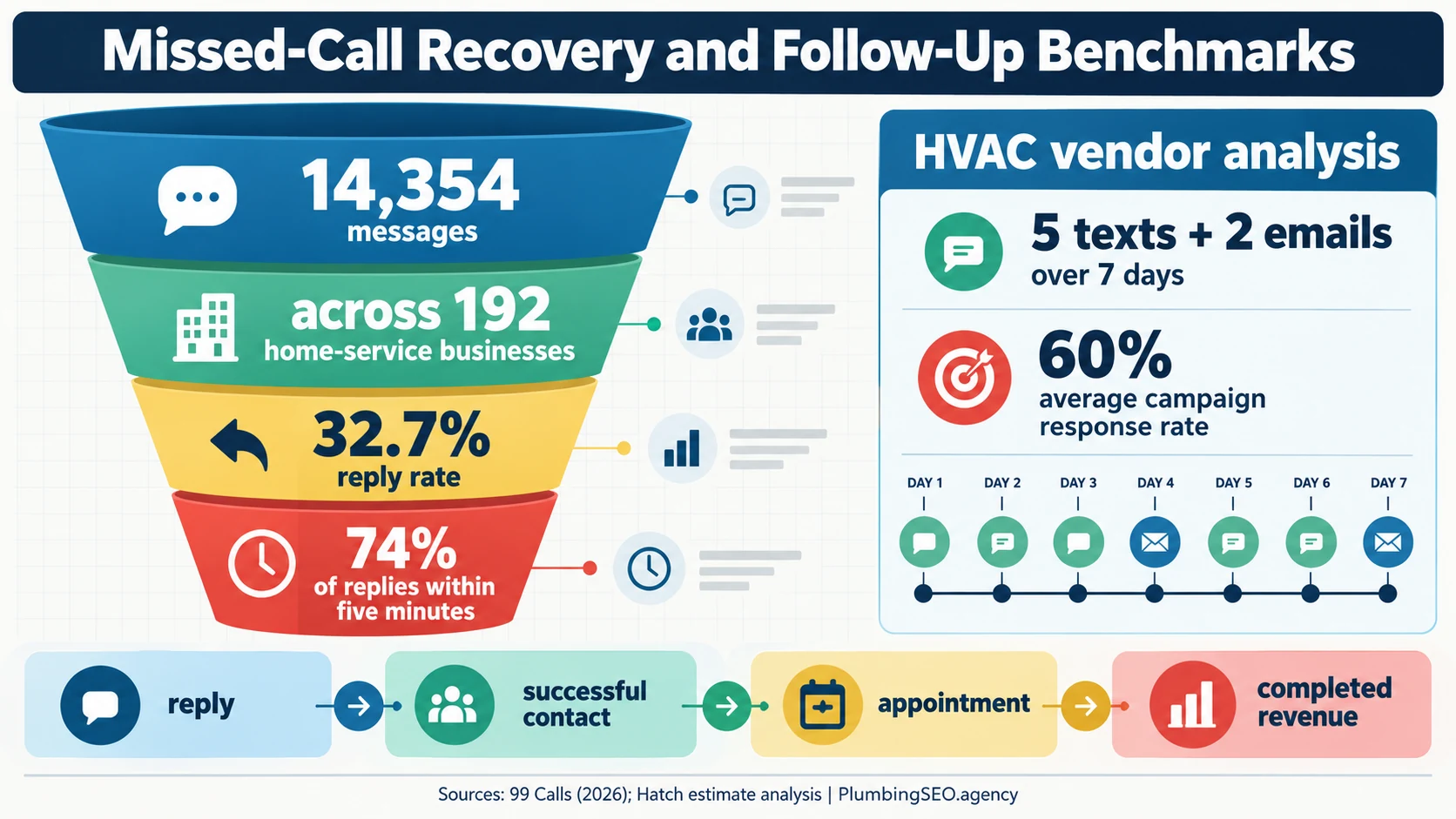
- Recovery belongs in the customer record: a 2026 home-service study reported a 32.7% reply rate to missed-call texts, with 74% of replies arriving within five minutes.
- Convenience is measurable: 80% of surveyed homeowners factored online booking into provider choice, and 96% expected a professional, user-friendly website.
- Activity is not revenue: report inquiry, answer, qualification, booking, completion, collected revenue, repeat work, and loss reason with consistent denominators.
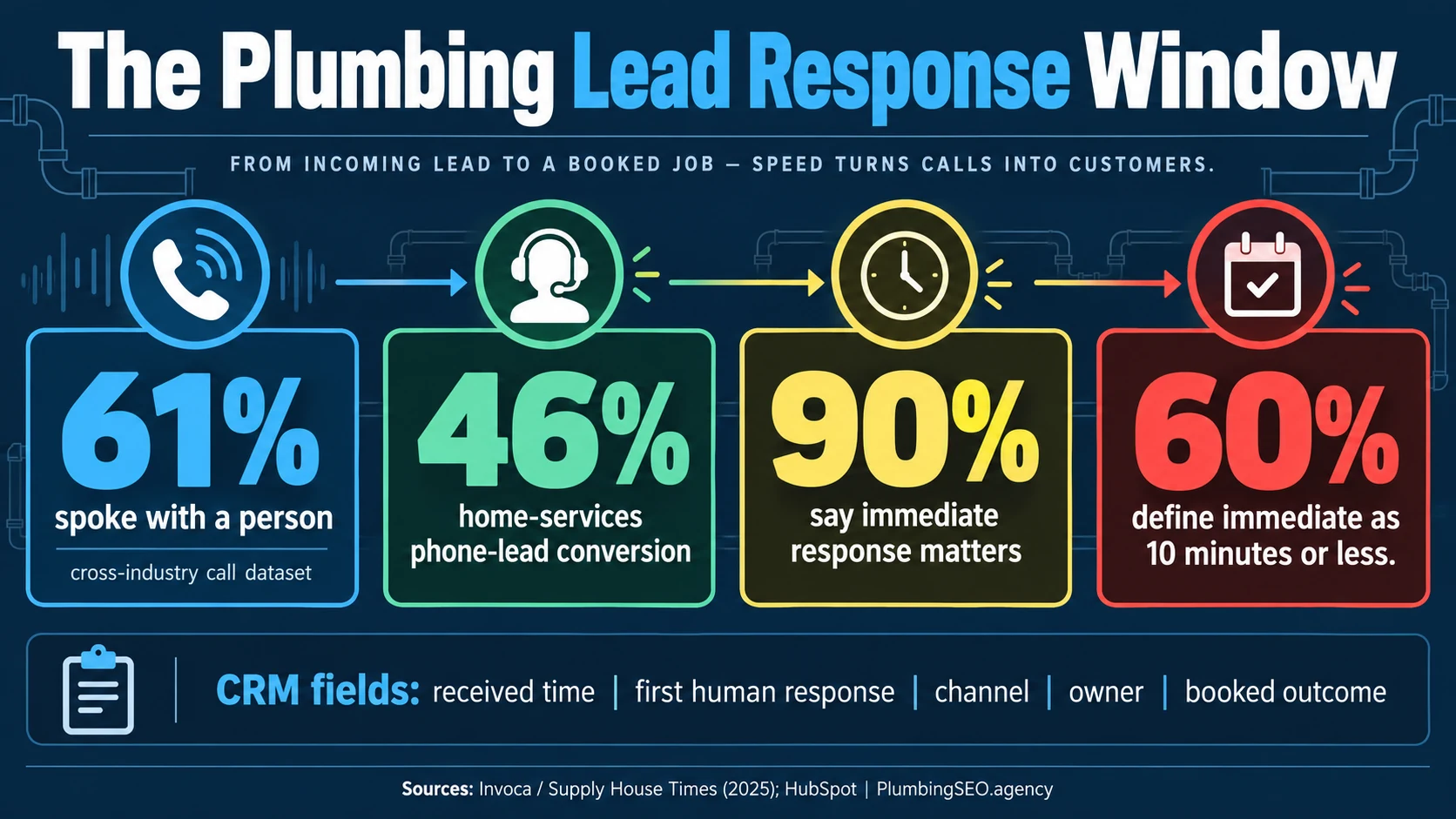
A plumbing CRM should answer more than “How many leads came in?” Owners, office managers, dispatchers, and marketers need to know whether a real customer reached the company, whether the opportunity fit the service area, whether someone offered an appointment, whether the work was completed, and which source produced collected revenue.
This report organizes 70 numbered CRM-related statistics from home-service, trade-platform, call-performance, consumer, mobile, email, retention, and paid-media research. Public plumbing-only CRM studies are scarce. Every table therefore labels the source scope, and none of the broader figures should be presented as a universal plumbing average.
- Keep source, year, population, and metric definition attached to every outside benchmark.
- Separate plumbing-specific rows from home-services, multiple-trade, and cross-industry context.
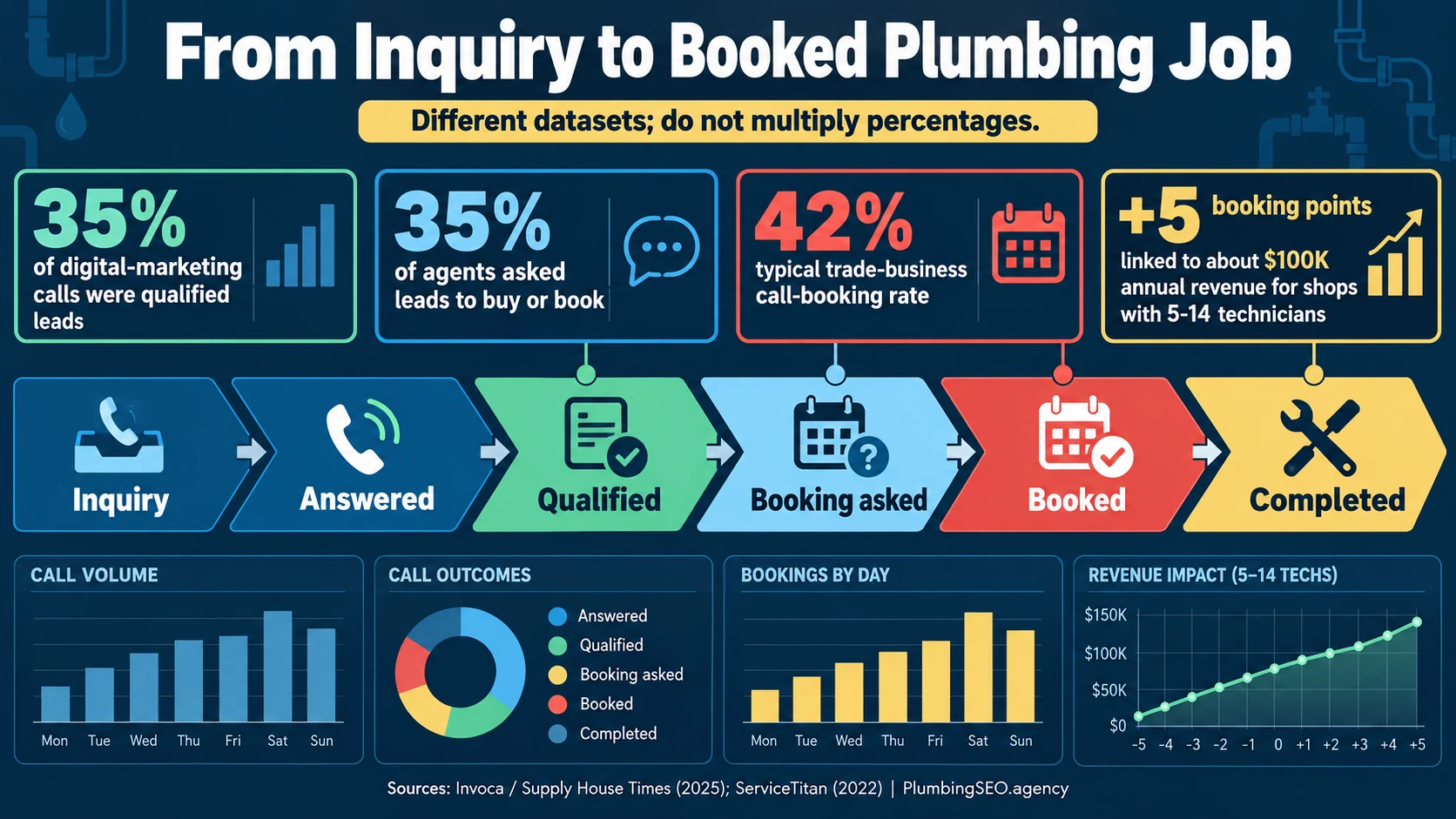
- Do not multiply percentages from unrelated datasets into a synthetic CRM funnel.
- Review performance by business hours, source, service line, market, first-time customer, and repeat customer.
- Use your own call, CRM, dispatch, invoice, and payment records as the operating truth.
Define the plumbing CRM funnel before comparing statistics
One platform may call every phone ring a lead. Another counts only callers who meet service-area and job-type rules. “Conversion” might mean a conversation, an appointment, an approved estimate, or a completed job. Those are different events with different denominators.
The companion guide to building a plumbing lead CRM covers fields and workflow design. This page focuses on external benchmarks and how to interpret them without turning vendor statistics into promises.
CRM adoption and stack maturity: measure capability, not software ownership
We found no public, source-transparent adoption rate that applies specifically to U.S. plumbing companies in 2026. A license count would be a weak substitute anyway: a shop can own field-service or CRM software while still tracking web forms in email, missed calls in a phone portal, estimates in another system, and revenue only in accounting.
Audit active users, required-field completion, duplicate rate, unknown source, unknown disposition, integration failures, and the delay between a field event and its CRM update. Those measures reveal adoption more reliably than the number of purchased seats.
1. Plumbing CRM statistics for lead response and qualification
Invoca's 2025 call-performance reporting covered more than 60 million calls and included a home-services segment. HubSpot's response figures are cross-industry expectations, while Jobber's figures are home-service customer expectations. They tell a consistent operating story—fast ownership matters—but they do not share one population or one definition.
| # | Response or qualification benchmark | Value | Source | Scope |
|---|---|---|---|---|
| 1 | Calls included in call-performance reporting | 60M+ | Invoca via Supply House Times, 2025 | Dataset size |
| 2 | Callers who spoke with a person | 61% | Invoca, 2025 | Cross-industry |
| 3 | Range in answer rates across measured industries | 54%–69% | Invoca, 2025 | Industry range |
| 4 | Digital-marketing calls classified as qualified leads | 35% | Invoca, 2025 | Cross-industry |
| 5 | High-end lead rate reported for some industries | 54% | Invoca, 2025 | Industry high end |
| 6 | Phone leads converting during the call | 37% | Invoca, 2025 | Cross-industry |
| 7 | Home-services phone leads converting during the call | 46% | Invoca, 2025 | Multiple home-service trades |
| 8 | Calls rated excellent by contact-center managers | 28% | Invoca, 2025 | Manager rating |
| 9 | Agents who asked the lead to buy or book | 35% | Invoca, 2025 | Observed call behavior |
| 10 | Business-services phone-lead conversion | 22% | Invoca, 2025 | Industry comparison |
| 11 | Customers rating immediate response important or very important | 90% | HubSpot | Cross-industry expectation |
| 12 | Customers defining immediate response as ten minutes or less | 60% | HubSpot | Cross-industry definition |
| 13 | Home-service customers expecting a same-day response | Over 70% | Jobber, 2026 | Home-service research |
| 14 | Home-service customers expecting a response within an hour | More than half | Jobber, 2026 | Home-service research |
2. Booking-rate and after-hours CRM statistics
ServiceTitan's 2022 platform analysis covered more than 3,000 trade businesses. It is older, platform-specific, and not a census of plumbing companies. It remains useful because the source separates shop size, trade, and time of day—the same segments a plumbing CRM should preserve.
| # | Booking benchmark | Value | Source | CRM interpretation |
|---|---|---|---|---|
| 15 | Typical call-booking rate | 42% | ServiceTitan, 2022 | Multiple trades |
| 16 | Businesses included in the analysis | 3,000+ | ServiceTitan, 2022 | Platform sample |
| 17 | Booking rate for businesses with 25+ technicians | 59% | ServiceTitan, 2022 | Large-shop cohort |
| 18 | Booking rate for businesses with fewer than five technicians | 24% | ServiceTitan, 2022 | Small-shop cohort |
| 19 | Plumbing June booking rate | 43% | ServiceTitan, 2022 | Plumbing; named-month comparison |
| 20 | Electrical June booking rate | 41% | ServiceTitan, 2022 | Trade comparison |
| 21 | HVAC June booking rate | 38% | ServiceTitan, 2022 | Trade comparison |
| 22 | Garage-door and water-treatment booking rate | 31% | ServiceTitan, 2022 | Trade comparison |
| 23 | Large-shop peak booking rate | 61% | ServiceTitan, 2022 | Time-of-day high |
| 24 | Large-shop after-hours booking rate | 21% | ServiceTitan, 2022 | Time-of-day low |
| 25 | Small-shop peak booking rate | 26% | ServiceTitan, 2022 | Time-of-day high |
| 26 | Small-shop after-hours booking rate | 9% | ServiceTitan, 2022 | Time-of-day low |
| 27 | Year-over-year monthly booking-rate lift | 2%–5% | ServiceTitan, 2022 | 2022 versus 2021 |
| 28 | Illustrative annual revenue tied to a five-point booking lift | About $100K | ServiceTitan, 2022 | 5–14-technician businesses; estimate |
What this means for plumbers: report office hours, lunch and overflow, evening, overnight, weekend, and holiday contacts separately. Store both “answered” and “booked” because an answering service that only takes messages may improve one metric while leaving the customer unscheduled. The plumbing missed-call statistics report examines this handoff in more depth.
3. Missed-call, estimate, and maintenance follow-up statistics
The 99 Calls study is directly relevant to home services but measured replies—not booked plumbing jobs. Hatch analyzed HVAC estimate campaigns, not plumbing programs. Simpro supplies trade-service reminder guidance, and GetResponse supplies broad email context. Each belongs in a different part of the dashboard.
| # | Follow-up benchmark | Value | Source | Scope |
|---|---|---|---|---|
| 29 | Missed-call text messages analyzed | 14,354 | 99 Calls, 2026 | Study sample |
| 30 | Home-service businesses represented | 192 | 99 Calls, 2026 | Multiple trades |
| 31 | Reply rate to missed-call text-back | 32.7% | 99 Calls, 2026 | Replies, not bookings |
| 32 | Text-back replies arriving within five minutes | 74% | 99 Calls, 2026 | Among replies |
| 33 | Texts in a frequently effective estimate cadence | 5 | Hatch estimate analysis | HVAC campaign pattern |
| 34 | Emails in that estimate cadence | 2 | Hatch estimate analysis | HVAC campaign pattern |
| 35 | Length of that estimate follow-up cadence | 7 days | Hatch estimate analysis | HVAC campaign pattern |
| 36 | Average response rate cited across analyzed campaigns | 60% | Hatch estimate analysis | Vendor analysis; responses |
| 37 | Early service-reminder checkpoint | 90 days | Simpro reminder guide | Trade-service guidance |
| 38 | Second service-reminder checkpoint | 60 days | Simpro reminder guide | Trade-service guidance |
| 39 | Third service-reminder checkpoint | 30 days | Simpro reminder guide | Trade-service guidance |
| 40 | Final pre-due maintenance window | 7–14 days | Simpro reminder guide | Trade-service guidance |
| 41 | Average email open rate | 39.64% | GetResponse benchmarks | Global platform data |
| 42 | Average email click-through rate | 3.25% | GetResponse benchmarks | Global platform data |
CRM automation and staff time savings
Automation is useful when it removes a predictable handoff without removing ownership. Good candidates include source capture, missed-call acknowledgment, duplicate alerts, task creation, appointment confirmation, technician-on-the-way updates, estimate reminders, and review requests after an eligible completed job.
Automate the trigger
Create the record, preserve the timestamp and source, assign the responsible queue, set a due time, and suppress overlapping workflows.
Keep the decision human
Let staff confirm urgency, diagnose fit, offer the appointment, handle objections, approve concessions, and own escalations.
Measure minutes saved only after checking error rate, duplicate outreach, unresolved replies, false promises, opt-outs, and bookings. An automation that sends more messages while staff still rekey customer data is not a productivity win.
4. Customer-record, mobile, and digital-intake statistics
A useful CRM recognizes a returning household, preserves the service address and asset history, supports the customer's preferred contact path, and makes booking easy. Housecall Pro's 2025 survey covered 1,040 U.S. homeowner decision-makers. ServiceTitan's booking figures are contractor context, while Pew measures U.S. adult mobile access.
| # | Customer-data or intake benchmark | Value | Source | CRM use |
|---|---|---|---|---|
| 43 | Homeowner decision-makers surveyed | 1,040 | Housecall Pro, 2025 | U.S. online survey |
| 44 | Homeowners factoring online booking into provider choice | 80% | Housecall Pro | Digital intake |
| 45 | Homeowners expecting a professional, user-friendly website | 96% | Housecall Pro | Pre-CRM trust |
| 46 | Homeowners appreciating technician name and photo before arrival | Nearly 60% | Housecall Pro | Pre-arrival workflow |
| 47 | Homeowners comfortable with AI handling initial inquiries | 53% | Housecall Pro | Initial intake only |
| 48 | Homeowners expecting photo or video proof after work | 68% | Housecall Pro | Job-closeout record |
| 49 | Homeowners saying instant estimates influence hiring | 93% | Housecall Pro | Estimate speed and clarity |
| 50 | Homeowners frustrated by hidden costs | 77% | Housecall Pro | Price communication |
| 51 | Homeowners who value useful tips from technicians | 70% | Housecall Pro | Closeout and nurture |
| 52 | Homeowners saying they would hire the same company again | 68% | Housecall Pro | Repeat-hire intent |
| 53 | Consumers reported as expecting online booking | 70% | ServiceTitan, 2024 | Contractor context |
| 54 | New-contractor shoppers more likely to choose online booking | 94% | ServiceTitan, 2024 | Stated likelihood |
| 55 | U.S. adults owning any cellphone | 98% | Pew Research Center, 2025 | U.S. adults |
| 56 | U.S. adults owning a smartphone | 91% | Pew Research Center, 2025 | U.S. adults |
What this means for plumbers: a web form, scheduler, chat, or phone system should create or update one customer record—not five disconnected contacts. Preserve original source and landing page while matching phone, email, household, and service address carefully. Our lead-tracking guide for plumbers explains the connection from source to booked outcome.
Dispatch and field-service integration
The office record should not stop at “booked.” Send the dispatcher the issue, address, urgency, customer preference, promised window, access notes, known equipment, and prior-job context. Return the assigned technician, arrival status, work performed, estimate decision, completion state, photos, invoice, and payment to the same customer timeline.
Track integration latency, failed syncs, manual re-entry, orphaned appointments, appointments without a source, completed jobs without an invoice, and payments without a customer match. These are pipeline-visibility and productivity metrics, not merely IT issues.
5. CRM attribution, retention, ROI, and revenue statistics
A CRM becomes commercially useful when acquisition source survives through completed work and collected revenue. LocaliQ's 2025 plumbing paid-search benchmarks show the price of losing that attribution. The retention and experience figures are broader than plumbing, so they provide strategic context rather than a forecast for one service company.
| # | Attribution or customer-economics benchmark | Value | Source | Scope |
|---|---|---|---|---|
| 57 | Plumbing paid-search conversion rate | 7.63% | LocaliQ, 2025 | Configured campaign conversions |
| 58 | Plumbing paid-search click-through rate | 4.97% | LocaliQ, 2025 | Search campaigns |
| 59 | Plumbing paid-search cost per click | $10.49 | LocaliQ, 2025 | Campaign benchmark |
| 60 | Plumbing paid-search cost per lead | $129.02 | LocaliQ, 2025 | Campaign benchmark |
| 61 | Retention increase used in Bain's frequently cited model | 5% | Bain & Company | Classic cross-industry model |
| 62 | Profit increase associated with that retention improvement | 25%–95% | Bain & Company | Range, not a plumbing forecast |
| 63 | Frequently cited acquisition cost relative to retention cost | 5×–25× | Harvard Business Review | Cross-industry framing |
| 64 | Customers saying good service makes another purchase more likely | 94% | Salesforce | Cross-industry stated likelihood |
| 65 | Customers saying experience is as important as products or services | 88% | Salesforce | Cross-industry expectation |
| 66 | Consumers saying experience is an important buying factor | 73% | PwC | Cross-industry |
| 67 | Consumers who would leave a loved brand after one bad experience | 32% | PwC | Global result |
| 68 | Consumers who would leave after several bad experiences | 59% | PwC | Repeated friction |
| 69 | Consumers willing to pay more for greater convenience | 43% | PwC | Cross-industry |
| 70 | Consumers willing to pay more for a friendly, welcoming experience | 42% | PwC | Cross-industry |
Pipeline visibility and CRM data quality
The smallest useful plumbing CRM is not the one with the fewest fields. It is the one that captures each decision-critical handoff without forcing staff to write a novel. Keep controlled values for reporting and a short note for context.
| Stage | Required fields | Why owners need them |
|---|---|---|
| Original inquiry | Contact ID, received timestamp, channel, source, campaign, landing page, tracking number | Preserves attribution before forms, phones, and schedulers overwrite it. |
| Identity and location | Name, preferred contact, service address, billing address, service area, new or existing customer | Deduplicates households and prevents out-of-area opportunities from distorting booking rates. |
| Need and urgency | Service category, problem, asset, urgency, occupancy, safety flags, preferred window | Supports dispatch triage without pretending the office diagnosed the repair. |
| Response | Live answer, missed reason, first human response, responder, recovery channel, consent status | Separates the marketing lead from the office response and the recovery effort. |
| Qualification | Qualified status, reason, service-area fit, booking ask, objection, loss reason | Shows whether the lead was workable and whether staff offered a real next step. |
| Appointment | Booked timestamp, job type, promised window, assigned team, reschedule, cancel, no-show | Measures calendar creation and schedule leakage independently. |
| Estimate and job | Estimate amount, sent date, approval, completed date, invoice, collected amount, direct cost | Connects pipeline activity to completed work, cash, and gross profit. |
| Relationship | Prior jobs, equipment history, warranty, membership, reminder eligibility, referral, review request | Makes repeat service relevant instead of sending generic campaigns to everyone. |
Productivity benchmarks and a weekly plumbing CRM scorecard
A dashboard should help the owner choose an action. Review these six views by source, market, service line, daypart, and new versus repeat customer. Display the denominator beside every rate. For productivity, record administrative minutes per booked and completed job, manual re-entry, records corrected, overdue tasks, and customer replies waiting without an owner.
1Reachability
Total attempts, unique contacts, live answer, abandon, voicemail, missed-call reason, successful recovery, and after-hours coverage.
2Response
Median and 90th-percentile first-human response, unowned contacts, acknowledgment channel, reply rate, and time to successful contact.
3Qualification
Qualified share, service-area fit, supported job type, urgency, booking ask, recorded loss reason, and unknown disposition.
4Booking
Qualified-to-booked rate, daypart, reschedules, cancellations, no-shows, capacity turnaways, and time to available appointment.
5Revenue
Completed jobs, collected revenue, gross profit, average ticket, refund, warranty callback, cost per booked job, and source-level return.
6Relationship
Second paid job, repeat-customer share, membership renewal, reminder booking, referral, review request, complaint, and recovered customer.
A 30-minute weekly CRM review
- Audit five records: one booked lead, one lost qualified lead, one missed call, one canceled job, and one repeat customer.
- Listen to or read the underlying contact rather than trusting the disposition alone.
- Find one field with too many blanks and one loss reason increasing week over week.
- Assign one operational fix—routing, coverage, script, capacity, estimate clarity, follow-up, or data entry.
- Check completed revenue and customer outcome in the next meeting. Do not close the issue because a setting changed.
Methodology and source notes
This article was published October 21, 2026. It contains exactly 70 numbered entries from 15 source families. We prioritized platform analyses with visible sample context, original consumer research, home-service studies, mobile research, and established business publications. Every numbered row keeps the reported population and metric scope attached.
What we excluded: unattributed claims that CRM software guarantees a particular ROI, recycled “speed-to-lead” figures without an accessible original study, software-market forecasts presented as contractor outcomes, and vendor promises that did not define the measured conversion. We also avoided inventing a universal plumbing CRM adoption, booking, close, or retention rate.
- Invoca call-performance benchmarks via Supply House Times (2025) — reporting based on more than 60 million calls, including a home-services segment.
- ServiceTitan Call Booking Rate Analysis (2022) — platform analysis of more than 3,000 trade businesses.
- 99 Calls Missed-Call Text-Back Study (2026) — 14,354 messages across 192 home-service businesses.
- HubSpot Customer Service Statistics — cross-industry response expectations.
- Jobber Home Service Trends Report (2026) — home-service customer response expectations.
- Hatch Estimate Follow-Up Analysis — HVAC campaign cadence and response context, not plumbing performance.
- Simpro Service Reminder Guide — trade-service reminder timing.
- GetResponse Email Marketing Benchmarks — global open and click context.
- Housecall Pro Home Service Customer Service Report (2025) — online survey of 1,040 U.S. homeowner decision-makers.
- ServiceTitan Online Booking Research (2024) — contractor-booking expectation context.
- Pew Research Center Mobile Fact Sheet (2025) — U.S. cellphone and smartphone ownership.
- LocaliQ Home Services Search Advertising Benchmarks (2025) — more than 3,200 campaigns from April 2024 through March 2025.
- Bain & Company Retention Analysis and Harvard Business Review retention-cost context — classic cross-industry economics, not plumbing forecasts.
- Salesforce State of the Connected Customer — cross-industry experience and repurchase expectations.
- PwC Future of Customer Experience — broad experience, convenience, and churn context.
Frequently asked questions about plumbing CRM statistics
There is no universal rate. ServiceTitan reported a 42% typical call-booking rate across more than 3,000 trade businesses, and Invoca reported 46% phone-lead conversion for home services in 2025, but the populations and definitions differ. Compare your company only after defining qualified leads, booking, service area, hours, source, and job type.
Start with unique inquiries, live answer, first-human-response time, qualified opportunities, booking ask, booked jobs, cancellations, completed jobs, collected revenue, gross profit, loss reason, and source. Add repeat work and maintenance renewal after customer identity is reliable.
As quickly as the company can reliably support, with urgent safety and property-damage issues triaged first. HubSpot reports that 90% of customers consider immediate response important and 60% define immediate as ten minutes or less, but those are cross-industry expectations—not a plumbing guarantee.
It is worth testing when live answer is not always possible. A 2026 study of 14,354 messages across 192 home-service businesses found a 32.7% reply rate, with 74% of replies arriving within five minutes. It measured replies, not plumbing bookings, so track successful contact and completed revenue in your own CRM.
Track both. Preserve original source, campaign, landing page, tracking number, and first contact, then connect them to the customer, appointment, completed job, invoice, payment, gross profit, and repeat work. Otherwise, cost per lead can hide cost per booked or profitable job.
Use the fewest fields needed to identify the customer, preserve source, classify the need, measure response, record qualification and booking, and connect work to revenue. Prefer short controlled values for outcomes and loss reasons, plus one optional context note.
Are good plumbing leads disappearing between the click and the invoice?
We can review the local visibility, landing pages, call paths, attribution, and handoffs that connect search demand to booked plumbing work.
Run My Free SEO Leak Check