
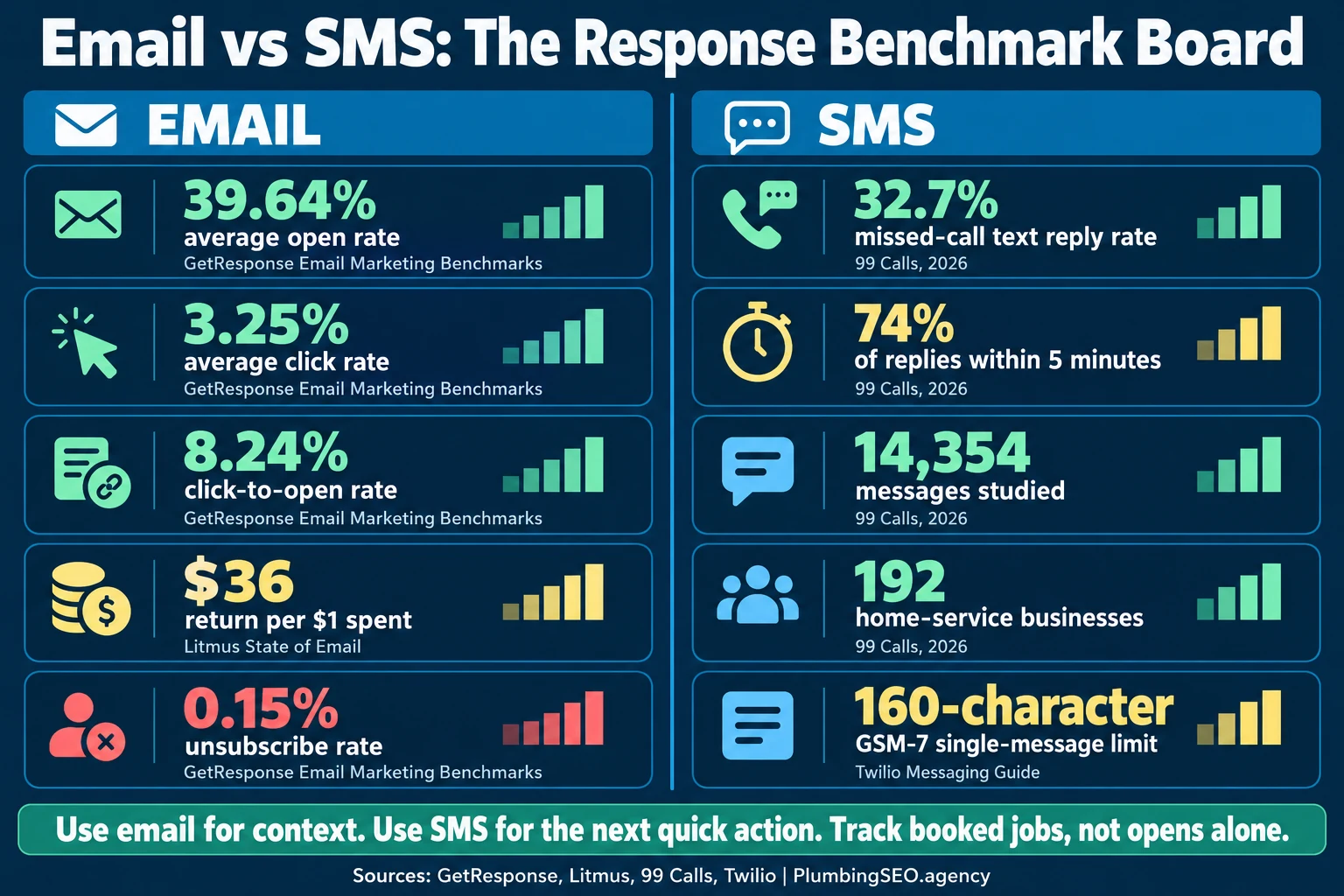
- Email and text do different jobs: email carries estimates, financing details, maintenance education, and proof; SMS is better for a short acknowledgement or next action.
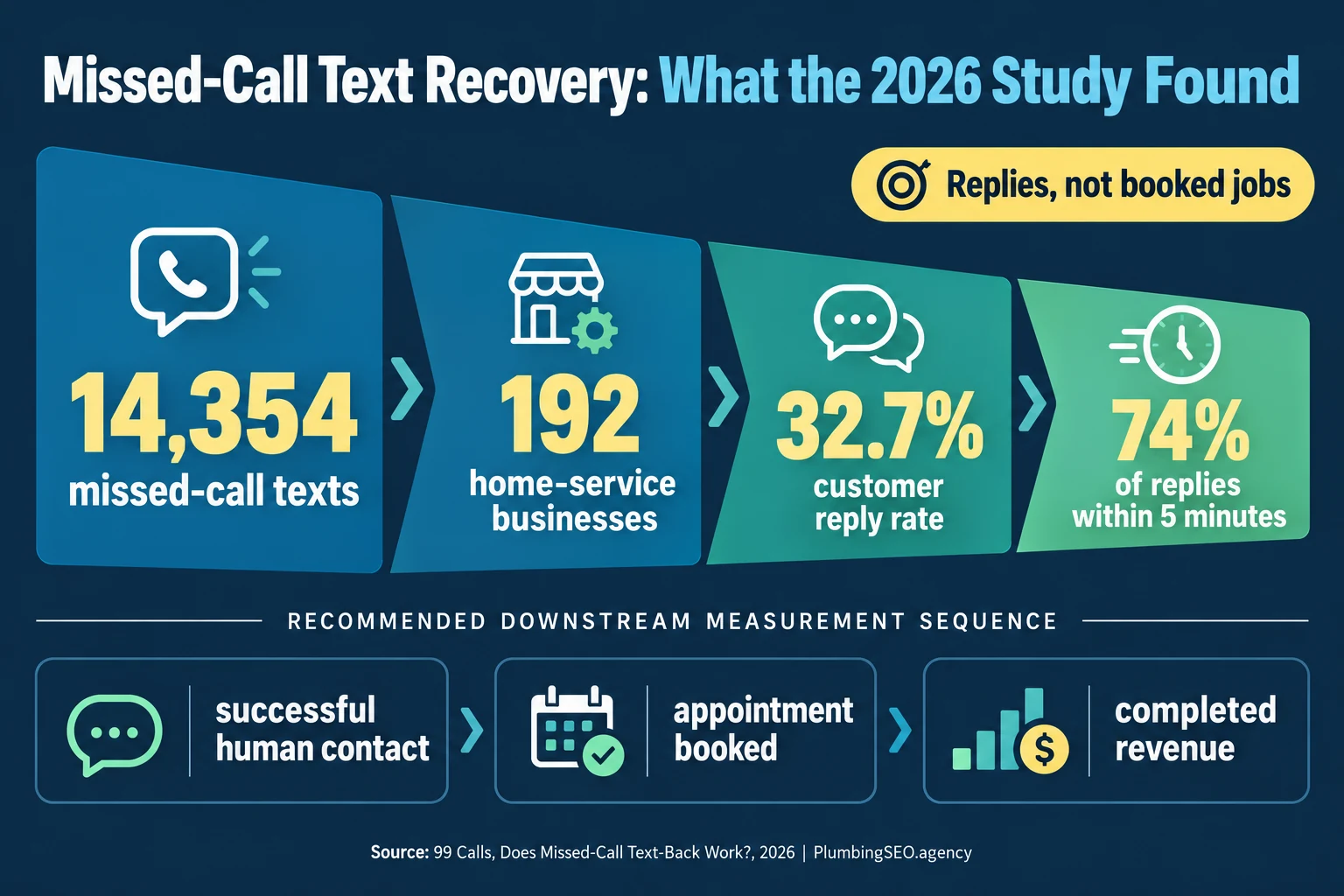
- Text recovery can reopen a missed call: one 2026 home-service study reported a 32.7% reply rate, with 74% of replies arriving within five minutes.
- Generic email benchmarks are context, not plumbing targets: GetResponse reported 39.64% average opens and 3.25% average clicks across its dataset.
- The customer experience is mobile: Pew reports 91% U.S. adult smartphone ownership, while Housecall Pro found 80% of homeowners factored online booking into provider choice.
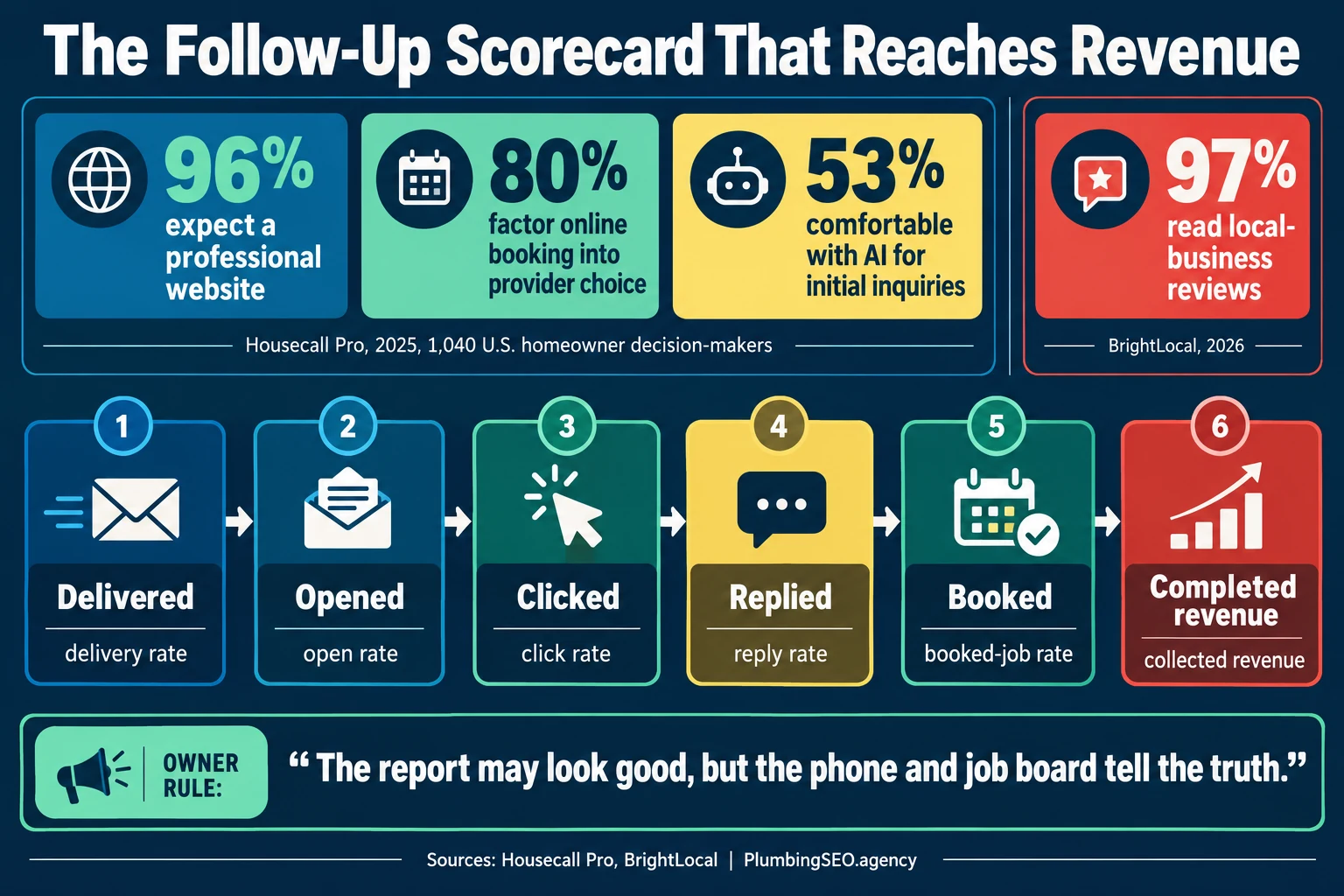
- Compliance and revenue belong on the same dashboard: record consent and opt-outs, then connect delivered messages to replies, bookings, completed jobs, and collected revenue.
A plumbing company can use email and SMS at almost every point after a homeowner raises a hand: missed-call recovery, estimate follow-up, appointment confirmation, technician arrival, maintenance reminders, invoice delivery, review requests, and reactivation. The danger is treating all of those messages as one campaign.
This report organizes 72 numbered email, SMS, mobile, booking, trust, and compliance statistics. Direct plumbing-message benchmarks are scarce, so each table identifies the scope: home services, U.S. consumers, broad email programs, a platform dataset, or a legal and technical limit. Use the figures to set questions and tests—not to promise a result.
- Separate transactional updates from promotional campaigns.
- Keep source scope, year, audience, and metric definition attached to every benchmark.
- Compare email and SMS by use case—not only by open rate.
- Measure qualified replies, appointments, completed jobs, revenue, opt-outs, and complaints.
- Have qualified counsel review consent, quiet hours, revocation, and state-law requirements.
Email and SMS metrics plumbers should define first
An open is not a reply, a reply is not a booking, and a booking is not collected revenue. Email opens are especially noisy because privacy features and image loading can record activity without proving that a person read the message. SMS “open rate” is rarely exposed as a dependable first-party metric, so reply, click, booking, and opt-out rates are more useful.
Email works best for context
Use it for estimate scope, financing disclosures, photos, warranties, maintenance education, invoices, and any message the customer may need to search later.
SMS works best for action
Use it for a missed-call acknowledgement, arrival update, confirmation question, short booking prompt, or a direct link—when consent and message type allow it.
Connect both channels to your plumbing lead CRM and the same booked-job definitions used for calls and forms.
1. Email open, click, and engagement statistics
The first two rows come from GetResponse's worldwide email benchmark. Mailchimp and Campaign Monitor provide older cross-industry comparison sets. They use different customers, filters, periods, and definitions, so do not average them together or call any one figure a plumbing benchmark.
| # | Email benchmark | Value | Source | Scope |
|---|---|---|---|---|
| 1 | Average email open rate | 39.64% | GetResponse benchmarks | Global platform data |
| 2 | Average email click-through rate | 3.25% | GetResponse benchmarks | Global platform data |
| 3 | Average email click-to-open rate | 8.24% | GetResponse benchmarks | Clicks relative to opens |
| 4 | Average email unsubscribe rate | 0.15% | GetResponse benchmarks | Global platform data |
| 5 | All-industry average open rate | 35.63% | Mailchimp benchmarks | Cross-industry |
| 6 | All-industry average click rate | 2.62% | Mailchimp benchmarks | Cross-industry |
| 7 | All-industry average unsubscribe rate | 0.22% | Mailchimp benchmarks | Cross-industry |
| 8 | Construction-industry average open rate | 31.08% | Mailchimp benchmarks | Construction, not plumbing |
| 9 | Construction-industry average click rate | 2.37% | Mailchimp benchmarks | Construction, not plumbing |
| 10 | Average email open rate | 21.5% | Campaign Monitor, 2022 | Older global comparison |
| 11 | Average email click-through rate | 2.3% | Campaign Monitor, 2022 | Older global comparison |
| 12 | Average email click-to-open rate | 10.5% | Campaign Monitor, 2022 | Older global comparison |
| 13 | Average email unsubscribe rate | 0.1% | Campaign Monitor, 2022 | Older global comparison |
| 14 | Average email bounce rate | 0.7% | Campaign Monitor, 2022 | Older global comparison |
2. Email economics, cadence, and deliverability statistics
Return-on-investment estimates describe broad marketing programs, not guaranteed plumbing revenue. Platform requirements below are operating thresholds. A plumber's useful economic measure is collected gross profit from customers who received a message, after software, staff, discount, and fulfillment costs.
| # | Email economics or practice benchmark | Value | Source | Scope |
|---|---|---|---|---|
| 15 | Frequently cited average email return for each dollar spent | $36 | Litmus State of Email | Broad marketing estimate |
| 16 | Marketers reporting increased email engagement | 77% | HubSpot email statistics | Marketer survey context |
| 17 | Brands increasing email budget | 37% | HubSpot email statistics | Marketer survey context |
| 18 | Marketers sending weekly emails | 33% | HubSpot email statistics | Marketer practice, not best cadence |
| 19 | Daily Gmail threshold that triggers bulk-sender rules | 5,000+ | Google sender guidelines | Messages to personal Gmail accounts |
| 20 | Spam-rate level Google says senders should stay below | 0.3% | Google sender guidelines | Postmaster Tools spam rate |
| 21 | Preferred Google spam-rate ceiling | Below 0.1% | Google sender guidelines | Recommended operating level |
| 22 | Time for bulk senders to honor one-click unsubscribe | 2 days | Google sender guidelines | Marketing and subscribed mail |
| 23 | Gmail domain-authentication protocols required for bulk senders | 3 | Google sender guidelines | SPF, DKIM, and DMARC |
| 24 | Yahoo bulk-sender spam-rate ceiling | Below 0.3% | Yahoo sender best practices | Complaint-rate requirement |
What this means for plumbers: remove bad addresses, authenticate the sending domain, separate estimates and service notices from newsletters, suppress opt-outs across every tool, and avoid blasting the entire customer file because the schedule looks light. Our email and SMS follow-up guide shows how to build a practical sequence around real service events.
3. SMS missed-call recovery and follow-up timing statistics
The 99 Calls analysis is unusually relevant because it covers home-service missed-call texts. It measured replies, not plumbing bookings. The Hatch sequence is based on analyzed HVAC campaigns, which resemble plumbing estimate follow-up but still come from a different trade and vendor context.
| # | SMS recovery or cadence benchmark | Value | Source | Scope |
|---|---|---|---|---|
| 25 | Missed-call text messages in study | 14,354 | 99 Calls, 2026 | Study sample |
| 26 | Home-service businesses in study | 192 | 99 Calls, 2026 | Study sample |
| 27 | Reply rate to missed-call text-back | 32.7% | 99 Calls, 2026 | Home services; replies |
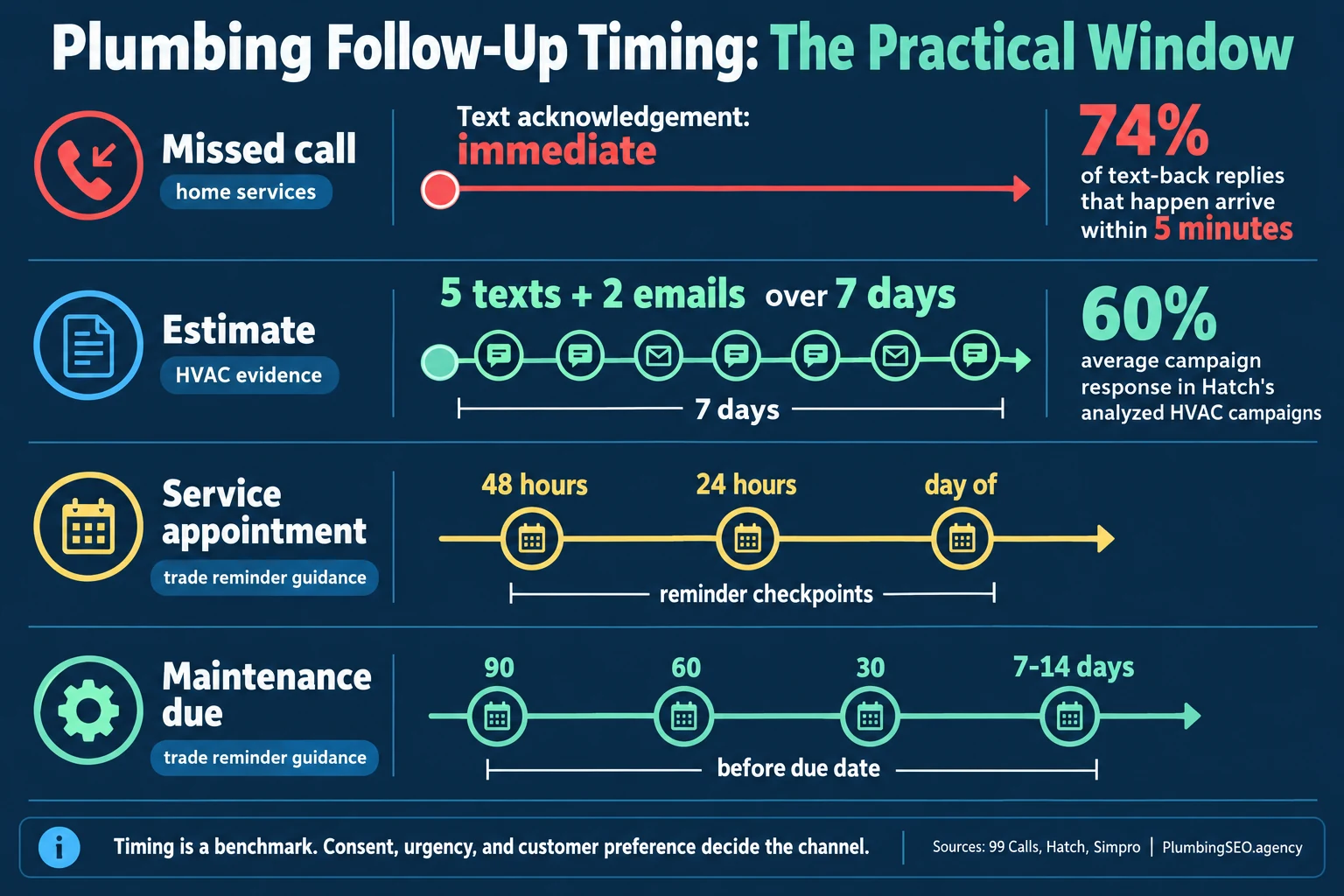
| 28 | Text-back replies arriving within five minutes | 74% | 99 Calls, 2026 | Among replies |
| 29 | Texts in a frequently effective estimate cadence | 5 | Hatch estimate study | HVAC campaign pattern |
| 30 | Emails in that estimate cadence | 2 | Hatch estimate study | HVAC campaign pattern |
| 31 | Length of the estimate follow-up cadence | 7 days | Hatch estimate study | HVAC campaign pattern |
| 32 | Average campaign response rate cited across analyzed campaigns | 60% | Hatch estimate study | Vendor analysis; responses |
| 33 | Early maintenance-reminder checkpoint | 90 days | Simpro reminder guide | Trade-service guidance |
| 34 | Second maintenance-reminder checkpoint | 60 days | Simpro reminder guide | Trade-service guidance |
| 35 | Third maintenance-reminder checkpoint | 30 days | Simpro reminder guide | Trade-service guidance |
| 36 | Final pre-due maintenance window | 7–14 days | Simpro reminder guide | Trade-service guidance |
4. SMS length, encoding, and message-design statistics
SMS length is technical, not a copywriting superstition. GSM-7 text supports more characters than UCS-2. A smart quote, emoji, or unsupported character can change encoding and split a message into more segments. Carrier billing and display behavior can therefore change even when the customer sees one bubble.
| # | SMS technical benchmark | Value | Source | Operational meaning |
|---|---|---|---|---|
| 37 | Single-segment GSM-7 SMS limit | 160 characters | Twilio messaging guide | Basic Latin character set |
| 38 | GSM-7 characters per segment in a concatenated message | 153 | Twilio messaging guide | Header uses segment capacity |
| 39 | Single-segment UCS-2 SMS limit | 70 characters | Twilio messaging guide | Unicode encoding |
| 40 | UCS-2 characters per segment in a concatenated message | 67 | Twilio messaging guide | Multipart Unicode message |
| 41 | Segments produced by a 161-character GSM-7 message | 2 | Twilio messaging guide | Length crosses single-SMS limit |
| 42 | Digits in U.S. 10DLC long-code numbers | 10 | Twilio A2P 10DLC | U.S. application-to-person messaging |
| 43 | Parties in the mobile messaging ecosystem described by CTIA | 4 | CTIA Messaging Principles | Consumers, senders, aggregators, providers |
| 44 | Core consumer-protection principles highlighted by CTIA | 3 | CTIA Messaging Principles | Consent, privacy, and control |
Owner takeaway: put the company name early, write one question, link only when needed, and let a person own the reply. Test encoding before sending at scale. A short plumbing text should not become a six-part message because a copied template introduced curly quotes and an emoji.
5. Mobile access, homeowner expectations, and booking statistics
These figures do not say that homeowners prefer SMS for every plumbing interaction. They show why a mobile-capable, reply-friendly workflow matters—and why the text must lead to a useful human or booking path.
| # | Mobile or homeowner benchmark | Value | Source | Scope |
|---|---|---|---|---|
| 45 | U.S. adults owning a smartphone | 91% | Pew Research Center, 2025 | U.S. adults |
| 46 | U.S. adults owning any cellphone | 98% | Pew Research Center, 2025 | U.S. adults |
| 47 | U.S. adults relying on a smartphone without home broadband | 16% | Pew Research Center, 2025 | Smartphone-only internet users |
| 48 | Homeowner decision-makers in survey | 1,040 | Housecall Pro, 2025 | U.S. online survey |
| 49 | Homeowners factoring online booking into provider choice | 80% | Housecall Pro, 2025 | Stated decision factor |
| 50 | Homeowners expecting a professional, user-friendly website | 96% | Housecall Pro, 2025 | Stated expectation |
| 51 | Homeowners comfortable with AI handling initial inquiries | 53% | Housecall Pro, 2025 | Initial inquiry only |
| 52 | Homeowners appreciating a technician name and photo before arrival | Nearly 60% | Housecall Pro, 2025 | Pre-arrival communication |
| 53 | Consumers reported as expecting online booking | 70% | ServiceTitan, 2024 | Contractor context |
| 54 | New-contractor shoppers more likely to choose online booking | 94% | ServiceTitan, 2024 | Stated likelihood |
| 55 | Home-service customers expecting a same-day response | Over 70% | Jobber, 2026 | Home-service research |
| 56 | Home-service customers expecting a response within an hour | More than half | Jobber, 2026 | Home-service research |
A text that leads to a slow, broken form is not a good mobile experience. Keep the linked page fast, put the service and area at the top, prefill known details when appropriate, and provide click-to-call for urgent situations. See the wider plumbing landing-page statistics for speed, form, and call benchmarks.
6. Review, trust, and post-job message statistics
Email and SMS are often used to request a review after a completed job. The request should invite honest feedback without screening unhappy customers, coaching keywords, paying for sentiment, or making a review the condition of an incentive.
| # | Review or trust benchmark | Value | Source | Scope |
|---|---|---|---|---|
| 57 | Consumers who read reviews for local businesses | 97% | BrightLocal, 2026 | U.S. local consumers |
| 58 | Consumers who care about star ratings | 92% | BrightLocal, 2026 | U.S. local consumers |
| 59 | Consumers only willing to use businesses with four stars or more | 68% | BrightLocal, 2026 | Rating threshold |
| 60 | Consumers focused on reviews from the last three months | 74% | BrightLocal, 2026 | Review recency |
| 61 | Consumers visiting a business website after positive reviews | 54% | BrightLocal, 2026 | Reported next action |
| 62 | Consumers expecting business owners to respond to reviews | 89% | BrightLocal, 2026 | Owner-response expectation |
| 63 | Homeowners willing to refer after an excellent experience | 73% | Housecall Pro, 2025 | Stated referral likelihood |
| 64 | Homeowners saying they would hire the same company again | 68% | Housecall Pro, 2025 | Repeat-hire intention |
Send a neutral request after the job is complete and the customer has received any promised documentation. Offer the same path to every eligible customer. For policy-safe execution, use our guide to Google reviews for plumbers.
7. Email and SMS compliance statistics and operating limits
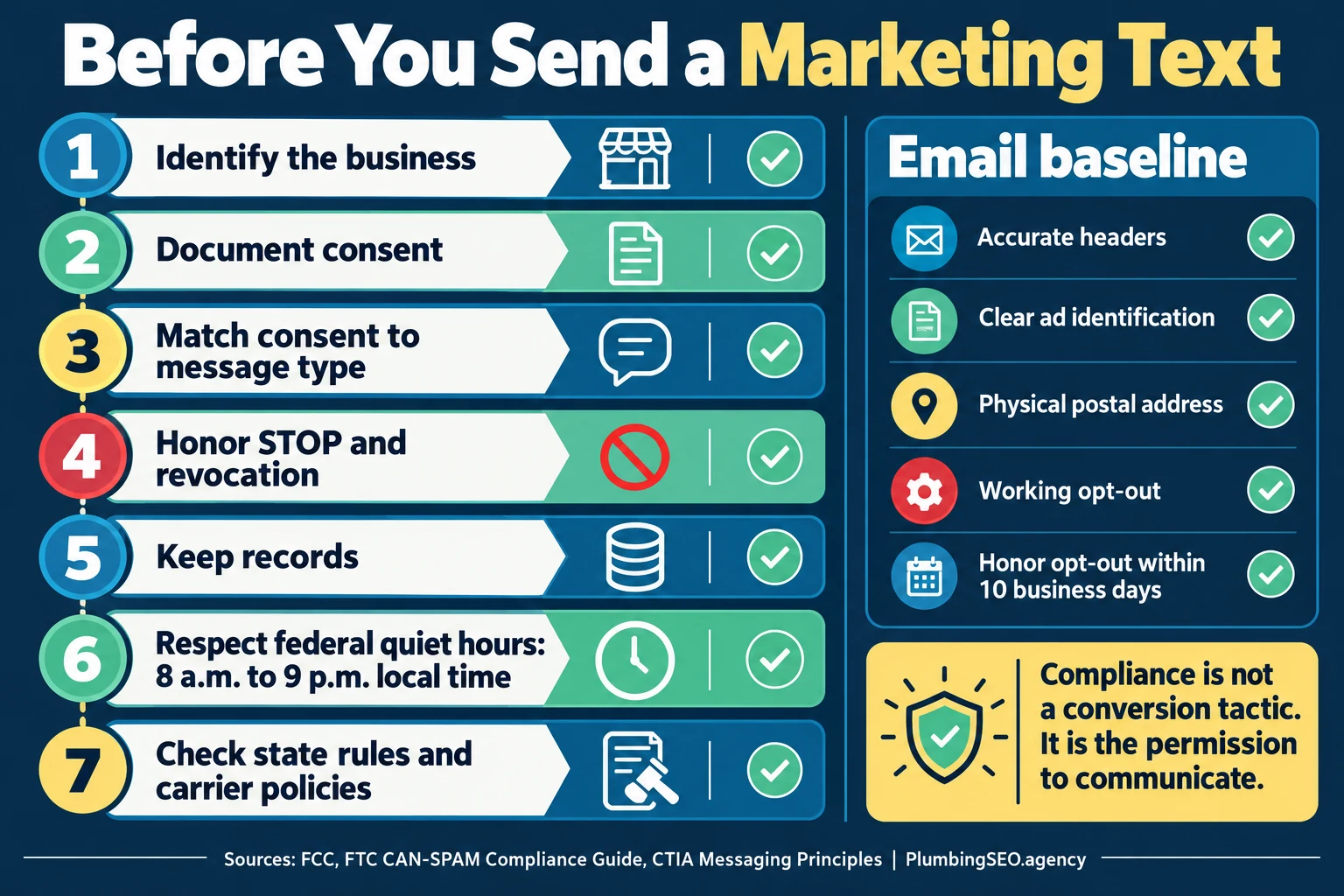
This section is operational context, not legal advice. Federal rules, state mini-TCPA laws, message type, relationship, technology, carrier policy, and current court or agency action can change the answer. Have qualified counsel review the exact workflow before launch.
| # | Compliance benchmark or limit | Value | Source | Scope |
|---|---|---|---|---|
| 65 | Beginning of federal residential telephone solicitation window | 8 a.m. | 47 CFR §64.1200 | Called party's local time |
| 66 | End of federal residential telephone solicitation window | 9 p.m. | 47 CFR §64.1200 | Called party's local time |
| 67 | CAN-SPAM time allowed to honor an opt-out request | 10 business days | FTC CAN-SPAM guide | Commercial email |
| 68 | Minimum time an email opt-out mechanism must remain available | 30 days | FTC CAN-SPAM guide | After sending |
| 69 | Fee allowed for honoring a CAN-SPAM opt-out | $0 | FTC CAN-SPAM guide | No fee or extra personal data |
| 70 | Physical postal addresses required in a commercial email | 1 | FTC CAN-SPAM guide | Valid postal address |
| 71 | Maximum time in the FCC rule for honoring a reasonable consent revocation | 10 business days | FCC revocation order | Federal robocall and robotext rule |
| 72 | Core records to tie to each SMS-capable contact | 4 | CTIA Messaging Principles | Identity, consent, preference, revocation |
Build a plumbing email and SMS scorecard that reaches revenue
The outside benchmarks help identify questions. The company's own customer records decide whether email and SMS are helping. Review performance by use case so a high-volume appointment reminder program does not hide weak estimate follow-up.
1Permission
Track consent source, timestamp, disclosure version, channel, message category, phone or email, opt-out, and suppression across connected systems.
2Delivery
Track attempts, delivered messages, bounces, carrier failures, spam complaints, blocked links, invalid contacts, and sending domain health.
3Engagement
Track unique clicks, replies, positive replies, questions, stop requests, complaints, and successful human contact. Treat opens as directional.
4Booking
Track appointment offered, booking completed, estimate accepted, maintenance renewed, cancellation, no-show, and time from message to booking.
5Revenue
Connect each workflow to completed jobs, collected revenue, gross profit, discounts, software cost, staff time, refunds, and repeat work.
6Experience
Audit frequency, overlapping campaigns, reply ownership, escalation, after-hours promises, accessibility, tone, and customer channel preference.
A practical monthly review
- Separate missed-call, unsold-estimate, appointment, maintenance, review, and promotional programs.
- Check consent and suppression before looking at campaign performance.
- Read a sample of real replies, including opt-outs and complaints.
- Trace five booked jobs and five lost opportunities from message to final disposition.
- Fix one leak—audience, timing, copy, routing, booking link, or staff ownership—then measure again.
Use the plumber's guide to measuring marketing ROI to connect these workflows to acquisition source and gross profit. More sends are not the answer when replies already wait in an unmonitored inbox.
Methodology and source notes
This article was published October 21, 2026. It contains 72 numbered entries from 18 source families. We prioritized original benchmark publishers, first-party platform guidance, federal rules, trade research, and sources with a visible metric definition. Every row includes scope so a broad email average is not presented as a plumbing result.
What we excluded: unsupported “98% SMS open rate” roundups, unattributed “90-second response” claims, synthetic email-versus-text conversion comparisons, and plumbing revenue promises without a study design. Public read-receipt data for ordinary SMS is limited; replies, clicks, bookings, opt-outs, and completed jobs are more defensible.
- GetResponse Email Marketing Benchmarks — global email open, click, click-to-open, and unsubscribe context.
- Mailchimp Email Marketing Benchmarks — cross-industry and construction comparison figures.
- Campaign Monitor Benchmarks (2022) — older global open, click, bounce, and unsubscribe comparisons.
- Litmus State of Email — broad email ROI context.
- HubSpot Email Marketing Statistics — marketer engagement, budget, and frequency context.
- Google Email Sender Guidelines — authentication, bulk-sender, spam-rate, and unsubscribe requirements.
- Yahoo Sender Best Practices — deliverability and complaint-rate guidance.
- 99 Calls Missed-Call Text-Back Study (2026) — 14,354 messages across 192 home-service businesses.
- Hatch Estimate Follow-Up Analysis — HVAC campaign cadence and response context, not plumbing data.
- Simpro Service Reminder Guide — trade-service reminder timing.
- Twilio SMS Character Guide — GSM-7 and UCS-2 segment limits.
- CTIA Messaging Principles and Best Practices — ecosystem and consumer-protection principles.
- Pew Research Center Mobile Fact Sheet (2025) — U.S. cellphone and smartphone access.
- Housecall Pro Home Service Customer Service Report (2025) — online survey of 1,040 U.S. homeowner decision-makers.
- ServiceTitan Online Booking Research (2024) — contractor-booking preference context.
- Jobber Home Service Trends Report (2026) — home-service response expectations.
- BrightLocal Local Consumer Review Survey (2026) — U.S. review behavior, recency, and response expectations.
- FTC CAN-SPAM Compliance Guide and 47 CFR §64.1200 — federal operating requirements; not a substitute for legal advice.
Frequently asked questions about plumbing email and SMS
Use SMS for one quick, reply-friendly action and email for context the customer may need to review later. Estimates, warranties, financing details, and photos fit email; confirmations, arrival updates, and short questions often fit SMS. Consent and customer preference come first.
There is no dependable universal plumbing benchmark. GetResponse reported a 39.64% global average, while other sources report different figures because datasets and methods vary. Compare like-for-like message types and prioritize replies, bookings, and revenue over opens.
A 2026 analysis of 14,354 texts across 192 home-service businesses reported a 32.7% reply rate, with 74% of replies arriving within five minutes. It measured home-service replies, not plumbing bookings, so test successful contact and booked-job rate in your own system.
A single GSM-7 SMS can contain 160 characters; concatenated GSM-7 messages use 153 characters per segment. Unicode can reduce a single segment to 70 characters. Keep the company name, purpose, one action, and required opt-out language clear rather than chasing length alone.
Do not assume that a phone number alone permits promotional texts. Requirements depend on message type, technology, relationship, jurisdiction, and current law. Document consent, identify the sender, honor revocation and opt-outs, keep records, and have qualified counsel review the workflow.
Track consent, delivery, bounces or carrier failures, unique clicks, replies, positive replies, successful contact, bookings, completed jobs, collected revenue, opt-outs, complaints, and staff response time by workflow. Treat email opens as directional.
Are good plumbing leads leaking between the message and the booking?
We can review the local visibility, landing pages, call paths, tracking, and follow-up handoffs that turn search demand into booked plumbing work.
Run My Free SEO Leak Check