
- A professional plumbing website costs $1,500 to $15,000+ depending on whether you go DIY, hire a freelancer, or use a specialized agency.
- Hidden costs including hosting, maintenance, SEO tools, and CRM software can add $3,000 to $20,000+ to your Year 1 total.
- A well-built website pays for itself in 2-3 months. One repiping or water heater job can cover the entire build cost.
What Does a Plumbing Website Actually Cost in 2026?
The honest answer: anywhere from $0 to $30,000, and that range is exactly why most plumbers feel confused when they start shopping. A DIY website builder costs as little as $16 per month. A full-service agency build with CRM integration, 15+ service pages, and conversion optimization runs $10,000 to $15,000 or more.
For most plumbing companies doing under $1M in annual revenue, the sweet spot lands between $3,000 and $8,000 for a professional website that actually generates leads. That gets you a custom design, mobile optimization, dedicated service pages, local SEO foundations, and a site that looks like it belongs to a company you would trust to work in your home.
On Reddit's r/agency, web developers in 2026 report charging $1,500 to $3,000 for a simple 5-8 page site with CMS, $3,500 to $5,000 for a standard business site with SEO foundations, and $10,000+ for complex builds with data migration or custom integrations. One developer put it bluntly: "A plumber doesn't charge less because he has a wrench now. You're paying for knowing which buttons to click and why."
Plumber Website Pricing: Three Tiers Explained
Website pricing falls into three distinct tiers. The right choice depends on where you are in your business, your budget, and how aggressively you want to grow.
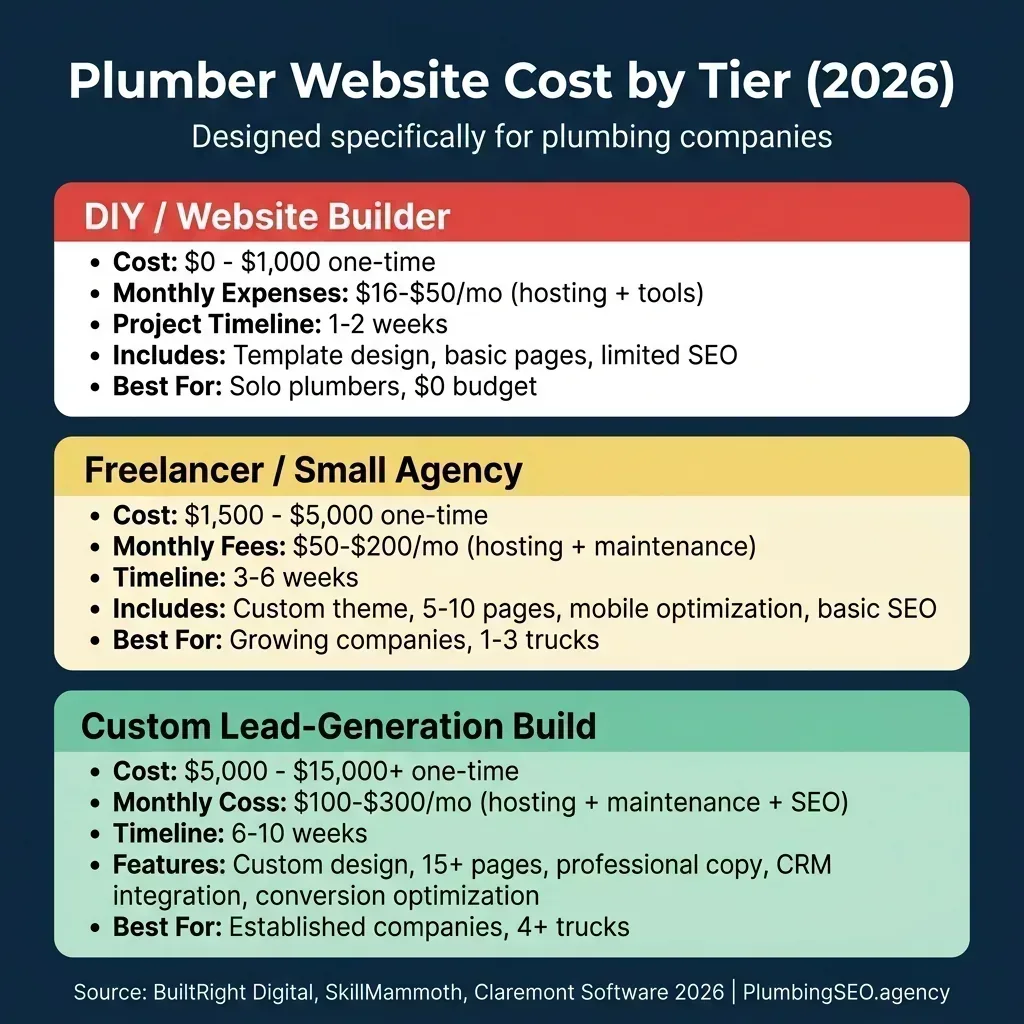
Tier 1: DIY / Website Builder ($0-$1,000)
Platforms like Wix, Squarespace, and GoDaddy let you build a basic site for $16 to $50 per month. You pick a template, add your photos and text, and publish. Total Year 1 cost runs $200 to $600.
The catch: your site looks like every other template site, DIY platforms are notoriously difficult to rank on Google for competitive local keywords, and you will spend 20-40 hours of your own time building it. As one experienced plumber on Reddit noted, "A £1,000 website won't make more than a £100 one if you do it yourself" — the value comes from the strategy, not the tool.
Tier 2: Freelancer / Small Agency ($1,500-$5,000)
At this level you are hiring a professional. They will typically use WordPress or Webflow, deliver a customized design with 5-10 service pages, mobile optimization, basic local SEO setup, and Google Business Profile integration. Build time runs 3-6 weeks.
This tier works well for growing plumbing companies with 1-3 trucks doing under $500K in annual revenue. You may still need to provide your own content and photos, and you likely will not get deep competitive SEO strategy or CRM integration at this price point.
Tier 3: Custom Lead-Generation Build ($5,000-$15,000+)
This is the tier where websites stop being digital brochures and start being lead-generation machines. A specialized agency builds the site from scratch with UX research, professional SEO copywriting for 15+ pages including city and service area pages, conversion rate optimization, CRM integrations, and schema markup. Build time is 6-10 weeks.
SkillMammoth reports that for a $5K-$12K custom build with proper local SEO, most plumbing operators see payback in 3-6 months. Multi-location or enterprise companies with 15+ trucks should budget $15,000 to $30,000 for a fully integrated build with field service management (FSM) software connections. For more on what ongoing SEO investments look like alongside your website, see our SEO campaign cost breakdown.
The Hidden Costs Nobody Tells You About
The quoted build price is just the tip of the iceberg. According to data from Claremont Software, hidden fees can add $20,000 or more per year on top of your quoted website price. Here is what most agencies do not mention upfront:
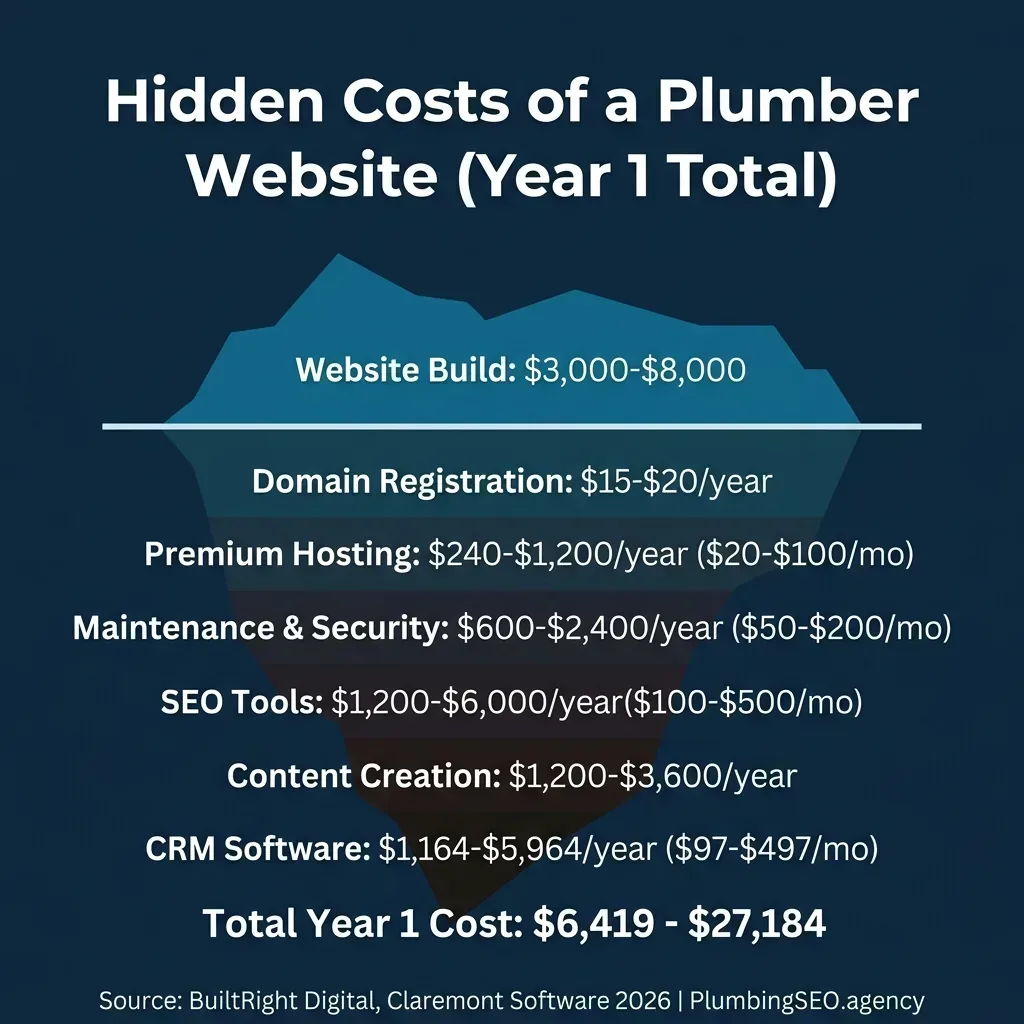
- Domain registration: $15-$20 per year. This is your www.yourplumbingcompany.com name. Always register this yourself so you own it, not your agency.
- Premium hosting: $20-$100 per month ($240-$1,200/year). Cheap hosting means slow load times. Premium hosting guarantees speed and includes daily backups.
- Maintenance and security: $50-$200 per month ($600-$2,400/year). WordPress core updates, plugin updates, and security patches are necessary to prevent hackers from bringing your site down.
- Ongoing SEO: $500-$2,500 per month ($6,000-$30,000/year). Once the site is built, you need content, backlinks, and Google Maps optimization to actually rank. See our complete digital marketing cost guide.
- CRM software: $97-$497 per month ($1,164-$5,964/year). Tools like ServiceTitan, Housecall Pro, or Jobber that connect to your booking forms.
- Call tracking integration: $30-$150 per month ($360-$1,800/year). Essential for attribution and knowing which marketing channels generate calls. See our guide on call tracking integration options.
- Content creation: $100-$300 per month ($1,200-$3,600/year). Blog posts, service page updates, and seasonal content.
The lesson: always ask for a complete Year 1 cost estimate that includes all tools and ongoing services before signing any contract. A $2,500 quote that balloons to $18,000 in hidden annual costs is not a deal — it is a trap.
Website ROI: Why a $5,000 Plumber Website Pays for Itself in 90 Days
Stop looking at the price tag. Start looking at the return. A well-built plumbing website works like your best 24/7 dispatcher — it never sleeps, never takes a sick day, and constantly guides high-intent customers right to your phone line.
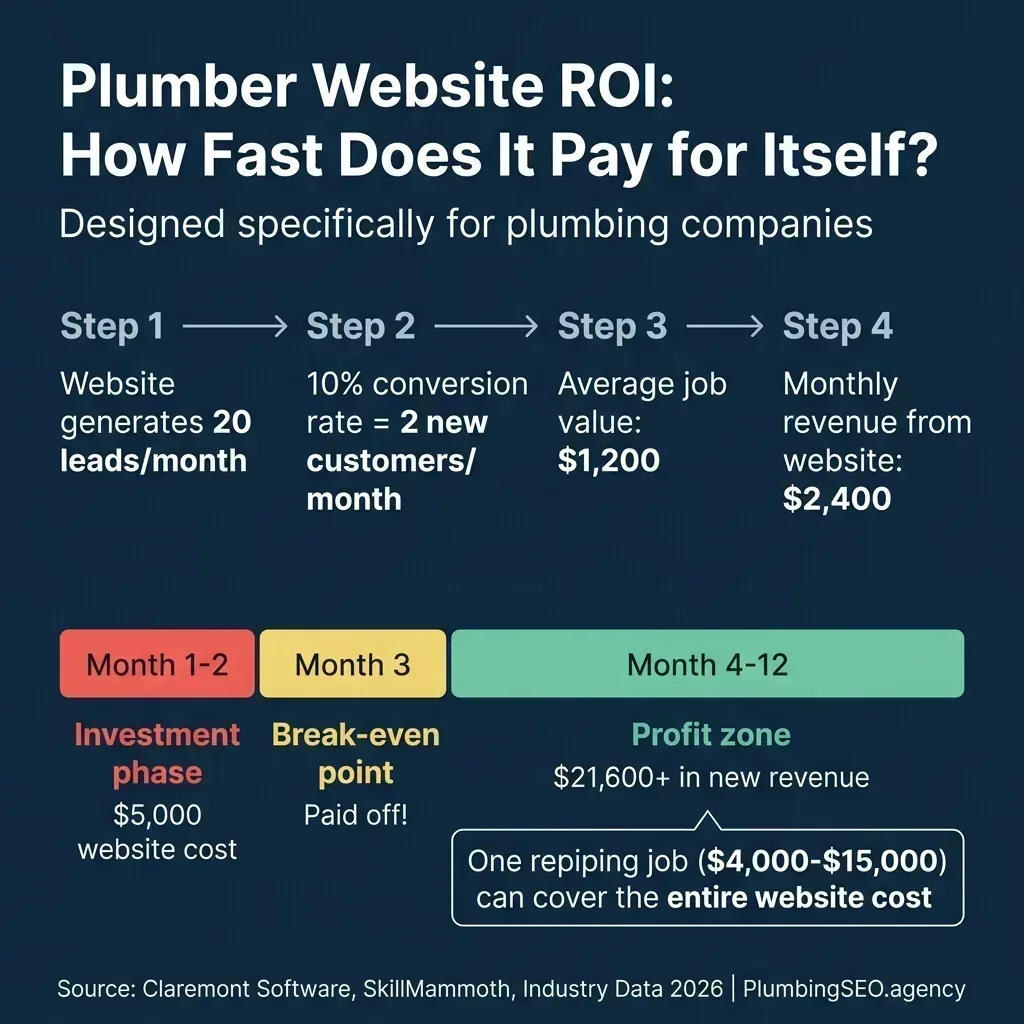
Here is the math. A professional website generating just 20 leads per month at a 10% conversion rate equals 2 new customers. At an average job value of $1,200, that is $2,400 in new monthly revenue. A $5,000 website investment gets recovered within 2-3 months at that rate.
High-value jobs accelerate the timeline even further. A single repiping job ($4,000-$15,000) or water heater replacement ($1,500-$4,000) can cover 50-80% of the entire website cost from one booking. Emergency plumber websites tend to see the fastest ROI because they capture urgent, high-intent searches — including the 35-40% that happen outside of business hours.
For a deeper dive into how marketing spend compounds over time, see our guide on measuring marketing ROI for plumbers.
10 Must-Have Features for a Plumber Website That Gets Calls
Not all plumber websites are created equal. The difference between a site that costs you money and one that makes money comes down to these non-negotiable features:
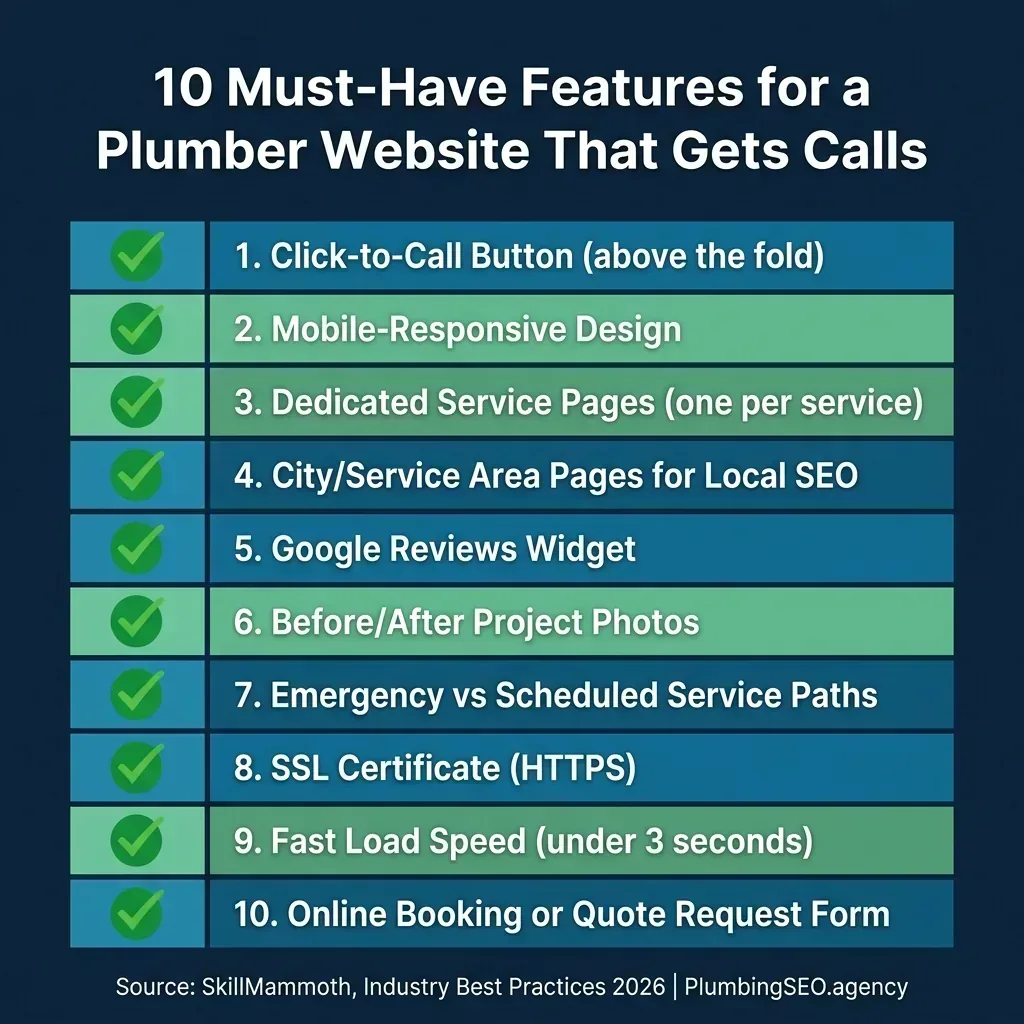
- Click-to-call button above the fold. On mobile, 60% of plumbing searches result in a call. If your phone number requires scrolling, you are losing emergency leads. Learn more in our mobile website guide.
- Mobile-responsive design. Over 70% of plumbing searches happen on smartphones. Your site must work perfectly on every screen size.
- Dedicated service pages. One page per service you offer: drain cleaning, water heater repair, repiping, slab leak detection, gas line repair. Google ranks pages, not websites. Learn more about how we build service pages that rank.
- City and service area pages. One page per city you serve with unique local content. This is the single biggest local SEO lever for plumbers. Our city pages guide covers the full strategy.
- Google Reviews widget. Embed your best reviews directly on the site. Profiles with 100+ photos get 520% more calls — the same principle applies to reviews displayed on your website.
- Before and after project photos. Plumbing work is invisible by definition. Visual proof that the work happened and looks clean drives trust harder than testimonials alone.
- Emergency vs. scheduled service paths. A panicked homeowner with a burst pipe and a price-shopping remodel customer need different experiences. Give them two clear paths above the fold.
- SSL certificate (HTTPS). Google penalizes non-secure sites. This is non-negotiable and usually included with modern hosting.
- Fast load speed under 3 seconds. 30% or more of mobile visitors leave when a page takes more than 3 seconds to load. Compress images, enable lazy loading, and eliminate unused code.
- Online booking or quote request form. 35-40% of plumbing searches happen outside business hours. Give those potential customers a way to reach you while you sleep.
9 Website Mistakes That Cost Plumbers Money
We audit plumbing websites every week, and the same mistakes appear in over 80% of them. These are not design preferences — they are revenue killers. For a complete technical audit checklist, see our technical SEO checklist.
- Phone number not above the fold on mobile. If a visitor has to scroll to find your number, they will call a competitor instead. Fix this in 30 minutes.
- No service area pages. You are losing local SEO to every competitor who has them. Build city pages with 400-800 words of unique content each.
- Stock photos of pipes. Instant trust killer. Have your techs upload one real photo per job to a shared drive. Refresh the site weekly.
- No financing copy on install pages. You are losing $5,000+ jobs at the quote stage. Add Synchrony or Wells Fargo financing language.
- Slow mobile load times. Compress images, lazy-load everything below the fold, and eliminate unused plugins.
- No reviews on the website. Your biggest trust signal is missing. Embed Google reviews using tools like NiceJob or Birdeye.
- Generic "service area" text. Vague signals to Google and visitors. List your actual cities in plain text.
- One generic "Services" page. A single page listing everything may struggle to rank for any individual service keyword. Create dedicated pages for each service.
- No schema markup. LocalBusiness schema, ServicePage schema, and FAQPage schema help Google understand your site. Our schema markup guide walks through implementation.
Build vs. Buy vs. DIY: Which Path Is Right for Your Plumbing Company?
The right approach depends entirely on your business stage. Here is the honest decision matrix based on data from SkillMammoth and verified against Reddit community feedback:
| Your Situation | Recommended Path | Budget |
|---|---|---|
| Brand new, $0 budget | DIY on Wix / Squarespace | $200-$600/yr |
| 1-3 trucks, want results without ongoing fees | Freelancer / small agency | $1,500-$5,000 |
| 4-15 trucks, ready to scale | Mid-tier custom build | $5,000-$12,000 |
| 15+ trucks or multi-location | High-end custom + FSM integration | $15,000-$30,000 |
| Subscription preference | Monthly website service | $49-$500/mo |
One critical rule regardless of which path you choose: always own your domain name. Register it yourself at Namecheap, Google Domains, or GoDaddy. If your agency owns the domain and you part ways, you lose your entire online identity. Multiple plumbers on Reddit have shared horror stories about this exact scenario.
Frequently Asked Questions
How much does a basic plumber website cost in 2026?
A basic plumber website costs as little as $16 per month using a DIY website builder, putting your Year 1 total around $200-$500. Hiring a freelancer for a semi-custom build costs $1,500-$4,500 as a one-time fee. Most professional plumbing businesses spend between $3,000 and $8,000 for a properly built site with service pages, mobile optimization, and basic local SEO.
Is it worth paying $5,000+ for a custom plumbing website?
Yes, for most established plumbing businesses. A professionally built site can generate 10-30 leads per month. At a 10% conversion rate and $1,200 average job value, that is $2,400+ in new monthly revenue — meaning the site pays for itself within 2-3 months. High-value jobs like repiping ($4,000-$15,000) can cover the entire cost from a single booking.
Can I build my own plumbing website for free?
Technically yes, but free plans come with the builder's branding, limited SEO capability, and no custom domain. You will also invest 20-40 hours of your own time. For a credible online presence, a paid DIY plan starting around $16/month is the realistic minimum. Free websites rarely rank in local search or convert visitors into calls.
How long does it take to build a plumber website?
A DIY build takes 1-2 weeks. A freelancer or small agency build takes 3-6 weeks. A custom agency build takes 6-10 weeks. Enterprise builds with FSM integration take 8-16 weeks. The biggest variable is how quickly you can provide content, photos, and feedback during the revision process.
Should I choose a subscription website service or pay for a one-time build?
Subscription services ($49-$199/month) lower the barrier for new plumbers but may limit ownership, customization, and SEO potential. A one-time custom build ($3,000-$15,000+) gives full ownership and a stronger long-term SEO foundation. If cash flow is tight, start with a subscription and upgrade as revenue grows — just make sure you own your domain name from day one.
What hidden costs should plumbers watch for when building a website?
Common hidden expenses include: CRM software ($97-$497/month), SEO tools ($100-$500/month), ongoing content creation, citation management, review management platforms, call tracking software, and hourly revision charges ($75-$150/hour). In total, hidden fees can add $20,000 or more per year on top of your quoted website price. Always ask for a complete Year 1 cost estimate before signing.
Not Sure If Your Current Website Is Costing You Calls?
We will audit your plumbing website and show you exactly where you are losing leads — for free. No contracts, no obligations, no agency jargon.
Run My Free Website Audit