
- Google has never said every plumber city page is spam. The risk appears when pages are built only to rank for near-identical city keywords and funnel visitors to another page instead of helping the local searcher.
- Build a local landing page only when you truly serve that area, want calls from it, and can add city-specific proof: job photos, reviews, neighborhoods, local issues, response expectations, and service links.
- A safe city-page program is usually 5 to 15 strong pages plus a service-area hub. A risky program is 40 copied pages where only the city name, ZIP list, and title tag change.
Local landing pages can be one of the highest-return SEO assets on a plumbing website. They can also become the exact pattern Google describes when it warns about doorway pages: many similar pages targeting similar queries, built mostly to expand a search footprint, with little unique value for the person who lands there.
That difference matters because plumbers often serve a wide radius from one office. A homeowner in Plano, Frisco, Garland, or Arlington does not care that your main office is 22 minutes away. They want to know: do you actually come here, can you solve this specific problem, how fast can you arrive, and can I trust you in my neighborhood?
This guide is the compliance-focused version of our broader city pages for plumbing companies framework and supports our local SEO for plumbers service page. The goal is not to publish more pages. The goal is to decide which local landing pages deserve to exist, then build them so they are useful pages in your site architecture, not thin search-engine bait.
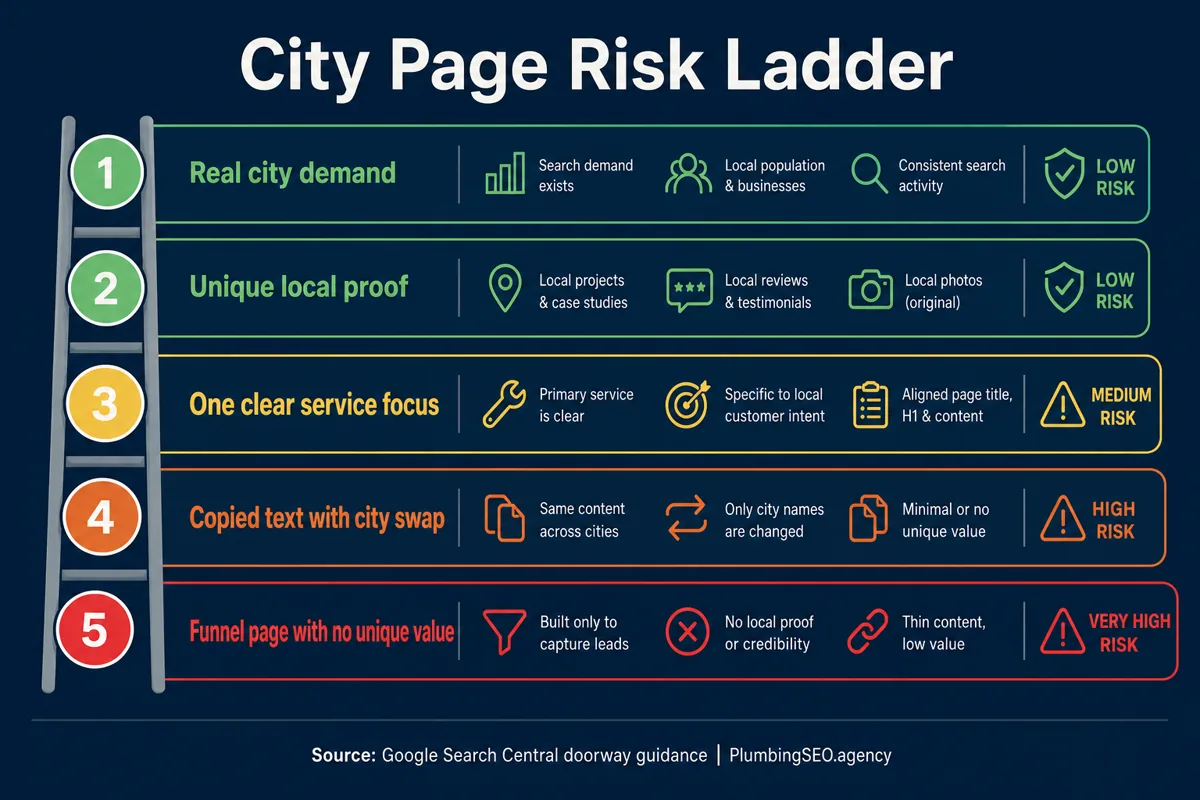
What Google Means by Doorway Pages
Google's doorway-page concern is not the word "city" in your URL. It is the purpose and quality of the page. In its 2015 doorway-page update, Google said it had seen sites try to maximize their "search footprint" without adding clear, unique value. Its questions include whether pages are built to funnel visitors into the real usable part of the site, whether they duplicate useful location aggregations, and whether they exist as islands that are hard to navigate to from the rest of the site.
The current Google Search spam policies call this "doorway abuse." Google gives examples like multiple pages targeted at specific regions or cities that funnel users to one page, generated pages that push visitors into the usable portion of a site, and substantially similar pages that feel closer to search results than a clearly browseable site hierarchy.
For plumbers, that translates into a simple test: if a customer in that city would be disappointed after clicking the page, the page is unsafe. If the page helps that customer confirm coverage, choose the right service, see local proof, and call with confidence, the page is much safer.
Local Landing Page vs. Doorway Page: The Practical Difference
| Element | Useful plumber local landing page | Doorway-risk page |
|---|---|---|
| Purpose | Helps a homeowner or property manager in a real service area decide whether to call. | Exists mainly to rank for "plumber in [city]" and push visitors to the home page or phone number. |
| Content | Includes city-specific services, neighborhoods, proof, local issues, and next steps. | Uses the same copy on every page with city names swapped. |
| Navigation | Fits in a browseable service-area hub and links to relevant service pages. | Exists as an island or hidden page created only for search engines. |
| Proof | Shows real photos, reviews, project notes, local response expectations, or local credentials. | Makes generic claims with no evidence that the company works in that area. |
| Scale | Starts with priority cities where jobs, search demand, and proof already exist. | Mass-publishes dozens of near-identical city pages because the keyword list is long. |
The Plumber City Page Decision Tree
Before writing anything, decide whether the page deserves to exist. This prevents the common mistake of turning a service-area strategy into a doorway-page campaign.
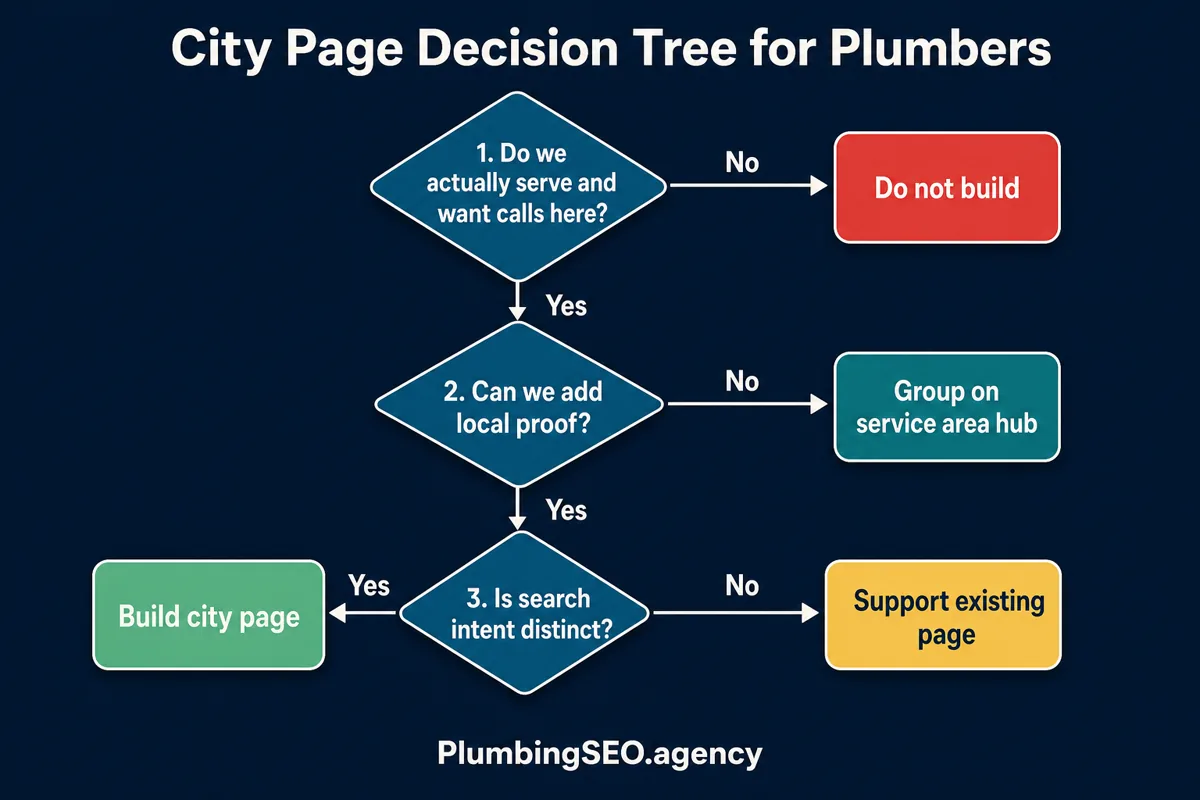
Question 1: Do you actually serve and want calls from this city?
If the answer is no, do not build the page. That sounds obvious, but many local SEO campaigns start with a radius map and publish every city inside it. A plumber can technically drive to a far suburb, but that does not mean the job is profitable, the response time is competitive, or the company wants emergency calls from that market.
Question 2: Can you add proof that is specific to the area?
Proof does not need to be dramatic. It can be a real job photo, a review from a customer in the city, a note about common pipe material in local housing stock, neighborhood names your dispatcher actually uses, or a simple explanation of how your team routes trucks there. Without proof, the page will sound like every other city page on the web.
Question 3: Is the search intent distinct enough?
Sometimes a separate page is justified because the city has search demand, local competition, and a different customer context. Other times the city is better handled as a section on an area hub. A small suburb with limited demand may not need its own full page until you have more job history and content to support it.
What Belongs on a Safe Plumber City Page
A local landing page should answer the questions a real homeowner would ask before calling. It should not read like a list of keywords. The best page feels like a local service page, not a directory page.
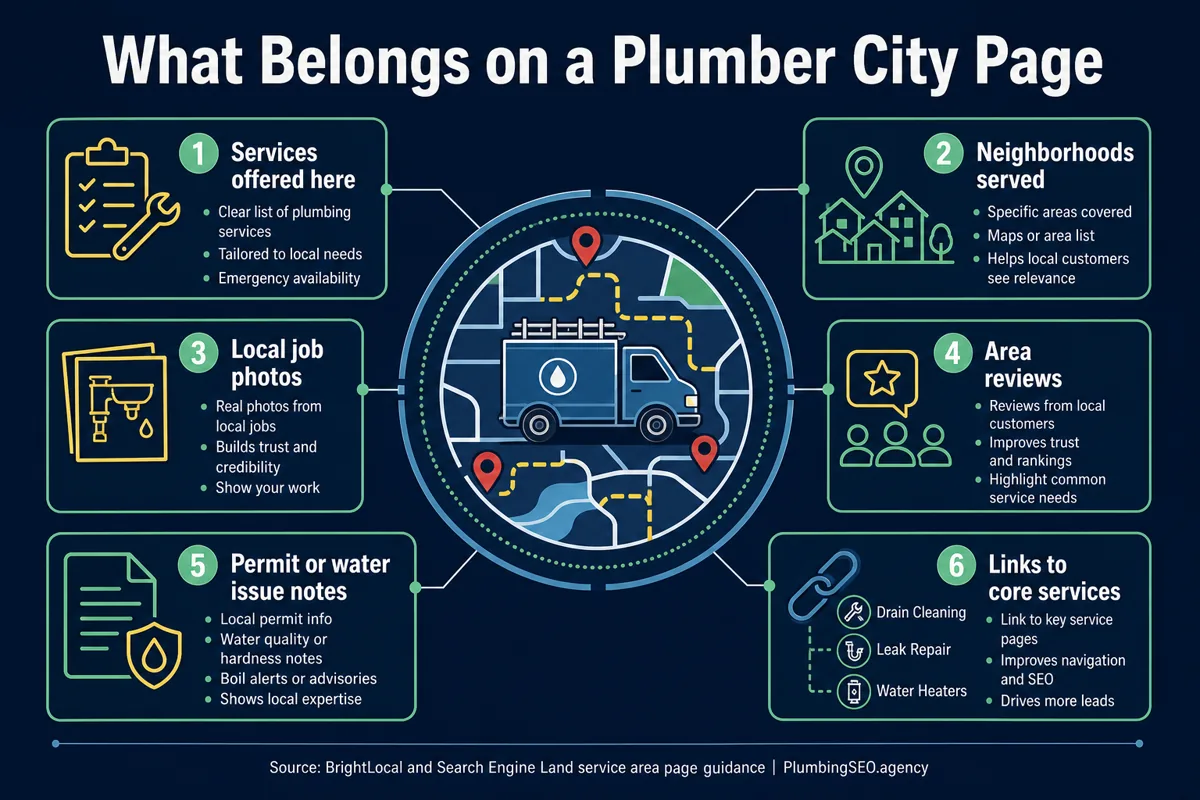
1. A city-specific opening that proves coverage
Do not open with "Looking for the best plumber in [city]?" on every page. Start with something true and useful: the type of customers you serve there, the service patterns you see, the response expectations, and the services worth calling for in that area.
Weak: "We are the leading plumber in Frisco offering all plumbing services."
Better: "Our plumbing team serves Frisco homeowners for slab leak detection, water heater replacement, drain cleaning, and emergency repairs, with frequent calls from neighborhoods near Stonebriar, Panther Creek, and Main Street."
2. A service mix that matches local demand
Every city page does not need to list every service. If the area produces emergency calls, slab leaks, tankless replacements, sewer backups, or commercial maintenance, make that service mix clear. Then link to your primary service pages so the city page supports the core architecture instead of replacing it.
For example, a Dallas page might link naturally to drain cleaning SEO ideas because blocked drains are a high-frequency call type, while a newer suburban market might emphasize water heaters, tankless installation, and whole-home shutoff upgrades.
3. Local proof that cannot be copied to another city
Google's helpful content guidance asks whether content provides original information, reporting, research, or analysis. For a plumber city page, original information often comes from the business itself: job photos, technician notes, call patterns, review snippets, local water issues, and city-specific FAQs.
Use proof like this:
- Photos from jobs in or near the city, with descriptive alt text.
- Short project notes: "replaced a leaking 50-gallon gas water heater near downtown Plano."
- Reviews from customers in the city, if you have permission to quote them.
- Common local questions, such as hard water, older galvanized lines, slab leaks, sewer roots, permits, or freeze prep.
- Response-time or routing notes that are true for your operation.
4. A browseable service-area hierarchy
Doorway-risk pages often sit outside the normal website journey. A safer setup uses a hub-and-spoke structure: one service-area hub lists the primary cities, each city page links back to the hub, and each city page links to the core services most relevant to that city. This is why our service-area page process treats city pages as part of the site architecture, not a one-off publishing trick.
- Service-area hub: /areas-we-serve/ explains your coverage and links to priority cities.
- City page: /areas-we-serve/plano/ explains why Plano searchers should call you.
- Core service page: /services/water-heater-repair/ explains the service in depth.
- Supporting blog content: educational posts answer related questions and link back to the right page.
The 7-Point Doorway Risk Audit
Use this audit on every existing or proposed city page. If a page fails more than two checks, rewrite, consolidate, or noindex it until it deserves to compete.
How Many City Pages Should a Plumber Publish?
Most single-location plumbing companies should not start with 50 city pages. Start with the markets where you have the strongest combination of job history, profitability, search demand, and local proof. For many plumbing companies, that means 5 to 15 strong pages, not every town within driving distance.
There are exceptions. A multi-location plumbing company with real crews, separate office coverage, and deep project history may justify a larger location footprint. But the scale should follow evidence. Our advanced local SEO for plumbers guide explains how to use search demand, Google Business Profile data, service mix, and ranking gaps before deciding where to expand.
A Safer City Page Template for Plumbing Companies
Use this structure when a city page passes the decision tree:
- H1: Primary service intent plus city, such as "Plumber in Plano, TX" or "Emergency Plumber in Plano."
- Intro: Two short paragraphs proving you serve the city and naming the highest-value service needs.
- Services section: 4 to 6 services with links to your main service pages.
- Local proof section: photos, reviews, project notes, or neighborhoods served.
- Local issues section: water quality, housing age, weather, sewer roots, permits, or common repairs.
- Why call us section: dispatch, guarantees, licensing, financing, emergency availability, and response process.
- FAQ: 4 to 6 city-specific questions that a real caller might ask.
- CTA: call, book online, or request service in that city.
- Internal links: service-area hub, nearby city pages, and priority service pages.
This template is intentionally harder than a copy-paste city page. That is the point. If the business cannot fill in the local proof, the page may not be ready yet.
Internal Linking Rules That Reduce Doorway Risk
Internal links tell both users and search engines that the page is part of a real website journey. They also keep your city pages from cannibalizing your main service pages.
- Link from the service-area hub to the city page so the page is discoverable to users.
- Link from the city page to core service pages like emergency plumbing, drain cleaning, water heaters, sewer repair, and leak detection.
- Link from relevant blog posts to the city page only when the city is contextually relevant.
- Link between nearby city pages sparingly when it helps users understand your coverage, not as a massive footer block.
- Keep your main local SEO guide in the cluster so broad educational intent flows to pages like local SEO for plumbers and then down to specific city content.
If your city pages have no meaningful inbound links from the rest of the site, that is a doorway warning sign. If every page links to every other city with keyword-stuffed anchors, that is also a warning sign. Use links like a customer would use them.
What to Do With Existing Thin City Pages
Do not delete everything blindly. First classify each page.
| Page status | What it means | Best next action |
|---|---|---|
| Ranking and converting | The page earns impressions, clicks, calls, or form fills. | Keep it, then improve proof, internal links, and conversion elements. |
| Indexed but weak | The page exists but has little traffic or unique value. | Rewrite with local proof or merge into a stronger service-area hub. |
| Not indexed or ignored | Google may not see enough value to keep it in search. | Consolidate, redirect, or rebuild only if the city is strategically important. |
| Wrong page ranking | A nearby city page ranks for another market or broad query. | Tighten titles, headings, internal links, and page intent. Consider consolidation. |
This is where a content audit becomes more valuable than more publishing. If you need a broader diagnostic, start with our plumber SEO diagnostic checklist before adding another location page.
Sources and Research Notes
This article uses the standard production line, not the stats-post line, because the task is a decision and compliance guide rather than a data roundup. The recommendations are based on Google Search Central's doorway-page update, Google's current spam policies, Google's helpful-content guidance, and current service-area page guidance from BrightLocal and Search Engine Land.
Owner takeaway
A city page is safe when it earns its place in the site. If you can prove you serve the city, answer local questions, show local proof, and connect the page to your service-area architecture, build it. If you only have a city name and a template, wait.
Want City Pages Without Doorway-Page Risk?
We will audit your current local landing pages, flag doorway-risk patterns, and show which cities deserve dedicated pages based on proof, search demand, and real plumbing revenue potential.
Get My Free City Page AuditFrequently Asked Questions
No. A city page becomes doorway-risk when it is created mainly to rank for a city keyword and funnel visitors elsewhere without unique value. A plumber city page is much safer when it proves real service coverage, answers local questions, includes local proof, and fits into a browseable service-area structure.
Most single-location plumbing companies should start with 5 to 15 high-priority cities where they have job history, search demand, profitability, and local proof. Publishing 40 to 80 copied city pages before the first set performs is usually a quality and maintenance problem.
Use proof that cannot be copied to another city: job photos, customer reviews, neighborhoods served, local plumbing issues, response expectations, permit notes, water-quality concerns, seasonal problems, and links to the services most requested in that city.
Sometimes. If a city page is thin, not indexed, or hurting site quality, you can temporarily noindex it while you rewrite it. For pages with no strategic value, consolidation or a redirect to a stronger service-area hub may be better than keeping another weak page live.
Yes, organic rankings are possible if the plumber truly serves that city and the page is useful. Ranking in the Google Map Pack is usually harder without a physical address because proximity matters more there, but organic city pages can still capture valuable local searches.
For most plumbing companies, a clear structure like /areas-we-serve/city-name/ is easiest for users and search engines. Flat URLs can still work, but a service-area hub makes the pages easier to navigate and reduces the chance that they look like isolated doorway pages.
Ready to Turn Service Areas Into Calls?
A free PlumbingSEO audit shows which city pages to keep, which to consolidate, and which new local landing pages can safely grow your organic call volume.
Run My Free SEO Leak Check