
- Drain cleaning SEO should send the right clogged-drain searches to a dedicated service page, your Google Business Profile, and a fast click-to-call path.
- Do not chase every drain, sewer, hydro jetting, and camera keyword with thin pages. Build the page only when you can prove the service, area, photos, reviews, and next step.
- The best drain cleaning rankings come from a tight loop: local intent, service proof, reviews that mention drain work, internal links, and call tracking that shows which jobs booked.
If your phone goes quiet on drain cleaning days, it is not always a demand problem. People are still searching when the kitchen sink backs up, the tub will not drain, or the main line starts acting ugly. The problem is that Google has to decide which plumber looks most relevant, closest, trusted, and ready to answer.
That is what drain cleaning SEO is about. Not fancy reports. Not a pile of keywords. It is the work of helping your company show up when a homeowner searches for clogged drain help in your service area, then giving that person enough proof to call you instead of the next shop.
The way I see it, drain cleaning is one of the best services for plumbing SEO because the intent is clear. A customer with a backed-up drain usually wants help now, but the job can also lead to camera inspection, sewer repair, maintenance plans, and repeat work if the company handles the call right. For a commercial plan that connects drain demand with the rest of the plumbing business, see the SEO for plumbing and drain companies service page.
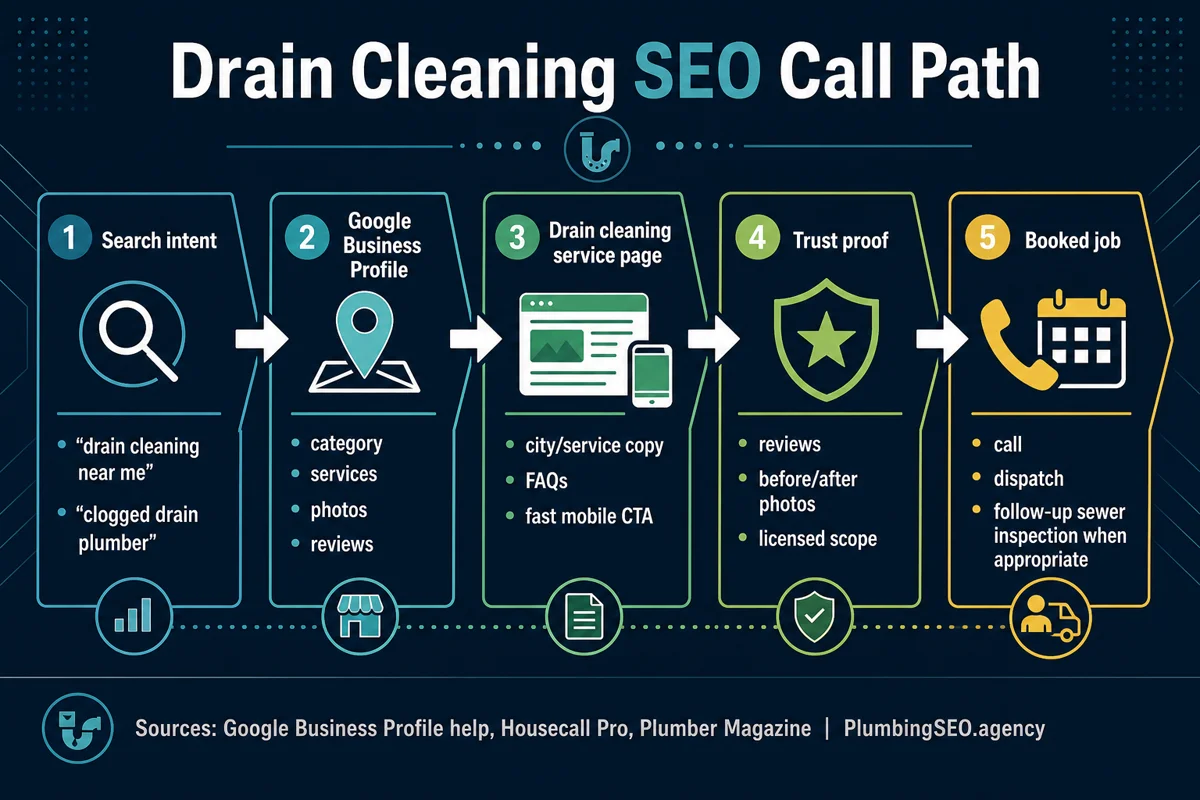
What drain cleaning SEO actually has to rank for
Most plumbing owners think of one keyword: drain cleaning. Customers do not search that cleanly. They search with the problem, the urgency, the fixture, and the city mixed together.
| Search pattern | What the customer likely needs | Page or proof that should answer it |
|---|---|---|
| drain cleaning near me | A local company they can call fast | Google Business Profile, reviews, service page |
| clogged kitchen sink plumber | Fixture-specific help | Drain cleaning page with common drain examples |
| main sewer line clogged | Diagnosis, camera work, or sewer backup help | Drain page that links naturally to sewer inspection or repair |
| hydro jetting [city] | Higher-intent service comparison | Only a dedicated page if you offer it and can prove it |
That last column is where a lot of shops leak calls. They either have one vague plumbing page that barely mentions drains, or they create too many thin pages that all say the same thing. Google does not need another copy-paste page. The customer does not either.
Build the drain cleaning page like a dispatcher would explain it
A good drain cleaning page should answer the questions your office hears all week. What drains do you clear? Do you handle main lines? Do you use cameras? Do you offer same-day help? What areas do you serve? What should the customer do before the truck arrives?
Keep it practical. A homeowner with sewage backing up is not reading a novel. They are checking whether you handle their problem, whether you are close enough, whether you look trustworthy, and whether the phone number works.
For the broader service foundation, connect the article to your main plumbing SEO service page so Google and readers can see how drain cleaning fits into the bigger ranking system.
Google Business Profile has to support the page
Your website can say drain cleaning all day, but your Google Business Profile still carries a lot of the local trust load. Google tells businesses to keep profile information accurate and complete, including services, hours, photos, and customer-facing details. That matters when the search is urgent and local.
Use the profile to back up the service page. Add drain cleaning as a service where appropriate. Upload real drain equipment photos. Ask happy customers to mention the actual work, such as kitchen sink cleared, main line opened, or sewer camera used. Do not coach fake wording. Just make the request specific enough that useful details show up naturally.
Google's own Business Profile guidance focuses on accurate business information. For a plumber, that means the profile should line up with the page, the phone number, the service area, and the work your crew really performs.
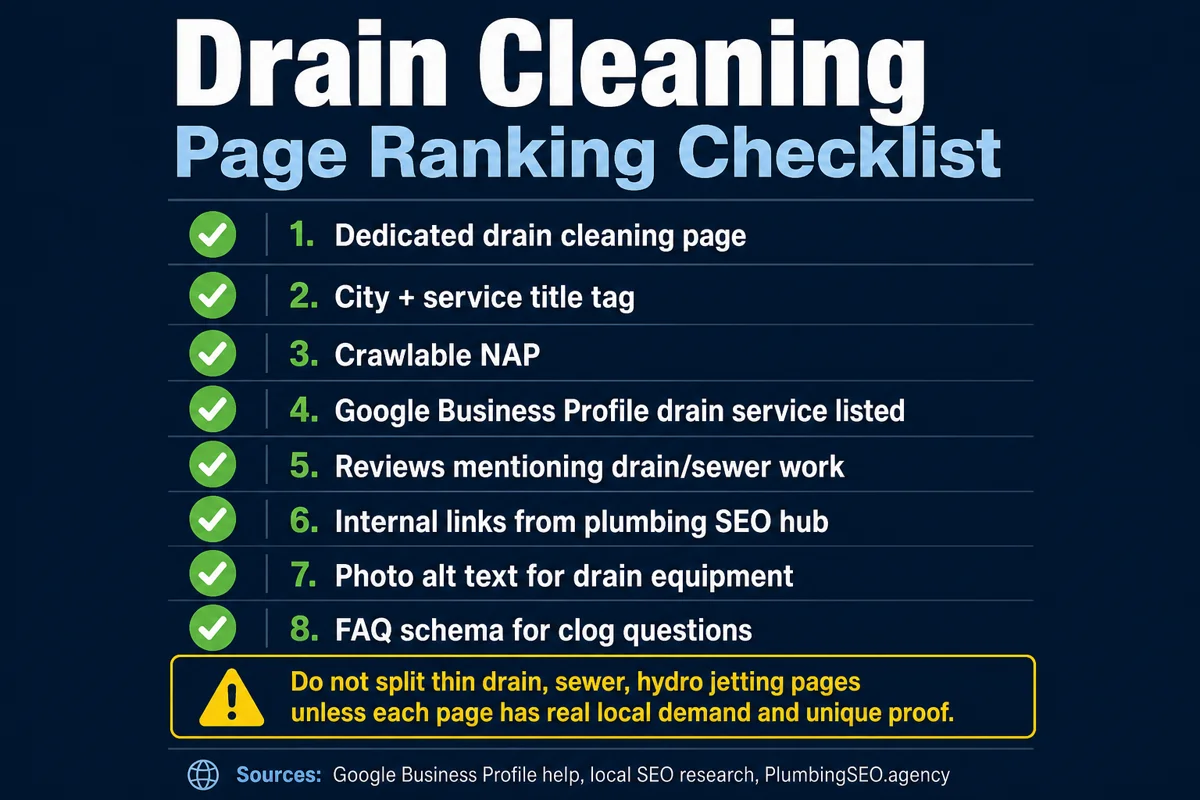
Reviews should prove drain cleaning, not just general plumbing
A five-star review that says “great company” helps. A review that says “cleared our main drain on a Saturday and explained the camera inspection” helps more for drain intent. It gives the customer a reason to trust you and gives search engines clearer service context.
This is not about gaming reviews. It is about asking properly after the job. Your tech can say, “If we took care of you today, a Google review mentioning the drain issue we fixed really helps our local crew.” That is honest. It is specific. It does not offer a discount or pressure the customer.
Drain cleaning SEO and PPC should not fight each other
Some drain calls are urgent enough that paid search makes sense while SEO is building. Housecall Pro's plumbing PPC guide points out that high-intent searches like emergency plumber or drain cleaning plus city can be strong ad targets because the customer is ready to act. That does not mean SEO is optional. It means the two jobs are different.
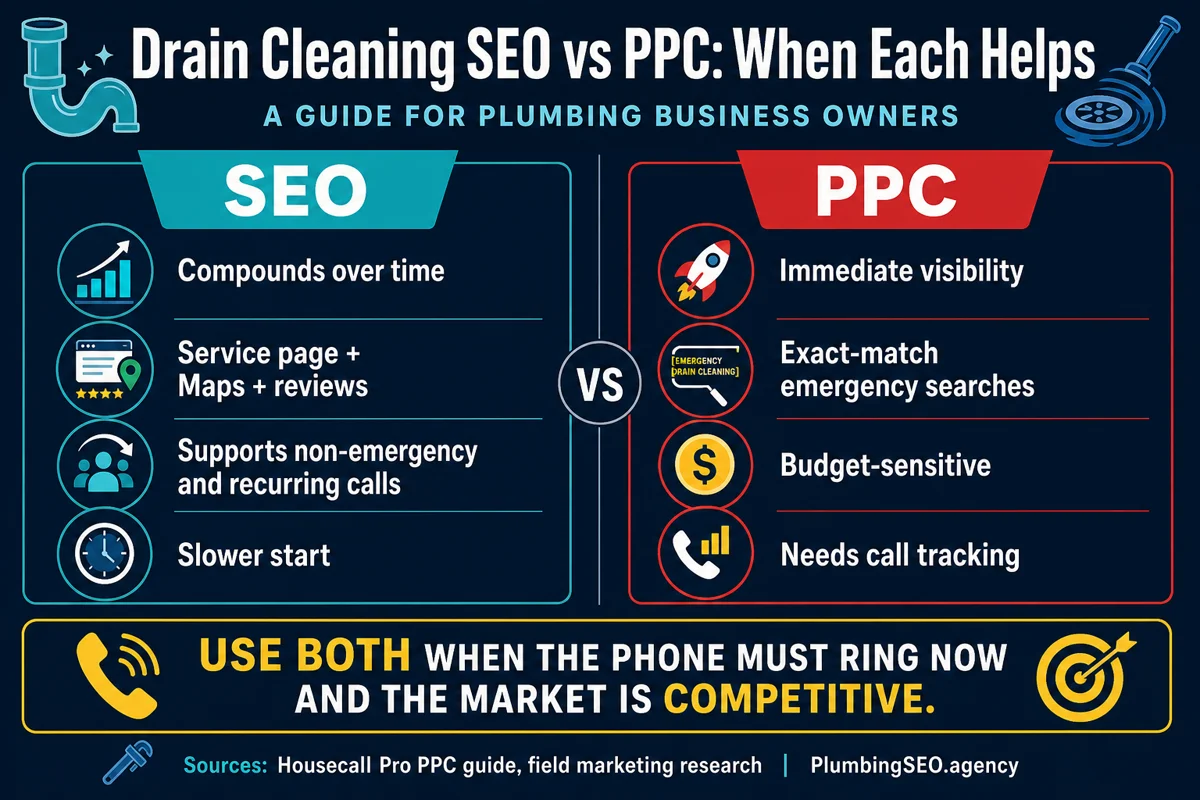
In plain English, ads can keep the board moving while organic rankings catch up. SEO should lower the pressure over time by building a service page, Maps trust, reviews, and internal authority that keep working after the ad click is gone.
If you are weighing paid and organic together, this guide on PPC marketing for plumbers explains how to judge ad spend without letting it eat the whole marketing budget.
Do not build thin drain, sewer, and hydro jetting pages just because keywords exist
Here is where plumbing SEO can get messy. Drain cleaning, sewer cleaning, hydro jetting, camera inspection, and rooter service overlap. If every page says the same thing with a different heading, you are not building authority. You are making Google choose between your own pages.
Community SEO discussions around plumber site structure often come back to the same point: service pages need real depth and clear relationships. A main plumbing page can link to service pages. Service pages can link to related services. But the pages should not fight each other for the same exact job.
Build a separate page when
- You offer the service as a real line of work.
- Customers search for it separately in your market.
- You have photos, reviews, FAQs, and process details.
- The page can link to related services without copying them.
Keep it inside the drain page when
- The service is only mentioned once or twice.
- You cannot show unique proof yet.
- The page would mostly repeat your existing drain copy.
- The search intent is better handled by the main service page.
Internal links tell Google which page matters
Internal links are not decoration. They are how your site explains priorities. A drain cleaning article should link to the main plumbing SEO service page, relevant local SEO guidance, and closely related posts only when they help the reader.
For example, if your drain cleaning page depends heavily on Maps visibility, point readers to a practical local SEO for plumbers page. If the owner needs a bigger diagnostic first, send them to a free plumbing SEO audit. Two useful links beat six awkward ones every time.
Track drain calls like jobs, not vanity traffic
Rankings are useful, but the phone tells the truth. Track which page produced the call, which search theme drove it, whether it booked, and what kind of job it became. Drain cleaning can be a small invoice, a repeat maintenance relationship, or the first step toward sewer diagnostics. You need to know which one your SEO is producing.
Plumber Magazine's coverage of expanding into drain cleaning makes the business point clearly: the service can open a new revenue stream, but it requires equipment, training, market demand, and competitive awareness. SEO should support that business plan, not pretend every click is equally valuable.
What I would fix first
- Make one strong drain cleaning page. Put the service, cities, proof, photos, FAQs, and call button in one place.
- Align the Google Business Profile. Services, photos, reviews, hours, and call path should match the page.
- Add proof from real jobs. Before and after photos, camera inspection notes, and specific review language all help.
- Link from the right pages. Use the homepage, plumbing SEO service page, local SEO page, and relevant blogs to support the drain page.
- Measure booked work. Separate calls, booked jobs, missed calls, and low-value price shoppers.
Drain cleaning SEO is not magic. It is a practical system for showing Google and customers that you handle the job, serve the area, answer the phone, and have proof from real work. Do that better than the shop across town and you give yourself a real shot at the next clogged drain call.
Drain Cleaning SEO FAQs
Drain cleaning SEO is the work of helping a plumbing company rank for local clogged drain, drain cleaning, rooter, and related searches. It usually includes a dedicated service page, Google Business Profile optimization, reviews, internal links, local proof, and call tracking.
Yes, if drain cleaning is a real service line with enough demand and proof to support its own page. If the page would be thin or duplicate sewer, rooter, or hydro jetting copy, strengthen one main drain cleaning page first.
They need local relevance, a complete Google Business Profile, a strong drain cleaning page, consistent NAP information, reviews that mention drain work, service-area proof, fast mobile calls, and internal links from related plumbing pages.
PPC can help when you need calls quickly or want to target urgent searches. SEO builds longer-term visibility so you are not paying for every drain lead forever. Many plumbing companies use both, then shift budget based on booked-job data.
It should include the service area, types of drains handled, emergency or same-day availability, tools used when relevant, safety notes, photos, reviews, FAQs, clear pricing guidance where appropriate, and a click-to-call CTA.
It can, but the page should be honest. Drain cleaning content can naturally mention camera inspection, recurring clogs, roots, and sewer repair next steps. Do not promise a sewer repair from every drain call. Track what the calls actually become.
Want to know if your drain cleaning SEO is leaking calls?
We will check your service page, Google Business Profile, internal links, and call path so you can see what is helping and what is holding the phones back.
Run My Free SEO Leak Check