
- PPC can get plumbing calls moving fast, but only when campaigns are built around booked jobs, not cheap clicks.
- Use Google Ads, Local Services Ads, and SEO together. PPC fills the schedule now, while local SEO lowers your cost per call over time.
- Track calls, forms, booked jobs, and sold revenue before raising the budget. A pretty report means nothing if dispatch cannot tie leads to money.
If the phones are quiet on a Tuesday morning, PPC sounds tempting. You turn on Google Ads, customers search for a plumber, and the calls start coming in. That is the promise. The problem is that plumbing PPC can also burn through a week of payroll before lunch if the setup is loose.
The way I see it, PPC marketing for plumbers in 2026 is not really about buying clicks. It is about buying controlled visibility for the jobs you can actually service, then proving which clicks turned into booked work. If the campaign cannot show that, it is just a meter running in the background.
This guide is for plumbing owners who want the phone ringing but do not want to guess where the money went. We will cover budget ranges, lead quality, campaign structure, Local Services Ads, common leaks, and how to judge ROI without agency fog.
What PPC Marketing Means for a Plumbing Company
PPC means pay per click. In Google Ads, you pay when someone clicks your ad. In Google Local Services Ads, you usually pay when a lead contacts you. Both can work for plumbers because the searcher often has an immediate problem. A leaking water heater does not wait for somebody to read ten blog posts and compare philosophy.
For a plumbing shop, the real question is not whether PPC works. The real question is whether your campaign is aimed at the right services, right zip codes, right schedule, and right type of customer. A drain cleaning lead across town at rush hour is not the same as a water heater replacement ten minutes from the shop.
The 2026 Numbers to Know Before You Spend
Current PPC research shows a wide range because markets, services, and account quality vary. SearchLight Digital reported an average non-branded plumbing Google Ads cost per lead of $183 across $14.6 million in observed spend from 524 contractors in Q1 2026. It also reported median non-branded plumbing search spend of $5,055 per month and median cost per paying customer of $333.
Those numbers are useful, but they are not a target by themselves. A $183 lead can be profitable if it turns into a sewer line job. A $60 lead can be expensive if it is a tire kicker outside your service area. The phone tells the truth, but only if you track what happened after it rang.
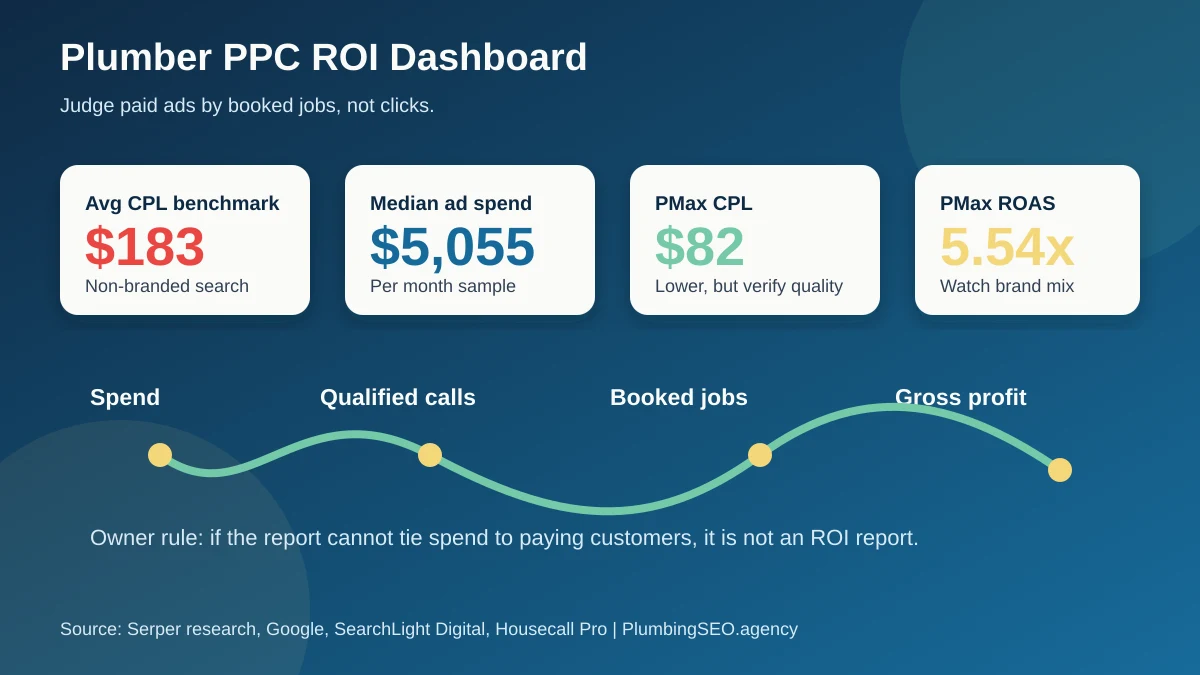
Use PPC benchmarks as guardrails. Your real scorecard is cost per booked job and gross profit, not clicks.
PPC, SEO, and LSAs Each Have a Different Job
A lot of plumbing owners ask whether they should choose PPC or SEO. In my opinion, that is the wrong fight. PPC is a throttle. SEO is the foundation. LSAs are a trust-heavy lead source with less control. A healthy shop uses the right mix instead of putting every egg in one basket.
| Channel | Best use | Owner warning |
|---|---|---|
| Google Search Ads | Fast demand for emergency, drain, water heater, and high-intent service searches. | You pay for every click, so bad targeting gets expensive fast. |
| Local Services Ads | Top-of-page visibility with Google screening and pay-per-lead style billing. | You get less keyword and landing page control than Search Ads. |
| Local SEO | Long-term Maps and organic visibility that can lower cost per call over time. | It takes steady work. Read our advanced local SEO for plumbers guide before expecting overnight wins. |
If you are starting from zero, PPC can create lead flow while your plumbing SEO catches up. If your SEO already brings steady calls, PPC can help with seasonal gaps, new services, and zip codes where you have trucks ready.
Build the Campaign Around the Job Board
Most PPC problems start before the first ad is written. The owner says, "Get me more leads." The campaign manager hears, "Target every plumbing keyword in the county." That is how you end up paying for low-value calls, long drives, DIY searches, and services your crew does not even want this month.
Start with the job board. What do you want more of in the next 30 days? Water heater replacement? Sewer inspection? Emergency service in a profitable zip code? That decision should shape the campaign.
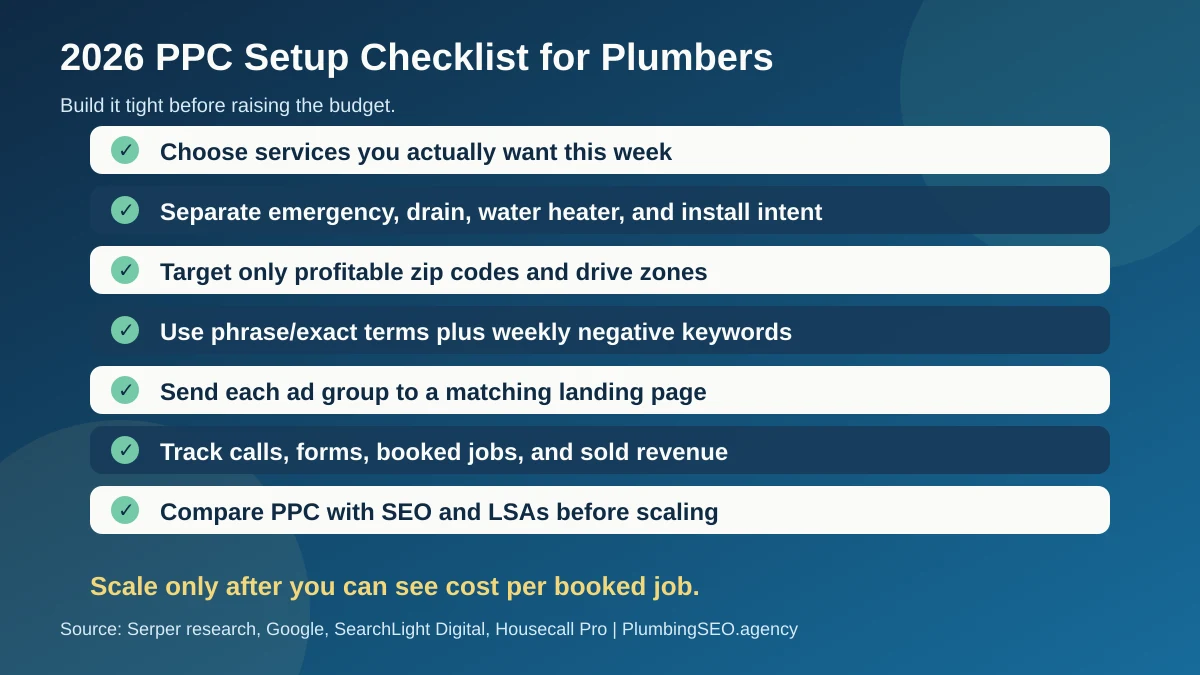
A tight setup beats a bigger budget. Fix the basics before asking Google to spend faster.
A Practical Setup Checklist
1. Split campaigns by service intent
Do not throw emergency plumbing, drain cleaning, slab leak detection, and water heater replacement into one bucket. Each service has different urgency, ticket size, close rate, and customer language. Separate campaigns or ad groups make it easier to control bids and write landing pages that match the problem.
2. Target service areas like a dispatcher
Google will happily spend money anywhere you let it. Your job is to draw the line. Target profitable zip codes, exclude areas that waste drive time, and adjust by hours when your phones are actually answered. If your after-hours call handling is weak, do not pay premium emergency rates while nobody is ready to book.
3. Use landing pages that match the ad
Housecall Pro's plumbing PPC guide also points to fast, mobile-friendly landing pages and tracking as core PPC requirements. That matches what we see in plumbing campaigns. A water heater ad should land on a water heater page, not a homepage with twelve services and a tiny phone number. The customer has a problem right now. Make the next step obvious.
4. Build negative keywords every week
Negative keywords are the shutoff valve for wasted clicks. Start with obvious terms like jobs, salary, DIY, training, school, parts, supply, diagram, and free. Then review the search terms report weekly. PPC is not set it and forget it. It is more like checking a cleanout. Ignore it long enough and something ugly backs up.
5. Track more than the lead
At minimum, track calls, forms, chat leads, booked jobs, revenue, and service type. If the report stops at leads, you are missing the most important part. A campaign with fewer leads can be better if those leads become bigger, cleaner jobs.
| Metric | What it tells you | What to do with it |
|---|---|---|
| Cost per lead | How much you paid for each call, form, or booked inquiry. | Use it as an early warning, not the final verdict. |
| Qualified lead rate | How many leads were real plumbing opportunities in your service area. | Add negatives and tighten geography when quality drops. |
| Booking rate | How many qualified leads turned into jobs on the board. | Fix call answering, follow-up, pricing, or landing page promises. |
| Cost per booked job | The number that tells an owner whether PPC is feeding the company. | Scale only when this fits your gross profit. |
Where PPC Money Usually Leaks
Bad PPC rarely fails in one dramatic moment. It leaks a little at a time. A broad keyword here. A weak landing page there. A missed call during lunch. A campaign running in a zip code your crew hates. By the end of the month, everybody is staring at a report wondering why the lead count looked fine but the bank account did not.
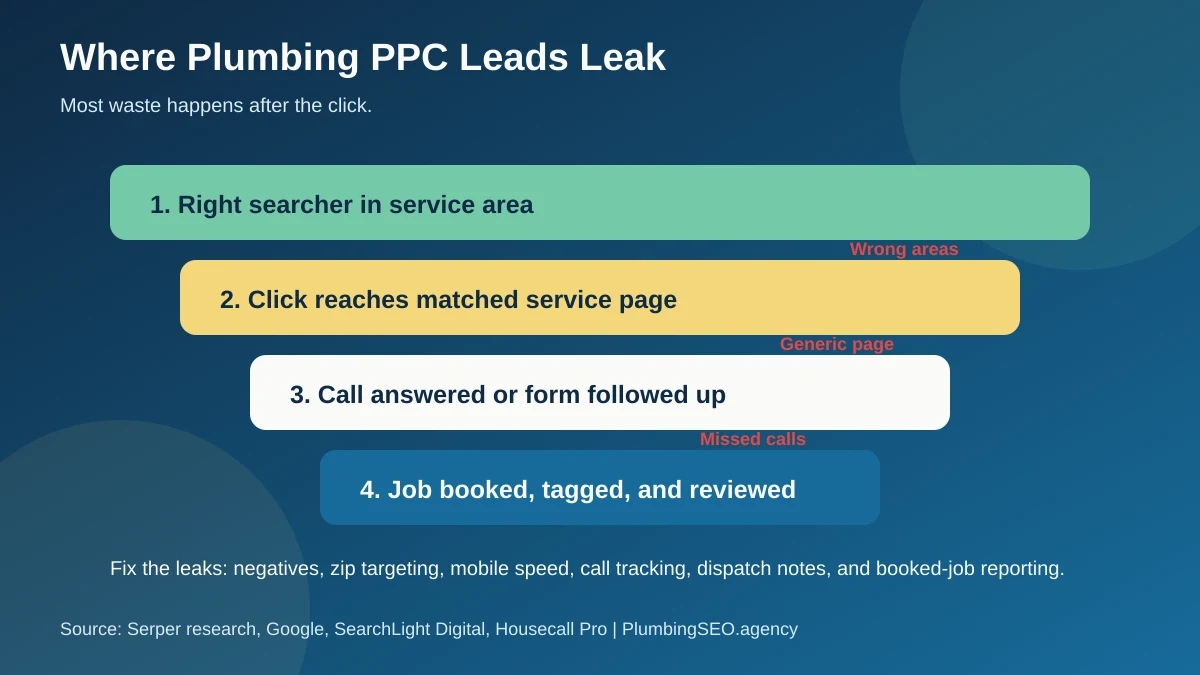
The click is only one step. Most profit leaks happen between the searcher, landing page, phone call, dispatch, and booked job.
Common PPC Mistakes Plumbers Should Avoid
- Chasing cheap clicks. Cheap does not matter if the searcher is wrong. A $20 click that books a replacement job beats a $3 click from someone looking for a plumbing course.
- Using one landing page for everything. Emergency drain cleaning and tankless water heater replacement need different proof, headlines, and calls to action.
- Ignoring call handling. PPC cannot overcome missed calls, slow callbacks, or office staff who do not know which campaign produced the lead.
- Letting Performance Max run without lead quality checks. SearchLight found lower PMax CPL in its sample, but it also noted brand mix could not be separated. Treat low CPL as a clue, not a trophy.
- Not comparing PPC against SEO and LSAs. Paid ads are useful, but they should not be your only pipe into the business. Our plumbing marketing guide explains how channels fit together.
Can a Plumbing Owner Run PPC In-House?
Yes, if the budget is small, the service area is simple, and somebody can check the account every week. You need time for search term reviews, negative keywords, conversion tracking, landing page work, and basic reporting. If nobody owns those tasks, the account will drift.
Hire help when the budget gets big enough that mistakes hurt, when multiple services or cities need separate campaigns, or when you cannot tie leads to booked jobs. A good PPC manager should speak in plain numbers: spend, qualified calls, booked jobs, cost per booked job, and revenue. If they only talk about impressions and click-through rate, ask better questions.
A Simple 30-Day PPC Action Plan
- Week 1: Pick the services and zip codes you want. Audit tracking before launching or changing anything.
- Week 2: Build service-specific campaigns, landing pages, call extensions, location settings, and starting negative keywords.
- Week 3: Review search terms, lead recordings, and dispatch notes. Pause bad queries and fix landing page mismatches.
- Week 4: Compare cost per lead, qualified lead rate, booking rate, and cost per booked job. Keep what feeds the schedule. Cut what only feeds the report.
If you want a second set of eyes before raising spend, start with a PPC and SEO leak check. We will look for wasted clicks, tracking gaps, service-area mistakes, and places where local SEO can reduce pressure on paid ads.
Frequently Asked Questions About PPC Marketing for Plumbers
PPC helps a plumbing business show up when customers are actively searching for services like emergency plumber, drain cleaning, leak repair, or water heater replacement. It is useful for fast lead flow, seasonal gaps, new service pushes, and areas where organic rankings are not strong yet.
Yes, but only if someone can review search terms, add negative keywords, check lead quality, and maintain tracking every week. Many owners start in-house to learn the basics, then hire help once spend, services, or service areas become harder to manage.
Clicks and calls can start the same day the campaign goes live, but useful optimization data usually takes two to four weeks. Judge early results by lead quality and booked jobs, not just click volume.
A small market may test with $1,500 to $3,000 per month in ad spend. Competitive metro areas and emergency-heavy campaigns often need more. Do not scale until tracking shows cost per booked job and gross profit are healthy.
Use both when possible. PPC can create immediate visibility and fill the schedule while SEO builds long-term Maps and organic rankings. SEO usually takes longer, but it can reduce the pressure to buy every lead later.
Track spend, calls, forms, qualified lead rate, booking rate, booked jobs, sold revenue, and gross profit. Cost per lead is only an early metric. Cost per booked job is the number most owners need before raising the budget.
Want to Know Where Your PPC Budget Is Leaking?
We will check your tracking, service-area targeting, landing pages, keyword waste, and SEO opportunities so you can spend with a clearer head.
Run My Free SEO Leak Check