
- Start with the money pages, Google Business Profile, tracking, and crawl basics before writing more content. A checklist only works when the foundation is sound.
- For plumbing and HVAC companies, local visibility depends on relevance, distance, and prominence signals. Your website, reviews, citations, and service pages all have to agree.
- Measure calls, forms, chats, and booked jobs every month. Rankings are useful, but the phone tells you whether the work is helping the business.
If you own a plumbing or HVAC company, SEO can feel like a drawer full of fittings. Some pieces matter today. Some pieces matter later. Some pieces look important because a vendor said them loudly on a sales call.
This checklist puts the work in the order I would use if the phones were too quiet, the trucks needed better jobs on the board, and nobody had time to chase every shiny SEO task. It is built for service businesses that need calls, booked work, and a website that proves the company can be trusted.
Use this page for the full SEO system. For a profile-only setup walkthrough, use the Google Business Profile setup guide for plumbers. For a comparison of HVAC profile advice and what plumbers should change, use the HVAC-to-plumbing GBP comparison.
Google explains local rankings through relevance, distance, and prominence. Google Search Central also says SEO is about helping search engines understand your content and helping users decide whether to visit your site. That is the practical test here. Can Google understand what you do, where you do it, and why a homeowner should call you?
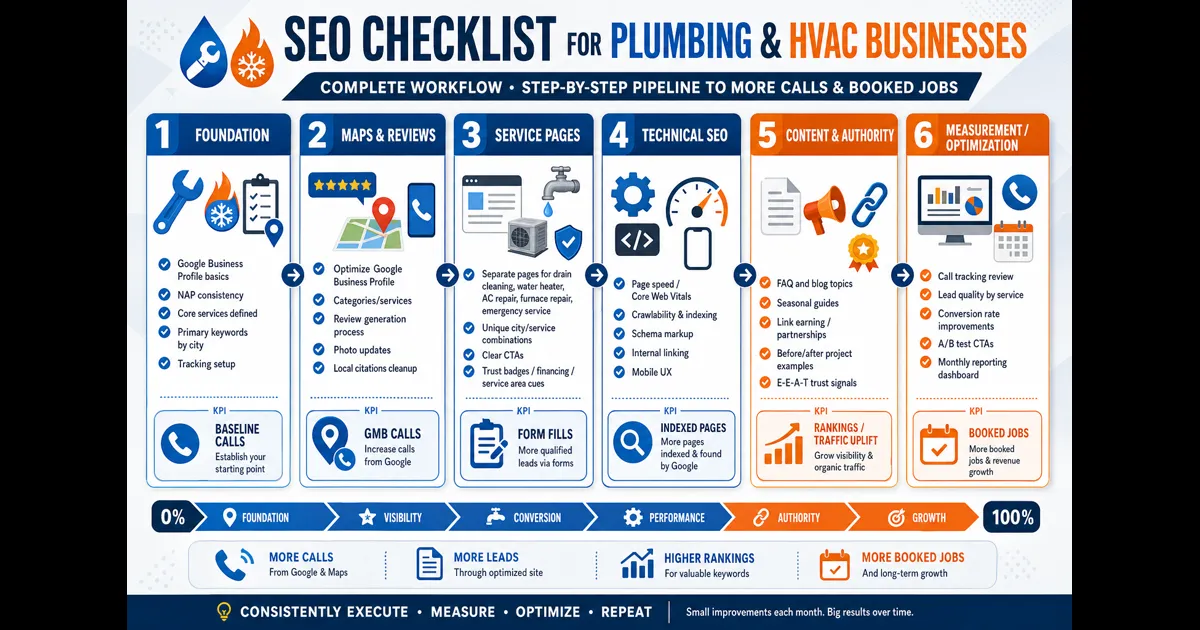
What this checklist is supposed to do
The goal is not to make you busy. The goal is to make the right customer find you before they call the other shop.
A complete SEO checklist for plumbing and HVAC businesses should help you answer five owner-level questions:
- Can Google crawl, index, and understand the important pages?
- Can homeowners quickly see your services, service areas, phone number, reviews, and trust proof?
- Do your Google Business Profile, citations, website, and tracking numbers match closely enough to build confidence?
- Do you have one strong page for each profitable service, not one weak services page trying to carry the whole company?
- Can you tell which work created calls, forms, chats, and booked jobs?
If the answer is no, do not panic. Bad SEO is like a slow drain. You can ignore it for a while, but eventually it backs up somewhere ugly. Start with the highest-leak areas below.
Phase 1: Set the foundation before touching keywords
Before you worry about rankings, make sure you can measure and diagnose the site. This is boring work, but so is checking shutoffs before cutting pipe. It saves pain later.
| Foundation item | Why it matters | Owner check |
|---|---|---|
| Google Search Console | Shows indexing, queries, pages, and technical problems. | Can you see clicks, impressions, and indexed pages? |
| GA4 or analytics | Shows traffic patterns and page behavior. | Are organic visits separated from paid traffic? |
| Call, form, and chat tracking | Connects SEO work to leads and booked jobs. | Can you tell which page started the lead? |
| XML sitemap | Google says sitemaps help search engines crawl important pages more efficiently. | Is the sitemap submitted and free of junk URLs? |
| Clean canonical URLs | Prevents duplicate versions of the same page from splitting signals. | Does each service page have one preferred URL? |
Use Google's SEO Starter Guide as the baseline. It warns that there are no secrets that automatically rank a site first, and that changes can take from hours to months to show in search. That is why this checklist focuses on steady improvements instead of magic tricks.
If you want this work handled as an operating system instead of a once-a-year cleanup, our plumbing SEO service explains how we turn the checklist into ongoing Maps, service-page, technical, content, and tracking work.
Phase 2: Tune Google Business Profile and local trust
For plumbers and HVAC contractors, the Map Pack can be the difference between a full board and a slow week. Your Google Business Profile should be complete, accurate, active, and backed up by your website.
Do this first
- Verify the profile and use the most accurate primary category.
- Set real service areas, hours, phone number, website, and appointment link.
- Add real team, truck, office, and job photos. No stock photo nonsense.
- Ask for reviews after finished jobs and respond like a real owner.
- Keep NAP details consistent across your site and major directories.
Do not do this
- Use fake office locations or service areas you cannot actually handle.
- Stuff keywords into the business name.
- Let old holiday hours, wrong numbers, or dead booking links sit there.
- Ignore negative reviews until they become the first thing customers see.
- Use a tracking number in a way that breaks NAP consistency.
When local SEO is the main leak, read our advanced local SEO guide for plumbers. It goes deeper into service-area architecture, review velocity, GBP tuning, citations, and monthly Map Pack diagnostics.
Phase 3: Build one strong page for each profitable service
Most weak plumbing websites make the same mistake. They have one generic services page and expect it to rank for drain cleaning, sewer repair, water heaters, slab leaks, leak detection, and emergency plumbing in every city they serve. That is too much weight for one page.
A better structure is simple:
- One main page for each money service.
- One clear city or service-area strategy.
- Real proof on the page: reviews, photos, licensing, warranty notes, financing if available, and a clear call button.
- Internal links from helpful blog posts to the matching service page.
- FAQ sections that answer the questions customers ask before they call.
If you want PlumbingSEO.agency to handle this as a service instead of using this as a DIY checklist, see our plumbing SEO service page.
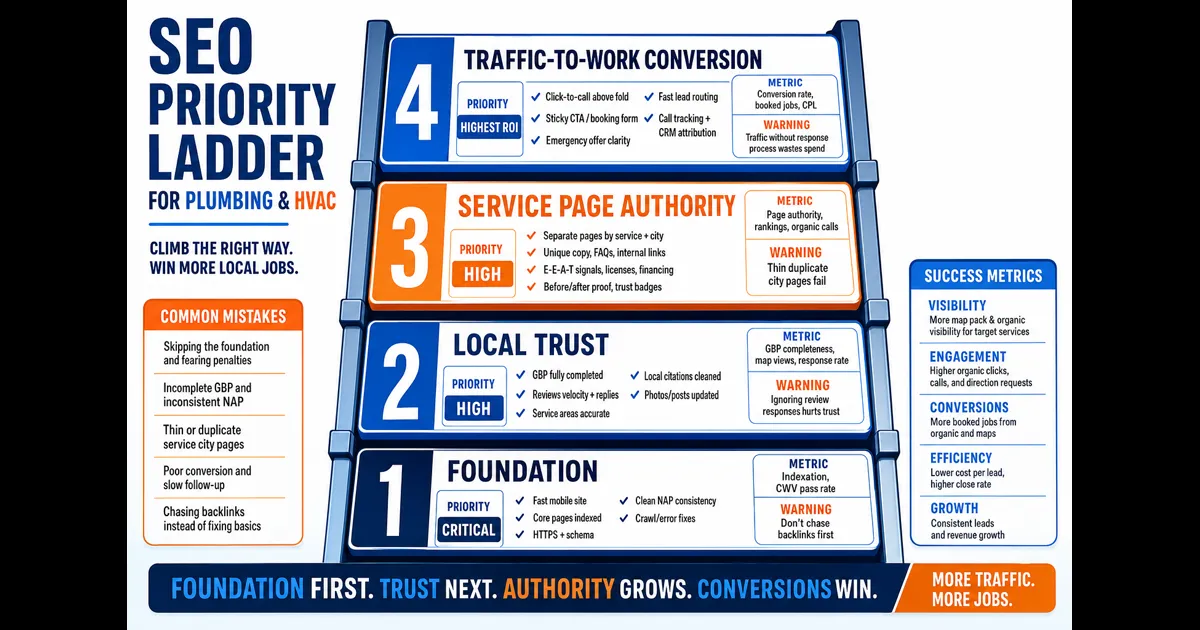
Phase 4: Fix technical SEO without getting lost in tech talk
Technical SEO is not the whole job, but it can block the whole job. If Google cannot crawl the page, if the mobile layout is painful, or if forms break on phones, the rest of your marketing has to work harder.
| Technical check | Good enough standard | Business reason |
|---|---|---|
| Mobile layout | Phone number, CTA, services, and trust proof are easy to tap. | Emergency searches happen on phones. |
| Page speed and Core Web Vitals | No painful lag, layout jump, or slow hero load. | Slow sites lose impatient customers. |
| Indexing | Main service pages are indexed and not blocked. | A blocked page cannot bring calls. |
| Schema | LocalBusiness, Service, Breadcrumb, and FAQ schema are valid where appropriate. | Structured data gives Google explicit clues about the page. |
| Internal links | Important pages are reachable from navigation and related content. | Links help users and search engines discover pages. |
Google's structured data documentation says structured data helps provide explicit clues about the meaning of a page, and recommends validating it with the Rich Results Test. That is why plumber service pages should not just say "we do plumbing." They should clearly describe the service, area served, questions answered, and business entity.
Phase 5: Write content that helps customers make a decision
Content should not be filler. A plumbing blog needs to answer real customer questions, support service pages, and prove the company knows the work. If a post does not help a customer choose, schedule, troubleshoot, compare, or trust you, it is probably noise.
Good plumber content usually falls into four buckets:
- Problem pages: why drains keep clogging, why water heaters fail, why AC freezes, what slab leak signs look like.
- Service pages: water heater installation, hydro jetting, sewer camera inspection, AC repair, furnace replacement.
- Location proof: service-area pages with genuine local details, not spun city-name copy.
- Decision support: repair vs replace, DIY vs call a pro, what affects cost, what to ask before hiring.
For a deeper page-level check, use our plumber SEO diagnostic checklist. It helps separate a content problem from a Maps problem, a technical problem, or a tracking problem.
Phase 6: Build authority without sketchy link games
Backlinks and mentions matter, but plumbers do not need weird link schemes. Start with real-world authority that already matches the business.
- Local chamber of commerce, trade associations, sponsorships, suppliers, and community groups.
- Manufacturer and financing partner profiles when they are legitimate.
- Local news or charity mentions when the company is actually involved.
- Helpful content that other local businesses can reference.
- Consistent citations on trusted business directories.
Do not buy a pile of random links and hope Google does not notice. That sounds good on paper, but in the real world it is like patching a pressure line with tape. You might get away with it for a minute.
Phase 7: Track the numbers that connect to booked jobs
Rankings are useful. They are not the scoreboard. The scoreboard is calls, qualified leads, booked jobs, close rate, and revenue from the right service areas.
| Metric | Where to check | What it tells you |
|---|---|---|
| Organic clicks and impressions | Google Search Console | Whether visibility is growing. |
| GBP calls and direction requests | Google Business Profile Performance | Whether Maps is producing action. |
| Call answer rate | Call tracking or phone system | Whether marketing is leaking at the front desk. |
| Booked job rate | CRM or dispatch software | Whether leads are turning into work. |
| Revenue by source | CRM, accounting, and attribution reports | Whether SEO is attracting the right jobs. |
If you need a clean measurement setup, read our lead tracking guide for plumbers. The report may look good, but the phone tells the truth.
What competitors often miss
The competitor pages we reviewed mostly list SEO tasks. That is useful, but it misses the owner-side order of operations. A checklist should tell you what to do first, what to ignore for now, and what result each task is supposed to affect.
| Common checklist item | What plumbers really need to know |
|---|---|
| "Do keyword research" | Separate emergency, repair, install, maintenance, residential, commercial, and city intent. |
| "Create content" | Prioritize content that supports profitable services and answers objections before the call. |
| "Build links" | Start with real local and trade authority before chasing random guest posts. |
| "Track rankings" | Track rankings, but judge success by qualified calls and booked work. |
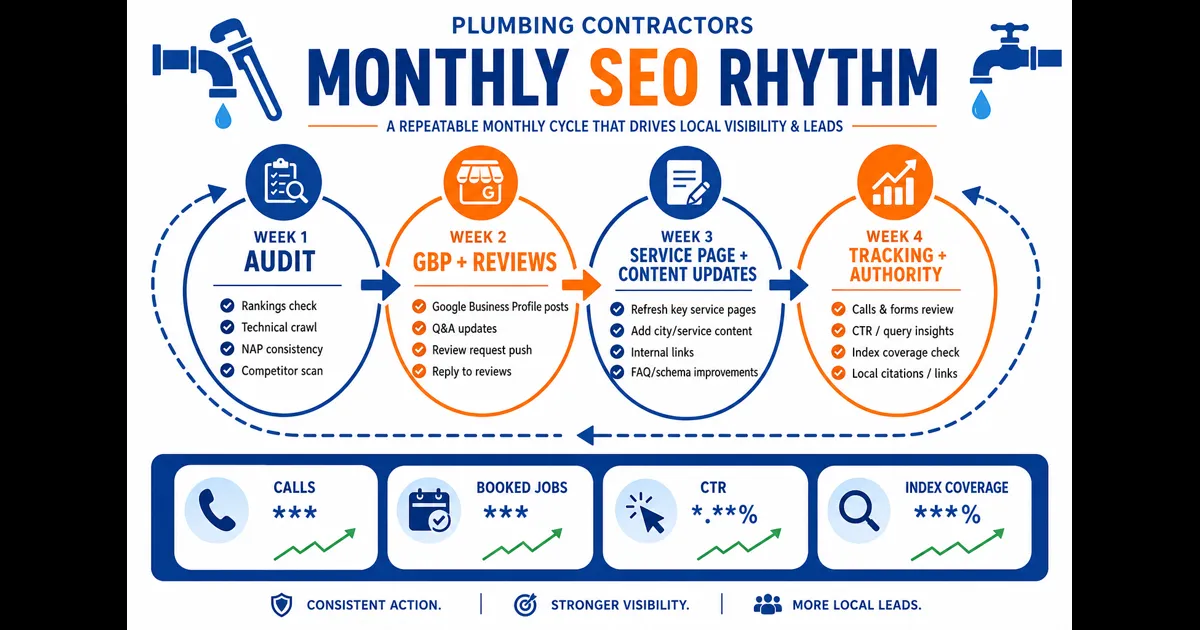
The first 30 days: a practical action plan
If you are starting from scratch, do not try to fix everything this week. Use this order.
- Day 1 to 3: Set up Search Console, analytics, call tracking, sitemap, and baseline rankings.
- Day 4 to 7: Audit Google Business Profile, reviews, hours, categories, photos, service areas, and citations.
- Day 8 to 14: Fix homepage and top service page CTAs, titles, meta descriptions, H1s, internal links, and trust proof.
- Day 15 to 21: Build or improve one service page for the most profitable job type.
- Day 22 to 30: Publish one supporting article, request reviews from recent happy customers, and review call quality.
After that, repeat monthly. SEO is not dispatch. You do not flip a switch and see the truck roll in ten minutes. But if the foundation is right and the work keeps moving, the results compound.
Frequently Asked Questions
It keeps the work in the right order. Instead of chasing random SEO tasks, the business fixes tracking, Google Business Profile, service pages, technical issues, content, authority, and measurement in a way that supports more calls and booked jobs.
Yes, especially the basics: Google Business Profile cleanup, review requests, page titles, service-page copy, photos, and monthly measurement. Technical SEO, schema, content strategy, and conversion tracking may need a specialist if the site is complex or the market is competitive.
Google says changes can take time to appear, sometimes weeks and sometimes months. A plumbing company may see early movement within a few months after fixing major issues, but meaningful organic lead growth usually depends on market competition, site quality, reviews, service pages, and consistency.
Fix tracking, Google Business Profile accuracy, service-page clarity, phone CTAs, sitemap and indexing, and review generation first. Those items affect visibility and conversion. Blog content and link building work better after the core pages are solid.
The fundamentals are similar, but HVAC often has stronger seasonal demand around AC and furnace topics. Plumbing often has more emergency intent around leaks, drains, water heaters, and sewer issues. The checklist works for both, but the keyword map and content calendar should match the trade.
No. SEO should reduce dependency on paid leads over time, but many plumbing and HVAC companies still use Local Services Ads or PPC while SEO compounds. The safer plan is to track both and put budget where qualified booked jobs are coming from.
Want the checklist applied to your plumbing site?
We will check the pages, Maps setup, tracking, and call leaks that matter most for booked jobs.
Run My Free SEO Leak CheckNo production changes. No pressure. Just the highest-impact fixes in plain English.