
- For most plumbing shops, the profile should be fixed before new ads, new landing pages, or another directory package.
- Do not copy HVAC advice blindly. Plumbers need tighter service areas, emergency-service proof, review habits, and job photos.
- Measure the profile by calls, direction requests, booked jobs, and service-area gaps, not by pretty impressions alone.
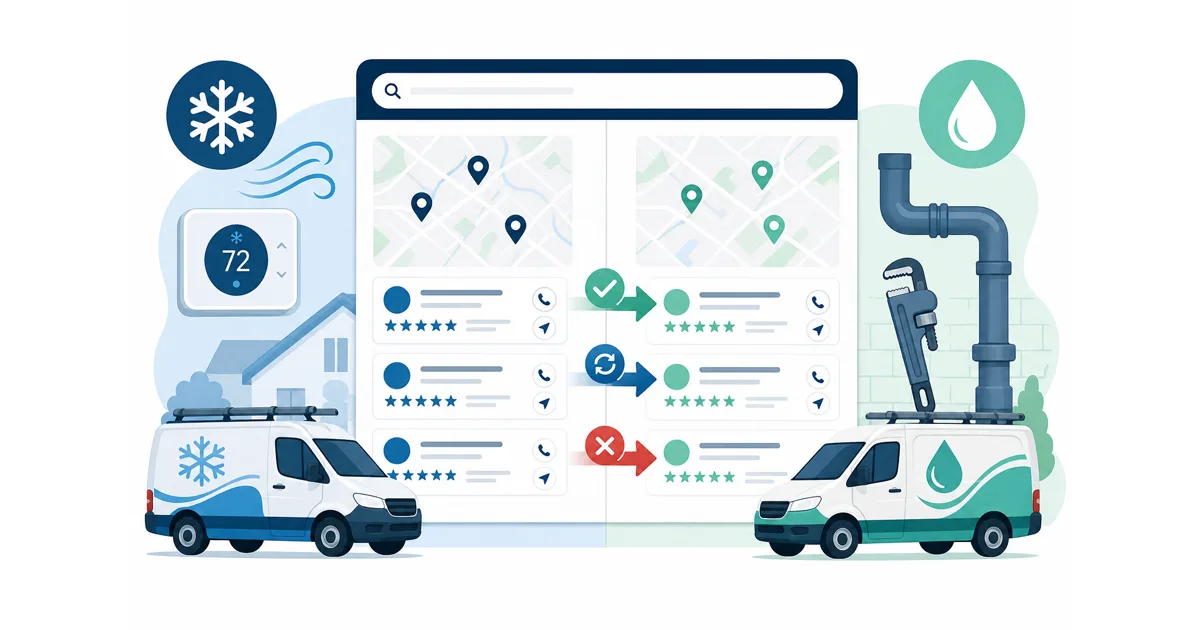
HVAC Google Business Profile advice can be useful for plumbers, but it should not become a copy-and-paste setup plan. HVAC searches often revolve around seasonal maintenance, AC repair, furnace replacement, and installation timelines. Plumbing searches are more likely to be urgent: leak detection, clogged drains, sewer backups, water heater failures, and service-area trust.
Use this article as the comparison layer. If you need the full plumber setup walkthrough, read the Google Business Profile setup guide for plumbers. This page is for deciding which HVAC profile tactics to borrow, which to change, and which to avoid.
The practical position is simple: HVAC templates can teach structure, but plumbers need tighter emergency proof, service-area clarity, review habits, job photos, and call tracking. Build the wider plumbing SEO system around those differences.
Why plumbers cannot just follow an HVAC GBP checklist
HVAC and plumbing are both home services, but the search behavior is not identical. Plumbing calls skew urgent. The customer may be standing in water, dealing with a stopped toilet, or trying to keep a tenant calm. They care about trust fast. That means your profile needs to answer a few questions before they even click:
- Are you a real local plumbing company, not a lead seller?
- Do you serve this neighborhood today?
- Can you handle the exact job, such as drain cleaning, water heater repair, leak detection, or sewer line work?
- Do recent customers trust you?
- Will the phone number reach someone who can actually book the job?
Google's own guidance says Business Profile local rankings are based mainly on relevance, distance, and prominence. That is the plain-English reason your profile cannot be half-filled. Relevance comes from the right category, services, description, photos, and connected website. Distance comes from your real location and service area. Prominence comes from reviews, links, mentions, and overall trust. You can read Google's explanation in its local ranking guidance.
Borrow: claim, verify, and control owner access before any optimization
Before you optimize anything, make sure the owner controls the profile. Not a past agency. Not an employee who left two summers ago. Not a Gmail account nobody can find. Owner access is a business asset, the same way your domain name and main phone number are assets.
Use your real-world business name. Google is clear that your profile name should match your actual name as used on signage, website, stationery, and customer-facing materials. Do not add keywords like "24/7 Emergency Plumber Near Me" unless that is truly your legal and real-world name. It may look clever for about ten minutes, right up until the profile gets edited, reported, or suspended.
| Setup item | Best move for plumbers | Why it matters |
|---|---|---|
| Business name | Use the real company name only | Keyword stuffing can trigger edits or suspension risk |
| Phone number | Use a local number controlled by the business | Customers and Google both need a direct, trustworthy line |
| Website URL | Point to the main plumbing website or strongest local landing page | The connected site reinforces relevance and conversion |
| Access | Keep owner access under a company-controlled account | You avoid losing the profile during staff or vendor changes |
Google's Business Profile representation guidelines also warn against virtual offices, fake addresses, keyword-heavy names, and phone numbers that route somewhere other than the actual business. For plumbers, that is not small print. It is the foundation.
Change: set service areas around plumbing response realities
Many plumbing companies are service-area businesses. If you work from a shop with permanent signage and customers can visit during stated hours, you may show the address. If you run the business from home and go to customers, Google says plumbers should hide the address and use service areas instead.
Do not cover half the state because you took one job there last month. Google's service-area guidance says the overall service area should generally not extend farther than about two hours of driving time from where the business is based. That is a useful rule for owners too. If dispatch would hate the route, the profile probably should not promise it.
Set service areas around places you actually serve and can support with your website. If drain cleaning is your money maker in three suburbs, build service pages and proof around those suburbs. That is where advanced local SEO for plumbers starts to connect the profile to the rest of the business.
Change: keep plumbing categories and services tighter than HVAC templates
Your primary category should usually be Plumber. That tells Google what the business is, not just what it has. Google's category guidance says categories should complete the statement, "This business is a," and should be specific but representative of the main business.
Secondary categories are useful only when they reflect real work. If you truly offer drain cleaning, water heater installation, sewer repair, septic services, or bathroom remodeling, add the relevant categories when available. Do not add every home-service category just because a competitor did. That is not optimization. That is tossing fittings into a bucket and hoping one threads.
| Profile field | Plumber-specific example | Common mistake |
|---|---|---|
| Primary category | Plumber | Choosing a broad contractor category first |
| Secondary categories | Drainage service, water heater installation, septic service when true | Adding categories for services you do not sell |
| Services | Leak repair, clogged drain, sewer camera inspection, emergency plumbing | Leaving default services blank or generic |
| Description | Plain summary of service area, specialties, and customer fit | Stuffing city names, prices, links, and slogans |
Borrow: use reviews and photos, but show plumbing-specific proof
A profile with a correct category but no proof is like a clean truck with no tools in it. It looks nice, but it does not calm the homeowner down. Reviews, owner responses, job photos, and service details help a searcher believe you are real and active.
Ask for reviews after jobs where the customer is genuinely satisfied. Make the ask simple. A text message after the invoice is paid usually works better than a vague "review us sometime" at the door. Google also publishes review collection tips, including creating and sharing a review link from your profile.
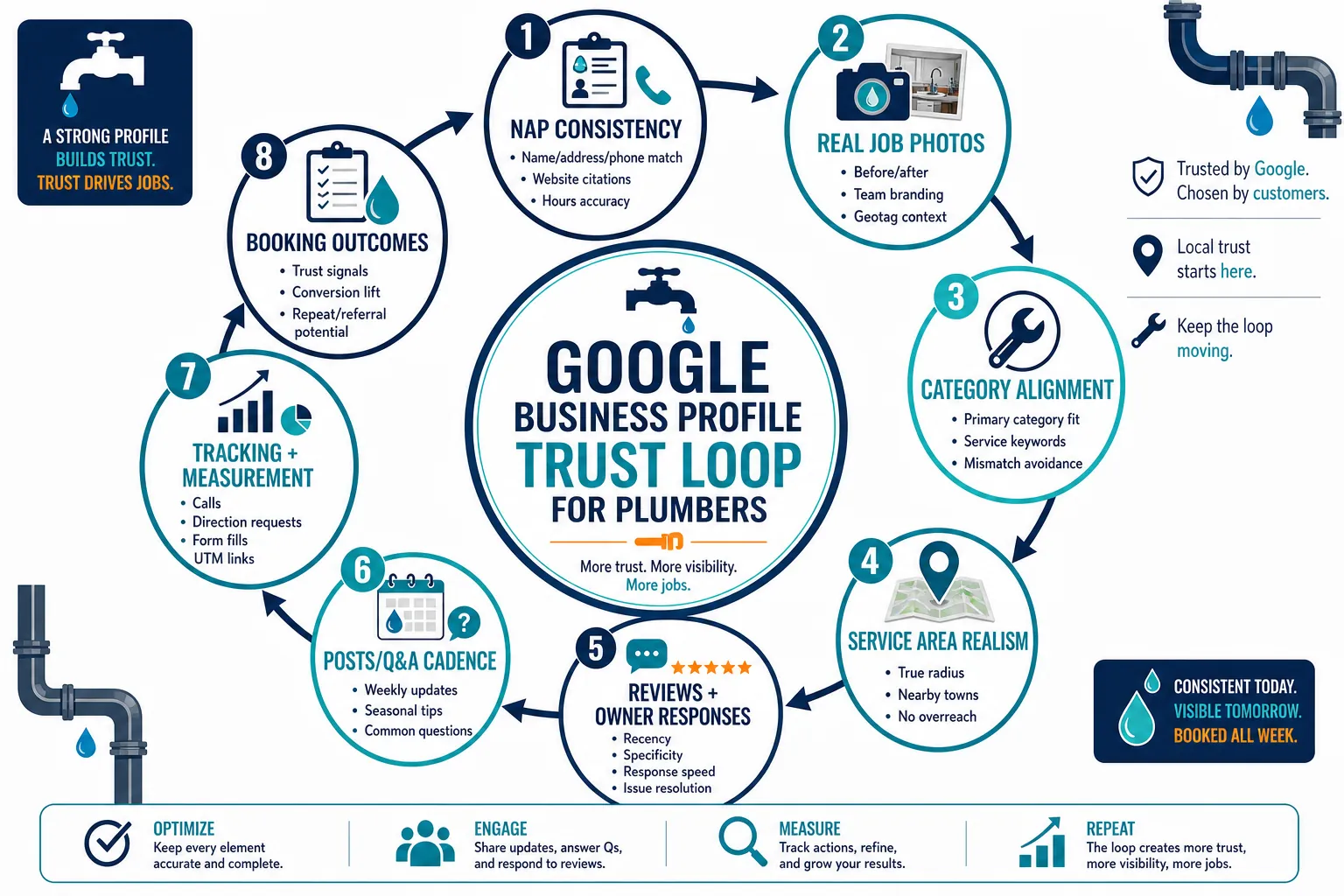
Use real photos. Trucks, uniforms, equipment, clean job sites, water heater installs, drain machines, sewer cameras, and office staff all beat stock photos. Do not post customer-sensitive information, private addresses, invoices, or anything that makes the customer feel exposed. The goal is confidence, not a scrapbook of every job you have ever touched.
Change: send profile visitors to job pages that close plumbing calls
Your profile is not the whole system. It is the front door. When somebody clicks through, they should land on a website that proves you handle the job, serve their area, answer the common questions, and make calling easy. If the website is slow, thin, or vague, the profile did its job and the site dropped the wrench.
At minimum, connect the profile to a strong plumbing SEO foundation with dedicated service pages, service-area pages, clean contact options, schema markup, and tracking. If you are not sure where the site is leaking, start with the plumber SEO diagnostic checklist before buying more traffic.
Borrow carefully: use posts and Q&A for urgency, not seasonal HVAC-style promotions
Google posts and Q&A will not save a weak business profile by themselves. But they can show activity and answer buying questions before the customer calls. Use them for useful updates: emergency service reminders before freeze season, water heater permit notes, drain maintenance warnings, new service areas, holiday hours, and real project photos.
Keep the language plain. "We now offer same-week sewer camera inspections in Plano" is better than "unlocking comprehensive residential utility visibility." Nobody with a clogged main line wants to decode that.
- Write Q&A answers for emergency availability, service fees, payment options, warranties, and areas served.
- Use posts for timely updates, not recycled ads with no local detail.
- Respond to reviews like a responsible owner. Thank them, reference the service generally, and never expose private details.
- Update special hours before holidays, storms, freeze events, or temporary closures.
Avoid: measuring the profile like an HVAC brand-awareness campaign
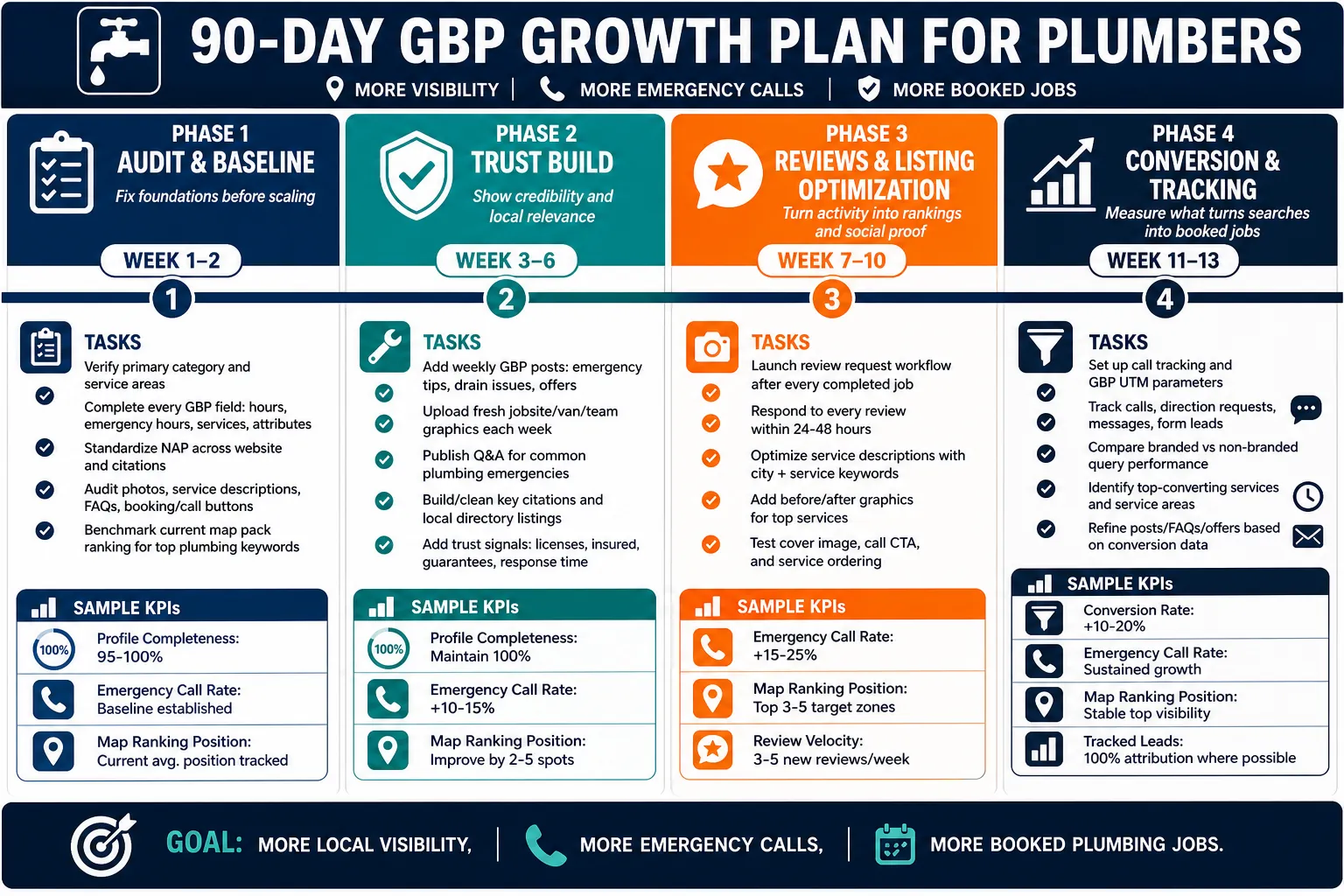
Impressions matter only if they lead to the right calls and booked jobs. A profile can show more views because it appeared for broad searches across too wide an area. That may look good in a report while dispatch is still quiet. The phone tells the truth.
Track the basics every month: calls from the profile, website clicks, direction requests if you show an address, review growth, top search terms, and which service areas are producing booked work. If you use call tracking, keep NAP consistency in mind and use dynamic tracking carefully on the website. Our guide to local SEO call attribution explains how plumbers can track calls without confusing Google.
Mistakes plumbers make when copying HVAC GBP advice
The biggest mistakes are usually not technical. They are shortcuts that look harmless until the calls slow down or the profile gets flagged.
- Using a fake or rented address. Google warns that virtual offices are not eligible unless staffed and properly signed.
- Keyword-stuffing the business name. Use the real name customers know.
- Serving too wide an area. Keep the map aligned with real dispatch capacity.
- Leaving services thin. Add the jobs you actually want, such as drain cleaning, sewer repair, repipes, leak detection, and water heaters.
- Ignoring reviews. A steady review habit beats a frantic review push once a year.
- Measuring only views. Watch calls, booked jobs, close rate, and service-area quality.
The owner move is to make the profile boringly accurate, visibly active, and easy to trust. Boring accuracy wins more calls than clever shortcuts. That may not sound exciting, but neither does properly gluing pipe until it saves the ceiling.
What to do next if you have both GBP guides open
If you need hands-on setup order, start with the plumber Google Business Profile setup guide. If you already have the basics in place and are comparing home-service advice from HVAC, use this page to sort tactics into borrow, change, and avoid. If the profile is only one part of a bigger SEO cleanup, move to the complete plumbing and HVAC SEO checklist next.
If you want help finding the leaks, book a free plumbing SEO audit. We will look at your profile, service pages, tracking, and local SEO setup so you know what to fix first.
FAQs About HVAC GBP Advice for Plumbers
Want Your Google Profile to Bring Better Calls?
We will review your Google Business Profile, service areas, reviews, website, tracking, and local SEO signals so you can fix the highest-impact leaks first.
Run My Free GBP SEO Leak Check