
- Start with the plumbing lead system you own: Google Business Profile, service pages, reviews, local proof, call tracking, and a mobile website that makes calling easy.
- Use paid channels such as Google Ads, LSAs, and lead providers for speed, but only after you can track calls through to booked jobs and revenue.
- The best first 90 days: fix GBP and tracking, repair website conversion, publish service pages, build review habits, then scale the channels that produce profitable work.
If you are asking how to get plumbing leads, the answer is not "try nine random marketing tactics and hope one works." Plumbing leads usually come from a system: homeowners find you in the moment of need, trust you faster than the other plumber on the screen, and can contact you without friction.
The current search results for this topic are heavy on generic lists: buy leads, run ads, ask for referrals, post on social media, improve SEO. Those channels matter, but the missing piece for most plumbing owners is order of operations. A one-truck shop with no call tracking should not spend like a ten-truck company. A company with weak reviews should not expect ads to fix trust. A company with no emergency service pages should not wonder why cheaper competitors get the organic calls.
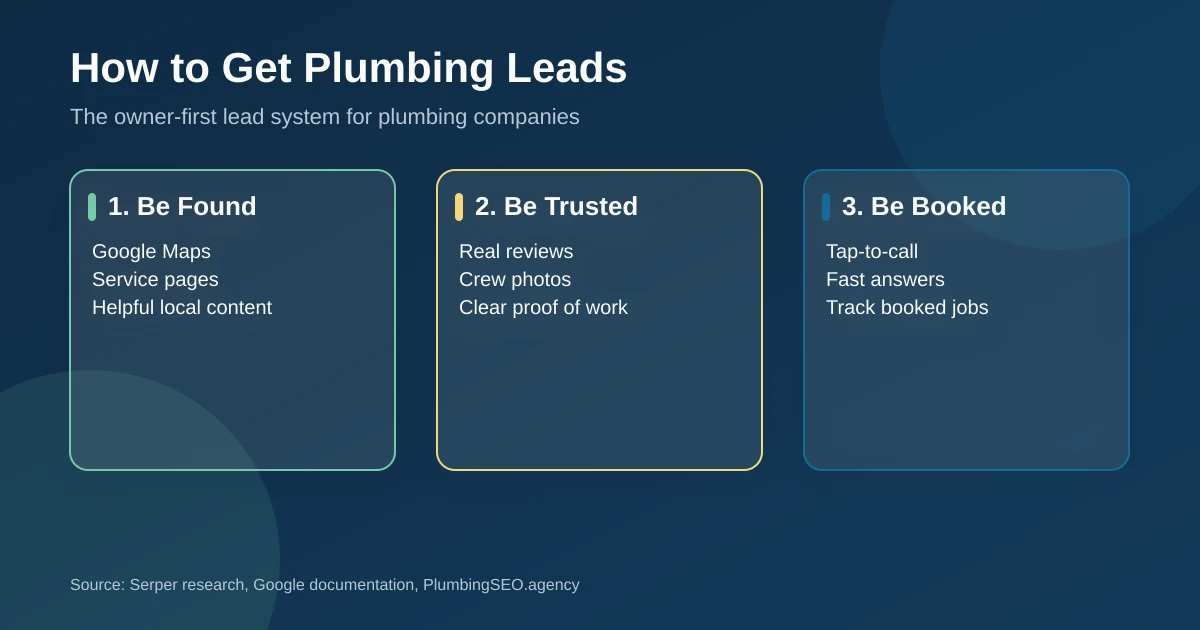
The short answer: build owned lead sources first, then use paid channels for speed
The healthiest plumbing companies do not depend on one lead vendor. They build owned assets that compound over time: Google Business Profile, service pages, reviews, local proof, referral systems, and a website that turns urgent searches into calls. Then they use Google Ads, Local Services Ads, and selective lead providers to fill capacity gaps. If you want that owned system managed for you, start with our plumbing lead generation services.
That distinction matters because bought leads can start fast but rarely build equity. ServiceTitan's plumbing lead guide makes the same high-level distinction: buying leads can fill short-term gaps, while organic channels, referrals, and owned marketing build a more sustainable pipeline over time. Google also states that local visibility is shaped by relevance, distance, and prominence, including business completeness, reviews, and links. In plain English: make it obvious what you do, where you work, and why a homeowner should trust you.
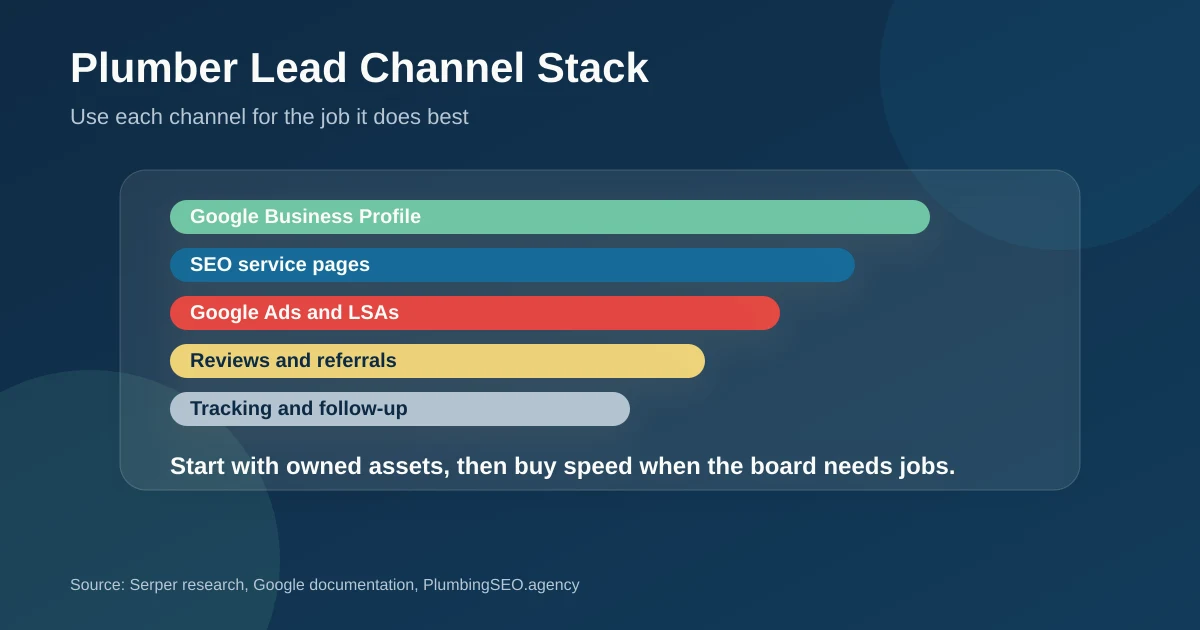
| Lead channel | Best use | Owner warning |
|---|---|---|
| Google Business Profile | Emergency and nearby searches | Incomplete hours, categories, photos, and review replies leak calls. |
| SEO service pages | Long-term city and service visibility | Thin pages rarely win against real local competitors. |
| Google Ads / LSAs | Fast call volume while SEO ramps up | Untracked spend hides bad calls and weak close rates. |
| Reviews and referrals | Trust and cheaper repeat business | If the crew does not ask, the happy customer usually forgets. |
| Purchased lead providers | Short-term capacity gaps | Shared leads can create price shoppers and margin pressure. |
1. Fix your Google Business Profile before buying more leads
For plumbers, the Google Business Profile is often the front door. Homeowners searching "emergency plumber near me," "water heater repair," or "drain cleaning" see a map result before they compare long-form websites. If your profile is weak, every other channel gets harder.
Start with the basics Google itself recommends: complete and accurate business information, verified profile, current hours, review replies, photos, and clear details about what the company does. For plumbing companies, that means primary and secondary categories, service areas, emergency hours if real, service descriptions, photos of technicians and trucks, and a phone number someone actually answers.
- Primary category: use the most accurate plumbing category available, then add relevant secondary categories only if they match real services.
- Services: list high-intent work such as drain cleaning, sewer repair, water heater replacement, leak detection, repiping, and emergency plumbing.
- Photos: add trucks, uniformed technicians, before/after work, equipment, office/shop photos, and team photos. Avoid generic stock images.
- Review replies: respond like an owner, not a template. Mention the service and city naturally when appropriate.
- UTM tracking: tag the website link and appointment link so GBP traffic is visible in analytics.
If this is your main bottleneck, use our Google Maps SEO for plumbers guide and our advanced local SEO checklist before you touch more paid lead sources.
2. Build service pages for the calls you actually want
Many plumbing websites have one generic "services" page and expect it to rank for every job type. That is not how homeowners search. A flooded basement customer does not want a paragraph that says "we do all plumbing." They want proof that you handle emergency leak repair in their area, with a phone number they can tap now.
Create one strong page for each money service. The priority list usually starts with emergency plumbing, drain cleaning, sewer line repair, water heater repair/replacement, leak detection, bathroom plumbing, commercial plumbing, and repiping. Each page should explain symptoms, when to call, what the technician will inspect, the local areas served, and what makes the company trustworthy.
Google's SEO Starter Guide says helpful, reliable, people-first content and descriptive site organization help search engines understand your pages. For plumbing owners, that means service pages should be written for real callers first, then optimized for search. Do not copy manufacturer text or reuse the same city paragraph 40 times.
3. Add city and service-area proof without making doorway pages
Local SEO is not just "put the city name in the title." If you serve Dallas, Plano, Frisco, and McKinney, the site needs a credible structure that shows those service areas. But each page has to earn its existence.
A strong local page includes details that a real customer would care about: common plumbing problems in that area, neighborhoods served, nearby landmarks if natural, photos from real jobs, reviews from local customers, and links to relevant service pages. A weak page says the same paragraph with only the city swapped. That creates clutter, not trust.
4. Turn reviews into a repeatable crew habit
Reviews are not just reputation decoration. Google says review count and positive ratings can affect local prominence, and homeowners use reviews to decide who feels safe to call. Competitor research for this topic also repeats the same theme: reviews, referrals, and GBP strength show up again and again because they reduce doubt.
The owner mistake is treating reviews as a marketing department task. Reviews are an operations habit. The dispatcher, technician, and office manager all need the same script:
- Confirm the customer is satisfied before asking.
- Ask in person while the job is fresh.
- Send a direct review link by SMS or email.
- Reply to every review within 24 to 72 hours.
- Use the best review themes on service pages, not only on the homepage.
A simple technician script works: "If everything looked good today, would you mind leaving us a quick Google review? It helps local homeowners find us when they need a plumber." Keep it human, not desperate.
5. Make the website easier to call from a phone
Most plumbing leads happen on mobile. If the website loads slowly, hides the phone number, buries the service area, or forces people through a long form, you lose calls before analytics can explain why.
For every high-intent page, check these conversion basics:
- A tap-to-call phone number is visible above the fold on mobile.
- The page states the service and service area within the first screen.
- The form has only the fields needed to start the conversation.
- Emergency pages make it clear whether emergency service is truly available.
- Trust proof appears before the customer has to scroll forever: reviews, licenses, photos, warranties, financing, or years in business.
- Tracking numbers are configured correctly so SEO and ad calls are not mixed together.
If calls are flat despite traffic, the problem may not be rankings. It may be conversion. Our plumber website conversion guide walks through those leaks.
6. Use Google Ads and Local Services Ads for speed, not as a crutch
Paid search can be useful when you need calls this week, want to test a new service area, or need to keep crews busy while SEO matures. But paid leads get expensive fast when the site, reviews, and phone process are weak.
The practical paid-channel rule is simple: do not buy more demand until you can see which calls became booked jobs. Track the source, service, call recording, booked status, revenue, and whether the lead was a fit. Otherwise, you are optimizing for form fills and phone rings instead of profit.
| When to use paid leads | What to watch | What to fix first |
|---|---|---|
| New shop needs calls fast | Cost per booked job, not just cost per lead | GBP, reviews, call answering, service pages |
| Slow season capacity gap | Job type mix and margin | Negative keywords, schedule routing, offers |
| Testing a new service area | Distance, close rate, travel time | Landing page and local proof |
| High-value jobs like sewer or repipe | Lead quality and sales follow-up | Dedicated page, proof, estimate process |
Competitor SERPs show Local Services Ads, PPC, referral platforms, and pay-per-call options because owners want speed. Use them, but do not let rented demand replace your owned plumbing SEO engine. If you are deciding where budget belongs, compare LSA vs SEO for plumbers before locking in spend.
7. Create referral prompts after the job, not months later
Referrals still matter because plumbing is trust-based. The mistake is waiting until the customer randomly thinks of you. Build a small referral loop into the job closeout process.
After a successful job, send a short follow-up:
Thanks for trusting us with your plumbing repair today. If a neighbor or family member needs help with a leak, drain, water heater, or sewer issue, we would be grateful if you passed our number along. Here is the direct booking link.
For repeat customers, add seasonal reminders: water heater age checks, holiday drain warnings, freeze prevention, sump pump testing, or annual plumbing inspections. Helpful reminders create repeat business without sounding like spam.
8. Track every lead source through to booked revenue
A plumbing lead is not valuable until it becomes a booked job at the right margin. That is why every lead-generation plan needs tracking. At minimum, separate calls from GBP, organic search, paid search, Local Services Ads, referral partners, direct mail, and repeat customers.
Then review the numbers weekly:
- How many calls came from each source?
- How many were qualified plumbing jobs?
- How many booked?
- How many sold?
- What was the average ticket?
- Which calls were missed?
- Which keywords or pages produced booked jobs?
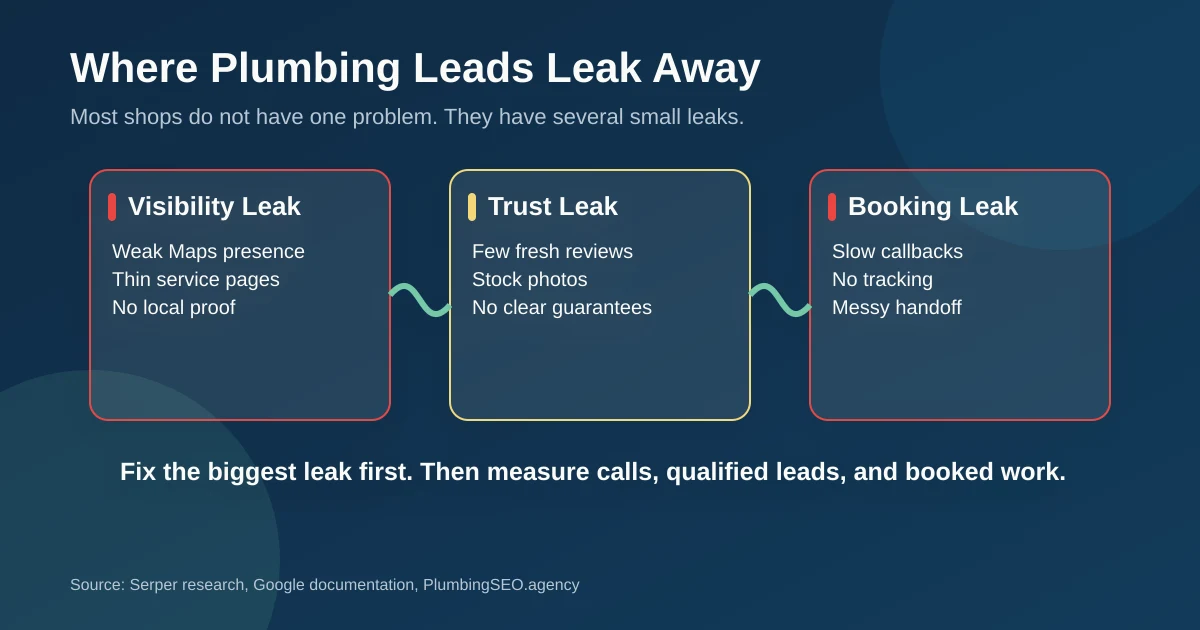
This is where many owners discover the real leak. The marketing may be producing enough phone calls, but the company misses after-hours calls, lets forms sit overnight, or books low-margin jobs while ignoring higher-value services. Our lead tracking guide for plumbers explains the closed-loop setup.
9. Publish local proof that a homeowner can believe
Generic content rarely convinces a stressed homeowner. Local proof does. Show real crews, real trucks, real before-and-after photos, common jobs in your service area, and answers to questions your dispatchers hear every week.
Useful local content for plumbing companies includes:
- "What to do before the plumber arrives" checklists for leaks, backups, and no-hot-water calls.
- Service-area guides for common pipe, water heater, or sewer issues in your city.
- Seasonal content: freeze prevention, sump pump testing, water heater maintenance, holiday drain clogs.
- Project stories with customer-identifying details removed.
- FAQ sections based on real sales and dispatch conversations.
Google's search documentation emphasizes unique, useful, people-first content. For plumbers, that means a page that helps the customer make the next decision: call now, turn off the water, schedule inspection, or compare repair vs replacement.
A 90-day plan to get more plumbing leads
If everything feels urgent, use this order. It prioritizes the work that stops immediate leakage before you scale spend.
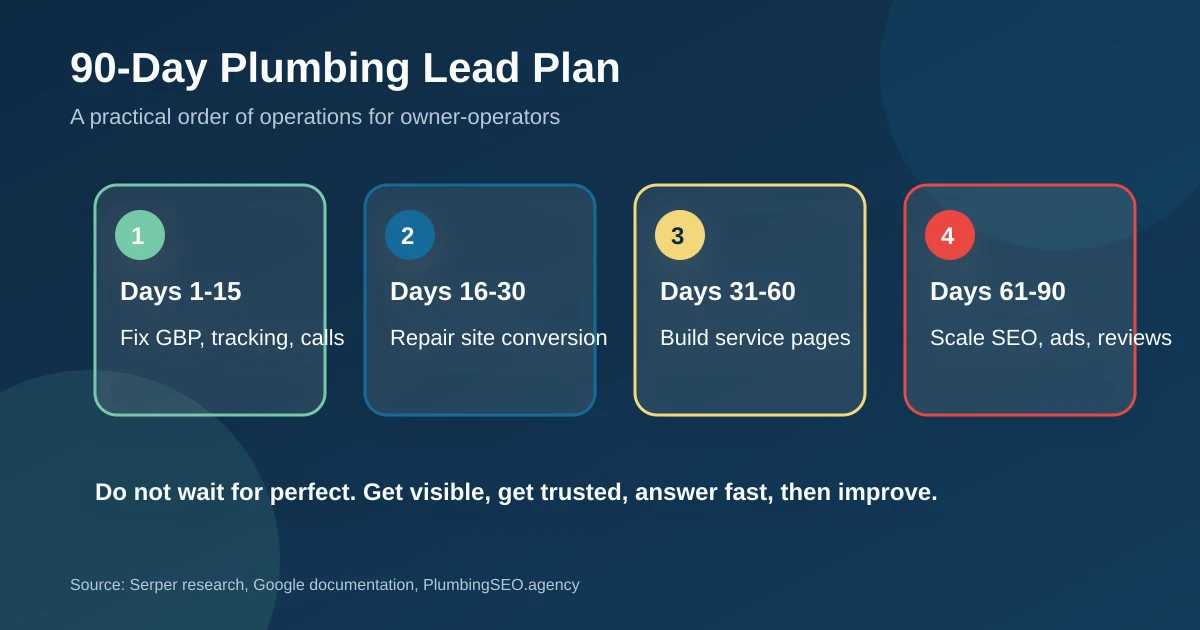
Days 1-15: stop obvious leaks
- Claim, verify, and clean up Google Business Profile.
- Fix phone number, hours, service areas, categories, and service list.
- Add call tracking without breaking NAP consistency.
- Make the mobile phone button obvious.
- Set a missed-call callback rule.
Days 16-30: repair website conversion
- Improve homepage hero message and emergency call CTA.
- Add trust proof above the fold.
- Shorten forms and test tap-to-call links.
- Add review snippets and real job photos to money pages.
- Create one high-quality page for the top revenue service.
Days 31-60: build the owned lead engine
- Publish core service pages and link them from navigation.
- Build local pages only where you have real proof and capacity.
- Create a review request process for every completed job.
- Add FAQ schema and service schema where appropriate.
- Start measuring rankings, calls, booked jobs, and revenue by source.
Days 61-90: scale what works
- Increase content depth around services that already close well.
- Run tightly controlled Google Ads or LSAs if tracking is ready.
- Improve internal links between GBP, service pages, city pages, and blog posts.
- Review call recordings for missed-booking reasons.
- Cut channels that produce bad-fit leads even if they look cheap.
Common mistakes that keep plumbing leads from turning into jobs
Most lead problems are not one big failure. They are small leaks stacked together. These are the ones we see most often:
- Buying leads before fixing trust. If the profile has weak reviews and the website looks outdated, paid traffic just exposes the weakness faster.
- Tracking only form fills. Plumbing customers call. If calls are not tracked to booked jobs, the report is incomplete.
- Letting everyone answer differently. Dispatch scripts affect close rate. A polite, fast, confident answer can beat a cheaper competitor.
- Publishing thin city pages. Duplicate local pages do not prove local expertise.
- Ignoring after-hours intent. Emergency plumbing searches happen at inconvenient times. Missed calls often go straight to competitors.
- Ranking for the wrong jobs. More drain calls are not helpful if the company needs water heater installs, sewer replacements, or commercial work.
How to decide what to do first
Use this decision tree:
| If this is true | Do this first |
|---|---|
| Your GBP is incomplete or has few reviews | Fix GBP, photos, categories, services, and review requests. |
| You get traffic but few calls | Repair mobile UX, CTAs, forms, speed, and trust proof. |
| You get calls but few booked jobs | Audit call answering, dispatch scripts, missed calls, and job-fit tracking. |
| You rely on one lead vendor | Build owned SEO, referrals, reviews, and repeat-customer campaigns. |
| You need calls this week | Use paid search/LSAs carefully while owned assets are repaired. |
Bottom line: plumbing leads come from a system, not a trick
The best way to get plumbing leads is to combine visibility, trust, speed, and tracking. Show up on Google Maps and organic search. Prove you are a real local plumbing company. Make calling easy. Answer fast. Track which calls became booked revenue. Then scale the channels that work.
If you want help finding the leaks, PlumbingSEO.agency can review your GBP, website, service pages, tracking, reviews, and local SEO structure. Start with a free plumbing SEO audit, or learn more about our SEO for plumbers service.
Sources used for this guide
- Google Business Profile Help: Tips to improve your local ranking on Google
- Google Search Central: SEO Starter Guide
- ServiceTitan: How to Increase Plumbing Leads
Frequently Asked Questions
Plumbers get leads consistently by combining Google Business Profile optimization, service-page SEO, reviews, referrals, paid search when needed, and call tracking. The key is not one tactic; it is a system that helps homeowners find you, trust you, and contact you quickly.
Good lead generation keeps trucks booked with the right jobs. It reduces dependence on one lead vendor, improves local visibility, builds customer trust, and helps the owner measure which channels produce booked revenue instead of just phone calls.
A plumber can handle basics like asking for reviews, uploading photos, answering calls faster, and improving GBP details. An agency is useful when the company needs technical SEO, service-page strategy, tracking, content, local pages, and ongoing measurement handled without pulling the owner away from operations.
Some fixes, such as GBP cleanup, review requests, and website call-button improvements, can help quickly. SEO improvements usually need weeks to months to show measurable gains, and competitive markets can take longer. Google notes that search changes can take anywhere from hours to several months to be reflected.
Paid plumbing leads can be worth it when tracking, call answering, and close rates are solid. They are risky when the business cannot tell which leads became booked jobs or when shared leads force the company into price competition. Use paid channels for speed, not as a replacement for owned lead sources.
Start with Google Business Profile completeness, review process, mobile call experience, and basic tracking. Those four items affect nearly every other channel. Once they are working, build deeper service pages, local proof, referral campaigns, and carefully measured paid campaigns.
Want More Plumbing Leads Without Guessing?
We will review your Google Business Profile, service pages, reviews, tracking, and website conversion path so you can see what is leaking calls. No jargon, no pressure, just a practical plumbing SEO leak check.
Run My Free SEO Leak Check