
- Angi can be useful when a plumbing company needs calls quickly, but you are usually buying access to a marketplace lead, not building an asset you control.
- SEO is slower because it builds service pages, reviews, Google Business Profile trust, and local authority; the payoff is owned demand that can compound instead of resetting every month.
- The safest plan is not “Angi or SEO forever.” Use rented leads as a short-term bridge only if you can answer fast, then invest in owned local visibility and track cost per booked job.
Angi and SEO can both put plumbing jobs on the board, but they solve different problems. Angi is a marketplace. SEO is an owned channel. One rents attention from a platform that can send the same homeowner to several pros. The other builds pages, reviews, and local search signals that make your company easier to find directly.
If you are asking “Angi vs SEO for plumbers,” the real question is not which channel is morally better. The real question is: do you need rented lead volume right now, or do you need a demand engine your company controls?
This guide compares the channels by speed, cost control, lead quality, ownership, and operational fit. It also shows where Angi belongs in a plumber marketing plan without letting it become the whole plan.
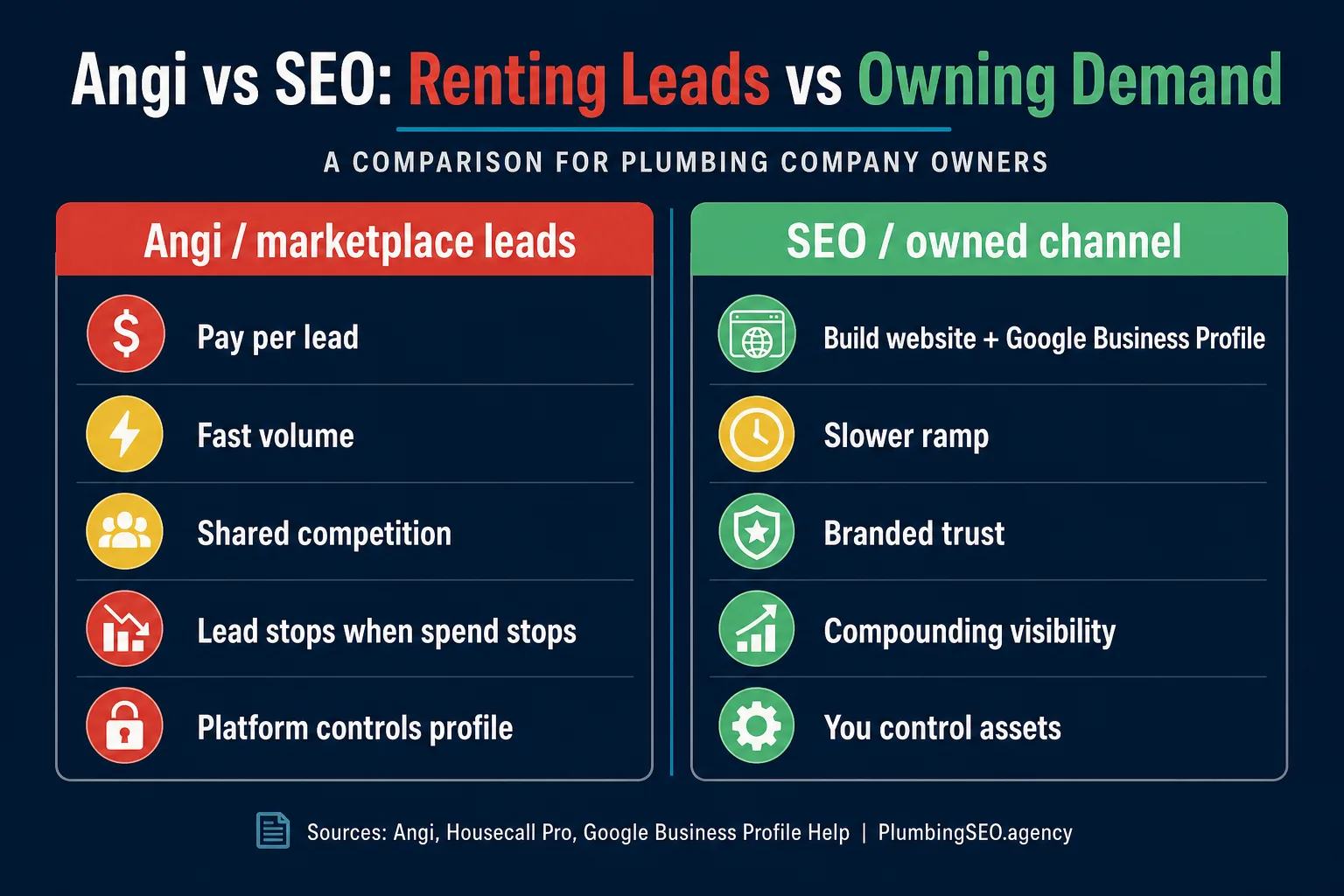
The short answer: use Angi for gaps, SEO for the base
For most plumbing companies, Angi should be treated like a rented-lead bridge, not the foundation of growth. It can help during a slow week, a new-market launch, or a service-line push. But if the channel works only while you keep paying a platform, you do not own the demand.
SEO is different. It takes longer because it depends on visible assets: service pages, service-area content, Google Business Profile accuracy, reviews, citations, internal links, schema, photos, and a website that converts mobile searchers into calls. Those assets stay with the business.
| Question | Angi / rented leads | SEO / owned channel |
|---|---|---|
| How fast can it create inquiries? | Usually faster if budget, category, and market fit are there. | Slower ramp. Local SEO often needs months of consistent work. |
| Who controls the relationship? | The platform controls the marketplace experience, profile rules, billing structure, and visibility. | Your company controls the website, content, tracking, reviews process, and brand path. |
| What happens if spending stops? | Lead flow usually stops or drops quickly. | Rankings can still move, but the built assets remain and can keep producing calls. |
| What is the biggest risk? | Shared leads, weak intent, disputed billing, and speed-to-lead pressure. | Slow early payback, poor execution, thin pages, and bad tracking. |
| Best role | Short-term schedule filler with strict tracking. | Long-term demand base for service calls and brand trust. |
How Angi works for plumbing leads
Angi, formerly connected with the Angie’s List and HomeAdvisor ecosystem, matches homeowners with local service providers. Angi’s own plumbing lead article positions paid lead generation as a fast way to reach homeowners who already need a plumber, while also listing referrals, local SEO, and testimonials as lead sources.
That speed is the appeal. If the phone is quiet today, a marketplace lead can feel more concrete than a six-month SEO plan. But the plumbing owner still has to win the job after the lead arrives.
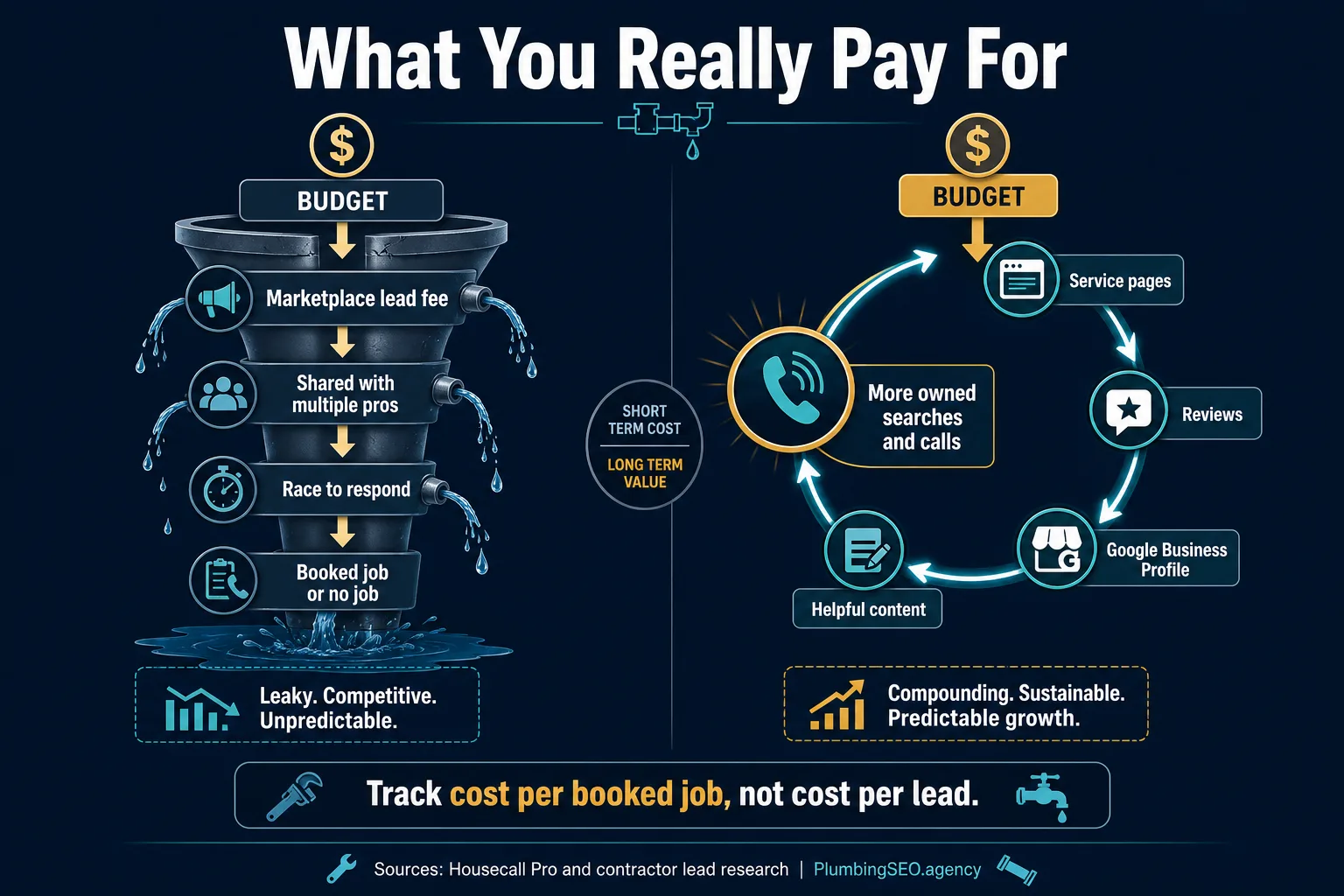
Housecall Pro explains that Angi commonly operates on a pay-per-lead model, where the contractor pays for the lead whether or not the job books. It also notes that the same lead may go to multiple qualified contractors at once, making response speed a major factor.
That creates a very specific type of plumbing lead: urgent enough to request help, but not necessarily loyal to your company. The homeowner may be comparing several names, your office may be racing other pros, and the close can become a price-and-speed contest.
What plumbers are really buying with Angi
When you buy Angi leads, you are not buying booked jobs. You are buying the right to chase a homeowner interaction. That may be worthwhile if the math works, but the cost should be judged against booked jobs and revenue, not raw lead count.
Published third-party estimates vary. Hook Agency cites Angi lead costs commonly around $15 to $85, with some markets pushing beyond $100. Olly Olly cites a wider $25 to $120 lead-cost range depending on trade and location. These are not guarantees for plumbers, but they are useful owner-side guardrails.
Use this simple test before scaling any rented-lead spend:
- Cost per lead: What did the platform bill for the inquiry?
- Qualification rate: How many were in your service area and matched work you wanted?
- Booking rate: How many actually became appointments or jobs?
- Cost per booked job: Total spend divided by booked jobs, not total leads.
- Gross margin: Did the booked work leave enough profit after labor, materials, truck time, and callbacks?
If you want the math behind that last step, compare your numbers with our guide to plumber cost per lead. A $60 lead can lose money if it never books. A $180 lead can be fine if it turns into a high-margin sewer, water heater, or emergency job.
Where Angi can make sense for plumbers
This is not an anti-Angi rant. Marketplace leads can make sense when the plumbing company is set up to work them correctly. The problem is using rented leads as a substitute for a brand, website, reviews, and follow-up system.
Angi is most defensible when:
- You need calls this week. A new truck, slow season, new territory, or cancelled commercial work may justify short-term rented demand.
- You have someone answering fast. If the same homeowner is being sent to multiple pros, speed-to-lead is not optional.
- You know your numbers. You can see lead source, booked job, invoice value, and gross margin by channel.
- You can filter services. You know which categories, ZIP codes, and job types are worth paying for.
- You cap the test. You set a budget, define success before launch, and stop if booked-job cost fails.
Where Angi usually gets dangerous is when a plumbing company keeps buying more leads to cover up a weak conversion system. Missed calls, slow callbacks, no CRM notes, poor review proof, and bad follow-up will make every rented lead source look worse.
If lead quality is the problem, read our guide to lead quality scoring for plumbers. If attribution is the problem, build the fields from our plumbing lead CRM article before increasing spend.
What SEO builds that Angi does not
SEO for plumbers is not just “blogging.” A real plumbing SEO program makes your company easier to find, easier to trust, and easier to call when a homeowner searches for help.
A strong owned channel includes:
Service-page coverage
- Drain cleaning, water heaters, sewer repair, leak detection, emergency plumbing, and other profitable services.
- Each page answers the specific job instead of sending everyone to a generic homepage.
Local trust signals
- Google Business Profile accuracy, service areas, photos, reviews, owner replies, and consistent citations.
- These signals support Maps visibility and conversion after the click.
Owned tracking
- Call tracking, form tracking, CRM outcomes, booked-job attribution, and revenue by channel.
- You can improve the system instead of guessing which platform deserves credit.
ServiceTitan describes plumbing SEO as improving visibility for potential customers through local SEO, Google Business Profile work, website pages, reviews, and technical optimization. That is the difference: SEO creates a discoverable business asset, not only a purchased conversation.
Our recommended support page for this topic is plumber digital marketing, because the best owned-channel strategy is broader than rankings. It connects SEO, Google Business Profile, conversion tracking, paid-channel decisions, and review growth into one operating system.
Angi vs SEO by lead quality
Lead quality depends less on the channel label and more on intent, fit, speed, and proof. But the two sources tend to create different conversations.
| Lead-quality factor | Angi pattern | SEO pattern |
|---|---|---|
| Intent | Often active; homeowner requested help through a marketplace. | Can be active and direct, especially service and “near me” searches. |
| Competition | May be shared with several pros, increasing response and price pressure. | Searcher may compare options, but they land on your owned page and brand path. |
| Trust | Borrowed from the platform and your marketplace profile. | Built through your reviews, photos, service pages, local proof, and brand. |
| Control | Limited control over lead matching, billing rules, and platform experience. | High control over page, call path, offers, tracking, and follow-up. |
| Best metric | Cost per booked job from paid marketplace leads. | Organic booked jobs, revenue, ranking coverage, and assisted conversions. |
The ownership problem: rented demand can disappear
The biggest problem with relying on Angi is not one bad lead. It is strategic dependency. If the platform changes pricing, lead volume, filters, review rules, or competition in your market, your plumbing company has limited control.
With SEO, you still depend on search engines and customer behavior. But you also build assets that belong to the company: service pages, location relevance, brand searches, review routines, photos, internal links, and content that explains your services.
That is why the Angi vs SEO decision should be framed as cash-flow bridge versus asset-building base. The bridge can help. The base is what you want to own.
Decision tree: when should a plumber use Angi?
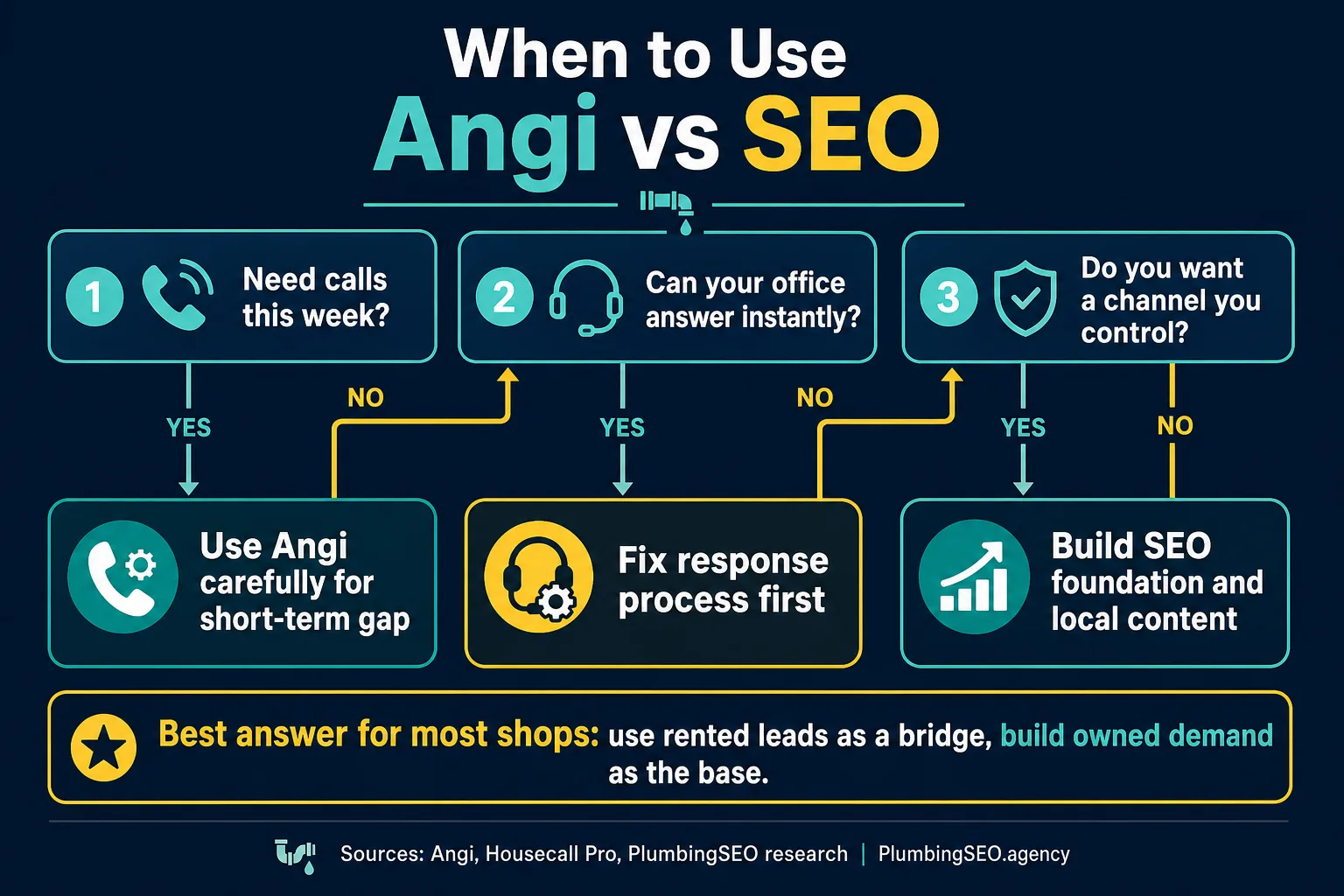
Use this owner-level decision path:
- If you need calls this week: test Angi only with a clear budget cap, service-area filter, and response plan.
- If your office misses calls: fix answer speed before buying more leads. Shared leads punish slow teams.
- If your website is thin: build service pages, proof, and tracking. Paying platforms forever is not a moat.
- If you cannot see booked jobs by source: stop scaling spend until CRM and call tracking are clean.
- If organic calls are growing: keep strengthening SEO and use rented leads only for short-term gaps.
A practical 90-day transition from rented leads to owned demand
If you are currently depending on Angi or similar lead vendors, do not shut everything off blindly. Replace dependency with a measured transition.
For payback planning, use the plumbing SEO ROI calculator. For a broader paid-versus-owned comparison, read SEO vs Google Ads for plumbers. For vendor comparisons, use our guide to the best plumbing lead generation companies.
Bottom line: stop renting your whole future
Angi can help a plumbing company buy speed. SEO helps a plumbing company build equity. The mistake is pretending those are the same thing.
If you test Angi, test it like an owner: cap the budget, answer instantly, score lead quality, and calculate cost per booked job. If the numbers work, use it as a tactical channel. If the numbers fail, do not keep buying hope.
At the same time, build the owned channel: service pages, local proof, reviews, Google Business Profile strength, internal links, and tracking. That is how a plumbing company moves from chasing marketplace leads to becoming the company homeowners search for by name.
Sources used for this guide
- Angi: How To Get Plumber Leads Quickly
- Housecall Pro: What Is Angi’s List and How Does It Work for Contractors?
- Housecall Pro: How to Get Plumbing Leads
- Hook Agency: Angi Leads Reviews From Contractors
- Olly Olly: Angi for Contractors
- Hatch: Is Angi Leads Worth It?
- ServiceTitan: SEO for Plumbers
Frequently Asked Questions
Angi can be worth testing if you need short-term call volume, can answer fast, and track cost per booked job. It is risky as the main growth channel because leads may be shared, billed whether or not they book, and controlled by the platform.
SEO is usually better as a long-term base because it builds owned website pages, Google Business Profile trust, reviews, and direct demand. Angi is faster for testing or filling gaps, but the lead flow generally depends on ongoing spend.
Published third-party estimates often cite Angi lead costs around $15 to $85, with some trades and markets higher. Other contractor marketing sources cite wider ranges such as $25 to $120. Plumbers should verify their own billed cost, qualification rate, booking rate, and profit per job.
Not automatically. If Angi produces profitable booked jobs, keep it capped and measured. But do not let it replace owned SEO, reviews, service pages, and direct brand demand. The goal is to use rented leads tactically while reducing dependency.
Build service pages for profitable jobs, strengthen Google Business Profile, request reviews consistently, publish useful local content, improve internal links, and connect call tracking to CRM outcomes. Those assets create an owned channel that is easier to improve over time.
Want to replace rented leads with owned plumbing demand?
We will inspect your website, Google Business Profile, service pages, reviews, and tracking so you can see which channels are producing booked plumbing jobs.
Run My Free SEO Leak Check