
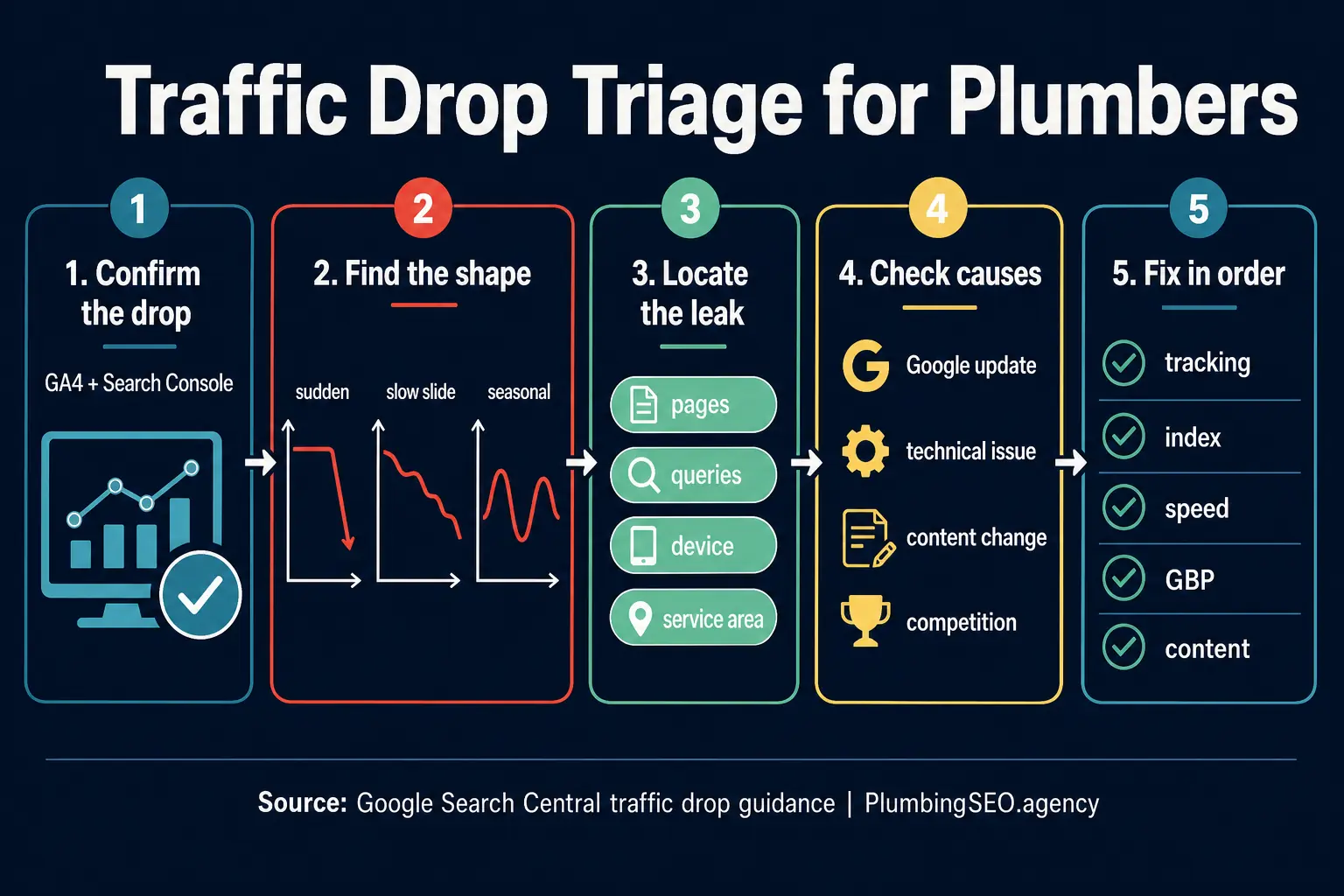
- Do not fix a traffic drop by guessing. First separate tracking, demand, rankings, indexing, Google Business Profile, and conversion problems.
- For plumbers, less traffic is only scary when it means fewer qualified local calls. Check calls, forms, booked jobs, and service-area visibility before panicking.
- Fix in this order: measurement, crawl/indexing, mobile speed, Map Pack signals, service-page content, then conversion paths.
First, make sure the drop is real
If your plumbing website traffic dropped, I would not start by rewriting every page or firing up a new ad campaign. I would start by asking one plain question: did the phone actually get quieter, or did a report change?
That sounds basic, but it matters. A plumbing owner cares about booked drain cleaning jobs, water heater calls, sewer inspections, and emergency work. Website sessions are only useful if they help the right local customer find you before they call another shop.
Google says organic Search traffic can drop for several reasons, including algorithmic updates, technical issues, security issues, reporting changes, demand shifts, and site changes. Their own Search traffic drop guide recommends using Search Console Performance data and Google Trends before assuming the cause.
Check the numbers that connect to calls
Open GA4, Google Search Console, your call tracking platform, and your form inbox. Then compare the same date range against the previous period and the same season last year. Month-over-month can fool you in plumbing because weather, holidays, storms, school schedules, and local construction all move demand around.
| What changed? | What it usually means | What to check first |
|---|---|---|
| GA4 traffic down, calls steady | Tracking, bot filtering, or low-value visitors fell off | Call log, form leads, booked jobs, GA4 channel setup |
| Search Console clicks down, impressions steady | CTR, SERP layout, ads, AI answers, or title/description issue | Top queries, average position, device split, search appearance |
| Impressions down across service pages | Ranking loss, indexing issue, or local demand drop | Page indexing, sitemap, recent edits, Google update dates |
| Map calls down but organic pages steady | Google Business Profile or Local Pack problem | GBP edits, categories, reviews, photos, service area, competitors |
If you use call tracking, make sure the tracking setup itself did not change. A missing dynamic number insertion script, a stripped UTM tag, or a new phone number on the Google Business Profile can make the report look worse than the business actually is. If you need a cleaner setup, read our lead tracking for plumbers guide.
The 7 most common reasons plumber traffic drops
Most traffic drops are not one big mystery. They are usually one or two leaks stacked together. Here is where I would look first.
1. Google changed what it rewards
Core updates can reshuffle pages even when nothing broke. Google notes that a small position drop, like moving from 2 to 4, can still produce a visible traffic loss.
2. A technical issue blocked visibility
Robots.txt, noindex tags, server errors, broken redirects, deleted pages, and crawl errors can all choke off traffic. This is the SEO version of a shut valve.
3. Important service pages slipped
If drain cleaning, water heater repair, or emergency plumber pages lost rankings, calls can drop fast even if blog traffic looks fine.
4. Your Google Business Profile lost ground
For local plumbing searches, Maps and the Local Pack can carry a lot of call intent. Category changes, review velocity, proximity, and stronger competitors all matter.
5. Search demand moved
Frozen pipe searches, sump pump searches, remodel work, and emergency terms can rise and fall by season. Compare year-over-year before assuming the site failed.
6. The page still gets traffic but converts worse
A hidden phone button, slow mobile page, weak reviews, thin service-area proof, or confusing form can turn traffic into silence.
The seventh cause is competition. A nearby shop may have added better service pages, more reviews, stronger local backlinks, or faster pages. That does not mean you did something wrong. It means the market moved and you need to inspect the job again.
Use Search Console like a leak detector
Google Search Console is not perfect, but it is the first place I would check because it shows what happened in Google Search before the visitor got to your site. The trick is to look at patterns instead of staring at one big traffic graph.
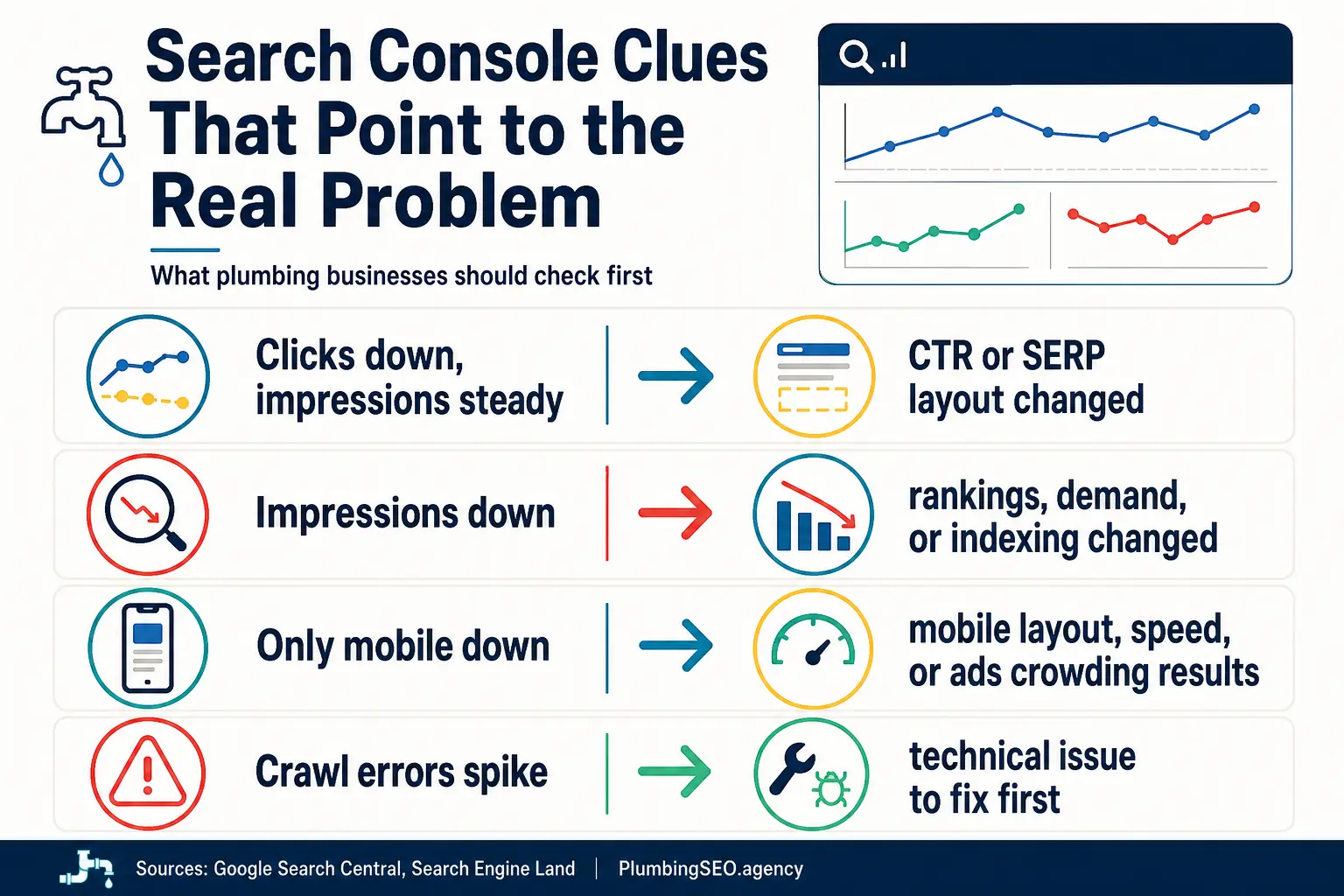
Search Engine Land points to device segmentation, search appearance, and crawl stats as useful reports for diagnosing drops. That lines up with what we see on plumber sites. A mobile-only drop can be a layout or speed problem. A crawl spike can point to redirects or broken URLs. A search appearance change can mean the search page got crowded, even if your position did not move much.
A plumber traffic drop checklist you can run in one hour
Do this before you rewrite the whole website. Rewriting without diagnosis is like replacing a water heater because the faucet drips. Maybe it works out, but that is not a plan.
| Step | Where to look | Good question to ask |
|---|---|---|
| 1. Mark the drop date | GA4, GSC, call tracking | Did calls and booked jobs drop on the same date? |
| 2. Split by channel | GA4 traffic acquisition | Is this organic search, Maps, paid, referral, or direct? |
| 3. Check pages | GSC Pages report | Did service pages drop, or only informational articles? |
| 4. Check queries | GSC Queries report | Did emergency and city terms lose visibility? |
| 5. Check indexing | GSC Page indexing and sitemap | Are money pages indexed and canonicalized correctly? |
| 6. Check GBP | Google Business Profile | Did category, phone, hours, reviews, or service area change? |
| 7. Check conversion | Mobile site and call buttons | Can a homeowner call in two taps from every key page? |
What generic traffic-drop articles miss for plumbers
Generic marketing advice usually talks about blog traffic, backlinks, algorithm updates, and content refreshes. Some of that is useful. But plumbing is service-area work. A drop in a national blog post is not the same as losing visibility for "emergency plumber near me" at 9 PM.
For plumbers, the real question is not "why is my website traffic dropping?" The better question is: which local call path is leaking?
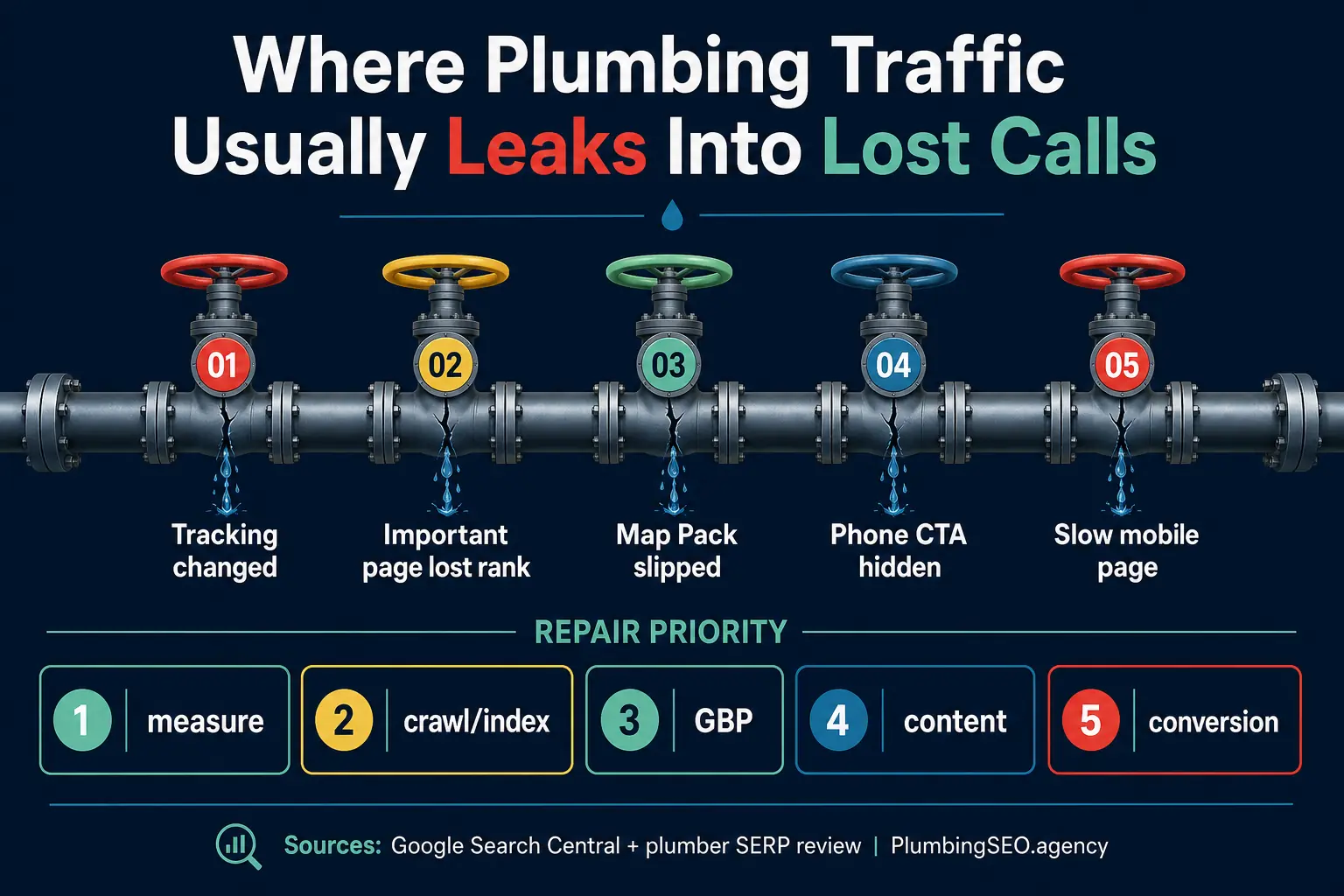
If the Map Pack slipped, work on Google Business Profile categories, reviews, photos, location proof, citations, and local service relevance. Our advanced local SEO for plumbers guide breaks that down deeper.
If organic service pages dropped, inspect page intent. A drain cleaning page should not read like a generic home page. It needs the service, the city or service area, proof, process, emergency availability if offered, FAQs, and a clear phone path. If the whole site is invisible, start with our SEO for plumbers service overview.
What to fix first when calls are down
Here is my opinion: fix measurement before marketing. If you cannot tell whether the loss came from Maps, organic pages, paid ads, or phone tracking, every fix is a guess. And guesses get expensive fast when payroll is due and trucks need jobs on the board.
When paid channels still matter
SEO recovery can take time. Google says some changes may show results in days, while others can take months to be fully processed. That is why a plumbing company should not put every egg in one basket. If organic calls dropped hard, keep Local Services Ads, Google Ads, referrals, email, and repeat-customer follow-up alive while the SEO fix is underway.
The goal is not to replace SEO with ads forever. The goal is to keep the trucks moving while the site gets healthy again. Paid leads can cover the short-term gap. SEO should make the business less dependent on expensive lead flow over time.
How long recovery usually takes
A tracking fix can show up the same day. An indexing fix might stabilize after Google recrawls the page. A content or authority recovery can take weeks or months. A competitive local market can take longer because you are not just fixing your own site. You are also trying to pass other shops that kept moving while your site got quiet.
Do not judge recovery only by traffic. Track the owner numbers:
- Qualified calls from your service area.
- Booked jobs by service type.
- Map Pack visibility for priority cities.
- Organic clicks to money pages, not just blog posts.
- Call answer rate and form response time.
- Cost per booked job across SEO, LSA, PPC, referrals, and repeat customers.
When to ask for help
If the drop is small, the site is indexed, and calls are steady, you can probably watch it for a couple of weeks. If calls are down, rankings fell across service pages, the Google Business Profile changed, or Search Console shows indexing problems, do not wait around hoping Google feels generous.
Run a clean audit, decide what actually broke, then fix the highest-value leak first. If you want a second set of eyes, contact us and we will help you sort the report from the reality.
FAQ: Plumbing website traffic drops
Your plumbing website traffic may drop because of tracking changes, Google algorithm updates, indexing problems, technical errors, seasonal demand, stronger competitors, Google Business Profile changes, or weaker conversion paths. Start by checking whether calls and booked jobs dropped too.
It keeps you from wasting money on the wrong fix. If the leak is call tracking, rewriting service pages will not help. If the leak is Map Pack visibility, a blog refresh will not fix the phone. Diagnosis points the crew at the right repair.
Check both. GA4 shows website visits and behavior. Google Search Console shows search impressions, clicks, average position, pages, queries, devices, and indexing clues. Pair both with call tracking and booked-job data.
Some fixes are DIY, like confirming tracking, checking forms, reviewing phone numbers, and comparing Search Console pages. Technical SEO, migration issues, GBP ranking drops, and service-page rebuilds are usually safer with someone who handles plumber SEO every day.
Simple tracking or form problems can recover immediately after repair. Indexing and crawl issues may take days or weeks. Content quality, authority, and local ranking recovery can take several weeks to several months depending on the market and the size of the drop.
Often, yes. If organic calls dropped, paid channels can keep leads coming while SEO is repaired. Use ads carefully, track cost per booked job, and avoid treating ads as a permanent substitute for a healthy local SEO foundation.
Traffic down and the phone got quiet?
We will inspect your traffic, rankings, Google Business Profile, tracking, and call paths so you know what to fix first.
Run My Free SEO Leak CheckNo pressure. Just a clear look at where the calls may be leaking.