
- Fix the revenue leaks before adding more traffic. Your checklist starts with tracking, mobile calls, forms, service pages, and Google Business Profile basics.
- Use SEO, Maps, reviews, ads, and email together. A plumbing shop needs one system that turns searchers into booked jobs, not five disconnected marketing chores.
- Measure booked jobs, not just leads. If you cannot see which calls became real work, you cannot decide whether SEO, LSA, PPC, or referrals deserve the next dollar.
If the phone gets quiet, most plumbing and HVAC owners feel the same pressure. Trucks still need work. Payroll still lands on Friday. Customers still need to find somebody, but they might be finding the other shop first.
This is the complete digital marketing checklist for plumbing and HVAC businesses that want fewer mystery leads and more booked jobs. It is not a generic agency list. It is built around the parts that actually affect a service business: how homeowners find you, whether they trust you, whether they can call fast, and whether you can prove which channel paid for itself.
Current search results are full of useful but broad lists. The common advice is website, local SEO, Google Business Profile, reviews, PPC, social, email, and tracking. That is correct, but it misses the owner-side order of operations. A checklist only helps if it tells you what to fix first.
Google’s own local ranking guidance says local results are mainly shaped by relevance, distance, and prominence. Google also says complete and accurate Business Profile information helps customers understand what you do and where you serve. For plumbing and HVAC, that means the checklist has to start with clarity, proof, and service-area fit before it gets fancy.
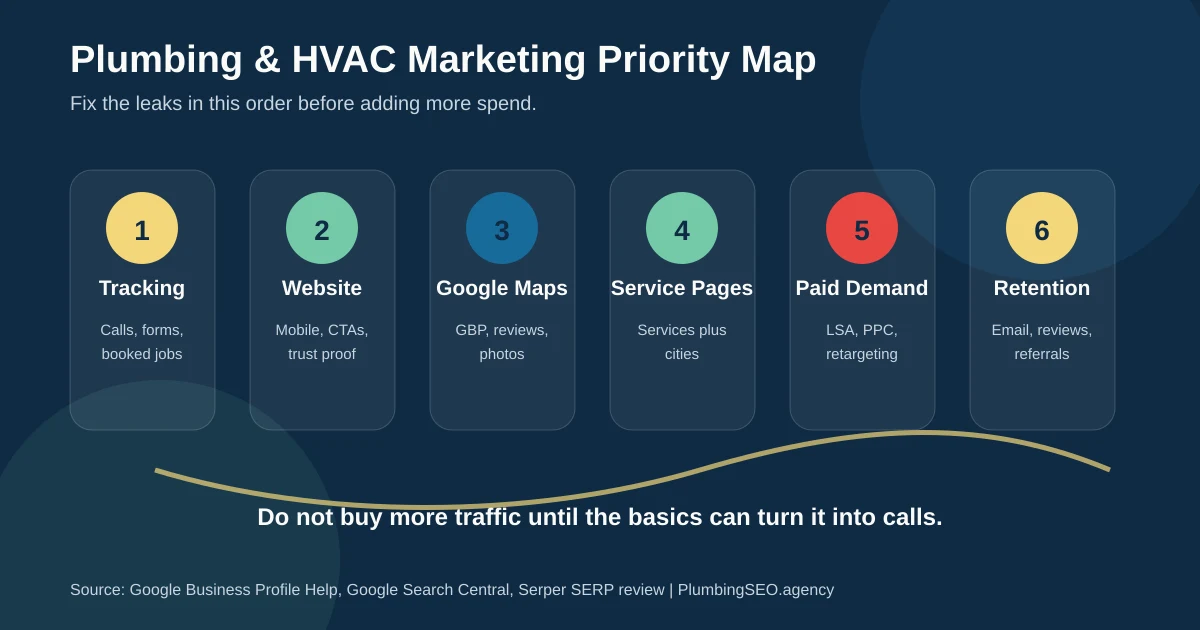
Before You Start: Decide What Counts as a Win
A plumber does not need prettier marketing reports. A plumber needs the right people calling from the right towns for jobs the company actually wants. That is the difference between a lead and a booked job.
Before you touch ads, SEO, or social posts, write down these numbers for the last 30 days:
- How many calls came from Google Business Profile, organic search, paid ads, referrals, and repeat customers?
- How many calls were answered live?
- How many turned into booked jobs?
- Which services had the best gross profit?
- Which towns or neighborhoods were worth the drive?
- Which leads wasted dispatch time?
If those answers are fuzzy, your first marketing task is tracking. Not a bigger ad budget. Not another blog post. Tracking is boring, but so is checking a shutoff valve. Skip it and you might get wet.
| Checklist area | Owner question | Pass condition |
|---|---|---|
| Tracking | Can we see calls, forms, chats, and booked jobs by source? | Every channel ties to a real job outcome. |
| Website | Can a mobile visitor call in under 5 seconds? | Phone, service, city, proof, and CTA are obvious. |
| Google Maps | Does the profile prove our services and service area? | Categories, services, photos, reviews, and hours are current. |
| SEO | Does each money service have a page worth ranking? | Main services and priority towns have useful, unique pages. |
| Paid leads | Are we buying jobs or just clicks? | Budgets are judged by cost per booked job. |
The Foundation Checklist: Tracking, Website, and Intake
This is the part most owners want to rush past. Do not. If your website confuses people, your calls go unanswered, or your forms disappear into an inbox nobody checks, every channel gets more expensive.
1. Set up clean lead tracking
- Track calls from organic search, Google Business Profile, Google Ads, LSA, and major campaigns.
- Track forms, chats, and booked jobs, not just submissions.
- Use call recordings or call notes to mark spam, price shoppers, service mismatch, and real jobs.
- Review missed calls weekly and fix routing before buying more traffic.
- Keep your public NAP consistent. Use tracking carefully so citations and GBP stay clean.
If call tracking is already confusing, read our guide to lead tracking for plumbers before you add another tool.
2. Make the website easy to use on a phone
- Put click-to-call in the header and near the top of service pages.
- Use short forms. Name, phone, service, zip code, and message is usually enough.
- Show emergency availability only if you truly answer emergency calls.
- Add trust proof near CTAs: reviews, license, insurance, team photos, trucks, warranties, and financing when relevant.
- Test the top pages on a real phone every month. Do not just resize a desktop browser.
Google’s SEO Starter Guide says useful, well-organized, people-first content helps users and search engines understand a site. For a plumbing owner, that means clear service pages, honest proof, and pages that help someone decide whether to call. You can read the source in Google Search Central’s SEO Starter Guide.
3. Build service pages before extra blog volume
Blog posts help, but they are not a substitute for money pages. A drain cleaning page, water heater page, sewer repair page, leak detection page, and emergency plumbing page should be clear before you chase a giant content calendar.
Each service page should answer: what you fix, where you serve, what signs customers notice, what happens when they call, what proof you have, and what the next step is. If you need the SEO side broken down further, start with our SEO for plumbers service guide.
The Local SEO and Google Business Profile Checklist
For plumbing and HVAC, local search is not theory. It is the map result a homeowner sees while standing beside a leaking water heater. Your Google Business Profile and local SEO have to make the safe choice obvious.
4. Clean up your Google Business Profile
- Use the correct primary category. For a plumbing company, that usually means Plumber.
- Add secondary categories only for real services you perform.
- Set accurate hours, holiday hours, phone number, website URL, and service areas.
- Add every major service in GBP services with plain descriptions.
- Upload real job photos, truck photos, team photos, equipment photos, and before-and-after images.
- Answer Q&A with honest service details. Do not stuff keywords.
- Respond to reviews like an owner who wants repeat business.
Google says positive reviews and helpful replies can help a business stand out, and that more reviews and positive ratings can help local ranking through prominence. That does not mean you chase fake reviews. It means you build a real review habit after completed jobs.
5. Strengthen local relevance
- Make sure your website lists the same core services and service areas as your GBP.
- Create city pages only when you have real local proof and enough useful content.
- Add neighborhood examples, common local plumbing problems, and dispatch details where true.
- Build citations on important directories and remove wrong old listings.
- Earn local links from suppliers, chambers, sponsorships, charities, local news, and partner businesses.
If you already have the basics and want the next level, use our advanced local SEO for plumbers guide after this checklist.
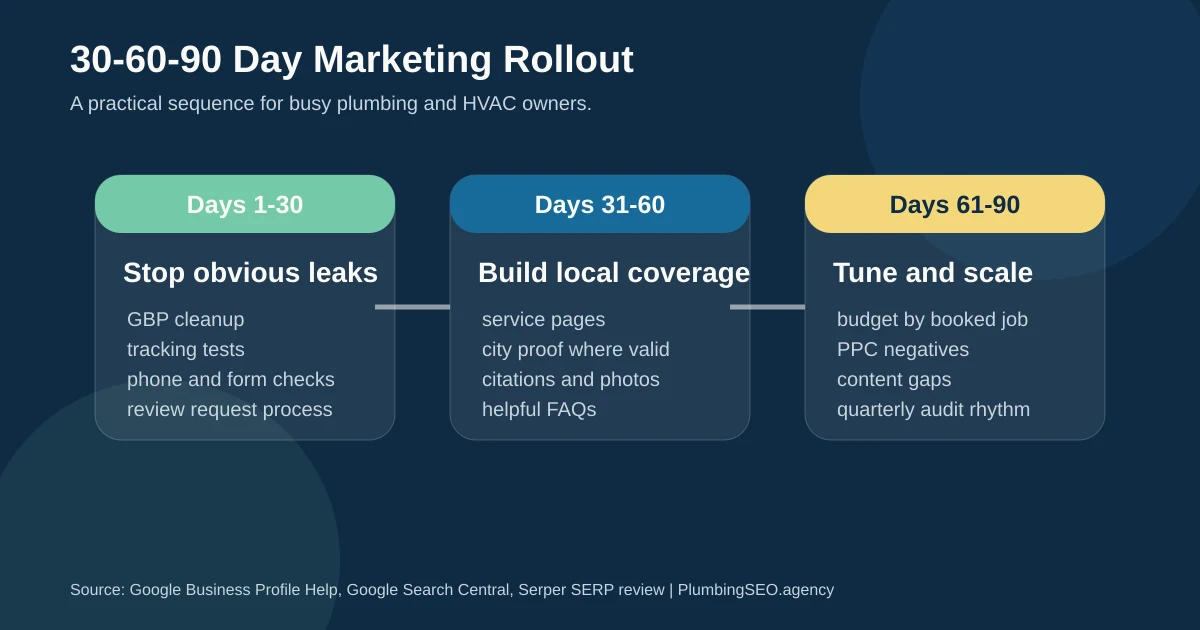
The SEO and Content Checklist
SEO for plumbing and HVAC should not be a pile of random keywords. It should match how customers search when they have a problem, a location, and a deadline.
6. Build keyword coverage around real jobs
- List services by revenue value: emergency plumbing, drain cleaning, sewer repair, water heaters, leak detection, repiping, AC repair, furnace repair, tune-ups, and installs.
- Map each service to the cities and neighborhoods you can serve profitably.
- Separate emergency, repair, replacement, maintenance, and estimate intent where needed.
- Do not make 40 thin city pages. Make fewer pages that actually prove local service.
- Add internal links from blog guides to service pages where the next step is natural.
7. Publish content that helps a homeowner decide
Good plumbing content answers the questions your office already hears. How serious is this leak? Should I repair or replace the water heater? Why does the drain keep backing up? What does a camera inspection show? What should a customer do before the tech arrives?
Content like that builds trust before the call. It also gives Google more context about what your company actually handles. The goal is not to sound clever. The goal is to help the right customer call you before they call the other shop.
8. Add schema where it fits
- Use LocalBusiness or PlumbingContractor schema on core business pages where supported.
- Use FAQ schema only for real visible FAQ content.
- Use Article or BlogPosting schema on blog posts.
- Keep business name, phone, URL, service area, and social profiles consistent.
The Paid Ads Checklist: LSA, PPC, and Retargeting
Paid ads are not bad. Bad tracking is bad. Bad landing pages are bad. Buying clicks for towns you do not want to serve is bad. Paid channels can keep trucks moving while SEO builds, especially for emergency and high-ticket work.
9. Use paid channels with guardrails
- Run Google Local Services Ads only for services and areas you can actually handle.
- Use Google Ads for high-intent search terms, not broad curiosity traffic.
- Send paid clicks to pages that match the service and location in the ad.
- Add negative keywords weekly. Jobs you do not want should not keep eating budget.
- Judge spend by cost per booked job and gross profit, not cost per click alone.
When SEO and paid ads fight each other, the owner loses. When they work together, PPC covers immediate demand while SEO builds cheaper long-term visibility. If you are choosing between channels, our LSA vs SEO for plumbers guide can help.
The Reputation, Social, and Email Checklist
Most plumbing companies already have proof. The problem is that the proof is trapped in the owner’s phone, the tech’s camera roll, or a customer text message nobody turned into marketing.
10. Turn completed jobs into trust assets
- Ask for a Google review after the job is complete and the customer is satisfied.
- Take real photos when the job allows it. Get permission where needed.
- Post helpful before-and-after notes, not just smiling stock photos.
- Save common customer questions for future service page FAQs.
- Respond to every review with the service and city when it reads naturally.
11. Keep social media simple and real
You do not need to become a dancing plumber on every platform. Start with useful proof. A short water heater replacement explanation, a drain warning sign, a team photo, a seasonal maintenance reminder, or a truck-in-the-neighborhood post can do more than generic graphics.
- Post 2 or 3 times per week if you can keep it real.
- Use Facebook and Instagram for community trust and retargeting audiences.
- Use short videos to explain common problems in plain language.
- Turn strong reviews into posts, but do not make every post a brag.
12. Use email for repeat jobs and reviews
- Send a thank-you email after completed jobs.
- Ask for reviews through a simple follow-up sequence.
- Send seasonal reminders for HVAC tune-ups, water heater checks, frozen pipe prevention, sump pumps, and drain maintenance.
- Reactivate old customers before slow season.
- Keep the message useful. One clear next step beats a newsletter nobody reads.
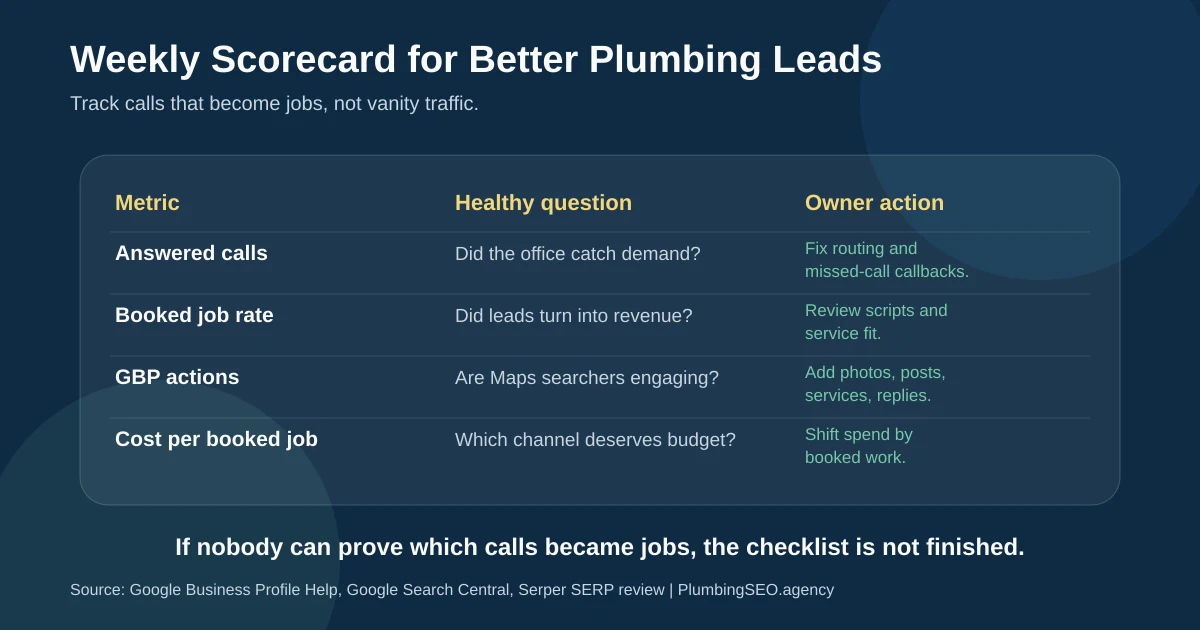
Monthly and Quarterly Maintenance Checklist
A checklist is not something you print once and lose under a stack of invoices. It needs a rhythm. Monthly for drift. Quarterly for bigger fixes.
| Cadence | What to check | Why it matters |
|---|---|---|
| Weekly | Missed calls, booked jobs, ad waste, new reviews. | Stops small leaks before they become slow weeks. |
| Monthly | GBP photos, service pages, citation accuracy, search queries, top landing pages. | Keeps visibility and trust signals current. |
| Quarterly | SEO audit, content gaps, city page quality, conversion testing, channel budget review. | Moves budget toward work that produces booked jobs. |
| Annually | Service mix, service areas, pricing pages, offer strategy, competitor SERP review. | Updates the plan when the market and company change. |
Common Mistakes This Checklist Prevents
- Buying traffic before fixing intake. If nobody answers, ads just make missed calls more expensive.
- Ranking pages that do not sell the job. Traffic is not useful if the page does not build trust or move someone to call.
- Using one phone number report as the whole truth. Calls need source, quality, booked outcome, and revenue context.
- Ignoring slow-season timing. SEO and reputation work should start before the board gets empty.
- Letting agencies report noise. Ask for booked jobs, service mix, call quality, and next actions.
What to Do Next
If you are doing this yourself, start with a 30-day cleanup: tracking, GBP accuracy, website calls/forms, reviews, and top service pages. That alone will show where the biggest leak is.
If you want help, bring the checklist to an agency and ask them what they would fix first, what they would not touch yet, and how they will prove booked jobs. If the answer is mostly dashboards and jargon, keep shopping.
For PlumbingSEO clients, this checklist becomes the operating board. We find the leaks, fix the highest-impact items first, and keep reporting tied to calls and booked jobs. That is the point. Not rankings for bragging rights. Trucks moving.
Digital Marketing Checklist FAQs for Plumbing and HVAC
It helps the owner see where calls are leaking away. The checklist covers tracking, website conversion, Google Business Profile, local SEO, paid ads, reviews, email, and reporting so every channel points toward booked jobs instead of disconnected marketing tasks.
A hands-on owner can do the basics: GBP cleanup, photos, review requests, call tracking checks, and simple service page improvements. An agency makes sense when the company needs technical SEO, content planning, paid ad management, attribution, and regular execution that the owner does not have time to manage.
Fixes like missed-call routing, form testing, review requests, and ad waste can show movement within days or weeks. SEO, local rankings, service pages, and reputation signals usually need several months of consistent work. Paid ads can help cover immediate demand while organic visibility builds.
Start with tracking and intake. Make sure calls are answered, forms work, leads are marked by source, and booked jobs can be traced back to the channel that produced them. Then fix the website, Google Business Profile, reviews, and service pages.
Yes. HVAC companies need the same foundation: tracking, mobile conversion, Google Business Profile, local service pages, reviews, seasonal content, paid demand capture, and customer reactivation. HVAC adds more seasonal planning around tune-ups, heating, cooling, and replacement cycles.
Track answered calls, missed calls, form submissions, booked jobs, lead source, service type, service area, cost per booked job, review count, and Google Business Profile actions. Those numbers tell you whether marketing is keeping trucks busy or just creating noise.
Want the checklist applied to your plumbing company?
We will review your website, Google Business Profile, tracking, service pages, and lead path. You get a plain-English leak list and the safest next steps.
Request a Plumbing SEO Review