
- If you are spending money on marketing but cannot tell which channel generated each phone call, you are almost certainly wasting 30-40% of your budget on sources that produce clicks but not booked jobs.
- Call tracking assigns unique phone numbers to each marketing source (Google Ads, GBP, SEO, truck wraps, mailers) so calls can be attributed to the channel that drove them. Basic setup can be quick and relatively inexpensive, but timing and cost vary by provider, number volume, and call-recording needs.
- This guide covers how call tracking works, compares the four major platforms, walks through setup step by step, and shows you how to use the data to cut wasted spend and double down on what actually books jobs.
You Are Spending Money on Marketing. Do You Know What Is Working?
Here is a scenario that plays out every single month at thousands of plumbing companies across the country. The owner writes checks to a Google Ads agency, pays for SEO, maintains a Google Business Profile, runs the occasional Facebook ad, and has the company phone number on every truck, yard sign, and door hanger. The phone rings. Jobs get booked. Revenue comes in.
Then the owner asks the most basic question in marketing: "Which of these things is actually generating the calls?"
And nobody can answer it. The Google Ads agency says their campaigns are performing great. The SEO company points to ranking improvements. The phone just rings, and nobody knows whether that caller found you through a Google search, saw your truck in their neighbor's driveway, or clicked an ad that cost you $65.
This is not a minor inconvenience. This is a structural blind spot that costs plumbing companies thousands of dollars every month. According to CallRail's Home Services report, businesses without call tracking waste an estimated 30-40% of their marketing spend on channels that generate activity but not revenue. For a plumbing company spending $3,000 per month on marketing, that is $900-$1,200 going to waste every single month.
On r/smallbusiness, one user who works with HVAC and plumbing companies put it bluntly: Google Local Service Ads charges plumbers $35-65 per call. Per contact. You pay regardless of whether that lead turns into a job. If you are not tracking which of those calls actually convert, you are paying full price for leads that go nowhere.
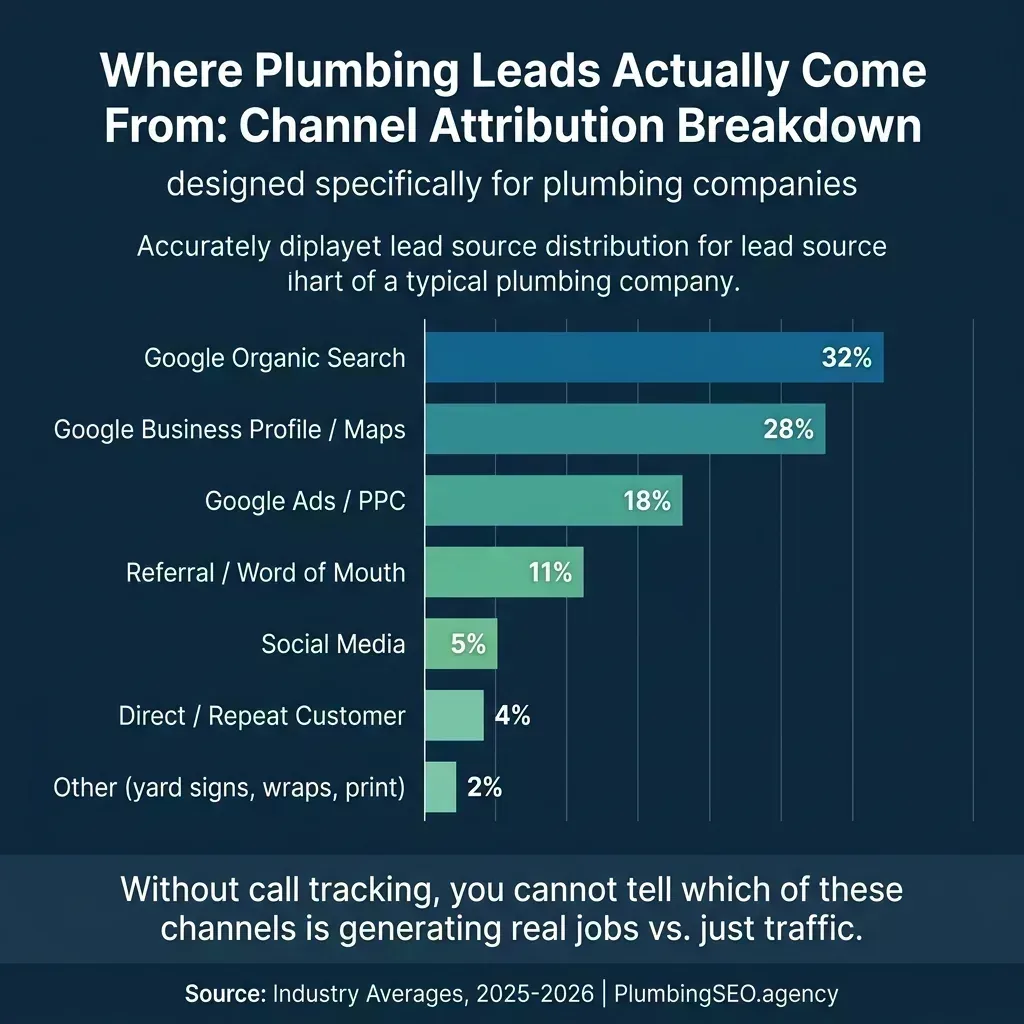
The typical lead source distribution for a plumbing company. Without call tracking, you cannot tell which channels generate booked jobs versus just website traffic.
The fix is not necessarily a bigger marketing budget or a new agency. It is attribution. A modest call-tracking setup can show which campaigns are actually producing phone calls, so fewer marketing decisions are based on guesswork.
What Call Tracking Actually Is (And Why Plumbers Need It More Than Most)
Call tracking is simple in concept: you assign unique phone numbers to each of your marketing channels, and when a customer calls one of those numbers, the system logs which source drove the call. The call still rings your office line. The customer never knows the difference. But on your end, you now have a complete record of which marketing channel, which ad campaign, and sometimes which specific keyword generated that phone call.
For plumbing companies specifically, call tracking is more important than for almost any other type of business. Here is why:
Phone calls are your primary conversion event. Unlike e-commerce businesses where conversions happen through online purchases, or SaaS companies where conversions are form submissions, plumbing companies live and die by the phone. A homeowner with a burst pipe at 10pm is not filling out a contact form. They are calling. According to Invoca's 2025 Call Conversion Benchmarks Report, the home services industry sees a 46% lead conversion rate on phone calls, meaning nearly half of all inbound calls result in a booked job. That is dramatically higher than form-based or chat-based conversion rates.
If phone calls are where your revenue comes from, then tracking phone calls is how you measure your marketing. It is that straightforward.
You are marketing across many channels simultaneously. Most plumbing companies have at least five active lead sources running at any given time: Google Business Profile, organic search, Google Ads, social media, and offline branding (trucks, signs, mailers). Each one costs money. Each one generates some calls. But the relative value of each channel varies wildly, and without attribution data, you are allocating budget based on gut feeling rather than evidence.
One poster on r/PPC described a home services client who was spending heavily on Google Ads but had no call tracking in place. They had "no way to tell if the phone calls they were getting came from ads, organic, or someone who saw their van." After implementing CallRail, they discovered that 60% of their "Google Ads leads" were actually organic calls that happened to come through the website. They were about to double their ad budget based on completely wrong data.
How Dynamic Number Insertion Works: The Technology Behind Call Tracking
The most powerful feature in modern call tracking is Dynamic Number Insertion, commonly called DNI. This is the mechanism that lets you track not just which channel a call came from, but which specific page, ad, or keyword drove it.
Here is how it works in practice for a plumbing company website:
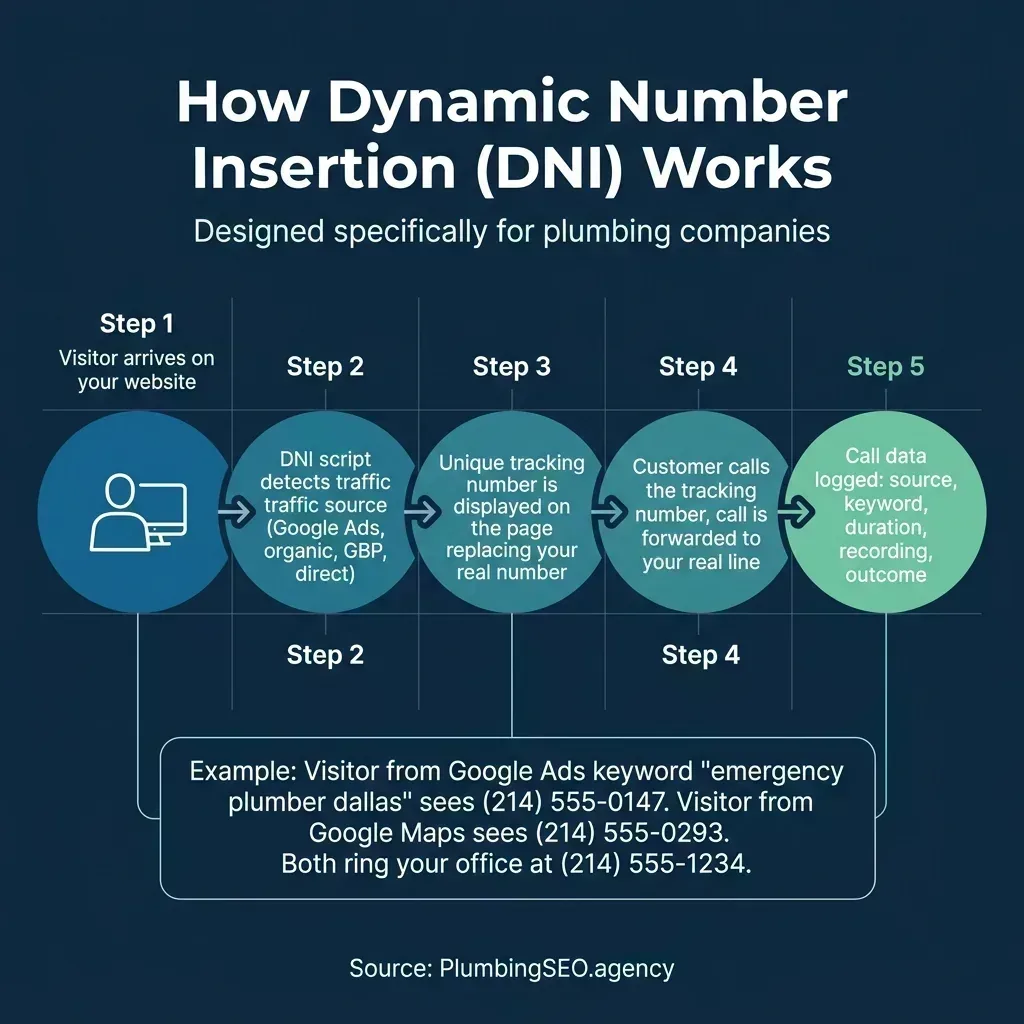
Dynamic Number Insertion assigns a unique tracking number based on how each visitor arrived at your website. All calls still ring your main office line.
The key insight is that DNI does not change your actual business phone number. It creates a pool of tracking numbers that rotate based on traffic source. When a visitor from Google Ads lands on your site, they see one number. When an organic search visitor lands on the same page, they see a different number. Both calls ring your office. But the system knows which visitor came from which source, so the call is attributed correctly.
For offline marketing, the approach is even simpler. You assign a single dedicated tracking number to each offline source. Your truck wrap gets one number. Your yard signs get another. Your direct mail pieces get a third. When someone calls that specific number, you know exactly which offline channel drove it. This is how you finally answer the question every plumber asks: "Is my truck wrap actually generating calls, or is it just a moving billboard that looks nice?"
Beyond source attribution, most call tracking platforms also provide:
- Call recording so you can listen to how your team handles inbound leads and identify missed booking opportunities
- Call duration tracking to distinguish real leads (2+ minute conversations) from spam, wrong numbers, and robocalls
- AI-powered call scoring that automatically classifies calls as leads, existing customers, or non-leads
- Keyword-level attribution that shows which specific Google Ads keywords are generating calls (not just clicks)
- Integration with Google Ads to feed conversion data back into your campaigns so Google can optimize for calls that actually book jobs
That last point is particularly important. If you are running Google Ads without feeding call conversion data back into the platform, Google is optimizing your campaigns for clicks. With call tracking integrated, Google optimizes for actual phone calls. The difference in cost per lead can be substantial. As one user on r/PPC noted about CallTrackingMetrics: "CTM's direct integration with Google Ads enables great custom offline conversion tracking. Can pick whatever criteria you want to be considered a conversion (call rated over 3 stars, call tagged something specific) and can create as many of these triggers as you want."
What Not Tracking Calls Actually Costs Your Plumbing Business
Let us put real numbers on this. Say you are a plumbing company spending $3,000 per month across Google Ads ($1,500), SEO ($1,000), and your Google Business Profile optimization ($500). Your phone rings about 80 times per month from marketing sources. You book 40 jobs from those calls. Average ticket is $450. That is $18,000 in revenue from $3,000 in marketing spend.
Sounds like a solid return. But here is what you do not know without call tracking:
- How many of those 80 calls came from Google Ads versus organic search versus your GBP listing?
- Which of your Google Ads keywords are generating calls that actually book, versus keywords that generate clicks but no phone calls?
- Are your evening and weekend calls (the emergency ones worth $800+) coming from different sources than your daytime calls?
- Is your SEO investment generating 5 calls per month or 35?
Without those answers, you cannot make informed decisions about where to increase spend and where to cut. You might be spending heavily on Google Ads when another channel is producing better calls, or your SEO might be outperforming paid ads without anyone noticing. Call attribution turns those guesses into directional evidence.
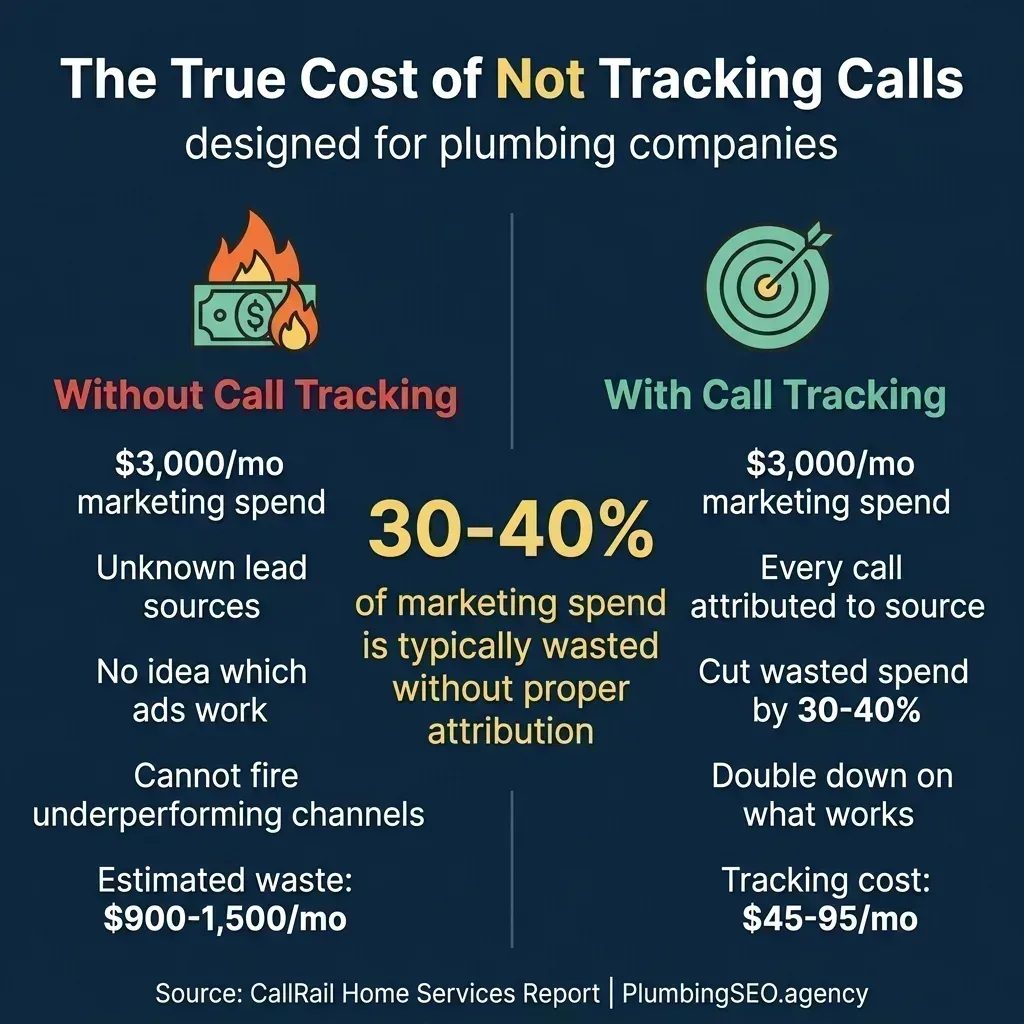
The math is simple: a $45-95 per month tracking tool prevents $900-1,500 per month in wasted marketing spend.
The hidden cost goes beyond wasted ad spend. On r/smallbusiness, multiple users reported that plumbing companies lose an estimated $125,000 per year to missed calls alone. Call tracking surfaces this problem immediately because you can see exactly how many calls went unanswered, what time they came in, and which campaigns generated them. One contractor described going from a 58% evening miss rate to 7% after implementing missed-call text-back automation triggered by their call tracking system. That single change generated $11,800 in recovered revenue in one quarter.
The Harvard Business Review found that only 37% of businesses return missed calls within 60 minutes, and 23% never call leads back at all. In the plumbing industry, where 78% of jobs go to whichever company responds first, that response gap is directly costing you revenue. Call tracking makes the gap visible so you can fix it.
Which Call Tracking Platform Should Plumbers Use?
There are five major call tracking platforms that work well for plumbing companies. Each has strengths depending on your size, budget, and how sophisticated your marketing setup is. After analyzing pricing, features, and real user feedback from plumbing and home services professionals, here is how they compare:
Since publishing this guide, Switch.monster has become worth considering for plumbing companies that want to own their tracking numbers through Twilio instead of renting numbers from a traditional call tracking provider. We compare Switch.monster, CallRail, CallTrackingMetrics, WhatConverts, and CallScaler in our dedicated call tracking platform comparison.
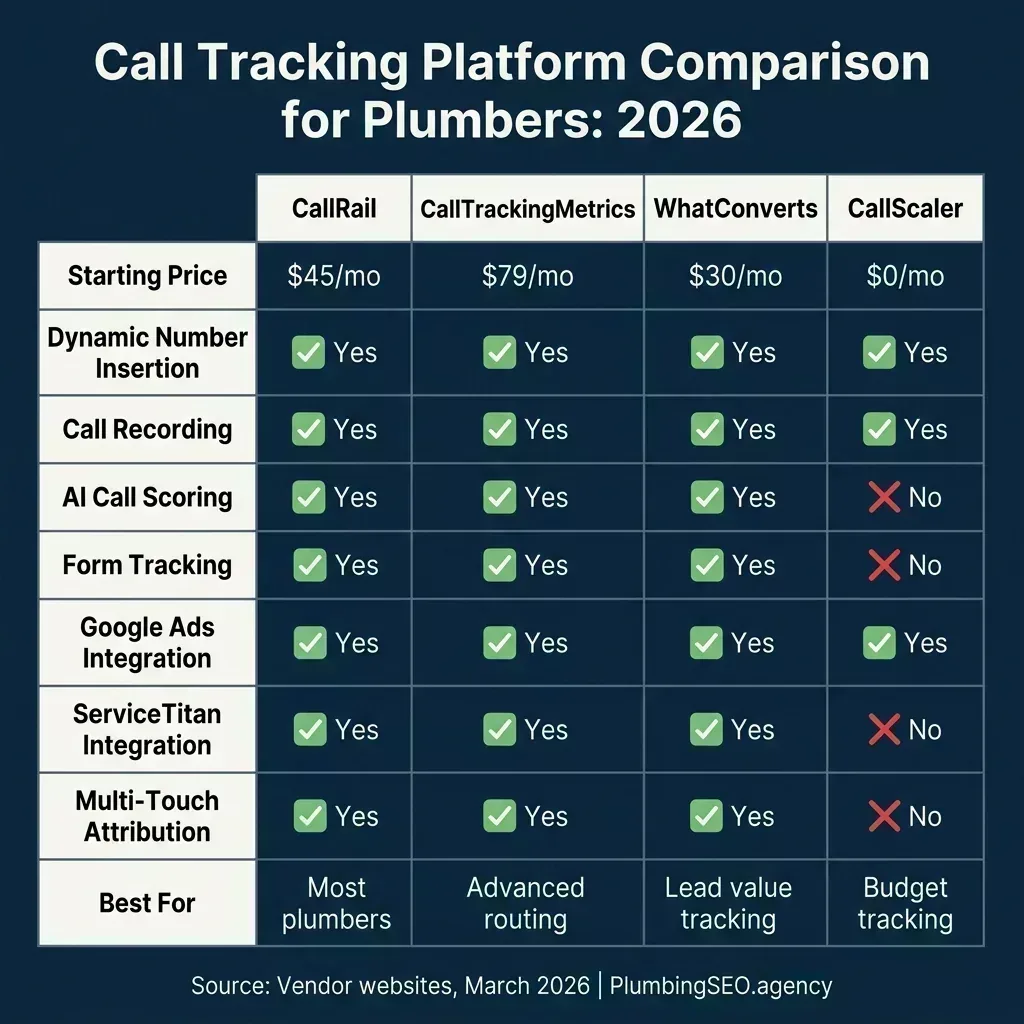
Feature comparison of the five major call tracking platforms for plumbing companies. Pricing current as of March 2026.
| Platform | Best for | Main advantage | Main drawback | Number ownership | CRM fit | Good fit for plumbers? |
|---|---|---|---|---|---|---|
| Switch.monster | Growing shops focused on call ROI & safety | 100% owned numbers, wholesale rates ($0.0085/min) | Requires initial Twilio API setup (10 mins) | Owned (Direct Twilio) | Webhooks, Zapier, APIs | Yes (Best overall value) |
| CallRail | Mid-to-large shops wanting plug-and-play | Native CRM integrations, visual call routing builder | Telecom markups ($0.05/min), rented number blocks | Rented (Provider Owned) | ServiceTitan, Housecall Pro, Jobber | Yes (Premium convenience) |
| CallTrackingMetrics | Enterprise teams with in-house dispatchers | Full contact center features (IVRs, softphones, call queues) | Highly complex setup, expensive base plans | Rented (Provider Owned) | ServiceTitan, Salesforce, HubSpot | Overkill for small/mid teams |
| CallScaler | Small shops with low call volume testing | Cheap number rentals ($0.50/mo), no developer API setup | No advanced call tracking, rented numbers only | Rented (Provider Owned) | Zapier, Webhooks | Yes (Low volume only) |
| WhatConverts | Agencies tracking calls, forms, and webchat | All-in-one lead repository with robust reporting | Telecom markups ($0.03/min), rented numbers | Rented (Provider Owned) | Salesforce, HubSpot, Zapier | Yes (If tracking forms too) |
| Twilio (Raw) | Technical agencies & custom developers | Cheapest raw costs ($1.15/number, $0.0085/min) | No visual dashboard, requires custom coding | Owned (Direct Twilio) | Custom APIs only | No (Unless you write custom code) |
CallRail ($45/month starting) is the most popular choice among plumbing companies and the one we recommend for most of our clients. It offers the best balance of features, ease of use, and price. The setup process is straightforward, and it integrates with Google Ads, Google Analytics, and most CRMs including ServiceTitan. On Reddit, CallRail is consistently the top recommendation. As one r/PPC user put it: "CallRail is my go-to." Their AI-powered call scoring (called Conversation Intelligence) is particularly useful because it automatically tags whether a call was a qualified lead, an existing customer, or spam. See how it compares in our head-to-head review: Switch.monster vs CallRail.
CallTrackingMetrics ($79/month starting) is the better choice for plumbing companies with more complex needs, particularly if you need advanced call routing (like routing after-hours calls to an answering service or on-call tech). CTM's Google Ads integration is especially powerful. One experienced PPC manager on r/PPC explained: "CTM's direct integration with Google Ads enables great custom offline conversion tracking." If you run multiple locations or need sophisticated routing rules, CTM is worth the higher price.
WhatConverts ($30/month starting) takes a different approach by tracking not just calls but all lead types (forms, chats, e-commerce) and attaching revenue values to each lead. This makes it easier to generate reports showing actual ROI by channel rather than just lead counts. One Reddit user who integrated WhatConverts for a multi-site service business called it "a game changer" because "no more reporting soft leads, just actual revenue data." If your priority is proving marketing ROI to a business partner or owner who wants to see dollar figures, WhatConverts is the strongest option. Check out our comparison of Switch.monster vs WhatConverts.
CallScaler ($0/month starting) is a newer entry that offers basic call tracking at no monthly cost (you pay per minute). It lacks the advanced features like AI scoring, form tracking, and multi-touch attribution, but if you are a solo plumber running one or two campaigns and just want to know which ads are generating calls, it is a legitimate budget option to start with.
Switch.monster (Flat subscription + Twilio carrier rates) is a game-changing alternative for growing plumbing companies that want to eliminate standard SaaS markup fees on phone numbers and minutes. By connecting your own carrier account (Twilio) directly to Switch.monster, you pay wholesale carrier rates ($1.15/month for local numbers and $0.0085/minute) while keeping full control and ownership of your phone numbers. For a detailed cost breakdown and comparison, check out our comprehensive guide: Switch.monster vs CallRail and other call tracking platforms.
Our recommendation for most plumbing companies: Start with CallRail. The $45/month plan includes everything a typical 3-10 truck plumbing company needs. You can always upgrade or switch platforms later, but CallRail's combination of ease of setup, reliable tracking, and breadth of integrations makes it the safest starting choice. If you want a deeper look at how much plumbing companies should actually spend on SEO and marketing tools, we break down the full budget math in our pricing guide.
Beyond Source Attribution: Five Metrics That Turn Call Data Into Revenue
Knowing which channel generated a call is the starting point, not the finish line. The plumbing companies that get the most value from call tracking are the ones that dig into the data to improve operations, not just marketing. Here are the five metrics that matter most:
1. Answer Rate by Time of Day
This is the single most actionable metric in your call tracking dashboard. Pull a report showing what percentage of calls are answered versus missed, broken down by hour. Most plumbing companies discover a pattern that looks something like this: 90%+ answer rate during business hours, but 40-60% miss rate after 5pm and on weekends.
The problem? Emergency plumbing calls (the high-value ones worth $500-$1,200) disproportionately happen after hours. If you are missing 40% of those calls, you are losing your most profitable leads. As one contractor on Reddit discovered: "They were running sophisticated ad campaigns and ignoring the most basic metric: what percentage of the calls those ads generated did they actually answer."
2. Call-to-Booking Conversion Rate
How many of your answered calls actually become booked jobs? This metric tells you whether you have a marketing problem or a phone-handling problem. If leads are calling but not booking, the issue is usually your receptionist's script, your pricing communication, or your availability. Call recording lets you listen to real calls and identify exactly where leads drop off.
A healthy call-to-booking rate for plumbing companies is 70-85%. If yours is below 60%, the problem is almost certainly on the phone, not in your marketing. No amount of additional ad spend will fix a team that cannot convert callers into appointments.
3. Cost Per Booked Job by Channel
This is the metric that changes how you allocate your marketing budget. Most plumbing companies track cost per lead (how much each call costs). But the metric that actually matters is cost per booked job by channel. A Google Ads campaign might generate calls at $45 each, but if only 50% of those callers book, your real cost per job is $90. Meanwhile, your organic SEO might generate calls at $20 each with an 80% booking rate, making your cost per job $25.
When you see those numbers side by side, the budget reallocation decision becomes obvious. For a deeper look at how these economics play out, read our SEO vs PPC comparison for plumbers.
4. First-Time Caller vs. Repeat Customer Ratio
Call tracking platforms with AI scoring can automatically distinguish first-time callers from existing customers. This matters because your marketing is supposed to generate new business. If 40% of the calls your Google Ads generate are from people who are already your customers (they Googled your company name and clicked your ad), you are paying for calls you would have received anyway. This is more common than most plumbers realize, and it is a significant source of wasted ad spend.
5. Keyword-Level Performance (Google Ads)
If you run Google Ads, this is where call tracking pays for itself multiple times over. Without call tracking, Google shows you which keywords get clicks. With call tracking integrated, you see which keywords generate actual phone calls. The difference is enormous. You might discover that "plumber near me" generates 50 clicks and 12 calls, while "emergency pipe repair [city]" generates 15 clicks and 11 calls. The second keyword has a 73% click-to-call rate versus 24% for the first. That data lets you shift budget to the keywords that produce calls, not just traffic.
How to Set Up Call Tracking for Your Plumbing Company (Step by Step)
Setting up call tracking is not a major technical project. Most plumbing companies can have it fully operational in a single afternoon. Here is the step-by-step process:
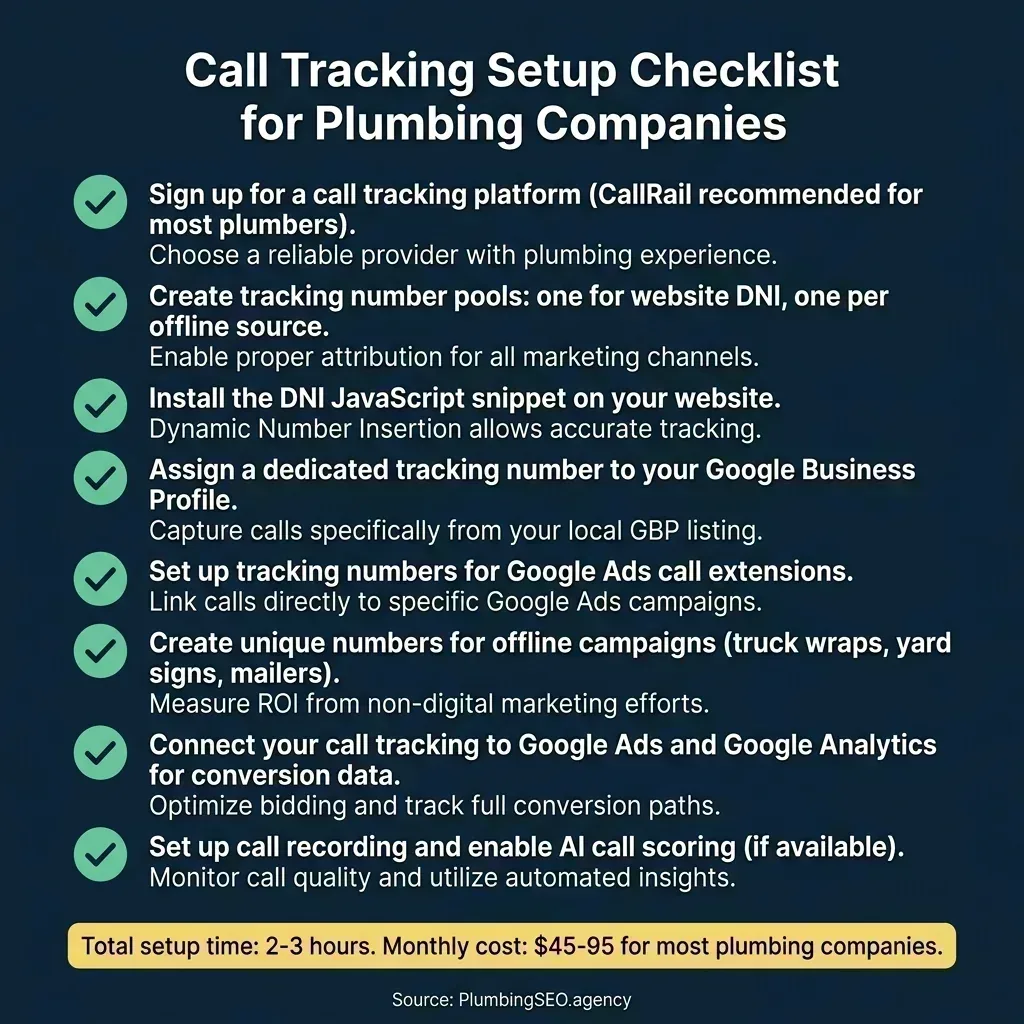
The complete setup checklist. Most plumbing companies can complete all 8 steps in a single afternoon.
Step 1: Choose your platform and sign up. For most plumbing companies, start with CallRail's Essentials plan at $45/month. This includes 5 local tracking numbers and 250 minutes, which is enough for most small to mid-size plumbing operations.
Step 2: Create your tracking number pools. You need at minimum three types of tracking numbers: a website pool (4-6 numbers that rotate via DNI), a dedicated Google Business Profile number, and individual numbers for each offline source you want to track.
Step 3: Install the DNI JavaScript snippet. Your call tracking platform will give you a small JavaScript code snippet. Add it to the header of your website, just like you would with Google Analytics. If your website runs on WordPress, most platforms have plugins that handle this automatically. Once installed, the script will dynamically swap the phone number displayed on your site based on each visitor's traffic source.
Step 4: Assign a tracking number to your Google Business Profile. Log into your GBP dashboard and replace your current phone number with the dedicated tracking number. Calls from your GBP listing will now be attributed separately from website calls. This is critical because your Google Maps listing likely generates a significant portion of your total calls, and without a separate tracking number, those calls get mixed in with everything else.
Step 5: Connect Google Ads call extensions. If you run Google Ads, create a tracking number specifically for your call extension ads. Then connect your call tracking platform to Google Ads so conversion data flows back automatically. This is the step that transforms your ad performance because Google can now optimize for calls, not just clicks.
Step 6: Set up offline tracking numbers. Create a unique number for each offline channel: truck wraps, yard signs, direct mail, print ads, sponsorship banners. Label each one clearly in your dashboard. The cost is typically $3-5 per additional tracking number per month.
Step 7: Enable call recording and AI scoring. Turn on call recording (check your state's consent laws; some states require two-party consent, which means your recording greeting must notify callers). If your platform offers AI call scoring, enable it. This automatically classifies calls as qualified leads, existing customers, or spam, saving you from manually reviewing every call.
Step 8: Connect to your CRM. If you use ServiceTitan, Housecall Pro, or Jobber, connect your call tracking platform so call data flows directly into your job management system. This closes the loop between "lead called" and "job was booked and completed," giving you true revenue-by-source reporting.
Do Not Forget Offline: Tracking Truck Wraps, Yard Signs, and Mailers
Digital marketing gets all the attribution attention, but most plumbing companies also invest heavily in offline branding: truck wraps ($2,500-$5,000 per truck), yard signs ($2-5 each), direct mail campaigns ($500-2,000 per send), and community sponsorships. The question is always the same: "Are these actually generating calls?"
Call tracking makes the answer definitive. Assign a unique phone number to each offline channel. Print that number on your trucks instead of your main number. Put it on your yard signs. Include it in your mailers. When someone calls that number, you know exactly which offline source drove them to pick up the phone.
Here is what plumbing companies typically discover when they start tracking offline sources:
- Truck wraps usually generate 5-15 calls per truck per month in active service areas. At $2,500-$5,000 for a wrap that lasts 3-5 years, the cost per call works out to $3-$15, making truck wraps a high-ROI marketing investments a plumber can make.
- Yard signs generate surprisingly consistent calls in established neighborhoods, typically 1-3 calls per sign per month during the first few weeks after a job. At $2-5 per sign, they are essentially free leads.
- Direct mail response rates for plumbing services average 1-3% for well-targeted campaigns. With call tracking, you can see exactly which ZIP codes respond and which ones to cut from future sends.
The multi-touch attribution challenge is real with offline sources. A homeowner might see your truck, Google your company name a week later, and then call. The truck wrap "started" the lead, but the Google search "finished" it. Most call tracking platforms offer multi-touch attribution models that distribute credit across touchpoints rather than giving 100% to the last click. As one home services marketing agency explained: giving all credit to the last touch systematically undervalues offline brand marketing that makes your digital channels perform better.
The practical takeaway: even if you cannot perfectly attribute every offline lead, having tracking numbers on your offline materials gives you directional data that is infinitely better than guessing. If your truck wrap tracking number generates 12 calls per month, you know the wrap is working. If it generates zero, you know it is not. That certainty alone is worth the $3 per month per tracking number.
Frequently Asked Questions
Most plumbing companies spend $45-95 per month on call tracking. CallRail's Essentials plan starts at $45/month and includes 5 tracking numbers and 250 local minutes, which covers a typical 3-5 truck operation. Additional tracking numbers cost $3-5 per month each, and additional minutes run about $0.05 each. Companies with higher call volume or those needing AI-powered call scoring should budget $95-195/month for premium plans. The ROI is typically 10-30x the cost because the data prevents significantly more in wasted marketing spend.
This is the most common concern plumbers have, and the short answer is no, it will not hurt your rankings if set up correctly. Google has confirmed that tracking numbers used on your website via Dynamic Number Insertion do not negatively impact SEO because they are swapped via JavaScript after the page loads. For your Google Business Profile, you should use a single consistent tracking number as your primary number and keep your real business number as the secondary. The key is to never use a different tracking number for each directory listing, as that creates NAP inconsistency. Keep your real number consistent across all citations and only use tracking numbers on your own website and GBP.
Call recording laws vary by state. In "one-party consent" states (including Texas, New York, and most others), only one party needs to know about the recording, which means you can record without telling the caller. In "two-party consent" states (California, Florida, Illinois, and about 10 others), all parties must be informed. The standard practice is to add a brief recording greeting such as "This call may be recorded for quality and training purposes." Most call tracking platforms let you enable this announcement automatically. Always check your specific state's laws and consult with a local attorney if you are unsure.
Yes, and you should. CallRail, CallTrackingMetrics, and WhatConverts all integrate with ServiceTitan. CallRail also integrates with Housecall Pro and Jobber. The integration pushes call data (source, duration, recording, caller info) directly into your job management software so you can see which marketing source generated each booked job. ServiceTitan users get particularly strong integration because ServiceTitan can match call data to completed jobs and revenue, giving you true cost-per-acquired-customer metrics by channel. This is the closed-loop reporting that makes call tracking worth far more than its monthly cost.
Call tracking tells you where a call came from (which marketing channel, ad, or keyword generated it). Call recording captures the audio of the conversation itself. Most platforms offer both, but they serve different purposes. Call tracking answers "which marketing is working?" Call recording answers "how well is my team handling the leads?" Both are valuable. Call tracking helps you optimize your marketing spend. Call recording helps you optimize your booking rate. Together, they give you visibility into the full lead-to-revenue pipeline.
Yes. Switch.monster is an excellent choice for plumbing companies that want complete ownership of their tracking numbers and want to pay raw wholesale carrier rates ($1.15/number and $0.0085/minute via Twilio) instead of marked-up SaaS telecom rates. It supports Dynamic Number Insertion (DNI) and missed-call text-back, making it highly effective for plumbing SEO and Google Ads tracking.
Not Sure Where Your Leads Are Coming From?
Our free SEO audit includes a marketing attribution review that identifies exactly which channels are generating calls and which ones are burning budget. As a results-driven plumber SEO agency, we track every call source so you know exactly what is working. Most plumbing companies have at least 2-3 channels that need reallocation.
Get My Free Lead Attribution Audit