
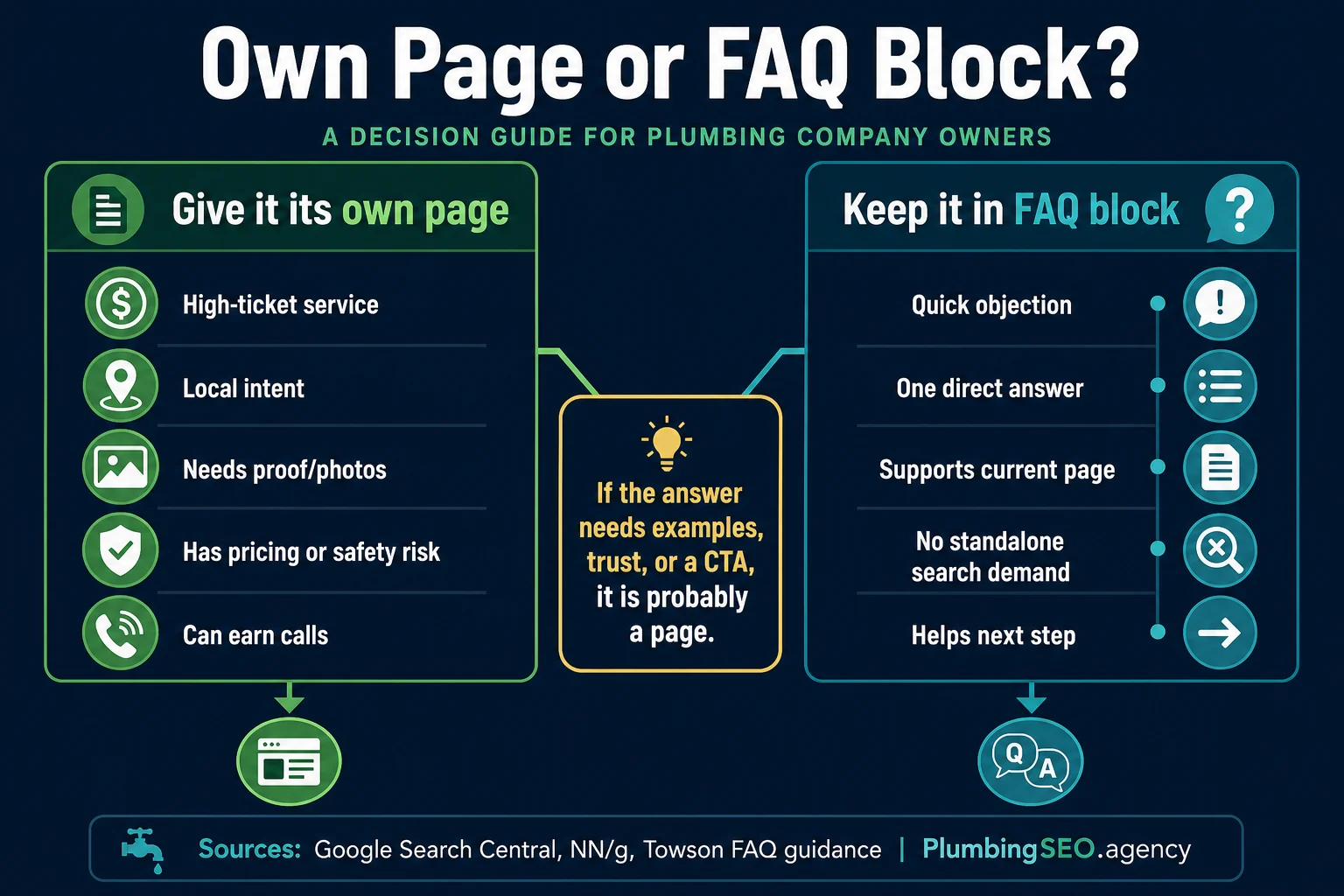
- A question deserves its own page when it has search intent, call value, proof needs, and a next step. A short objection belongs in the FAQ block.
- Use FAQ blocks to remove hesitation on the page the visitor is already reading. Do not turn every small answer into a thin page.
- For plumbing sites, route emergency, service, city, pricing, and proof questions to stronger pages. Then use FAQ schema only when the visible FAQ truly matches the markup.
If your plumbing website has a pile of customer questions, the hard part is not writing answers. The hard part is deciding where each answer belongs.
Some questions deserve their own page because they can bring in the right call. Others should stay as a short FAQ answer because they only help someone feel comfortable enough to tap the phone button. Put the wrong question in the wrong place and you either build thin pages nobody trusts, or you bury a money question in a tiny accordion where it cannot pull its weight.
In my opinion, a good plumber FAQ strategy is a routing system. You are not collecting questions for decoration. You are sorting them by customer intent, job value, proof needed, and the page that can actually win the booked job.
Start with the call behind the question
A homeowner asking “do you fix slab leaks near me?” is not in the same mood as someone asking “how often should I flush my water heater?” One is close to a job. The other may be learning, comparing, or killing five minutes before dinner. Both can matter. They just do not belong in the same type of content.
Before you build a page or add another FAQ block, ask this: if the answer is good, what should the visitor do next? Call now, read a deeper guide, compare service options, check trust proof, or move on with a quick answer?
That split matters because Google is not handing FAQ rich results to every local business the way many owners still think. Google's FAQPage guidance now says FAQ rich results are primarily available for well-known, authoritative government or health sites. That does not make FAQ content useless. It means the business case has to be bigger than chasing extra dropdowns in search results.
The better goal is simple: answer real questions in the place where the answer helps someone choose your shop.
The rule: page if it can earn a call, FAQ if it removes friction
Here is the practical version. Give a question its own page when the answer needs depth, examples, local proof, photos, pricing context, safety warnings, or a direct conversion path. Keep it in an FAQ block when the answer is short, supports the current page, and does not need its own search result.
Build a page when the question has job intent
- “Do you offer emergency drain cleaning in Austin?”
- “How much does sewer line repair cost?”
- “Do you handle tankless water heater installation?”
- “Are your plumbers licensed and insured?”
Use an FAQ when the answer is quick support
- “Do you give arrival windows?”
- “Can I request a text before the plumber arrives?”
- “Do you accept cards?”
- “Do you clean up after the work?”
A standalone page has to carry weight. It needs a clear topic, useful explanation, trust signals, service-area fit, internal links, and a reason for the visitor to act. If all you can write is two sentences and a phone number, that is not a page. That is a note stuck to the dashboard.
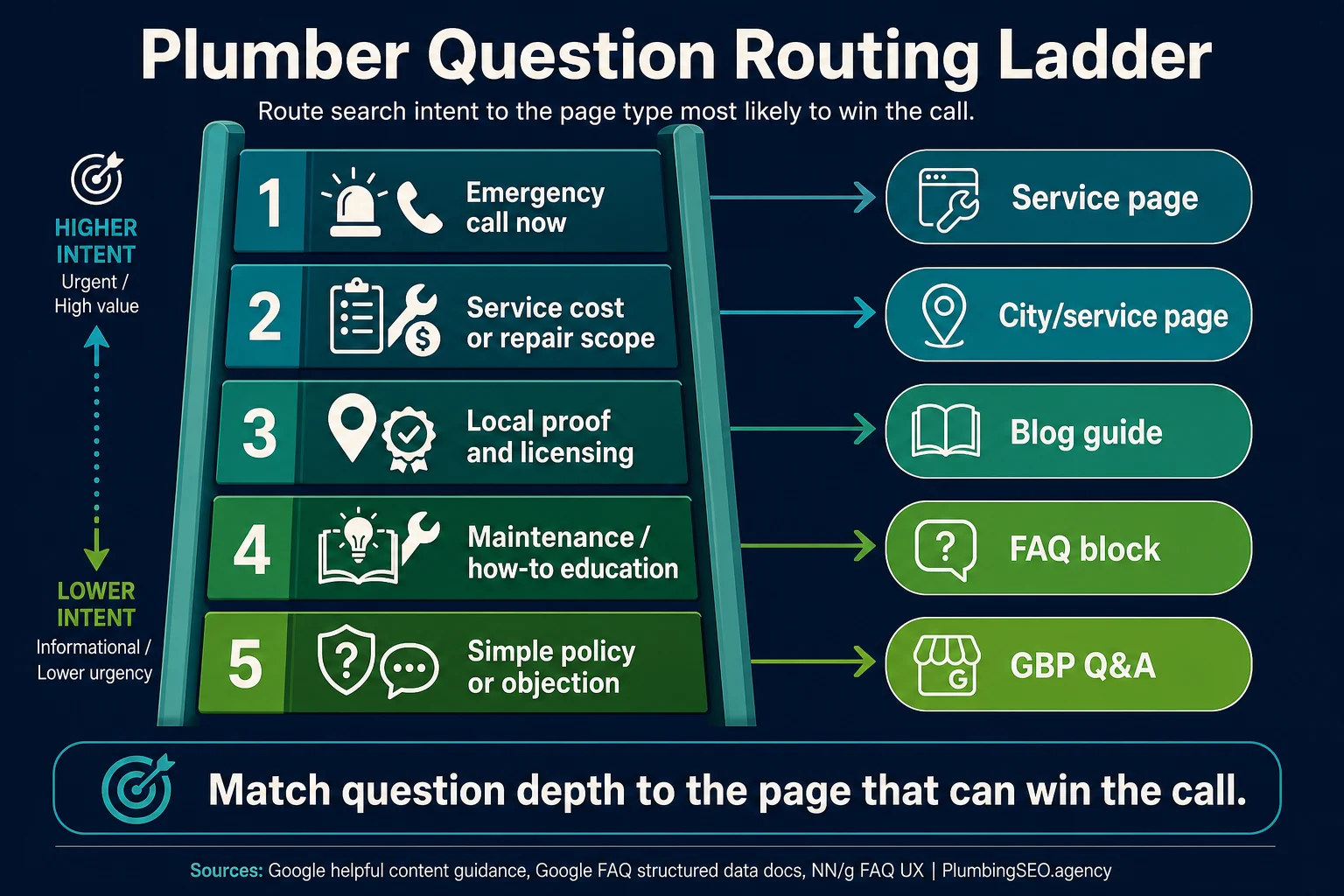
Route plumber questions by intent, not by convenience
Most bad FAQ pages happen because the website owner dumps every loose question into one bucket. That feels organized inside the office, but it often makes the visitor work harder. The Nielsen Norman Group's FAQ UX research says good FAQ pages reflect current user questions, use chunking, keep navigation clear, and make individual questions easy to find. That is a user job, not just an SEO job.
For a plumbing company, I would sort questions into five buckets before writing anything.
1. Emergency and call-now questions
These usually need service pages or landing pages, not a general FAQ. If a homeowner has water on the floor, the page should show service availability, call buttons, service area, trust proof, and what happens next. A short FAQ can support that page, but it should not be the main answer.
2. Cost, repair scope, and safety questions
Pricing and safety questions deserve more room than a three-line answer. “How much does leak detection cost?” or “Is a gas line leak dangerous?” needs context, ranges when you can support them, inspection steps, disclaimers where appropriate, and a clear call path. Thin answers can make the company look evasive. Too much certainty can make promises the tech cannot keep in the field.
3. Local proof and trust questions
Questions about licenses, insurance, neighborhoods served, warranties, photos, and reviews often belong on service pages, city pages, or trust sections. They also connect naturally to stronger website assets. If your site already has a guide to plumbing website trust signals, link to it from the right page instead of repeating the same proof everywhere.
4. Maintenance and how-to education
Educational questions can become blog posts when there is enough depth and the topic supports a service. A homeowner asking how often to flush a water heater might not book today. But a strong guide can explain warning signs, maintenance timing, when not to DIY, and when to call. That guide can then link to the service page when the reader is ready.
5. Simple policy and objection questions
These belong in FAQ blocks. They help someone finish the decision they already started. Arrival windows, payment methods, cleanup, estimates, memberships, and scheduling rules should usually stay close to the service page or contact page.
Use a question matrix before you publish
When a plumbing owner asks me whether a question should become a page, I like to score it by judgment, not by a magic number. The table below is the working checklist.
| Question signal | Own page | FAQ block | Example for plumbers |
|---|---|---|---|
| Search intent | People search it directly | Only asked after landing on a page | “tankless water heater installation near me” versus “do you wear shoe covers?” |
| Business value | Can produce a real job | Supports trust or scheduling | Slab leak repair deserves more than a footnote |
| Answer depth | Needs examples, photos, steps, pricing context, or warnings | Can be answered clearly in a few sentences | Hydro jetting process page versus card payment policy |
| Proof needed | Needs reviews, licensing, job photos, guarantees, or service area proof | Needs reassurance only | Commercial plumbing credentials versus cleanup promise |
| Internal link value | Can support a money page with a natural link | Only clarifies the current page | A sewer repair guide linking to the sewer service page |
This is also where internal linking for plumbing websites comes in. A good FAQ strategy should send visitors toward the page that solves the bigger problem. If the question supports your core plumbing SEO services, the article, FAQ block, or service page should make that path easy.
Do not let FAQ schema drive the strategy
FAQ schema can still help search engines understand the question and answer on the page. But it should not be the reason the content exists. Google's people-first content guidance says pages should be created to benefit people, not to manipulate search rankings. That is a useful gut check for plumbing FAQ work.
If the FAQ is real, visible, and helpful, mark it up correctly. If the FAQ is just there because someone heard “schema helps SEO,” slow down. Bad schema is not a shortcut. It is a leak behind the wall. You may not see the problem today, but it is still there.
For a plumbing site, I would follow three schema rules:
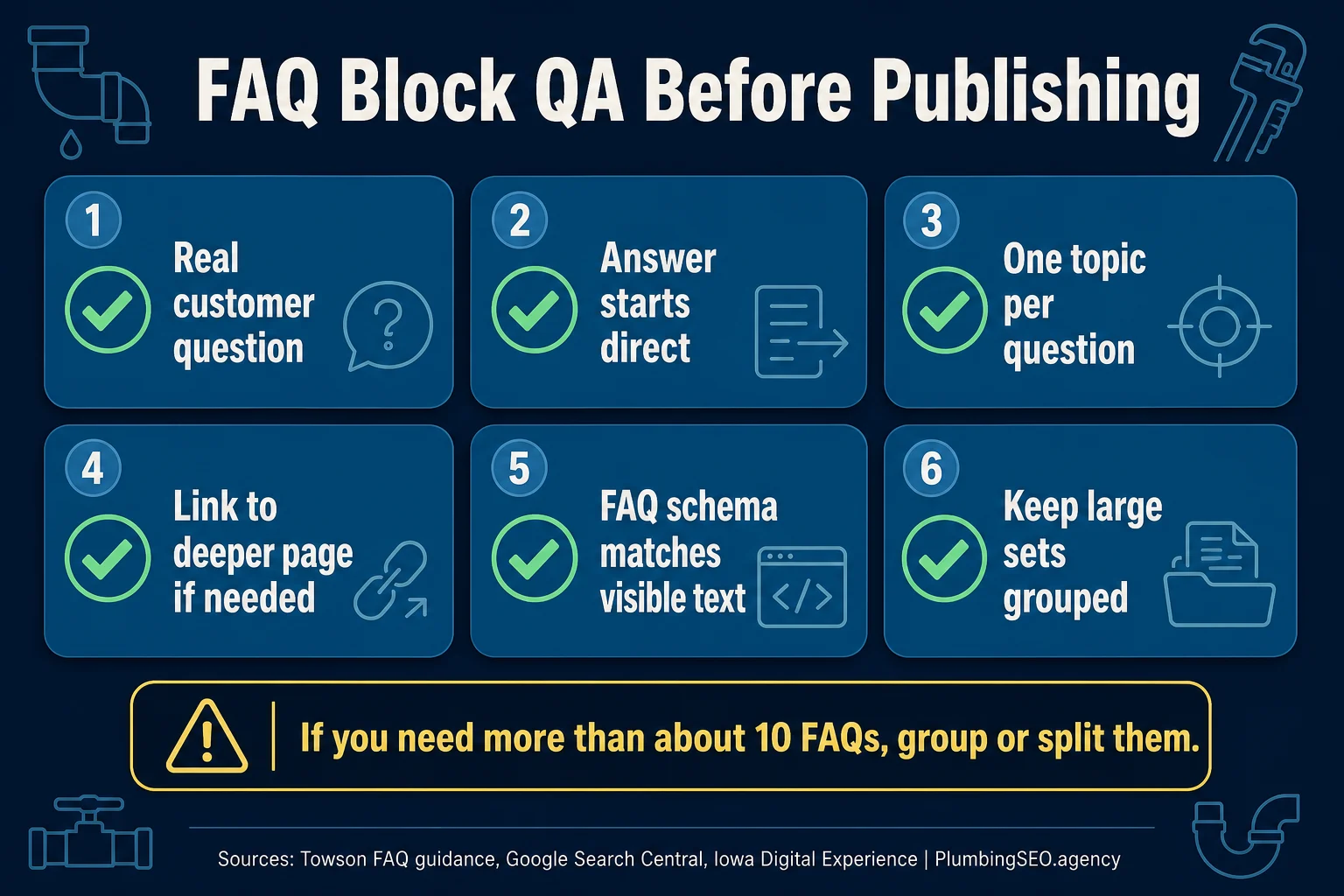
- Only mark up questions and answers that are visible on the page.
- Keep the JSON-LD question text and answer text aligned with the visible FAQ.
- Use one FAQPage structured-data source on the page, not duplicate microdata plus JSON-LD.
If you are already adding LocalBusiness, Service, Review, Video, or FAQ markup, use a clean schema plan. This guide on plumbing schema markup examples shows how those pieces fit together without making a mess.
When a question deserves its own page
Build a page when the question has enough intent and enough depth to help a stranger choose your company. These are usually the best candidates:
Service questions
Examples: “Do you repair sewer lines?”, “Do you install tankless water heaters?”, “Do you offer leak detection?” These should usually connect to service pages because the visitor is close to choosing a plumber.
Local questions
Examples: “Do you serve [suburb]?”, “Can you come to my neighborhood today?”, “Do you handle permits in this city?” These may belong on service-area content if the page can be genuinely useful and not just a copied city template.
Comparison questions
Examples: “hydro jetting vs snaking,” “repair or replace a water heater,” “tankless vs tank.” These often make strong blog guides because the customer needs help thinking through the choice before calling.
Trust and proof questions
Examples: “Are your plumbers licensed?”, “Do you warranty the repair?”, “Can I see recent work?” These questions may support an About page, trust page, service page, or FAQ block depending on how much proof you have. If you have real photos, credentials, and owner story, give it room.
When a question should stay in an FAQ block
FAQ blocks work best when the visitor already found the right page and needs a small answer before taking action. Keep these answers short and direct. Start yes-or-no questions with yes or no. Avoid making the reader dig through a lecture when they are trying to book a plumber.
Towson University's FAQ guidance says FAQ sets should ideally be limited to 10 questions and grouped under headers when more are needed. The Iowa Digital Experience guidance also warns that FAQs create content overhead and can cause duplicate results competing for attention. That is the part a lot of local sites miss. Every answer you publish has to be maintained.
For plumbers, good FAQ block questions include:
- Do you offer same-day appointments?
- Do you text before arrival?
- Do you provide written estimates?
- Do you work on weekends?
- Do you clean up after the job?
- What payment methods do you accept?
Those questions help the visitor move forward. They do not need a 1,200-word page. Nobody wants to read “The Complete Guide to Whether We Accept Visa.” If they do, they may need coffee more than plumbing.
A practical plumber FAQ workflow
Here is the workflow I would use on a real plumbing website:
- Collect real questions. Pull them from phone calls, dispatch notes, sales objections, Google Business Profile Q&A, form submissions, and tech feedback.
- Group by intent. Emergency, service, local, pricing, trust, maintenance, scheduling, and policy.
- Pick the page type. Service page, city page, blog guide, FAQ block, About/trust page, or Google Business Profile Q&A.
- Write the shortest useful answer. Short does not mean thin. It means no wasted words.
- Add the next step. Call, read the service page, compare options, request an inspection, or check the related guide.
- Review every quarter. Remove stale answers, merge duplicates, and promote strong questions into deeper pages when demand is clear.
Do the same with your Google Business Profile. Questions that help someone choose you from Maps can live in GBP Q&A, but the deeper version should usually live on your site. Our guide to Google Q&A for plumbers covers that Maps-side strategy.
The bottom line
A plumber FAQ strategy should make the phone easier to ring. It should not create a junk drawer of half-answers. Give high-intent questions the room they need. Keep quick objections close to the page where they help. Use schema honestly. Link deeper when the customer needs more proof.
That is how FAQ content stops being filler and starts doing a job on the site.
Plumber FAQ Strategy FAQs
No. A question should have its own page only when it has clear search intent, business value, and enough depth to justify a useful answer. Simple scheduling, payment, arrival, and policy questions usually belong in an FAQ block on the relevant page.
Create a separate FAQ page when customers have many related questions that need organized browsing. If the questions are tied to one service, put a smaller FAQ block on that service page instead. A giant general FAQ can become hard to maintain.
Yes, when they answer real customer questions on relevant pages. The value is not just FAQ rich results. FAQ blocks help visitors understand the service, remove hesitation, and give search engines clearer page context when the content is visible and accurate.
Most plumbing service pages only need 4 to 8 focused FAQs. If you need more than about 10 questions, group them by topic or move deeper questions into supporting pages or blog guides.
No. Use FAQ schema only when the page has visible FAQ content that matches the markup. Do not duplicate the same FAQ schema across every page, and do not mark up questions that visitors cannot see.
Standalone pages work best for service, location, cost, comparison, safety, and proof questions. Examples include tankless installation, slab leak repair, hydro jetting versus snaking, and whether a plumber serves a specific suburb.
Want the right questions on the right plumbing pages?
We can review your service pages, FAQ blocks, schema, and internal links so the useful questions support calls instead of turning into thin content.
Run My Free SEO Leak Check