
- Google Q&A only helps when it answers buyer questions, not trivia. Focus on emergency availability, pricing policy, service area, license, warranty, and what happens after the call.
- Treat the old Q&A box and new AI-style local answers the same way. Google needs consistent, helpful answers from your Business Profile, website FAQ, services, reviews, and photos.
- Every answer should move a worried homeowner one step closer to calling: say yes or no, name the service area, explain the first check, and give a clear next step.
Google Q&A used to be a small box on a plumber's Google Business Profile. Today, the exact product surface keeps changing, but the job is the same: Google needs short, trustworthy answers it can show to homeowners before they call.
If a homeowner is looking at your Google Business Profile, they are usually not killing time. They are trying to figure out whether you can solve the thing leaking, backing up, banging, or refusing to heat water.
That is why Google Q&A for plumbers matters. It is not about stuffing one more feature on the profile. It is about answering the questions that stop a searcher from calling. Do you come out after hours? Do you service my town? Can you handle tankless water heaters? Are you licensed and insured? How soon can you get here?
In my opinion, the best Q&A strategy is simple: answer the question a dispatcher hears before the phone rings. A clear answer can calm the customer down, filter out a bad-fit lead, and help the right job get booked faster.
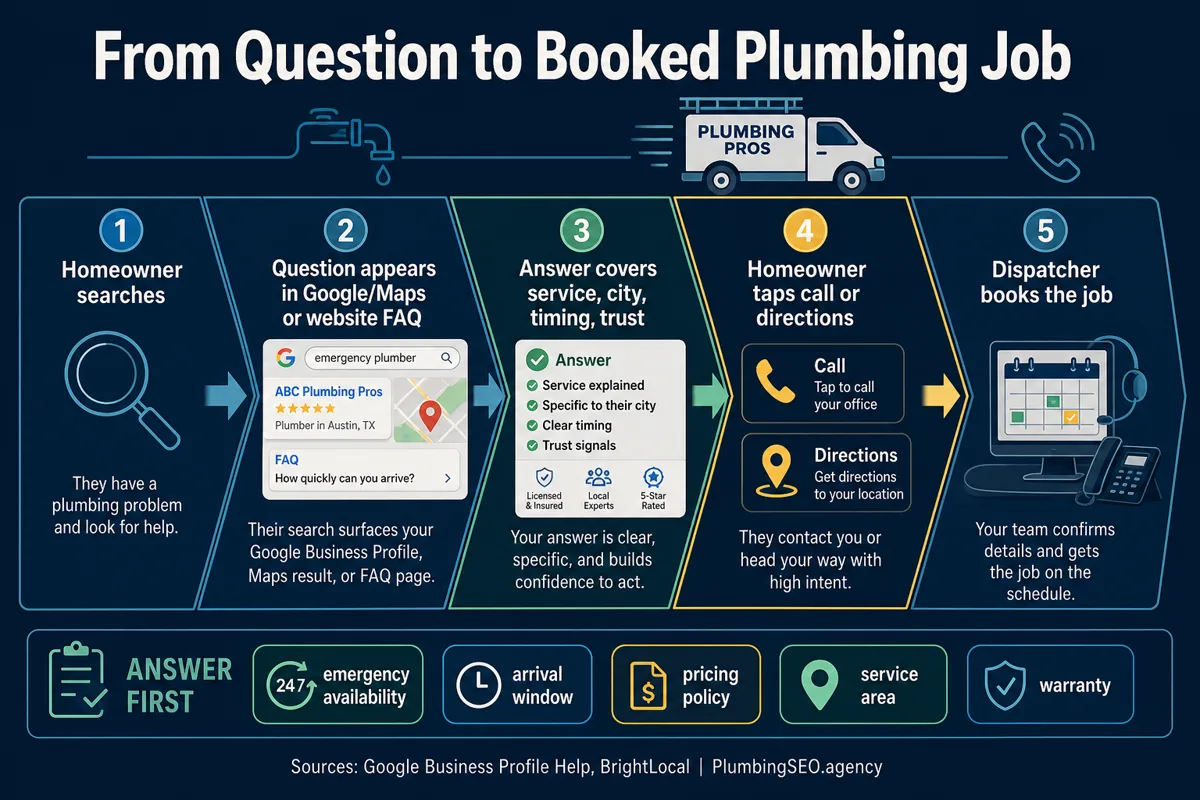
What Google Q&A Means Now
The old Google Business Profile Q&A feature has been changing. BrightLocal reports that Google has discontinued the traditional Q&A experience in favor of AI-powered local answers such as Ask Maps. At the same time, many profiles, older answers, and search experiences still show question-and-answer style content in different ways.
For a plumbing company, the practical lesson is not to chase the button. The practical lesson is to make sure Google can find clean answers about your services, cities, pricing policy, emergency availability, reviews, and trust signals.
Google's own Business Profile guidelines say your profile content should be useful, accurate, and relevant to customers. That is the standard to use. If an answer would help a homeowner decide whether to call, it belongs somewhere Google can understand it: your profile, your service pages, your FAQ content, your reviews, or your posts.
The Questions That Actually Book Plumbing Jobs
Most plumbers do not need clever questions. They need the boring ones answered clearly. Boring is good here. Nobody with a failed water heater is looking for poetry. They want to know if you can help before dinner, before the basement gets worse, or before their spouse asks why no one has been called yet.
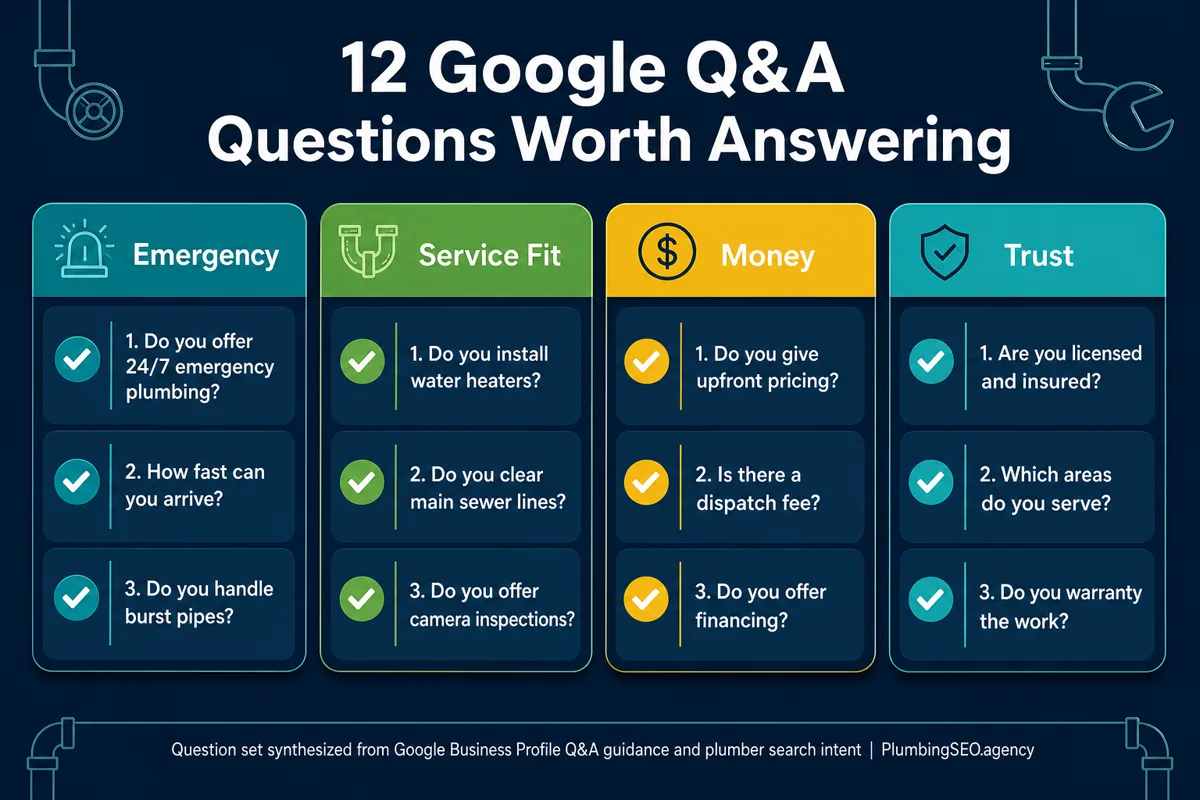
Start with questions that match real service calls:
| Question type | What the customer is really asking | Good plumber answer should include |
|---|---|---|
| Emergency | Can you help before this gets worse? | Hours, dispatch process, what to shut off, best phone number. |
| Service fit | Do you handle this exact job? | Specific service, brands or systems if relevant, next inspection step. |
| Service area | Will you come to my neighborhood? | Primary cities, nearby towns, trip or dispatch notes. |
| Price policy | Am I about to get surprised? | Estimate approach, dispatch fee if any, upfront approval before work. |
| Trust | Can I let this company into my home? | License, insurance, background checks, warranty, review proof. |
How to Write Answers That Do More Than Fill Space
A weak answer says, "Yes, call us." That is not enough. A strong answer gives the searcher confidence that your shop has handled this problem before and knows what happens next.
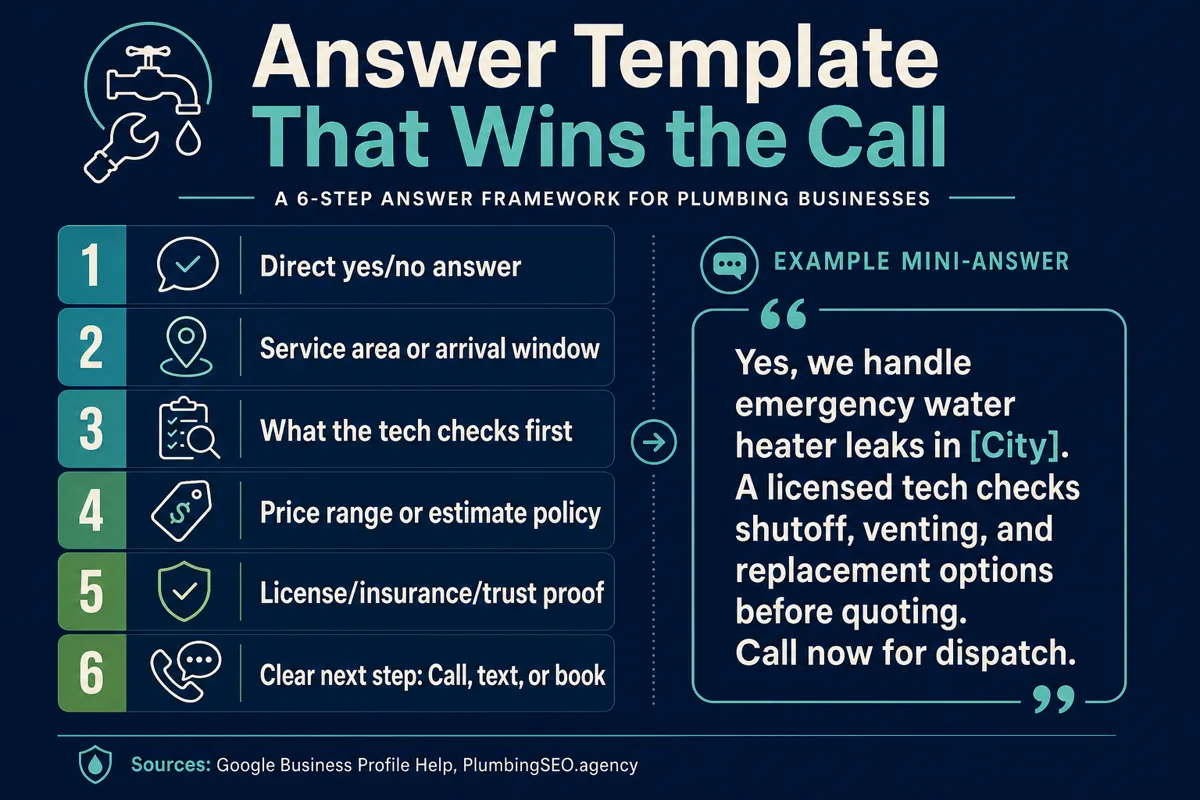
Use this six-part structure:
- Answer directly. Say yes, no, or "it depends" without hiding behind marketing copy.
- Name the service area. Mention the city or area when it is useful, but do not stuff every town you serve.
- Explain the first check. Tell the homeowner what your tech will look at first.
- Set price expectations honestly. You can explain estimate policy without quoting blind.
- Add trust proof. License, insurance, warranty, or a specific experience signal belongs here.
- Give the next step. Tell them to call, text, book, or send a photo if that is how your office works.
Examples Plumbers Can Adapt
Do not copy these word for word. Make them fit your service area, license rules, pricing policy, hours, and actual capacity. If you cannot honor it on a busy Friday, do not put it on Google. The phone will find out.
Emergency plumbing
Question: Do you offer emergency plumbing service?
Answer: Yes. We handle emergency plumbing calls in your city and nearby areas. If you have an active leak, shut off the nearest valve or the main water shutoff, then call our office. We will confirm availability, dispatch timing, and the safest next step before sending a tech.
Water heater replacement
Question: Can you replace a water heater the same day?
Answer: In many cases, yes. Same-day replacement depends on the heater type, venting, access, code requirements, and available inventory. A licensed technician checks the setup first, explains options, and gets approval before work starts.
Drain cleaning
Question: Do you clear main sewer line clogs?
Answer: Yes. We handle main sewer line stoppages, recurring drain backups, and camera inspections when needed. If sewage is backing up into the home, stop using water fixtures and call so we can help decide whether the line needs clearing, inspection, or both.
Pricing
Question: Do you give upfront pricing?
Answer: Yes. We inspect the issue first, explain what we found, and review pricing before approved work begins. Some calls may have a dispatch or diagnostic fee, depending on location and time. Ask when scheduling so there are no surprises.
Service area
Question: Do you serve your suburb?
Answer: Yes. We serve your suburb and nearby neighborhoods from our main service area. For urgent calls, the office can confirm the current dispatch window and whether a technician is already nearby.
Where These Answers Should Live
If Google's local answers are pulling from more than one place, your job is to make those places agree. The profile cannot say one thing, the service page another, and the reviews something else. That creates confusion for Google and for the homeowner.
Start with your local SEO and Google Maps SEO foundation. Then make the same answers visible across the assets that support it.
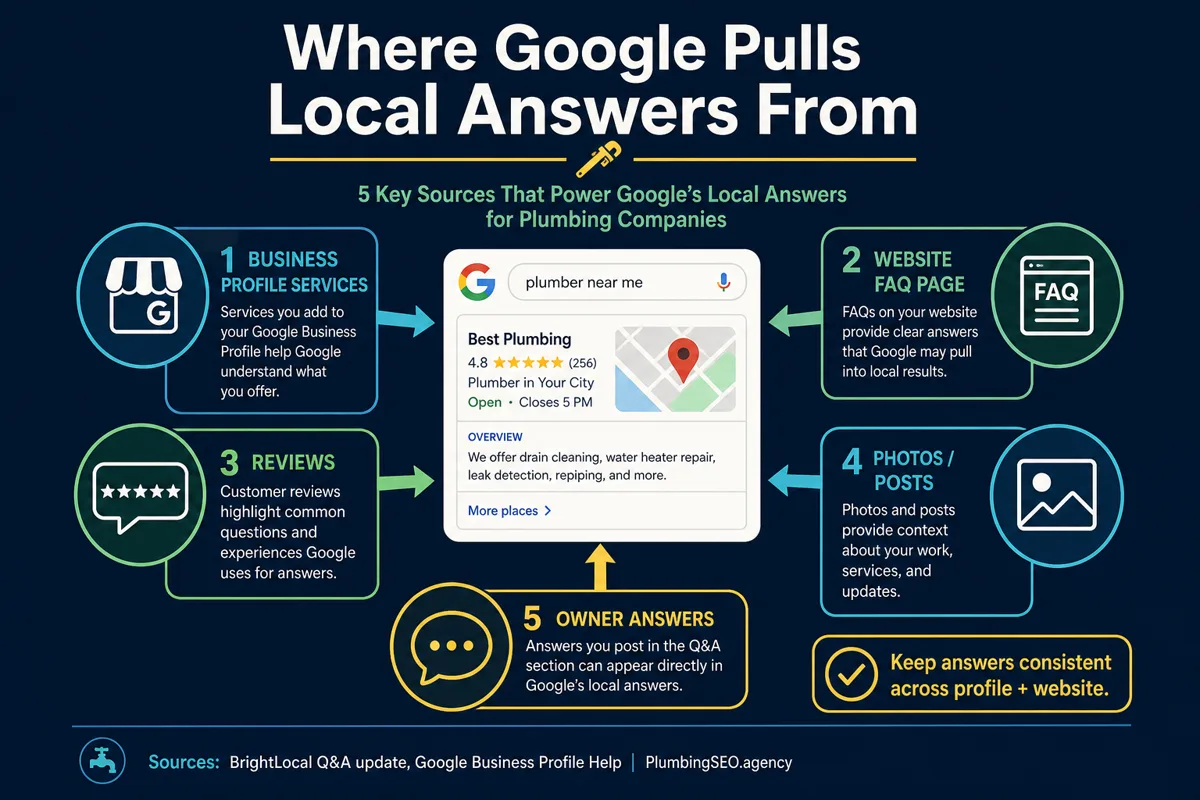
| Asset | What to add | Why it helps calls |
|---|---|---|
| Business Profile services | Specific services with plain descriptions. | Helps searchers see you handle the exact job. |
| Website FAQ | Detailed answers for price, timing, warranty, and service areas. | Gives Google and customers a deeper source than a short profile field. |
| Reviews | Requests that invite real details about service, speed, and outcome. | Google says reviews give potential customers helpful information in Maps and Search. |
| Photos and posts | Job-type photos with service context, not random truck pictures. | Supports trust before the customer calls. |
What Not to Put in Google Q&A
Bad answers can do damage. They can promise service you do not provide, invite price shoppers you cannot help, or create a policy problem. Google also restricts misleading, irrelevant, and inappropriate Business Profile content, so keep the answers clean.
Avoid these mistakes:
- Do not guarantee arrival times you cannot control. Say how dispatch confirms timing instead.
- Do not quote exact prices for jobs you need to inspect. Explain the pricing process.
- Do not list every city in every answer. It reads like spam and helps nobody.
- Do not answer as a fake customer. Use honest owner-managed answers and real website FAQ content.
- Do not ignore old answers. If an old answer is wrong, replace or correct it where you can and update the matching website FAQ.
A Simple Weekly Q&A Routine
This should not turn into a second job. A plumbing owner already has enough of those. Set a weekly routine that someone in the office can actually follow.
- Check the Business Profile for new questions, profile edits, reviews, and service changes.
- Ask dispatch for the top three questions callers asked that week.
- Add or update one website FAQ answer if the question comes up more than once.
- Make sure service pages support the answer. Water heater questions should point to water heater content, not a generic homepage.
- Review photos and posts so recent jobs support the services you want more of.
If your profile is also missing photos, categories, or spam monitoring, fix those next. The Q&A work pairs well with better Google Business Profile photos, the right plumbing GBP categories, and Google Maps spam checks.
The Real Goal: Better Calls, Not More Words
The goal is not to make your profile look busy. The goal is to help a real customer decide, "Yes, this is the plumber to call." That means fewer vague answers, fewer surprises, and fewer wasted calls from people outside your service area or looking for something you do not do.
Good Q&A work is small, but it compounds. A clear emergency answer helps after-hours calls. A clear pricing-policy answer lowers sticker shock. A clear service-area answer keeps the truck from rolling across town for a job you should not have taken. That is SEO doing its job in the real world.
Google Q&A for Plumbers FAQ
The traditional Q&A experience has changed in many Google local surfaces, but plumbers should still keep question-and-answer content accurate across the Business Profile, website FAQ, services, reviews, and posts. Google can use those sources to answer local searcher questions.
Start with questions tied to calls: emergency availability, arrival windows, service area, water heater replacement, drain cleaning, sewer line service, dispatch fees, upfront pricing, license and insurance, and warranty.
Use honest owner-managed answers where the platform allows it, and publish matching FAQ answers on your website. Do not pretend to be a customer or use fake accounts. The answer should be accurate, useful, and consistent with your real policies.
Q&A by itself is not a magic ranking switch. It supports relevance and conversion by making services, areas, timing, and trust signals clearer. For stronger local rankings, pair it with complete services, reviews, photos, service pages, and consistent local SEO work.
Check it weekly if calls matter to your shop. Update answers whenever hours, service areas, dispatch fees, warranties, or key services change. Ask dispatch which questions callers keep asking, then turn repeated questions into better profile and website answers.
Be careful with exact prices unless you can honor them consistently. It is safer to explain your estimate process, diagnostic or dispatch fee policy, and that work is approved before it begins. Clear pricing policy builds trust without creating bad promises.
Want Google to answer plumbing customers better?
We can audit your Google Business Profile, service pages, reviews, and local SEO signals so the right searchers know what you do before they call.
Run My Free SEO Leak Check