
- Use this page to compare local SEO providers—not as a do-it-yourself Maps tutorial or a substitute for a service proposal.
- Score each agency on plumbing proof, service-area judgment, review operations, call tracking, reporting, ownership, and contract clarity.
- If you already know you want implementation rather than a comparison guide, go to our local SEO for plumbers service.
If you are comparing agencies, the question is not who uses the most SEO jargon. It is who can show a credible plan for turning nearby searches into qualified calls in the service areas your crew can actually cover.
A local plumber SEO agency should understand Google Maps, Google Business Profile, reviews, city and service pages, call tracking, and the operational reality behind them. Emergency work, dispatch limits, seasonal demand, financing-sensitive jobs, and after-hours calls all change what “good local SEO” looks like for a plumbing company.
This guide helps you evaluate that fit before you sign. It gives you specific questions, a 12-point scorecard, proof standards, and a way to compare agency, in-house, and hybrid execution without mistaking a polished sales deck for a practical plan.
Stay here when you are comparing local SEO providers. Use the broader plumber SEO company hiring guide for company-wide pricing, contracts, and general SEO red flags. Use the advanced local SEO guide when your team wants tactical, do-it-yourself implementation ideas. If you are ready to discuss a managed Maps, GBP, review, and service-area program, review the local SEO service for plumbers.
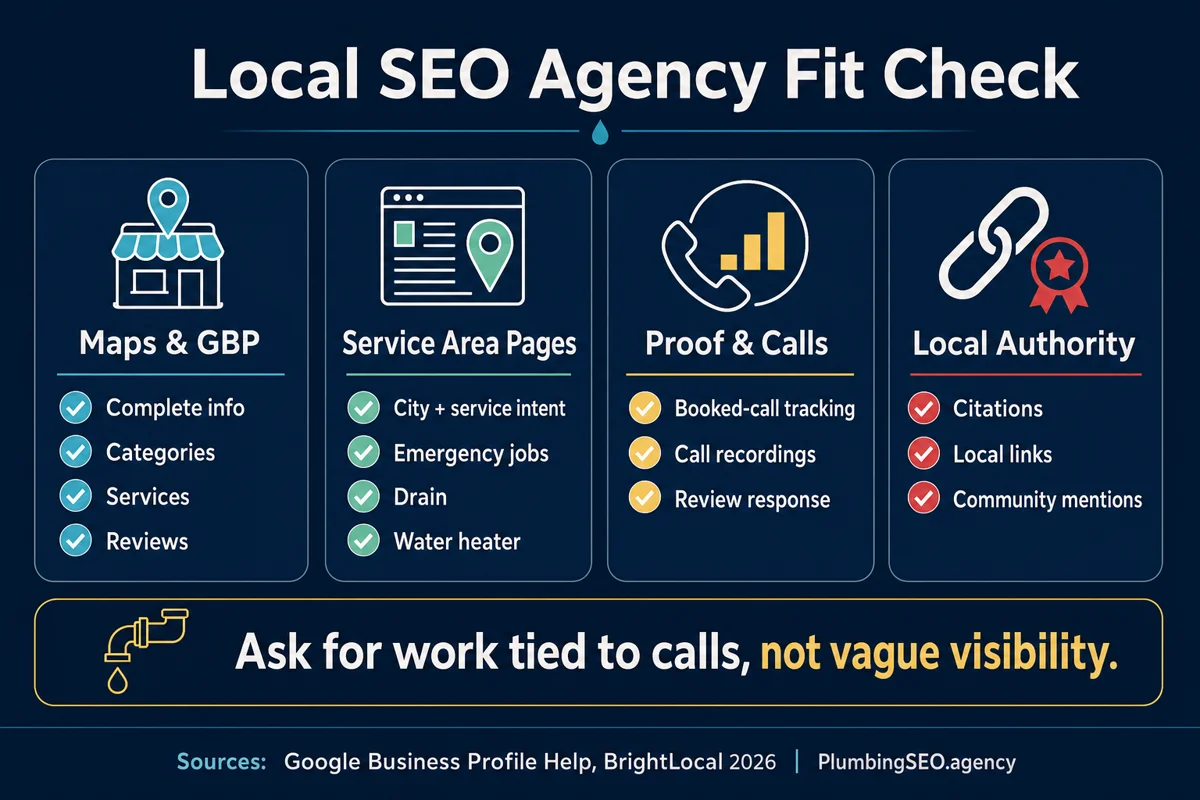
Know what this hiring checklist covers—and what it does not
This checklist is for a plumbing owner, marketing manager, or office lead who has one or more agency proposals on the desk. It helps you judge whether a provider understands local plumbing demand and whether its plan is specific enough to hold the agency accountable.
It is not a promise that one checklist can diagnose every ranking problem. It is also not a step-by-step playbook for changing categories, building city pages, or managing citations yourself. Those are implementation decisions that should follow an audit of your market, website, profile, competitors, and call data.
The distinction matters. A hiring guide should help you choose the right people and terms. A service page should explain the managed solution. A tactical guide should teach the work. When an agency blurs all three, it becomes harder to see what you are actually buying.
Start with the work that affects local calls
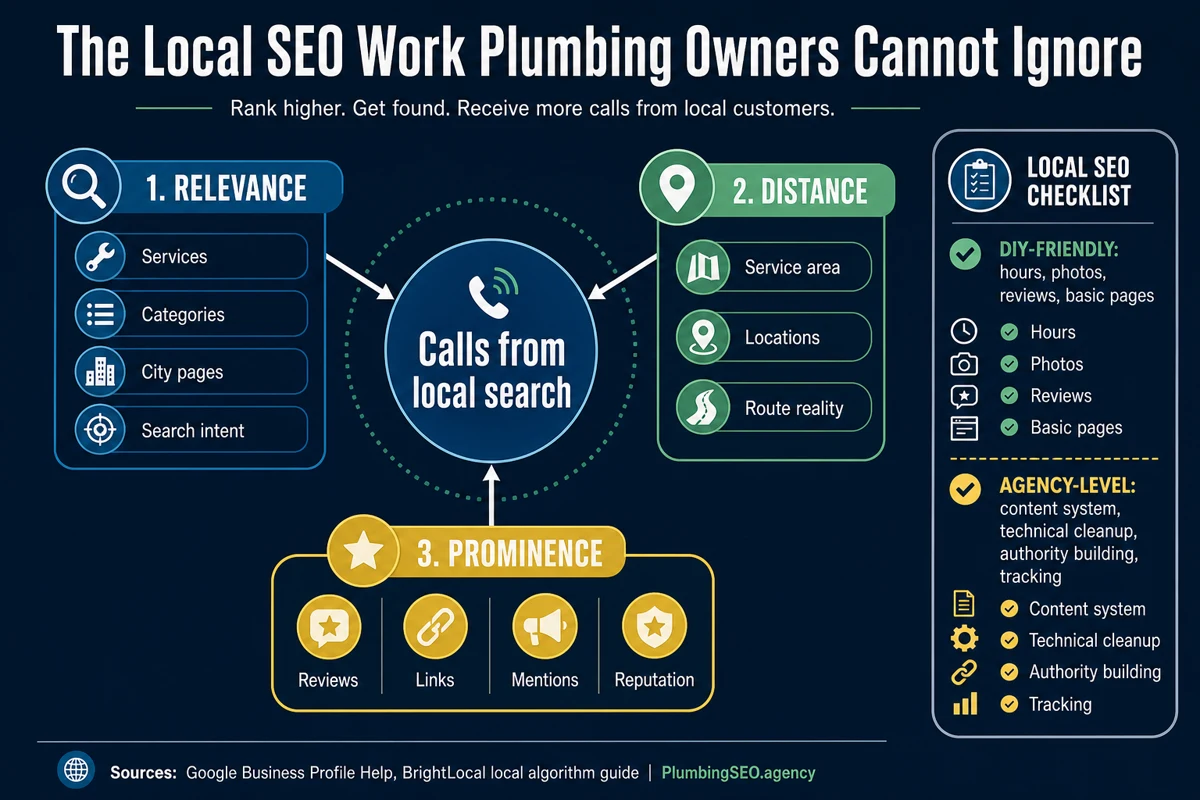
For a plumbing company, local SEO starts where the customer starts: the local pack, Google Maps, and your Google Business Profile. Google says local results are mainly based on relevance, distance, and prominence. It also says complete and accurate business information can help a Business Profile show up for relevant local searches. That is not agency theory. That is straight from Google's local ranking guidance.
So the agency should be able to explain your plan in those plain terms.
- Relevance: Do your categories, services, pages, photos, and content clearly tell Google what plumbing work you do?
- Distance: Are your service areas honest, specific, and supported by location-aware content instead of a giant list of towns?
- Prominence: Do your reviews, citations, local mentions, and useful pages help prove you are a trusted local option?
If an agency cannot explain how its monthly work touches those three areas, keep your wallet in your pocket. Bad SEO is like a slow drain. You can ignore it for a while, but eventually it backs up somewhere ugly.
Look for plumber-specific proof, not generic rankings
A plumber does not need the same plan as a dentist, roofer, restaurant, or ecommerce store. You need visibility for urgent and high-intent jobs in towns you actually serve. The agency should talk about calls, job types, service areas, reviews, and dispatch reality.
Good plumber-specific proof sounds like this:
- Which service lines already bring profit, such as drain cleaning, sewer repair, water heaters, repiping, or leak detection.
- Which cities or neighborhoods are worth building visibility in first.
- How your Google Business Profile categories, services, photos, Q&A, and review responses will be maintained.
- How website pages support Maps rankings instead of sitting off to the side doing nothing.
- How calls will be tracked without damaging name, address, and phone consistency.
If you are comparing providers, use this as the first filter. Ask for plumbing examples. Ask what they changed. Ask what happened to calls, not just keywords. If all they can show is a screenshot of a ranking report with no call context, that is not proof. That is a picture of a thermometer. It does not tell you why the room is cold.
Score every proposal with the same 12-point checklist
Sales calls are easier to compare when every agency answers the same questions. Give each item zero points for no answer, one point for a vague answer, and two points for a specific answer supported by examples or a proposed deliverable. The maximum score is 24. The number does not choose the agency for you, but it exposes missing details before a contract does.
- Plumbing experience: Can the agency show work involving emergency, repair, installation, or service-area demand—not only another local industry?
- Market diagnosis: Can it explain how your competitors, geography, crew capacity, and profitable services affect priorities?
- Google Business Profile plan: Does it name the categories, services, photos, posts, Q&A, review, and spam-monitoring work it will evaluate?
- Service-area judgment: Will it focus on places your team can serve profitably instead of publishing a copied page for every nearby town?
- Service-page plan: Can it connect drain, sewer, water heater, repipe, leak, and emergency pages to real search and call intent?
- Review operations: Does the proposal include a realistic request, response, and escalation workflow for your office and technicians?
- Call attribution: Will reports separate qualified calls and forms from traffic, spam, wrong numbers, and low-value inquiries?
- First 90 days: Are the audit, fixes, content, profile work, and measurement setup ordered clearly rather than bundled under “ongoing optimization”?
- Proof quality: Can the agency explain what changed, over what period, and how the result affected calls or booked work?
- Reporting and decisions: Will each report show completed work, results, problems, and the next priority in language you can understand?
- Asset ownership: Will your company retain access to the website, profile, analytics, call data, content, domains, and accounts?
- Contract clarity: Are price, scope, cancellation terms, communication cadence, and your team’s responsibilities written plainly?
A low score does not always mean the agency is bad. It means the proposal is not yet clear enough to approve. Ask follow-up questions and require important answers in writing. If the agency resists reasonable clarity before payment, communication usually will not improve after payment.
Ask exactly what they will do in the first 90 days
The first 90 days should not be mysterious. A good local plumber SEO agency can show the foundation work, the order of operations, and what it expects to learn before scaling. Nobody can promise a specific ranking by a specific date, but they can tell you what work will be done and why.
| Area to check | Good agency answer | Bad fit answer |
|---|---|---|
| Google Business Profile | Audit categories, services, hours, photos, Q&A, reviews, and service areas. | "We optimize your listing" with no task list. |
| Website pages | Build or improve service pages that match real plumbing jobs and cities. | Four generic blog posts with no connection to calls. |
| Reviews | Create a review request and response process the office can actually follow. | "Get more reviews" with no system. |
| Tracking | Report calls, forms, booked-job signals, and source quality. | Only report rankings and traffic. |
| Local authority | Fix core citations, then pursue relevant local links and mentions. | Sell bulk links or mystery authority packages. |
There is a simple reason this matters. If the agency cannot name the work, you cannot judge the work. And if you cannot judge the work, you are stuck hoping the invoice is doing something behind the wall.
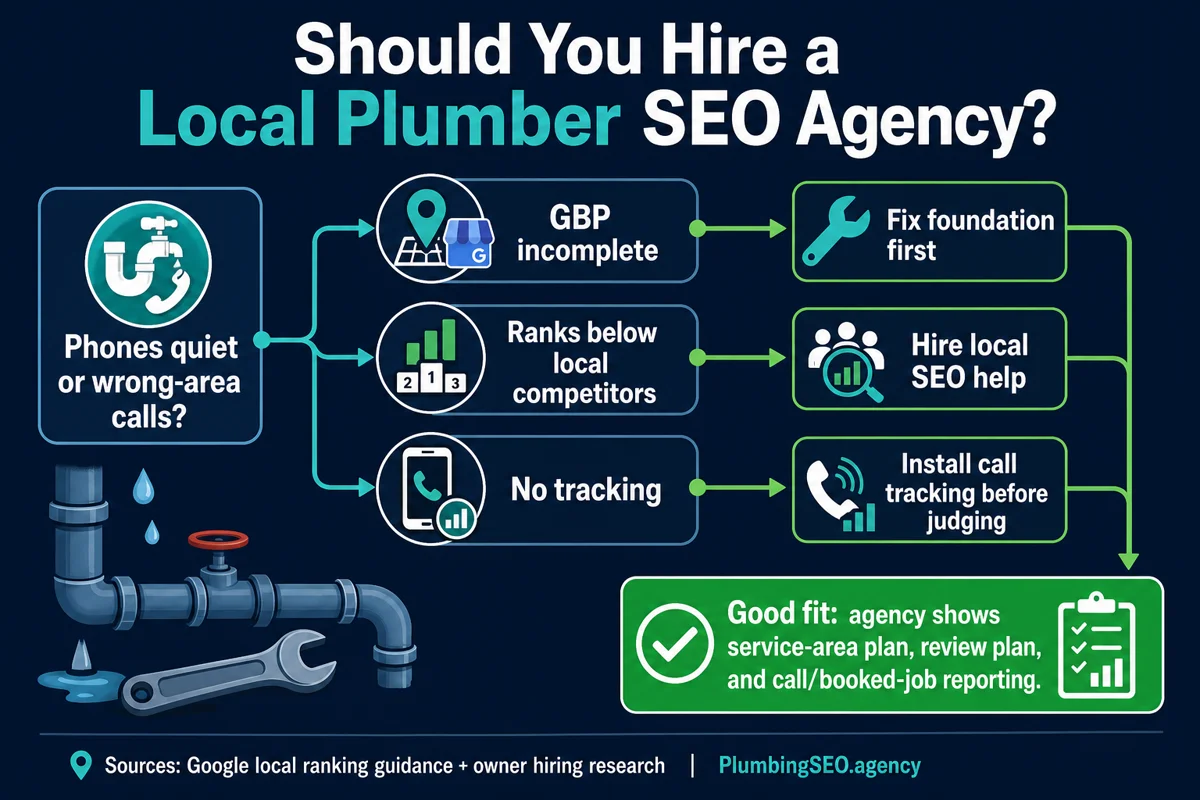
Make sure they understand the local plumbing customer
Local plumbing SEO is not only about showing up. It is about showing up for the right person at the right moment. A homeowner with a slow-draining tub behaves differently from a property manager pricing a repipe. Someone searching at 11:30 p.m. for an emergency plumber is not reading your whole website like it is a Sunday magazine.
The agency should understand these differences and build pages around them.
- Emergency intent: Fast trust, clear phone number, proof you serve the area, and no friction.
- Service-line intent: Drain cleaning, sewer camera inspection, tankless water heater installation, and similar pages need specific proof.
- City intent: A service-area page should be useful for that city, not a copied page with the town name swapped.
- Trust intent: Reviews, photos, license language, financing notes, and job examples help people choose who to call.
This is also why your support page matters. A strong blog should point readers toward the service that solves the problem. If you want the whole local visibility system handled, review our local SEO for plumbers service page after this guide.
Reviews are not a side project
Reviews affect trust before a customer ever lands on your site. BrightLocal's 2026 Local Consumer Review Survey notes that consumers increasingly expect higher star ratings and fresh reviews, with more customers only using businesses with 4.5+ stars. It also found that many consumers keep researching on websites, social channels, and other platforms after reading reviews. In plain English, reviews get the customer moving, but your whole presence has to back them up. You can read the survey summary from BrightLocal.
For plumbers, the review system should be operational, not decorative. The office needs a simple way to ask happy customers. Techs need to know when to mention it. The owner needs to see patterns in review language. If every good review says "fast emergency service," that belongs in your local SEO strategy. If customers keep praising one water heater crew, that can support a stronger water heater page.
A local plumber SEO agency that treats reviews as a once-a-quarter reminder is missing one of the biggest trust signals in the shop.
Decide whether an agency, in-house owner, or hybrid model fits
Not every plumbing company needs to outsource every local SEO task. A small shop with one location and an organized office may be able to handle hours, photos, review requests, and basic profile updates internally. The harder work is maintaining the content system, technical health, competitive research, service-area structure, local authority, and reliable tracking while the business is busy.
An agency is usually the better fit when nobody on your team owns the work, several locations or service areas need coordination, technical problems are accumulating, or you need regular content and measurement. In-house execution can work when one person has protected time, account access, a documented process, and enough knowledge to avoid shortcuts that create spam or duplicate pages.
A hybrid arrangement is often practical: your office supplies job photos, service details, review requests, scheduling changes, and call-quality feedback; the agency handles research, page strategy, technical fixes, reporting, and the work that needs specialized tools. Ask each provider to define this handoff. “We need your help” is too vague. A useful proposal says who sends what, through which system, and by what date.
Do not accept reporting that ignores the phone
The report may look good, but the phone tells the truth. A plumbing owner should not have to decode a 30-page dashboard to know whether SEO is helping. The monthly report should answer four questions:
- Are more qualified customers finding us in the right service areas?
- Which pages, profile actions, or searches are creating calls and forms?
- Which work was completed this month?
- What are we fixing next, and why?
Call tracking has to be handled carefully for local SEO because name, address, and phone consistency still matters across major listings. A good agency can explain how it tracks calls while protecting the main business phone number where it matters. If that part feels fuzzy, read our guide to local SEO call attribution before you sign anything.
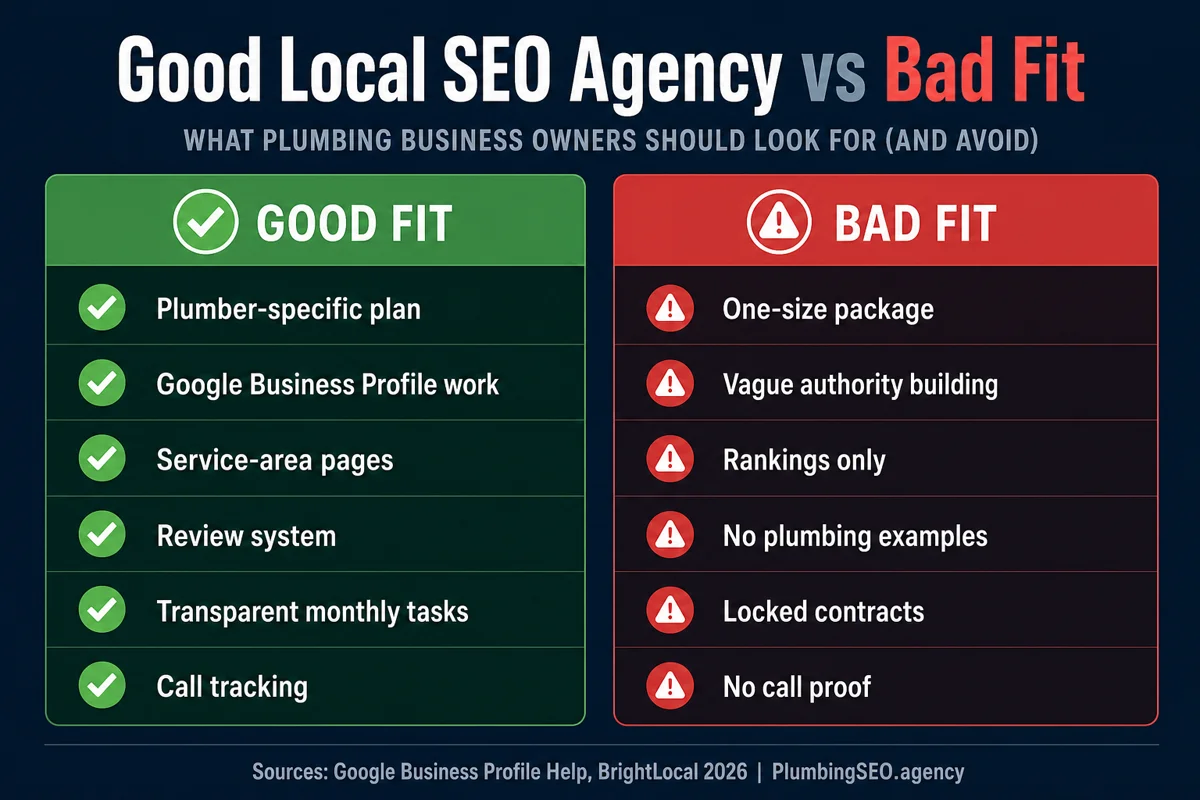
Watch for these red flags before you sign
Some red flags show up before the contract is even sent. Pay attention.
- They sell one package to every trade. Plumbing is not generic local SEO. Emergency intent and service-area work matter.
- They promise rankings. Nobody controls Google. They should promise work, transparency, and measurement.
- They cannot explain the first month. If the first month is all "research" and no clear audit, profile, tracking, or content plan, slow down.
- They talk only about traffic. Traffic that does not turn into calls is just noise with a chart.
- They avoid your service mix. A drain-heavy shop and a remodel plumbing contractor should not have the same plan.
- They lock you in before proving fit. Long contracts are not automatically bad, but they should come with clear deliverables and exit terms.
In my opinion, the best local plumber SEO agency is the one that can sit down with your service list, your service area, your slow weeks, and your call history, then tell you what should be fixed first. Not everything. First.
What to ask on the sales call
Use these questions. Do not worry about sounding difficult. You are not buying a box of fittings. You are hiring someone to influence where your next jobs come from.
- What would you check first on our Google Business Profile?
- Which service pages do you think we need, and which ones should wait?
- How will you help us earn and respond to reviews?
- How do you decide which cities or neighborhoods get priority?
- How do you track calls without hurting local listing consistency?
- What will the first 30, 60, and 90 days look like?
- Can you show a plumbing or home-service example where the work led to better calls, not just better rankings?
- What do you need from our office or techs to make this work?
That last question matters. SEO is not something an agency does in a back room while the business ignores it. The best results usually need job photos, service notes, review requests, accurate hours, real service-area details, and someone willing to answer the phone properly. No agency can fix a missed-call problem with title tags.
The practical next step
Put each proposal through the 12-point checklist, compare the written scope, and ask for clarification wherever the agency earned zero or one point. Confirm who owns the assets, who supplies business information, how qualified calls will be identified, and what the first 90 days will produce.
If you have finished comparing providers and want a plumber-focused team to manage the work, review our local SEO for plumbers service. It covers the managed Google Maps, GBP, service-area, review, website, and call-measurement work that this hiring checklist helps you evaluate.
If you are not sure what needs attention yet, run a free plumbing SEO audit first. Use the findings to ask sharper questions before you commit to a monthly plan.
Local Plumber SEO Agency FAQs
Ready to move from agency comparison to a local SEO plan?
See how our plumber-focused local SEO service connects Google Maps, your Business Profile, service areas, reviews, website pages, and call measurement.
See Local SEO for Plumbers Run My Free SEO Leak Check