
- Growth starts by fixing leaks: missed calls, slow follow-up, weak reviews, and unclear service pages waste the demand you already have.
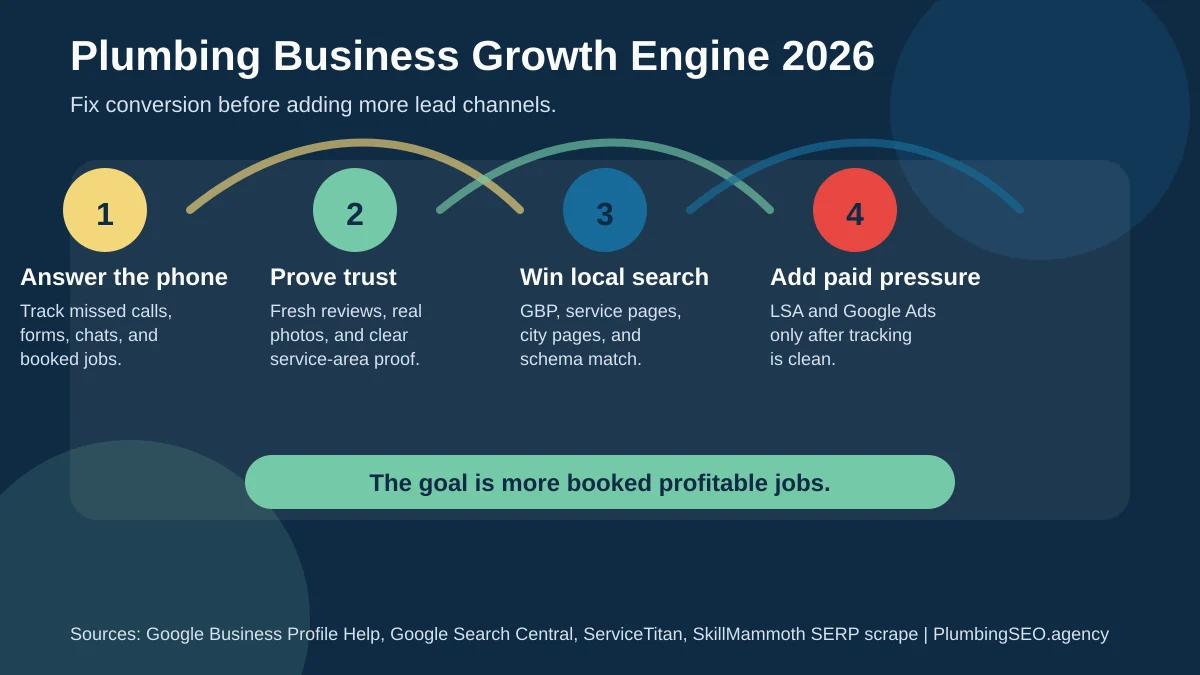
- For 2026, build the base in this order: Google Business Profile, local SEO pages, reviews, tracking, then paid leads when the math is clean.
- Do not measure growth by rankings alone. Track answered calls, booked jobs, gross profit, and which channels keep the trucks moving.
If your plumbing business feels busy but the bank account does not, growth is not the same as more work. A full calendar can still be a leaky system if the wrong jobs are coming in, the phone is being missed, estimates are not followed up, or your best service areas cannot find you online.
The way I see it, a plumbing company grows in 2026 when three things line up: the right customers can find you, they trust you enough to call, and your team turns those calls into profitable booked jobs. That sounds simple. So does fixing a drain, until somebody opens the wrong cleanout.
This guide is written for plumbing owners who want a practical growth plan, not a pile of marketing words. We will cover the order of work, where SEO fits, when paid ads still make sense, and what to measure so you know whether the company is actually moving forward.
Start With the Growth Leak, Not the Growth Goal
Most owners start with a revenue target. That is fine for the whiteboard, but it does not tell the dispatcher what to fix on Monday morning. Before you spend more money, find the leak that is holding the company back.
For some shops, the leak is visibility. They do good work, but they do not show up in Google Maps or organic search for the services they want. For others, the leak is trust. They appear online, but the profile has few reviews, old photos, or a website that looks like it has not been touched since the last water heater shortage. For a lot of plumbing companies, the leak is conversion. The phone rings, but nobody answers fast enough or follows up cleanly.
What 2026 Changed for Plumbing Business Growth
The old playbook was simple: buy ads, ask for referrals, maybe add a website. That is not enough anymore. Homeowners compare plumbers in seconds. They see Maps, Local Services Ads, reviews, photos, service pages, and sometimes AI summaries before they ever land on your site.
Google says local results are mainly based on relevance, distance, and prominence. You cannot move your shop closer to every searcher. You can make relevance and prominence much stronger by showing complete business information, clear services, strong reviews, fresh photos, and pages that match what customers actually need.
Google Search Central also says SEO changes can take time, with some showing in hours and others taking several months. That matters because a plumber should not fire a good SEO plan after two quiet weeks, but also should not wait six months to notice nobody is answering form leads. Measure the right things at the right speed.
What the Competing Advice Usually Misses
The competing article that triggered this task covers operations, pricing, hiring, reputation, and lead channels. That is useful. What it misses for a plumbing owner is the order of operations. If you add five lead channels before fixing phone handling, reviews, tracking, and job selection, you are just pouring more water into the same leaking bucket.
A better plan connects operations and marketing. Your website should not promise emergency service if nobody answers emergency calls. Your Google profile should not list every city in the county if your trucks cannot profitably serve them. Your ads should not chase cheap leads that send a tech across town for a tiny job with no margin.
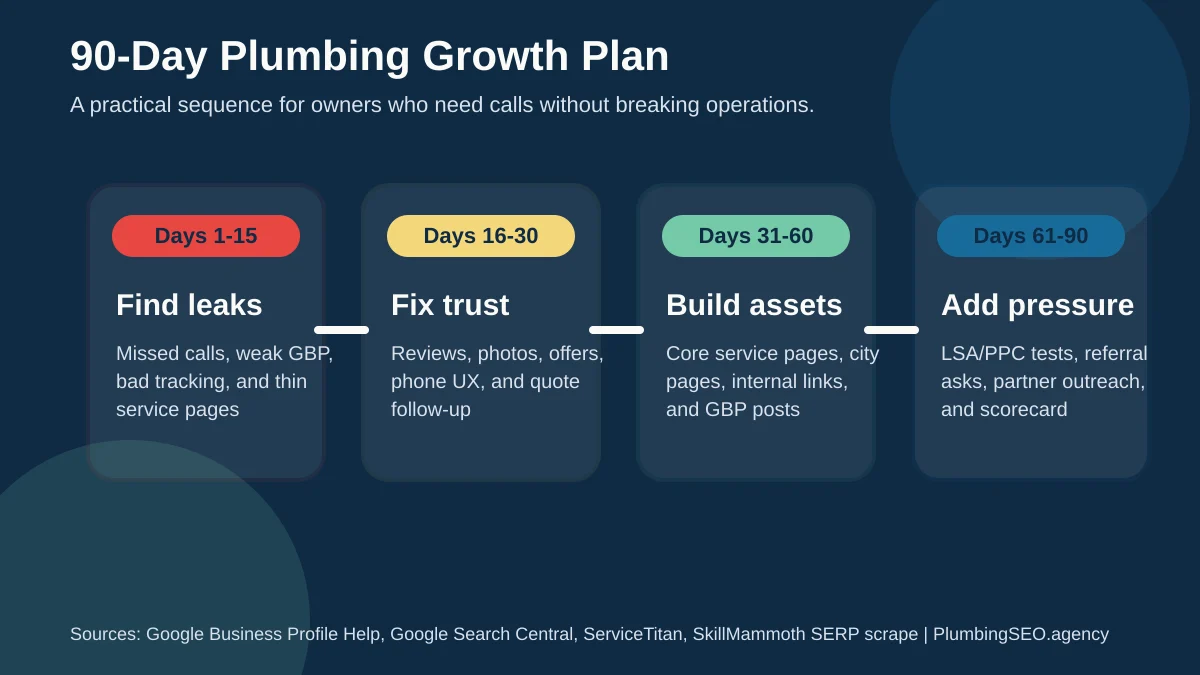
The 90-Day Plumbing Growth Plan
If you want to grow your plumbing business in 2026, work in a sequence. The order below is built for a real shop where the owner has jobs, payroll, callbacks, and customers already pulling attention away from marketing.
Days 1-15: Find the Leaks
Start by acting like a customer. Call your own number from a mobile phone. Send a form. Click the call button on your Google Business Profile. Ask how fast the office responds, whether the message is clear, and whether every lead is recorded somewhere.
Then check your local visibility. Search your main services from the towns you actually want to serve. Do you show for emergency plumber, drain cleaning, water heater repair, sewer line repair, and the profitable work you want more of? If not, your growth problem may be a service-page and Google Business Profile problem, not a bigger ad budget problem.
Days 16-30: Fix Trust and Conversion
Trust is what makes a homeowner pick you when three plumbers look similar. Update your Google Business Profile with accurate hours, service categories, service areas, photos, and review responses. Google specifically recommends complete and accurate information, updated hours, review responses, and photos because those details help customers choose.
On the website, make the phone number obvious, add real crew and truck photos, show service areas clearly, and write service pages in plain language. If your site is weak here, start with our plumbing SEO service page and our guide to advanced local SEO for plumbers.
Days 31-60: Build Local Search Assets
Local SEO is not one blog post and a prayer. Build the pages that match real buyer intent: emergency plumbing, drain cleaning, water heater repair, sewer line repair, leak detection, and the cities you can serve profitably. Each page should answer what the homeowner needs, show proof you serve that area, and make calling easy.
Use internal links like a good parts organizer. Your city pages should point to the right service pages. Your blog posts should support service pages. Your Google profile should point people to the best landing page, not always the homepage.
| Growth Area | What to Build | What to Measure |
|---|---|---|
| Google Business Profile | Categories, services, photos, Q&A, review responses, accurate hours | Profile calls, direction requests, photo views, review velocity |
| Website SEO | Service pages, city pages, internal links, schema, fast mobile layout | Organic calls, form fills, rankings by service and city |
| Paid leads | LSA profile, Google Ads landing pages, negative keywords, call tracking | Cost per qualified call, booking rate, gross profit per job |
| Operations | Answering process, follow-up scripts, estimate reminders, job costing | Answer rate, booked jobs, close rate, callback rate |
Days 61-90: Add Paid Pressure Carefully
Paid ads still have a place. Local Services Ads and Google Ads can help when you need calls faster than SEO can produce them. The mistake is using paid traffic to cover up a broken conversion system.
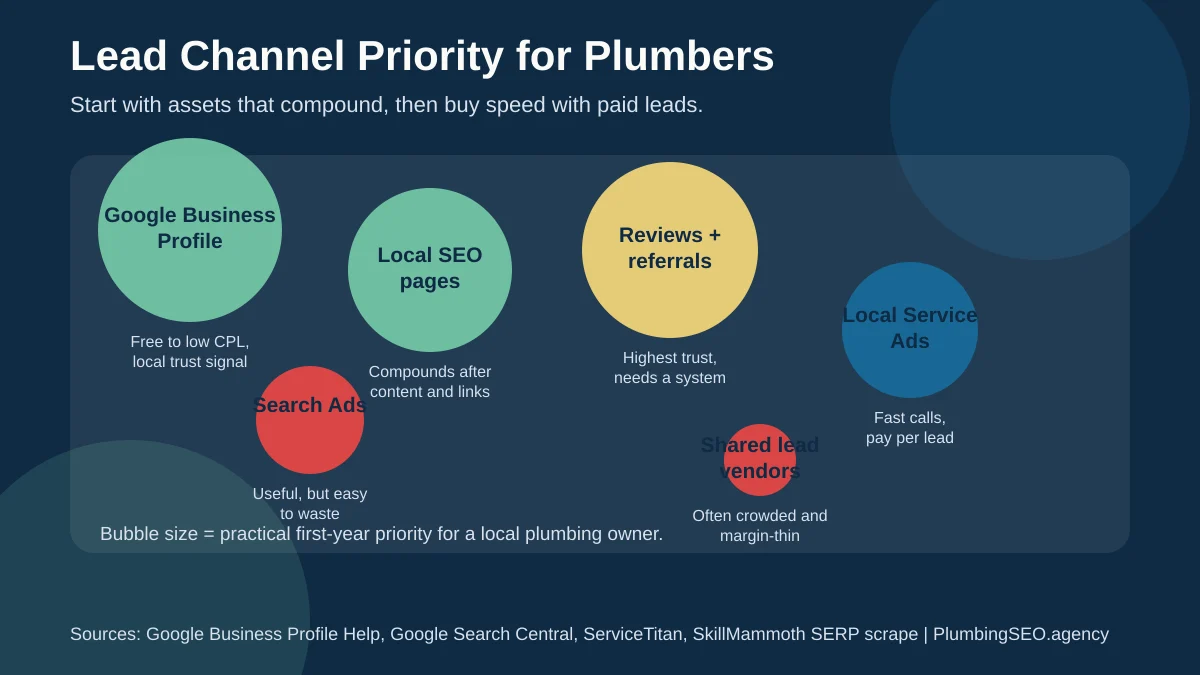
Research from the current SERP shows the channel advice is not all equal. SkillMammoth's 2026 lead-channel roundup ranks Google Business Profile, local SEO, Local Services Ads, and review-driven referrals as stronger plumbing lead channels than broad social ads or shared lead vendors. Use that as a directional benchmark, not a promise. Your market, crew, pricing, and answer rate decide the final math.
Where SEO Fits in a Plumbing Growth Plan
SEO is not magic. It is how your company gets found when someone has a leak, a cold shower, a clogged drain, or a sewer smell and does not know who to trust. The SEO work should make your real business easier to understand online.
For plumbers, good SEO usually means a strong Google Business Profile, clear service pages, local service-area pages, reviews that mention real work, technical cleanup, and content that answers buyer questions. If you want the full step-by-step version, read our guide on how to do SEO for plumbers.
Do not judge SEO only by impressions. Ask whether it is producing calls from the towns, services, and job types you actually want. A page that ranks for low-value tire-kicker searches is not growth. It is noise in a clean uniform.
Hiring, Capacity, and the Part Marketing Cannot Fix
Marketing can bring calls. It cannot make an untrained tech profitable, fix a messy dispatch board, or turn bad pricing into good margins. ServiceTitan's growth guide focuses heavily on planning, recruiting, culture, systems, and operations. That is the right reminder: a plumbing company must be ready to handle the work it wins.
One useful example from that research is Rooter Hero, which ServiceTitan describes as growing from a one-truck operation to 10 locations, more than 250 trucks, and $50 million in annual earnings. The lesson is not that every company needs 250 trucks. The lesson is that growth takes systems, not just hustle.
Workiz frames the same issue as moving from field work to systems: automation, recruiting, performance pay, local marketing, data, and a CEO mindset. For a plumbing owner, that means do not hire another truck just because the phone got busy for two weeks. First ask whether current trucks are profitable, routes make sense, callbacks are under control, and the marketing channels are bringing the kind of jobs you want.
The Scorecard: Measure Booked Jobs, Not Pretty Reports
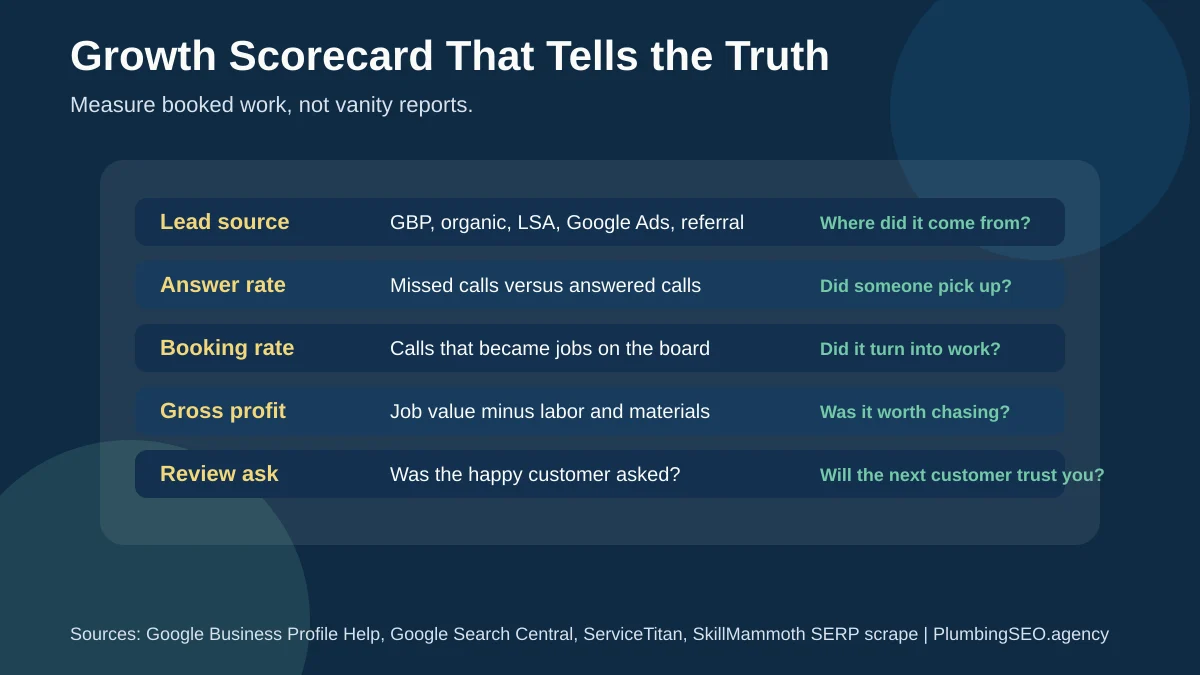
The report may look good, but the phone tells the truth. A useful growth scorecard is simple enough for the owner, office manager, and marketing partner to review every week.
Track These Numbers Every Week
- Answered-call rate: how many calls were answered during business hours and after hours.
- Booked-job rate: how many calls, forms, and chats turned into jobs on the board.
- Lead source: Google Business Profile, organic search, LSA, Google Ads, referral, repeat customer, or other.
- Gross profit by job type: which services are worth chasing and which keep the team busy without enough margin.
- Review requests sent: whether happy customers are being asked while the good work is fresh.
If you want a deeper measurement setup, use our plumber marketing ROI guide. It explains how to connect calls, jobs, and revenue instead of guessing from traffic reports.
Common Mistakes That Slow Growth
Buying More Leads Before Fixing the Phone
If the office misses calls, paid ads will expose the problem faster. Fix answer rate and follow-up before increasing spend.
Building Random City Pages
City pages work when they help customers and match real service areas. Thin pages for towns you barely serve can create a mess for users and search engines.
Letting Reviews Happen by Accident
Reviews need a process. Ask after good jobs, make the link easy, respond to every review, and use the feedback to coach the team.
Counting Leads Without Counting Profit
More calls are not always better. A job across town with low margin, high drive time, and a callback risk may not help growth at all.
What I Would Do First
If I owned a plumbing company and wanted growth this year, I would start with a one-week leak check. I would call the company, test the website forms, audit the Google Business Profile, review the top service pages, and pull the last 30 days of calls by source.
Then I would pick one bottleneck. If calls are not coming in, fix local visibility. If calls are coming in but not booking, fix phone handling and follow-up. If jobs are booking but profit is thin, fix job selection, pricing, and routing before buying more leads.
That is not fancy. It works because plumbing growth is not one big secret. It is a set of leaks you find, fix, and check again. Same as the work, just with fewer crawl spaces.
Frequently Asked Questions
Want to Find the Leak in Your Plumbing Growth Plan?
We will review your Google visibility, service pages, calls, and tracking so you can see what is blocking more booked jobs.
Run My Free SEO Leak Check