
- AI agents will not magically book good plumbing jobs from a messy website. They need clean service facts, service areas, hours, reviews, and booking paths.
- Fix your Google Business Profile, LocalBusiness schema, mobile call/text buttons, and appointment links before chasing shiny AI tools.
- Measure calls and booked jobs, not just impressions. If the phone does not ring with the right work, the search report is just decoration.
If you own a plumbing company, Google I/O 2026 may sound like a tech conference that has nothing to do with a leaking water heater on a Tuesday morning. But the search changes matter because Google is moving more search behavior toward AI Mode, agents, longer questions, and tasks that can run in the background.
That does not mean every plumber needs a robot receptionist tomorrow. It means your online facts need to be clean enough for a customer, a dispatcher, Google Search, Google Maps, and an AI assistant to understand the same thing: what you fix, where you go, when you answer, how to book, and why a homeowner should trust you.
Google says its I/O 2026 Search updates bring advanced model capabilities into Search and let people use agents by asking a question. TechCrunch reported that Google described information agents that can monitor topics in the background and synthesize information from multiple sources. For local service companies, the practical lesson is simple: the clearer your facts are, the easier it is for any search system to recommend the right next step.
This guide keeps the topic grounded for plumbing owners. We are not going to pretend AI agents replace good service, a trained CSR, or a truck that shows up on time. We are going to cover what to fix on your website, local SEO, Google Business Profile, reviews, and booking flow so your company is easier to find, trust, call, and book.
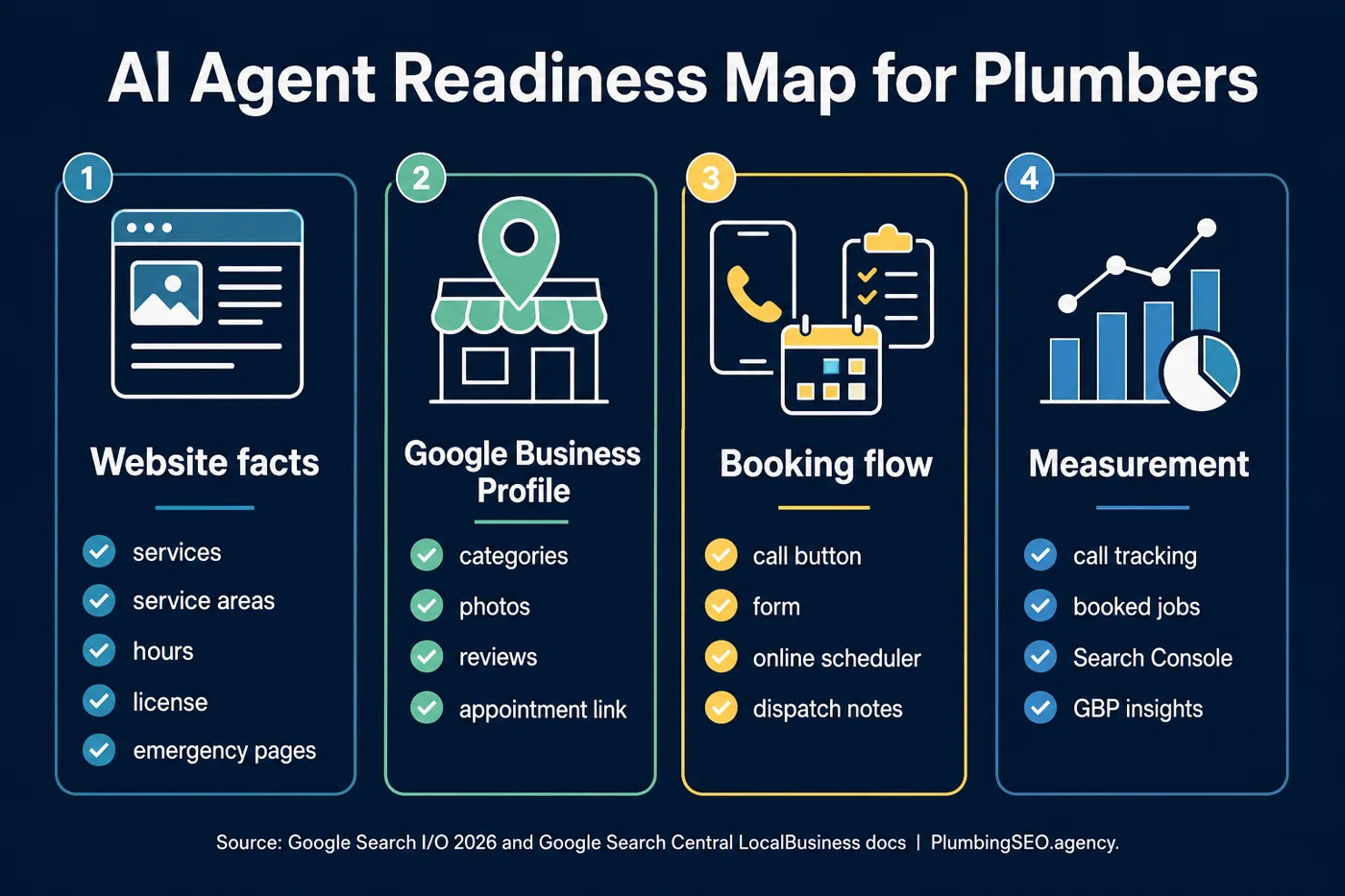
What Google I/O 2026 changes mean for plumbers
The big shift is not that homeowners stop needing plumbers. The shift is how they may ask for help. A customer might not type a short keyword like “plumber near me.” They may ask a longer question such as, “Who can replace a leaking water heater near me today, has good reviews, and lets me book online?”
AI search systems are built to compare, summarize, and suggest. That makes weak business information more expensive. If your site says “serving the metro area,” your GBP lists old hours, your emergency page is thin, and your booking form hides behind three clicks, you are making the machine guess. And when Google guesses, the phone does not always ring at your shop.
Google Search Central explains that LocalBusiness structured data can help tell Google about details such as business hours, departments, and other business information. That does not guarantee rankings. It does give Google cleaner facts to work with. In my opinion, that is the right place for plumbers to start.
| Area | What AI search needs to understand | What plumbers should fix first |
|---|---|---|
| Website service pages | Exact plumbing services, city coverage, emergency availability, trust proof | Build clear pages for water heaters, drain cleaning, sewer repair, leak detection, and priority service areas. |
| Google Business Profile | Categories, services, hours, photos, reviews, appointment link | Clean categories, add services, post recent photos, and make the call or booking path obvious. |
| Structured data | Business identity, location, service context, FAQs | Add LocalBusiness and FAQ schema where it matches visible page content. Validate before publishing. |
| Booking flow | Whether a customer can call, text, or request service without friction | Test mobile CTAs, forms, scheduling links, confirmation messages, and dispatch handoff. |
| Measurement | Which searches turn into calls and booked jobs | Track calls, forms, GBP actions, booked jobs, and service type. Rankings alone do not pay payroll. |
Fix the website facts first
Before you worry about AI agents, make sure a normal homeowner can understand your site in two minutes. That is still the standard. If your pages are thin, generic, or confusing, AI does not fix the leak. It just finds the leak faster.
Start with your core service pages. A water heater page should say whether you repair, replace, install tankless units, handle emergency leaks, pull permits when needed, and serve the cities you actually cover. A sewer page should explain inspections, camera work, excavation, trenchless options if offered, and what symptoms mean a customer should call.
Then add proof. Photos of real trucks, real team members, review snippets, financing notes if offered, license information, service-area details, and simple FAQs help a homeowner trust you. They also give search systems stronger context. Our SEO for plumbers work starts with this kind of practical cleanup because it ties directly to calls and booked jobs.
Clean up Google Business Profile for agentic search
Your Google Business Profile is still one of the main local trust sources. If AI Mode or another assistant is comparing nearby plumbers, your GBP can influence what it sees: categories, service list, reviews, photos, hours, and customer actions.
Check your primary category, secondary categories, service descriptions, appointment URL, phone number, holiday hours, service areas, and photos. Do not stuff every city in the county into every field. Be accurate. A wrong-area call wastes the customer’s time, the office’s time, and sometimes a truck roll. That is not growth. That is noise.
Reviews matter too. Not just the star rating. Read the words customers use. “Showed up same day,” “explained the repair,” “cleaned up,” and “fair price” are trust signals a homeowner understands. Keep asking for reviews after completed jobs and respond like a real owner, not a chatbot wearing a company shirt.
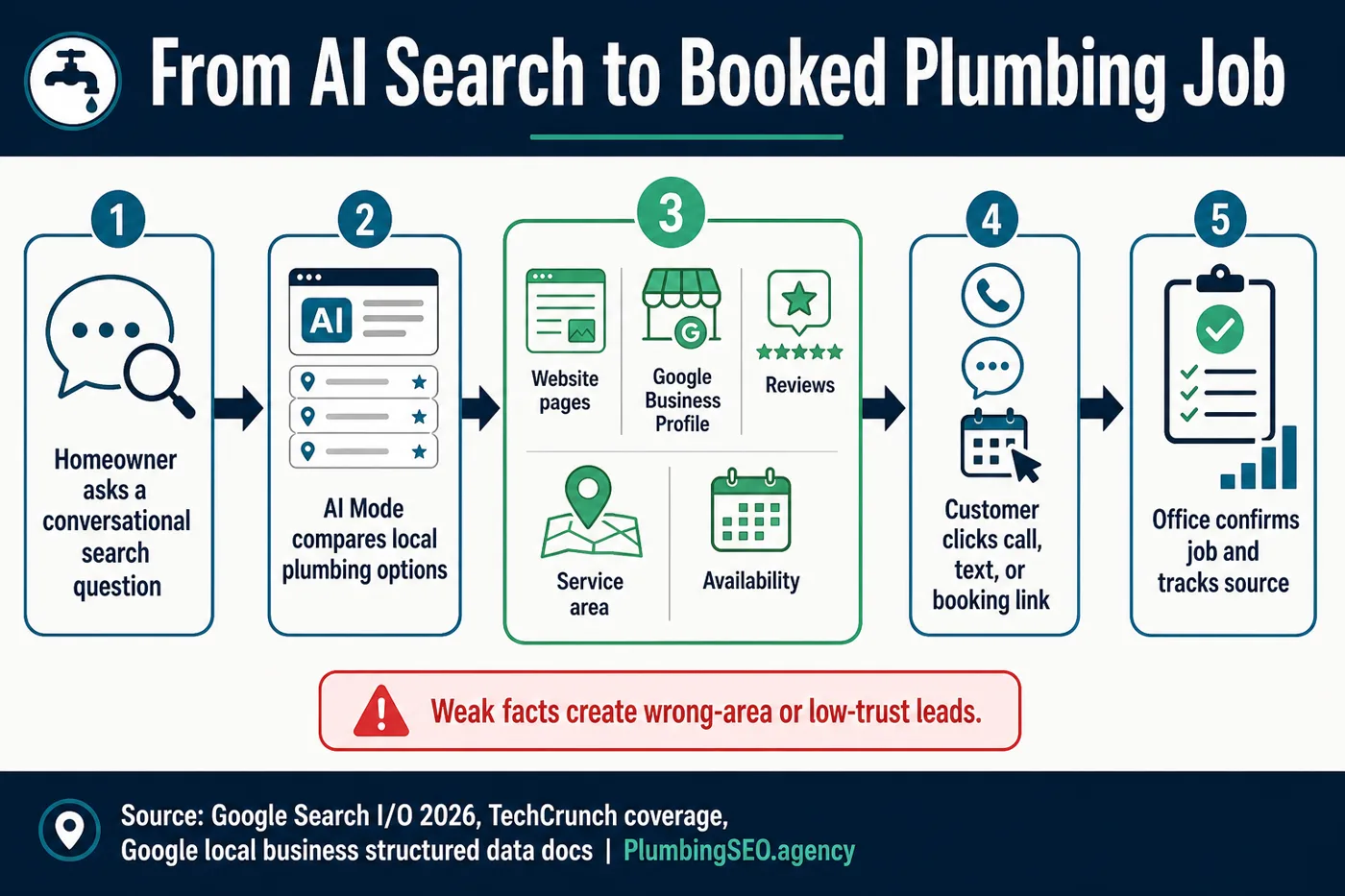
Make booking boring, obvious, and mobile friendly
A fancy AI answer is useless if the customer cannot reach you. Your mobile page should make the next step obvious: call, text, or request service. If you use online scheduling, the link should work on mobile, show the right service areas, and set clear expectations.
Test the path like a customer. Open your site on a phone. Try to book a drain cleaning. Try to call after hours. Try to submit a water heater form. If you get confused, a customer will too. And if a customer gets confused while water is spreading across the floor, they are not going to admire your design. They are going to call the next company.
For plumbing companies, the best booking flow is not always full online scheduling. Many shops still need the office to qualify the job, check dispatch capacity, and avoid sending a tech to the wrong problem. That is fine. Just make the handoff clear. Tell customers what happens after they call or submit the form.
Add structured data without turning it into a science project
Structured data is not magic dust. It is a standardized way to describe page content. Google’s LocalBusiness documentation says structured data is a standardized format for providing information about a page and classifying page content. For a plumbing company, that means your site can describe business identity, hours, address or service area context, phone number, and page-level information.
Use JSON-LD. Keep it truthful. Match schema to visible content. If the page does not show a FAQ, do not mark up a FAQ. If you do not serve a city, do not put it in markup. Bad schema is like labeling every fitting in the truck “miscellaneous.” It might technically be a label, but it will not help anyone do the job.
At minimum, review LocalBusiness schema for your main site, FAQ schema for clear FAQ sections, BreadcrumbList schema for navigation, and BlogPosting schema for educational posts like this one. Then validate before publishing. Google’s own docs recommend testing structured data with the Rich Results Test and using URL Inspection after deployment.
What to measure after the AI agent shift
Do not judge this work only by rankings. Rankings still matter, but the owner needs to know whether the right calls are coming in. Track call source, form source, booking source, service type, city, emergency versus non-emergency, booked job rate, and revenue where possible.
Google Search Console and GBP insights can show visibility movement. Call tracking and your CRM or dispatch notes show what actually happened. If impressions rise but booked jobs do not, something is leaking between search and the office. It might be weak service pages, bad reviews, confusing CTAs, poor after-hours handling, or a service area mismatch.
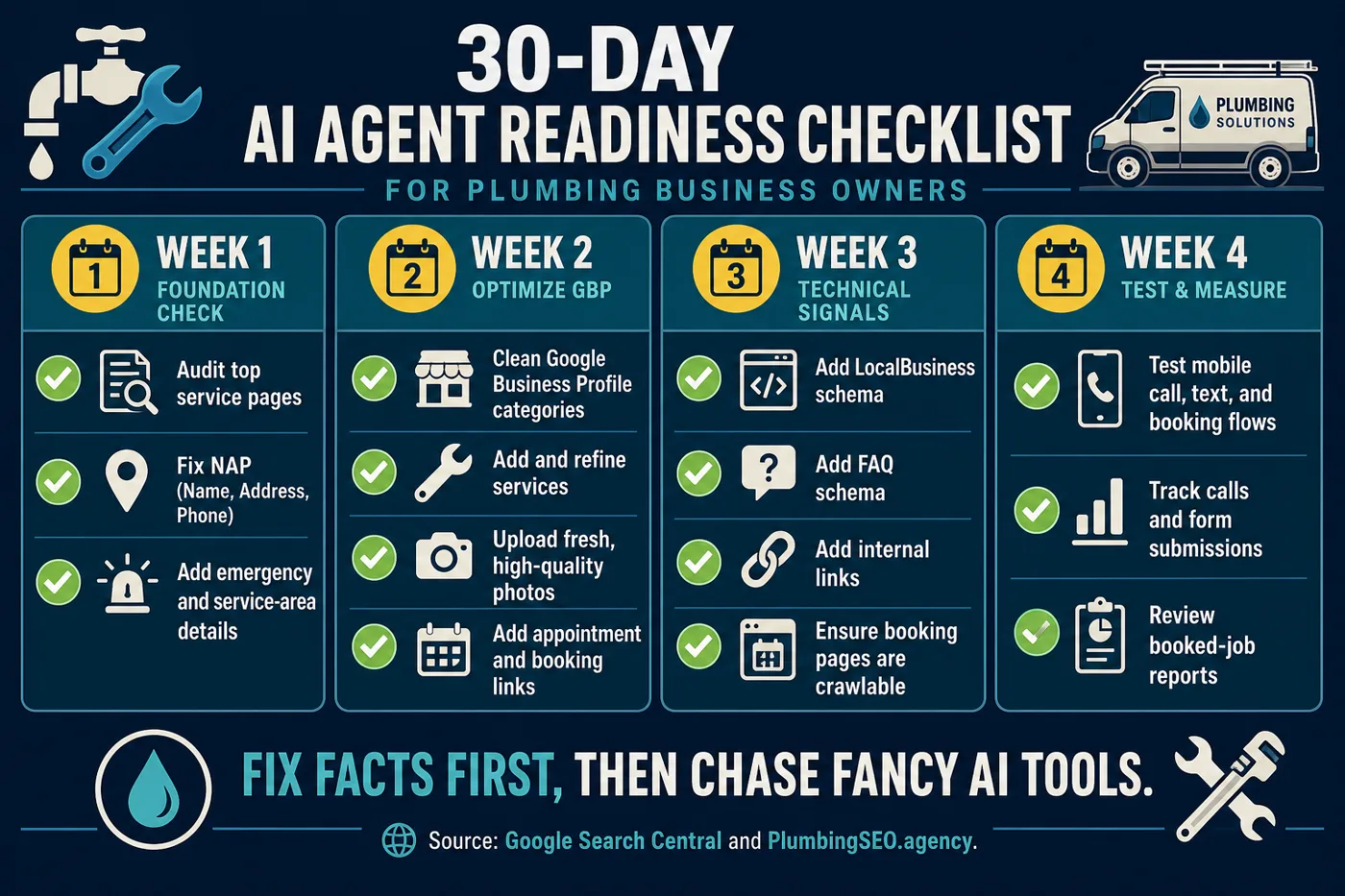
The 30-day plumber-owner action plan
Here is the practical order I would use if the phones, website, GBP, and booking process are all a little messy.
- Week 1: Audit your top service pages. Fix missing services, cities, emergency notes, trust proof, internal links, and mobile call buttons.
- Week 2: Clean up Google Business Profile. Review categories, services, hours, appointment URL, photos, and review responses.
- Week 3: Add or repair structured data. Validate LocalBusiness, BlogPosting, BreadcrumbList, and FAQ schema where relevant.
- Week 4: Test the booking path. Call from mobile, submit forms, check text links, confirm after-hours messages, and compare leads to booked jobs.
The way I see it, AI agents reward the plumbing companies that already make the basics clear. The trucks still need to roll. The customer still needs help. The owner still needs profitable jobs on the board. AI search just raises the price of sloppy information.
If you want a second set of eyes, start with a free plumbing SEO audit. We will look for the leaks in your website, GBP, booking path, and local search visibility before you spend money on another tool.
FAQ: Google I/O 2026 AI Agents for Plumbers
They make clean business information more important. If your website, Google Business Profile, reviews, service areas, and booking links are clear, AI-driven search has better facts to work with when a homeowner asks for help.
Most plumbers should fix the basics first. Clean service pages, GBP, LocalBusiness schema, call tracking, and booking flow usually matter more than launching a custom AI tool too early.
Start with pages that drive urgent calls and high-value jobs: water heater repair and replacement, drain cleaning, sewer repair, leak detection, emergency plumbing, and your most important service-area pages.
Schema can help search systems understand page content and business facts, but it does not guarantee rankings. Use accurate LocalBusiness, FAQ, BreadcrumbList, and BlogPosting schema that matches visible content.
Track calls, forms, GBP actions, online bookings, booked-job rate, service type, city, and revenue where possible. Rankings and impressions help, but booked jobs tell the truth.
Get Your Plumbing Site Ready for AI Search
If your website facts, GBP, reviews, and booking path are leaking calls, we will show you what to fix first. No scare tactics. No fake AI promises. Just a practical plumbing SEO leak check.
Run My Free SEO Leak Check