
- Schema markup is invisible code that helps Google understand your plumbing business, service area, hours, reviews, services, and page topics.
- For plumbers, the safest setup is JSON-LD for LocalBusiness or Plumber, Service pages, FAQ, Breadcrumb, and BlogPosting. Keep every fact accurate and visible on the page.
- Do not treat schema like magic ranking dust. Build it, test it in Google's Rich Results Test, inspect pages in Search Console, and measure clicks and calls over time.
Why Schema Matters When the Phone Is Quiet
If your plumbing company is not showing clearly in Google, the problem is not always the work you do. Sometimes Google simply cannot connect the dots. It sees a homepage, a few service pages, a phone number, maybe a Google Business Profile, and a pile of words about drains, water heaters, slab leaks, and emergency calls.
Schema markup helps organize those dots. It tells search engines, in a standardized format, what kind of business you are, where you work, what services you provide, what page a visitor is reading, and how that page fits into the rest of the site.
Google's structured data documentation says structured data gives Google explicit clues about the meaning of a page and can enable richer search results. Google also recommends JSON-LD because it is easier to implement and maintain than formats that are mixed into the visible HTML. For a plumbing owner, schema is not a fancy developer trick. It is a way to make the important facts about your company harder for Google to misunderstand.
That matters because customers do not search calmly. They search when a toilet backs up, a water heater quits, or a tenant is texting the landlord every five minutes. A clearer search result can be the difference between your truck getting the call and another company getting there first.
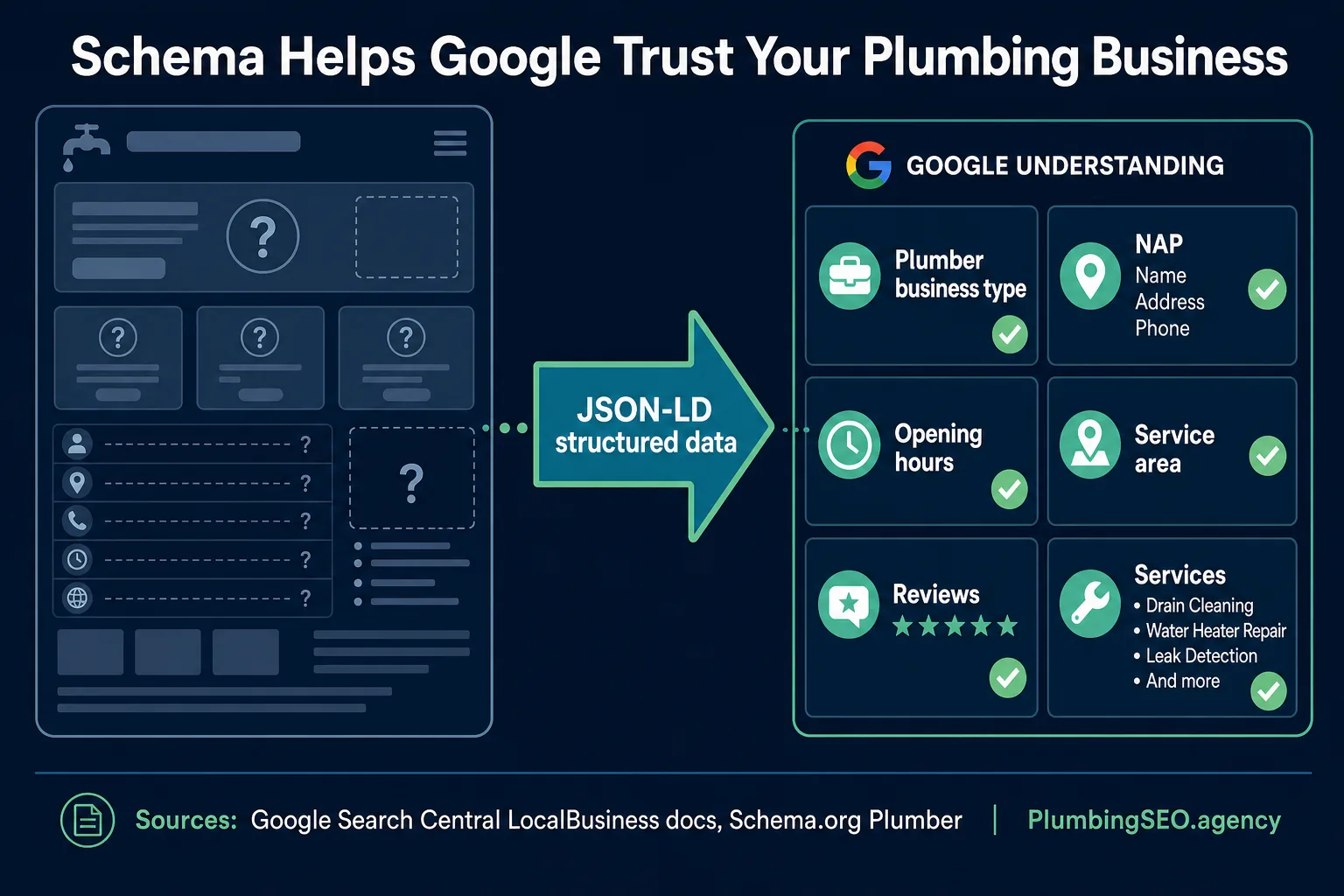
Schema turns scattered business details into facts Google can understand and verify.
What Schema Markup Actually Is
Schema markup is structured data added to a page. The most common format is JSON-LD, a script block that sits in the page code and describes the page in plain machine-readable facts.
Here is the plain-English version. Your visible page might say, "We repair water heaters in Dallas." Schema can clarify that the page is about a plumbing service, the provider is a local plumbing company, the service is water heater repair, the area served includes Dallas, and the page belongs to your website.
Search engines still need good content, crawlable pages, fast loading, strong local signals, and real-world trust. Schema does not replace those things. It labels them. Think of it like writing the job address clearly on the ticket before sending a truck. The work still has to be done, but nobody wastes time guessing where to go.
For plumber websites, schema usually belongs in five places:
- Homepage: Plumber or LocalBusiness schema for the company entity.
- Service pages: Service schema tied to drain cleaning, water heater repair, leak detection, sewer repair, and similar work.
- Location or service-area pages: careful areaServed details, real NAP consistency, and page-specific content.
- Blog posts: BlogPosting or Article schema, plus BreadcrumbList.
- FAQ sections: FAQPage schema only when the questions and answers are visible to users.
The Plumber-Specific Schema Stack
A generic local business guide usually stops at LocalBusiness schema. That is fine for a coffee shop. A plumbing company needs more detail because service intent is split across urgent calls, planned repairs, replacement work, commercial jobs, and city-level searches.
The best starting point is the Schema.org Plumber type, which is a more specific LocalBusiness subtype. It supports important business properties such as address, telephone, opening hours, areaServed, aggregateRating, image, logo, sameAs, and the services or offers tied to the company.
Use this stack as the practical order:
| Schema type | Where it belongs | Why plumbers need it |
|---|---|---|
| Plumber or LocalBusiness | Homepage and contact page | Defines the business entity, NAP, hours, logo, service area, and sameAs profiles. |
| Service | Main service pages | Connects each job type to the company, offer, and area served. |
| FAQPage | Visible FAQ sections | Clarifies common customer questions without hiding anything from users. |
| BreadcrumbList | Every important page | Shows Google how the page fits into the site structure. |
| BlogPosting or Article | Blog articles | Labels educational content, author, date, headline, and main page URL. |
If your website already has a technical SEO foundation, this schema stack pairs naturally with advanced local SEO for plumbers. Service-area architecture, reviews, GBP signals, and schema all need to tell the same story. If one says you serve Dallas, another says Fort Worth, and a city page uses a fake address, Google gets a mess instead of a map.
A Safe Step-by-Step Implementation Checklist
The safest way to add schema is boring in the best possible way. Build a small set of accurate markup, test it, deploy it to a few pages, inspect those pages, then expand. That is close to the workflow Google recommends in its LocalBusiness structured data documentation.
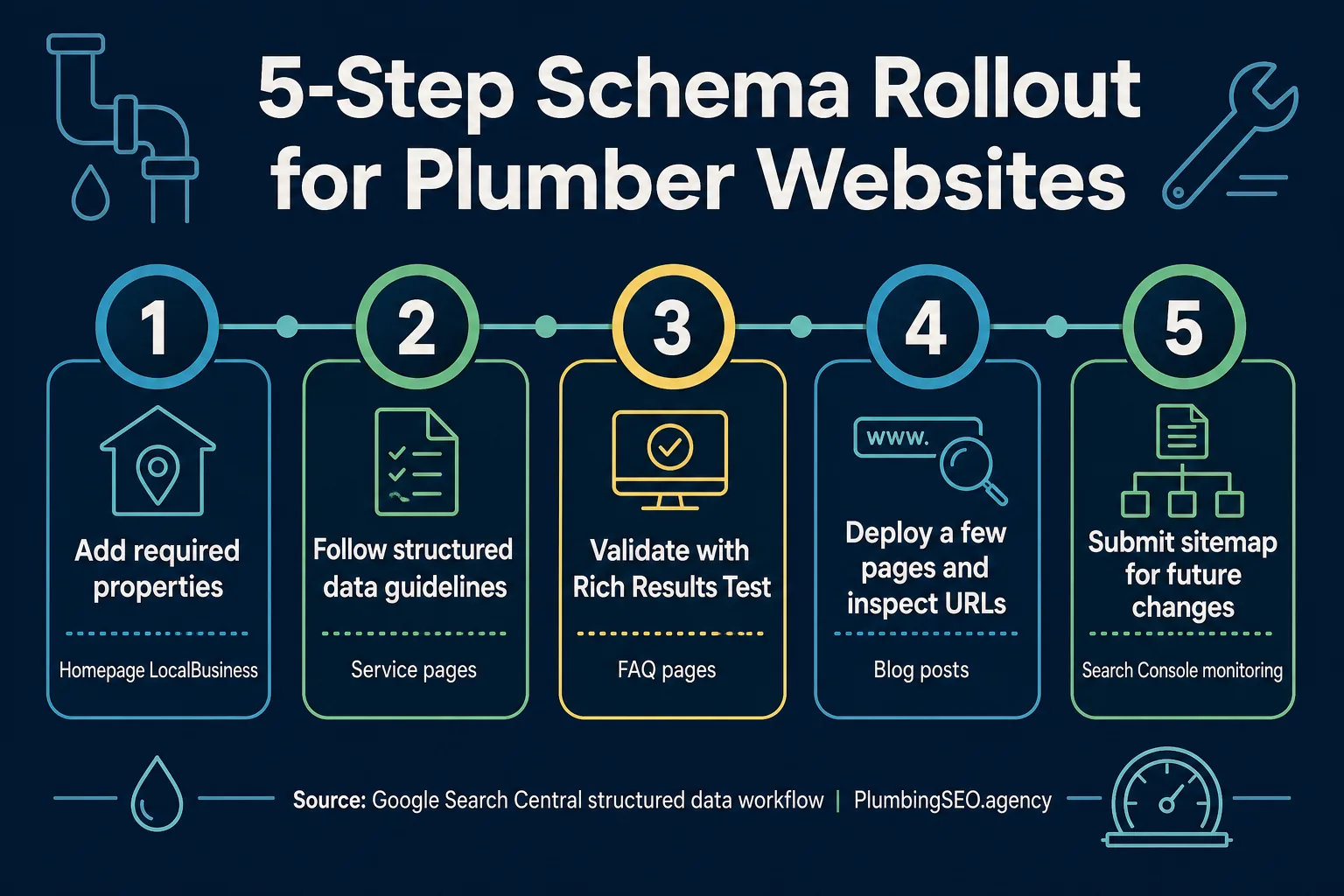
Use Google's rollout order: build, validate, deploy carefully, inspect, then keep the sitemap current.
1. Start with the homepage entity
Your homepage schema should describe the real plumbing business. Include the business name, URL, phone number, logo, image, address if you have a legitimate public address, service area, hours, and sameAs links to real profiles.
Do not create a separate business entity for every city unless you truly operate separate locations. Service-area businesses get into trouble when they try to look bigger than they are. Google is confusing enough without handing it a fake map.
2. Add service schema to pages that deserve it
A drain cleaning page should describe drain cleaning. A water heater page should describe water heater repair or installation. If the page is thin, fix the page first. Schema should label real content, not cover for content that does not help the customer.
3. Mark up visible FAQs
If you add FAQ schema, the questions and answers must also be visible on the page. Keep the answers useful. Customers want to know response times, service areas, pricing ranges, permits, warranty basics, and when a repair becomes a replacement.
4. Validate before publishing
Use Google's Rich Results Test during development. Then use URL Inspection in Search Console after the page is live. Google's intro guide also says complete and accurate recommended properties are better than stuffing every possible property with weak or inaccurate data.
5. Monitor changes after deployment
After schema goes live, submit the sitemap, request indexing for important changed pages, and watch Search Console. Look for valid structured data, indexing status, impressions, clicks, and the calls that follow. Rankings are nice. Booked jobs pay the bills.
Example JSON-LD for a Plumbing Company
This is not a copy-paste final for every shop. It is a clean starting pattern your developer can adapt. Replace every sample field with real business information that matches your site and Google Business Profile.
{
  "@context": "https://schema.org",
  "@type": "Plumber",
  "name": "Example Plumbing Company",
  "url": "https://www.exampleplumbing.com/",
  "telephone": "+1-555-555-0100",
  "image": "https://www.exampleplumbing.com/images/truck.jpg",
  "logo": "https://www.exampleplumbing.com/logo.png",
  "priceRange": "$$",
  "address": {
    "@type": "PostalAddress",
    "streetAddress": "123 Main Street",
    "addressLocality": "Dallas",
    "addressRegion": "TX",
    "postalCode": "75201",
    "addressCountry": "US"
  },
  "areaServed": ["Dallas", "Plano", "Irving"],
  "openingHoursSpecification": [{
    "@type": "OpeningHoursSpecification",
    "dayOfWeek": ["Monday", "Tuesday", "Wednesday", "Thursday", "Friday"],
    "opens": "08:00",
    "closes": "17:00"
  }]
}
The important part is accuracy. If your company is a service-area business without a customer-facing office, do not invent a storefront. If your hours change for emergencies, holidays, or after-hours dispatch, make sure the visible page and schema do not contradict each other.
What the Generic Competitor Guides Usually Miss
Most general schema articles explain what structured data is. They usually miss the owner-side plumbing details that affect calls.
- Service-area risk: plumbers often serve multiple cities without physical offices in each city. Schema must not imply fake locations.
- Emergency intent: customers need phone numbers, hours, and service availability to be clear across the page, GBP, and schema.
- Service-page matching: slab leak, sewer repair, drain cleaning, and water heater replacement are different jobs. They need different page intent.
- Review caution: review markup can create policy issues if it is not handled carefully. Never fake stars or mark up reviews that are not legitimately shown and supported.
- Tracking and measurement: schema should be judged by better visibility, cleaner indexing, click behavior, and phone calls, not by a one-time validation pass.
If you are rebuilding the full site, pair schema with a broader SEO for plumbers plan. Schema is one tool in the box. It works better when your service pages, local links, citations, reviews, and conversion tracking are all lined up.
Common Schema Mistakes That Can Make Things Worse
Bad schema is worse than no schema because it creates false confidence. The tool says something exists, the agency says the box is checked, and the owner wonders why the phone still is not ringing.
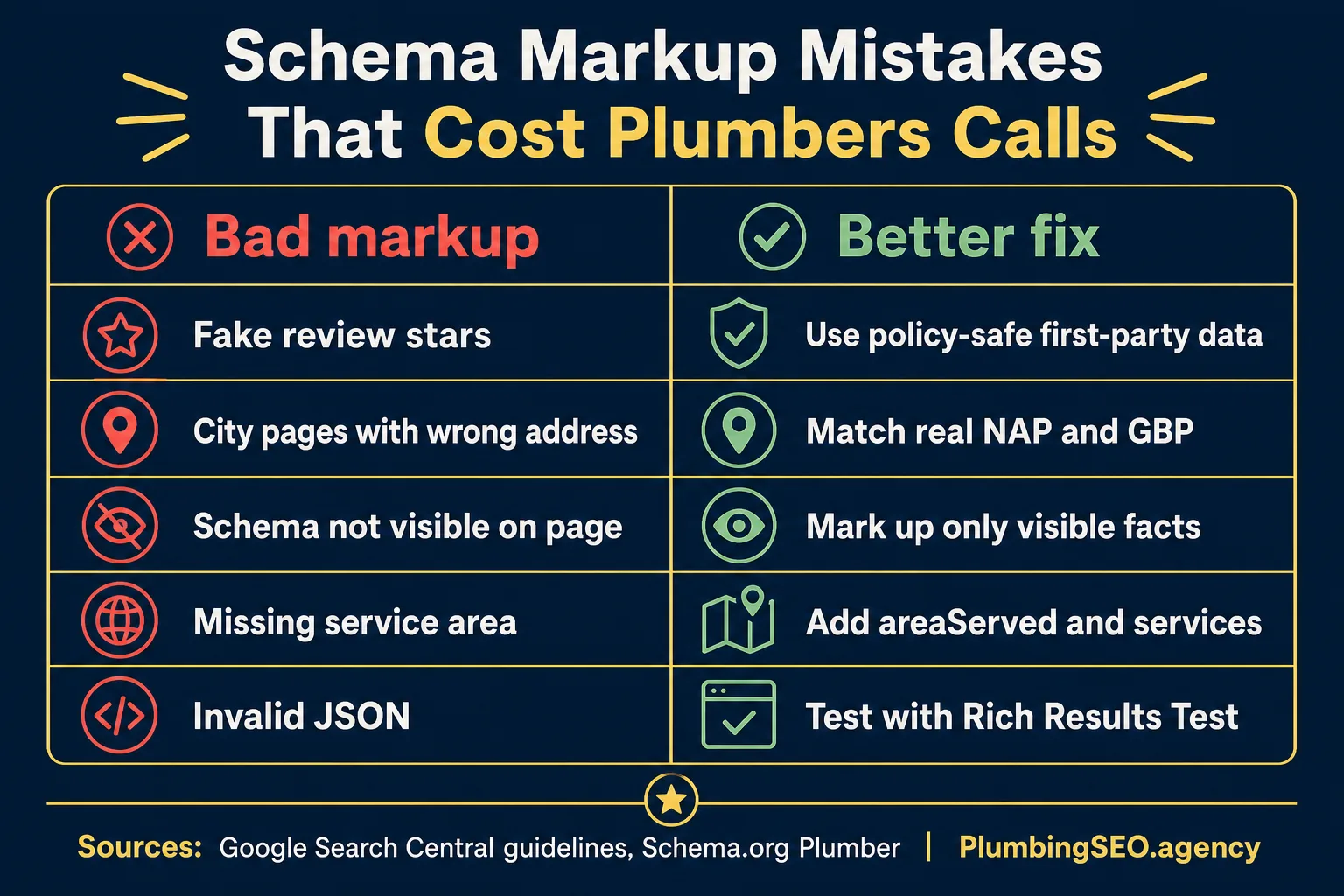
The safest schema is accurate, visible on the page, and tested before it goes live.
Fake review stars
Do not mark up fake ratings, cherry-picked ratings, or review data that is not properly supported on the page. It may look clever in a report. It is not clever if it creates a trust problem with Google.
Wrong city-page addresses
If you serve a city, say you serve it. Do not add an address there unless it is a real, eligible business location. Plumbing is local, but that does not mean every service-area page needs to pretend it has an office.
Schema that describes facts users cannot see
Google's structured data guidelines are clear that markup should describe the page content. If the page never mentions the service, city, hours, or FAQ answer, do not hide it in JSON-LD and hope nobody notices.
Invalid JSON
A missing comma can break the whole thing. That is why validation is not optional. Double-check it like you would double-check a valve before walking away from a job.
How to Measure Whether Schema Helped
Do not judge schema by feelings. Use Search Console and call tracking. Google's structured data intro recommends comparing performance before and after on pages with enough data to make the comparison useful.
For a plumbing company, watch these signals:
| Metric | Where to check | What it tells you |
|---|---|---|
| Valid structured data | Rich Results Test and Search Console | Whether Google can parse the markup without critical errors. |
| Indexed pages | URL Inspection and Page indexing | Whether changed pages are accessible and eligible to appear. |
| Impressions and CTR | Search Console Performance | Whether searchers are seeing and clicking improved listings. |
| Calls by page or channel | Call tracking and forms | Whether visibility is turning into real plumbing leads. |
| Booked jobs | CRM or dispatch software | Whether the lead quality is good enough to keep trucks moving. |
Google's own case studies report stronger engagement for pages using structured data, including Rotten Tomatoes measuring a 25% higher click-through rate for enhanced pages, Food Network seeing a 35% increase in visits after enabling search features on many pages, and Nestle measuring an 82% higher click-through rate for pages shown as rich results. Those are not plumbing-specific guarantees. They are a reminder that clearer listings can change user behavior when the underlying page earns the click.
What I Would Fix First
If a plumber asked me where to start, I would not start with every schema type under the sun. I would start with the pages most likely to create calls.
- Homepage Plumber schema with accurate NAP, URL, logo, service area, hours, and sameAs profiles.
- Top money service pages with Service schema and clear visible content.
- FAQ schema only on pages with genuinely helpful visible FAQs.
- Breadcrumb schema across the site.
- BlogPosting schema on educational articles.
Then I would run validation, inspect the URLs, update the sitemap, and watch Search Console for a few weeks. If rankings are still stuck, schema probably is not the only leak. At that point, look at service page quality, local authority, reviews, city targeting, mobile conversion, and whether your tracking tells the truth. If you want a second set of eyes, contact us and we can review the markup as part of a plumbing SEO audit.
Frequently Asked Questions
Schema helps search engines understand your plumbing company, service area, services, hours, and page topics. It can support richer search results and clearer local signals, but it works best when your visible content, Google Business Profile, citations, and reviews are accurate too.
Yes, a careful owner or webmaster can add basic JSON-LD, especially through a good CMS or SEO plugin. The risk is accuracy. If your schema says one thing and your page, GBP, or citations say another, you can create confusion instead of clarity.
Google has to crawl and process the changed pages first. Important pages can be inspected and requested in Search Console, then monitored over the following weeks. Schema is usually measured through valid structured data, impressions, click-through rate, and call activity rather than a same-day ranking jump.
Use Plumber when it fits, because it is a more specific LocalBusiness subtype. Include accurate NAP, URL, logo, phone, service area, hours, and sameAs links. If the business has no public storefront, be careful not to invent an address or location signal.
No. Valid schema can make a page eligible for certain search features, but Google decides what to show. The markup must be accurate, visible facts must match the page, and the page still needs strong content and local SEO signals.
Want Your Schema Checked Before Google Sees It?
We review plumber websites for LocalBusiness schema, service-page markup, FAQ schema, crawl issues, and the local SEO leaks that keep good companies from getting calls. No jargon. Just the fix list.
Request a Schema and SEO Review