
- Duplicate content is not usually a scary penalty problem. For plumbers, it is usually a calls problem because Google and homeowners cannot tell which page deserves attention.
- City pages, manufacturer descriptions, and repeated service pages can all work when each page has a real job, real local proof, and a clear reason to exist.
- Do not delete everything that looks similar. Audit first, choose the strongest page, then merge, canonicalize, redirect, or rewrite based on business value.
If your plumbing website has twenty city pages that all say the same thing, ten water heater pages using manufacturer copy, and a handful of drain cleaning pages that repeat each other, you do not have an SEO mystery. You have a filing cabinet problem.
Google is trying to decide which page helps the searcher. The homeowner is trying to decide which plumber to call before the leak gets worse. If every page sounds the same, both of them have to guess. That is where calls leak away.
Google defines duplicate content as substantive blocks of text that completely match or are appreciably similar across URLs. Google also says it tries to show a diverse set of useful results, not the same page over and over. In plain plumbing terms, ten nearly identical pages do not make your company look ten times more helpful.
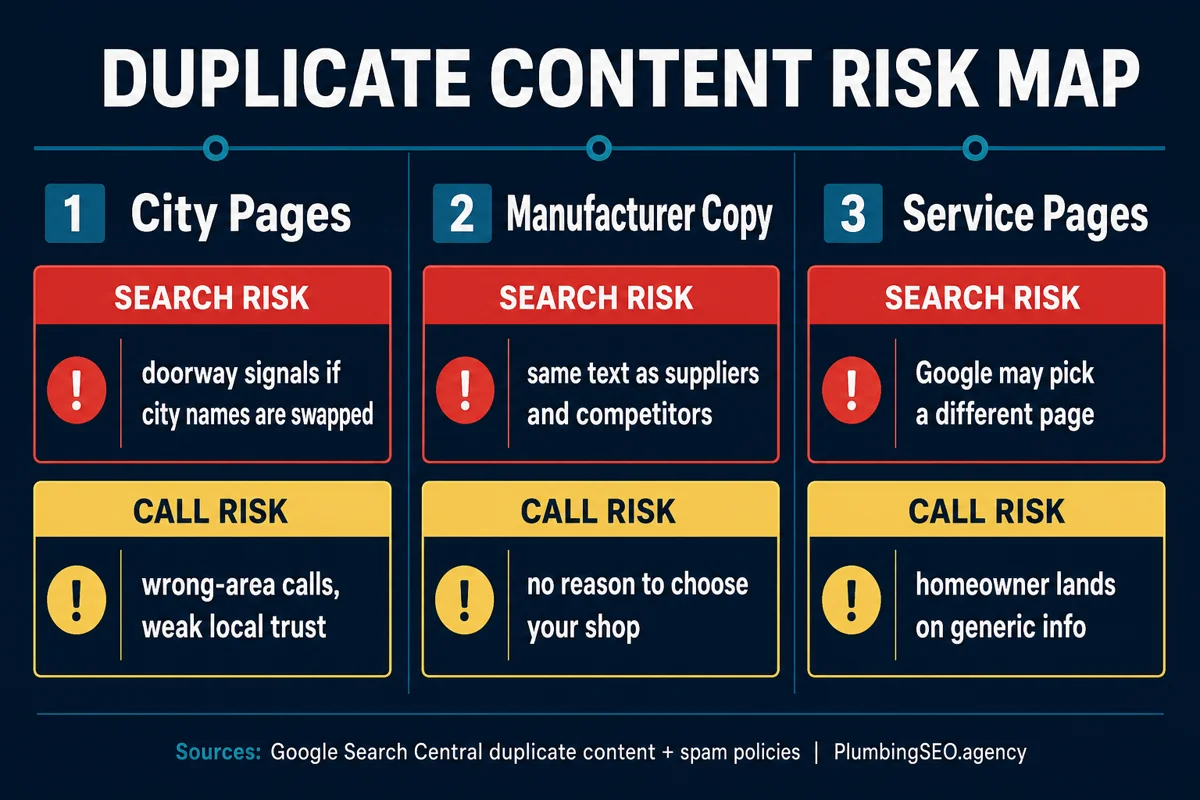
The real duplicate content problem for plumbers
Most plumbing owners hear "duplicate content" and think Google is about to punish the whole site. That is usually not the right way to look at it. Google has said for years that the famous duplicate content penalty is mostly misunderstood. The bigger risk is that Google filters, folds, or chooses a different page than the one you wanted.
For a plumbing company, that can show up in ugly ways:
- The wrong city page ranks, so the visitor thinks you are not close enough.
- A generic service page gets indexed instead of the page built to sell emergency calls.
- Copied manufacturer text gives the customer no reason to choose your shop over the supply house, big-box store, or another plumber.
- Internal links get split across several weak pages instead of pushing one strong page.
- Your team wastes time rewriting the same promise in twenty places while the phone stays quiet.
That last one matters. A plumbing company does not need more pages just to have more pages. It needs the right pages to rank, explain the work, prove the company can do the job, and make the next step obvious.
City pages: local proof beats swapped city names
City pages are not bad by default. A plumber who serves Dallas, Plano, and Frisco may need pages that explain those service areas. The problem starts when every page is the same page with the city name changed. That is not local SEO. That is a mail merge wearing work boots.
Google's spam policies describe doorway abuse as pages created to rank for similar queries and funnel people to a less useful destination. One example is pages targeted at specific regions or cities that send users to one page. That does not mean every service-area page is a doorway page. It means the page has to earn its place.
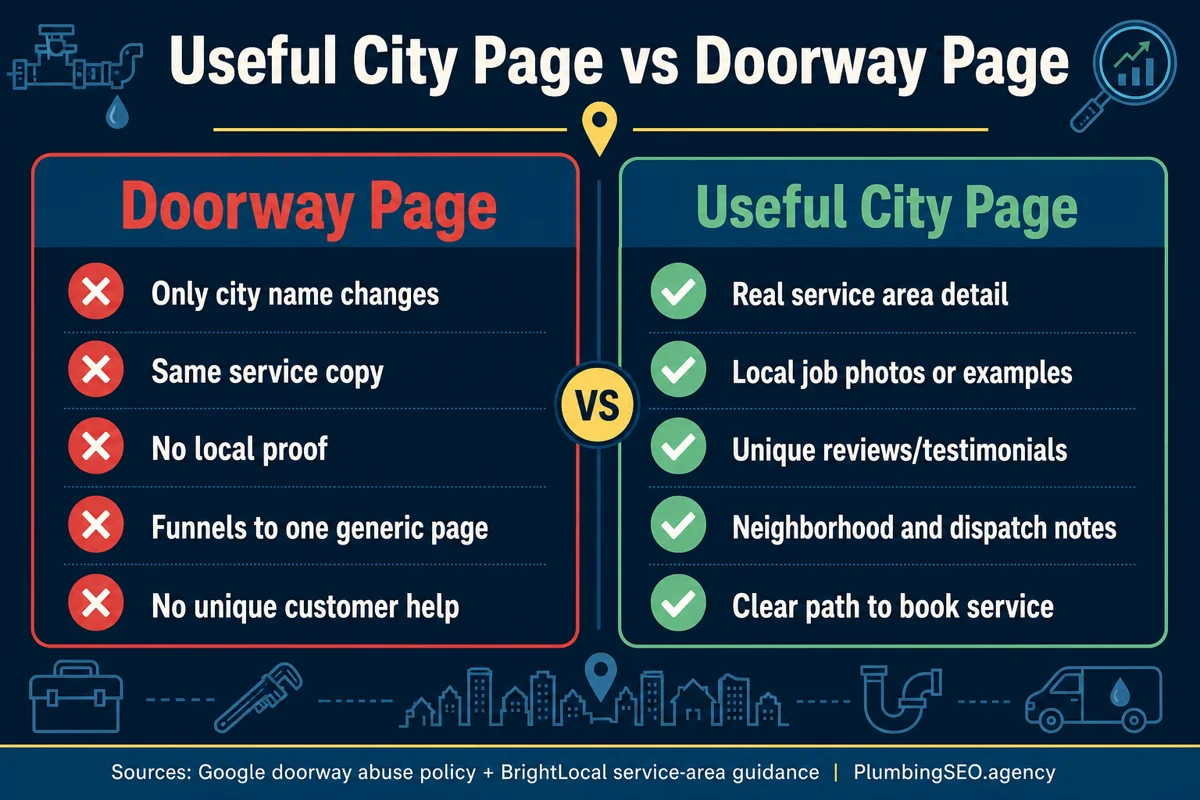
A useful city page answers local questions. Do you actually dispatch there? Which neighborhoods do you cover? Are there common pipe materials, water heater setups, slab leak issues, drain problems, or older-home concerns in that area? Do you have job photos, reviews, routes, or examples from nearby work?
If the answer is yes, keep the page and make it better. If the answer is no, do not pretend a different H1 solves the problem. Put that effort into fewer, stronger service-area pages and link them properly from your main services.
Manufacturer copy: useful for specs, weak for calls
Manufacturer descriptions are handy. They explain models, warranties, sizes, and features. But if your water heater page is copied from the manufacturer, you are saying the same thing as distributors, retailers, and a pile of other contractors.
That kind of copy does not answer the homeowner's real question: "Can this plumbing company help me pick, install, repair, or replace the right thing without making my day worse?"
Use manufacturer copy like a parts label, not the whole service page. Keep factual specs where they help. Then add what only your company can add:
- How you diagnose whether replacement is actually needed.
- Which models fit the homes you usually service.
- What installation mistakes cause callbacks.
- What the homeowner should ask before approving the job.
- Photos or examples from real installs, where available.
That is the difference between copy that fills space and copy that helps someone call you with confidence.
| Page type | Common duplicate issue | Better fix |
|---|---|---|
| City page | Same service text with a swapped place name | Add local proof, service-area detail, and unique call paths |
| Manufacturer or product page | Copied model descriptions with no contractor judgment | Keep specs, then add diagnosis, install advice, and real examples |
| Service page | Drain, sewer, and emergency pages all say the same thing | Separate intent, urgency, process, proof, and FAQs by service |
| Blog post | Thin rewrite of a service page | Answer a different question, then link up to the money page |
Service pages: similar work still needs different intent
Plumbing service pages are naturally similar. A homeowner with a clogged drain, sewer backup, slab leak, water heater issue, or fixture install all need a plumber. So yes, some language will overlap. The mistake is treating every service like the same job.
A drain cleaning page should talk about symptoms, urgency, camera inspection, safe clearing, and repeat-clog prevention. A sewer repair page should explain backups, line damage, excavation or trenchless options, permits, and risk. A water heater repair page should cover no hot water, leaks, pilot or ignition problems, replacement thresholds, and same-day service.
If those pages all say "fast, affordable, licensed plumbers near you," Google has very little to work with and the customer has even less. That phrase is not a strategy. It is the SEO version of a bucket under a leak.
This is where a plumbing website SEO audit earns its keep. The audit should not just count duplicate words. It should decide which pages deserve to exist, which page should be the canonical winner, which pages should be merged, and which pages need a better reason to rank.
When similar pages should stay separate
Do not flatten a useful plumbing website just because a crawler found overlap. Similar pages can stay separate when they serve different searches and different customer decisions.
- Different urgency: emergency plumber, scheduled install, maintenance, and replacement are not the same call.
- Different job value: whole-house repiping deserves more depth than a simple fixture repair.
- Different location proof: a major service area can need its own page if the company has real work and reviews there.
- Different audience: homeowner, property manager, restaurant owner, and facility manager pages should not all sound alike.
- Different next step: some pages should push a call, some should ask for photos, and some should route to an estimate.
The way I see it, duplicate content is not a word-count problem first. It is a usefulness problem. If the page helps a specific customer make a better decision, improve it. If it only exists because somebody wanted another URL, consolidate it.
How to audit duplicate content without breaking the site
Start with discovery, not demolition. Screaming Frog's duplicate-content workflow separates exact duplicates from near duplicates, and that distinction matters. Exact duplicates may be technical cleanup. Near duplicates need a human decision.
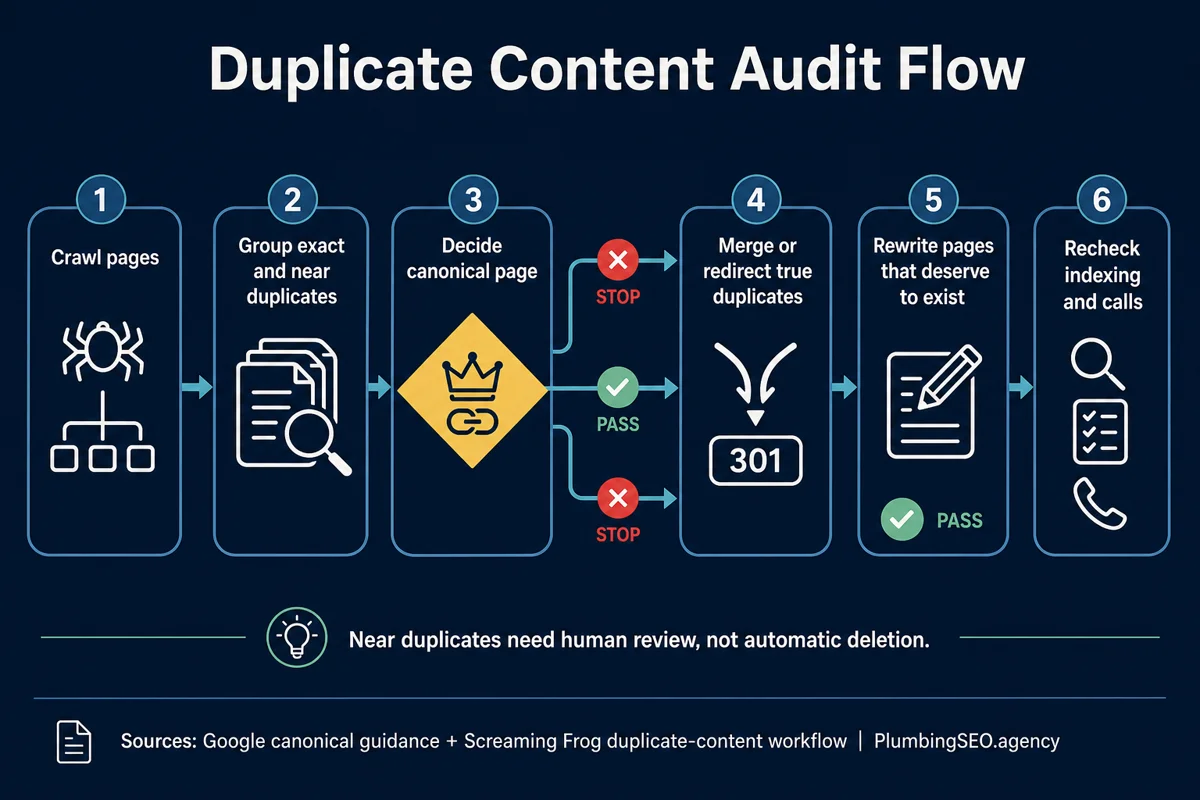
Here is the practical order I would use on a plumbing site:
- Crawl the site. Find exact duplicate titles, descriptions, H1s, body content, canonicals, and URL patterns.
- Group pages by intent. Put city pages together, service pages together, product pages together, and blog support pages together.
- Pick the page that should win. Choose based on service value, search demand, local proof, internal links, and conversion path.
- Merge true duplicates. If two pages serve the same customer need, combine the best parts and redirect the weaker URL when appropriate.
- Use canonicals carefully. Google's canonical guidance lets you signal the preferred version, but canonicals are not a substitute for useful pages.
- Rewrite pages that deserve to exist. Add real examples, local proof, service-specific questions, photos, trust signals, and a clear call path.
- Recheck indexing and calls. Rankings matter, but the phone tells the truth. Watch which page gets found and which page books work.
What to rewrite first
If you have a big site, do not try to fix every repeated paragraph in one sitting. Start where duplicate content can cost the most calls.
- Emergency service pages: these need clear urgency, mobile click-to-call, and fast trust signals.
- Highest-value services: water heaters, repiping, sewer line repair, slab leaks, and commercial plumbing need stronger proof than generic copy.
- Major city pages: keep the service areas that drive real jobs, then make them actually local.
- Pages with impressions but weak clicks: these may already be visible, but the snippet or page promise is not earning the call.
- Pages competing with each other: if two pages trade places for the same query, decide which one should be the main target.
Once the winners are stronger, use internal links to make the site easier to understand. The companion guide on internal linking for plumbing websites explains how to route authority toward the pages that make money instead of leaving good pages orphaned.
A simple rule for plumbing owners
Before publishing any city page, service page, product page, or blog post, ask one question: "If a homeowner landed here from Google, would this page help them choose us faster than the page beside it?"
If the answer is yes, keep going. Add proof. Add photos. Add a better FAQ. Link it from the right pages. Make the call button easy to find.
If the answer is no, do not publish another thin page and hope Google figures it out. Google has enough plumbing pages to sort through already. Give it fewer, better choices. Give the customer a reason to trust you. That is how duplicate content cleanup turns into more booked jobs, not just a prettier audit report.
FAQ: Duplicate Content on Plumbing Websites
Usually the bigger problem is filtering, canonical confusion, weak rankings, and poor customer trust. Google may choose a different page than the one you wanted, or it may ignore pages that look too similar. Deceptive or spammy doorway pages are a separate risk.
No. City pages can help when they serve real service areas and include unique local proof. They become risky when every page is the same copy with only the city name changed.
You can use factual specs, but do not make manufacturer copy the whole page. Add your own diagnosis advice, install notes, replacement thresholds, photos, and customer-focused guidance so the page has a reason to rank and convert.
Not automatically. First decide whether each page serves a unique search intent or customer need. Merge and redirect true duplicates, canonicalize technical duplicates, and rewrite pages that deserve to exist.
Use service-specific symptoms, urgency, process, equipment, local examples, photos, reviews, pricing context where appropriate, FAQs, and a clear call path. A sewer repair page should not read like a faucet repair page.
Check after major site changes, service-area expansion, template redesigns, or new content batches. For active SEO campaigns, a quarterly crawl is a practical rhythm, with priority reviews for pages that rank but do not get calls.
Find the duplicate pages before they cost you calls
If your city pages, manufacturer copy, or service pages are fighting each other, start with a plumbing-specific audit. We will show which pages to keep, merge, rewrite, and link so the right page gets found.
Audit My Plumbing Website