
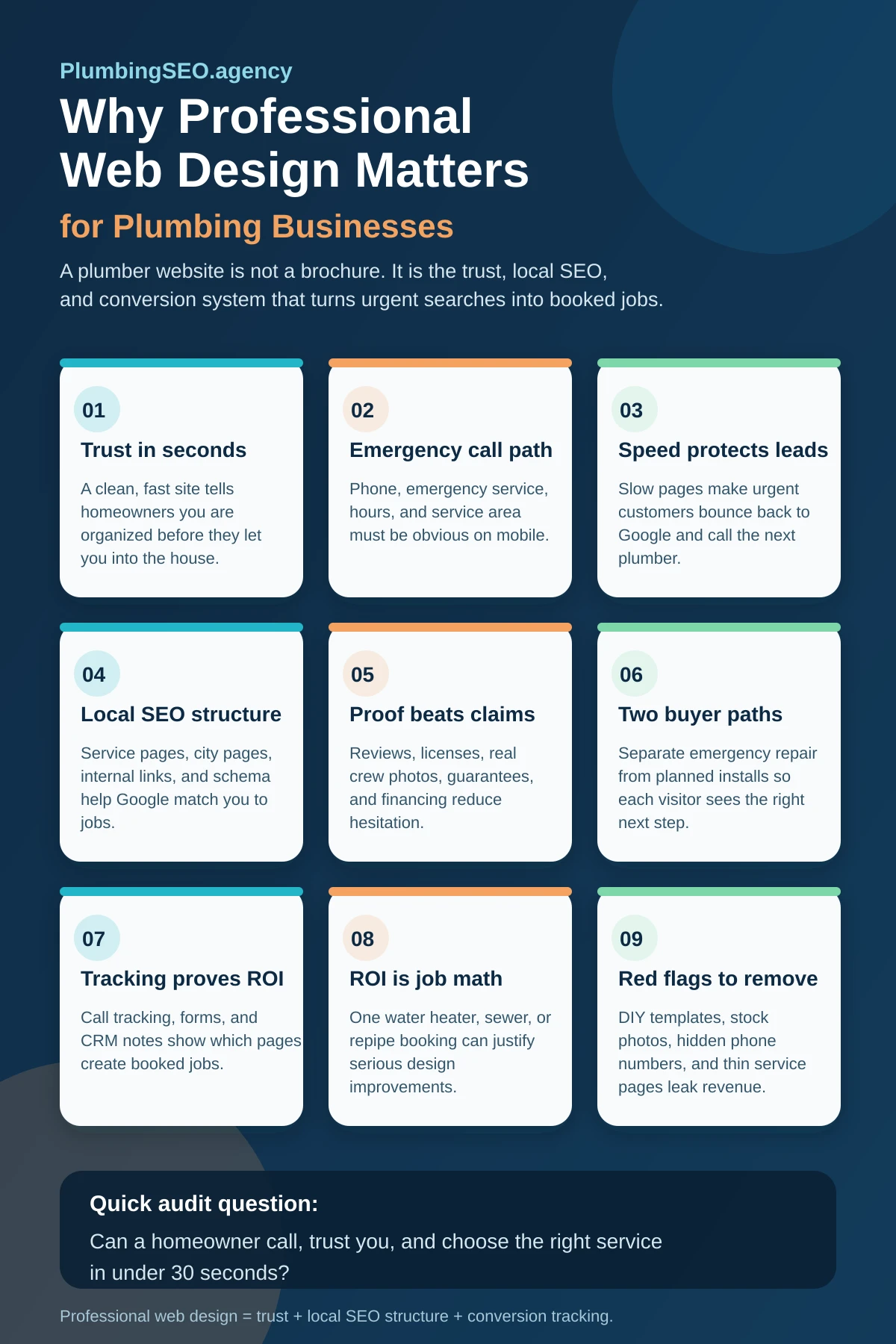
- Professional plumber website design is not about looking fancy. It is about helping the right homeowner trust you, confirm you serve their area, and call without friction.
- Current plumbing web design search results emphasize agency selection, examples, templates, conversion, cost, and local SEO.
- The strongest plumber sites separate emergency visitors from planned-project visitors, build service-specific pages, show proof near the call button, and track calls back to pages.
- If your current website hides the phone number, uses generic copy, lacks city/service structure, or cannot prove which pages create booked jobs, it is probably leaking calls.
A plumbing website has a harder job than a normal brochure site. A homeowner may land on it while water is spreading under a sink, a sewer line is backing up, or a water heater has failed before work. In that moment, design is not decoration. It is the path from panic to trust to phone call.
That is why this guide starts with current search intent instead of opinion. We reviewed current results for professional web design for plumbers, plumbing website design, plumber website design, plumbing website conversion optimization, plumbing website cost 2026, and related plumbing SEO queries. The pages ranking now are not all saying the same thing. Some focus on agency choice. Some show example galleries. Some sell templates. Some talk about conversion. The opportunity for a plumbing company is to combine the useful parts: clear local structure, strong proof, emergency-first mobile UX, and measurable lead tracking.
In plain English: a professional plumbing website should help a busy owner get found, get trusted, get calls, and know what is working.
What the Current SERP Shows About Plumber Website Design
The current search results are useful because they show what Google and searchers expect around this topic. Top-ranking pages include plumber web design service pages from agencies such as Scriptable Solutions and Thrive, agency comparison pages such as Built-Right Digital, example posts from sources such as Simpro, and conversion-focused guides such as Skill Mammoth.
That mix tells us something important. Searchers are not only asking, “Can you make my site look better?” They are asking: Who should build it? What should it include? What do good plumber websites look like? How much should it cost? Will it actually produce calls? A useful plumbing website article has to answer those questions in one practical framework.
The related searches also showed demand around plumber website design, plumbing web design agencies, templates, examples, cost calculators, and plumbing SEO companies. So the winning page should not be a generic design lecture. It should explain the business case, the page structure, the conversion path, and the budget decision.
Start With the Call Path, Not the Color Palette
Many redesign conversations start with colors, fonts, logos, and homepage style. Those things matter, but they are not the first problem. For plumbers, the first problem is whether a visitor can quickly decide, “This company can fix my issue, they serve my area, and I can call now.”
A professional design starts by mapping the call path. Emergency visitors need a direct phone path, fast-loading mobile layout, service-area confirmation, and proof near the top. Planned-project visitors may need more detail: financing, warranty language, photos, process explanation, and a form. Commercial or property-manager visitors may need a different proof set altogether.
If every visitor gets the same homepage hero and the same generic “contact us” button, the website is asking stressed homeowners to do too much thinking. A strong plumber website makes the next step obvious before the visitor has time to doubt you.
Trust Proof Has to Sit Where the Decision Happens
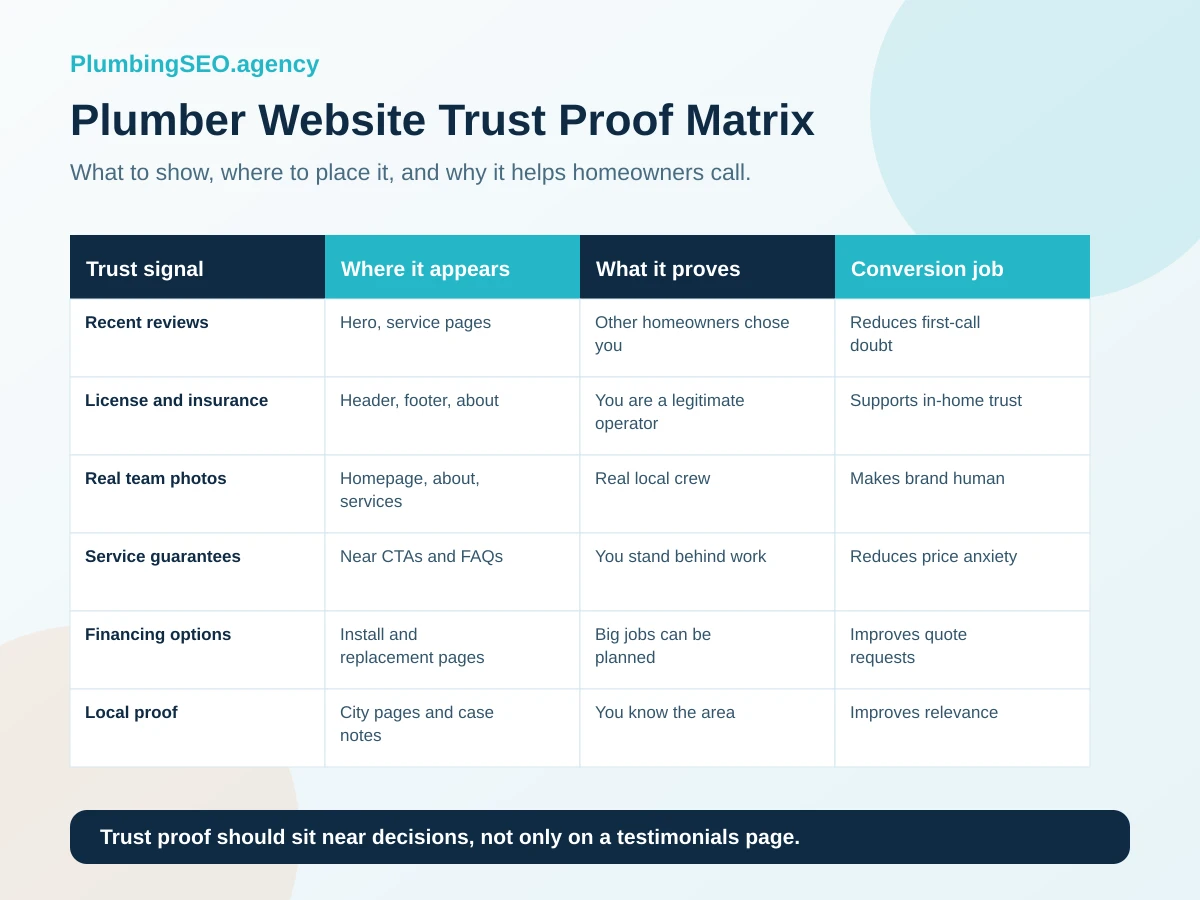
Plumbing is a high-trust service. The customer is not only comparing prices. They are deciding who can enter their home, diagnose a problem, protect their property, and explain a repair they may not understand. That is why trust proof cannot be buried on a separate testimonials page.
Good plumber website design places proof beside the decision point. Near the phone number, show reviews, license/insurance signals, years in business, warranty language, financing options, emergency availability, and real company photos. On a water heater page, show proof related to water heaters. On a sewer page, show proof related to inspections, equipment, and excavation or trenchless capability. On city pages, show local relevance instead of generic copy.
The goal is not to brag. The goal is to answer the silent objections that stop calls: Are they real? Are they local? Are they qualified? Will they stand behind the work? Have they handled this exact problem before?
Mobile Emergency UX Is the Money Path
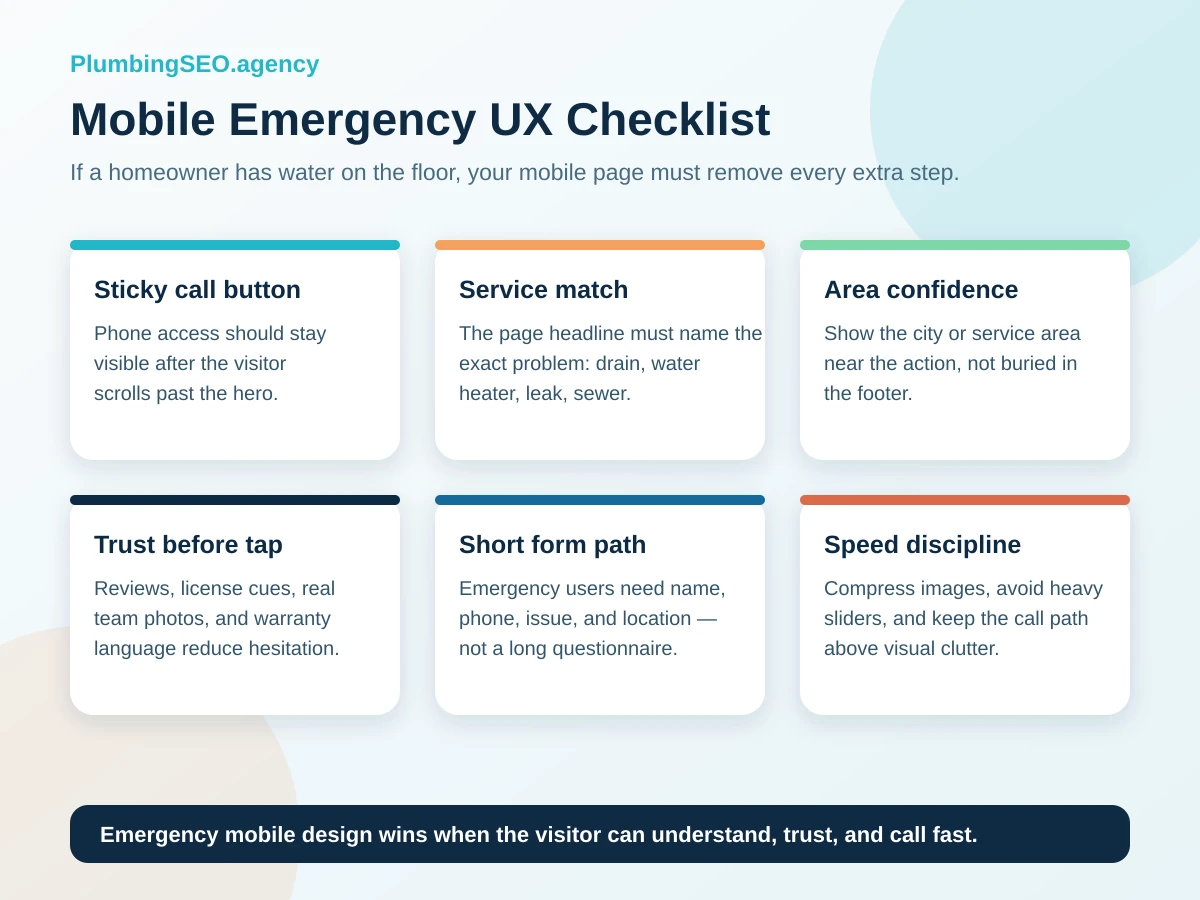
For plumbing, mobile design is not a smaller version of desktop. It is the main battlefield. Emergency visitors may be searching with one hand while dealing with a leak, a clogged toilet, or no hot water. They do not want to pinch, zoom, hunt through menus, close popups, or read a giant block of copy before they can call.
A strong mobile page puts the phone number and service match high on the screen. It uses short, plain headlines. It confirms the service area. It avoids huge sliders and oversized images that push the call button down. It gives the visitor enough proof to feel safe, then lets them act.
This is where many pretty websites fail. They look impressive on a designer’s monitor but become slow, vague, or cramped on a homeowner’s phone. A professional plumbing site should be tested like an emergency customer would use it: open it on a phone, search for the service, find the city, tap to call, and confirm that the tracking works.
Local SEO Structure Should Shape the Website
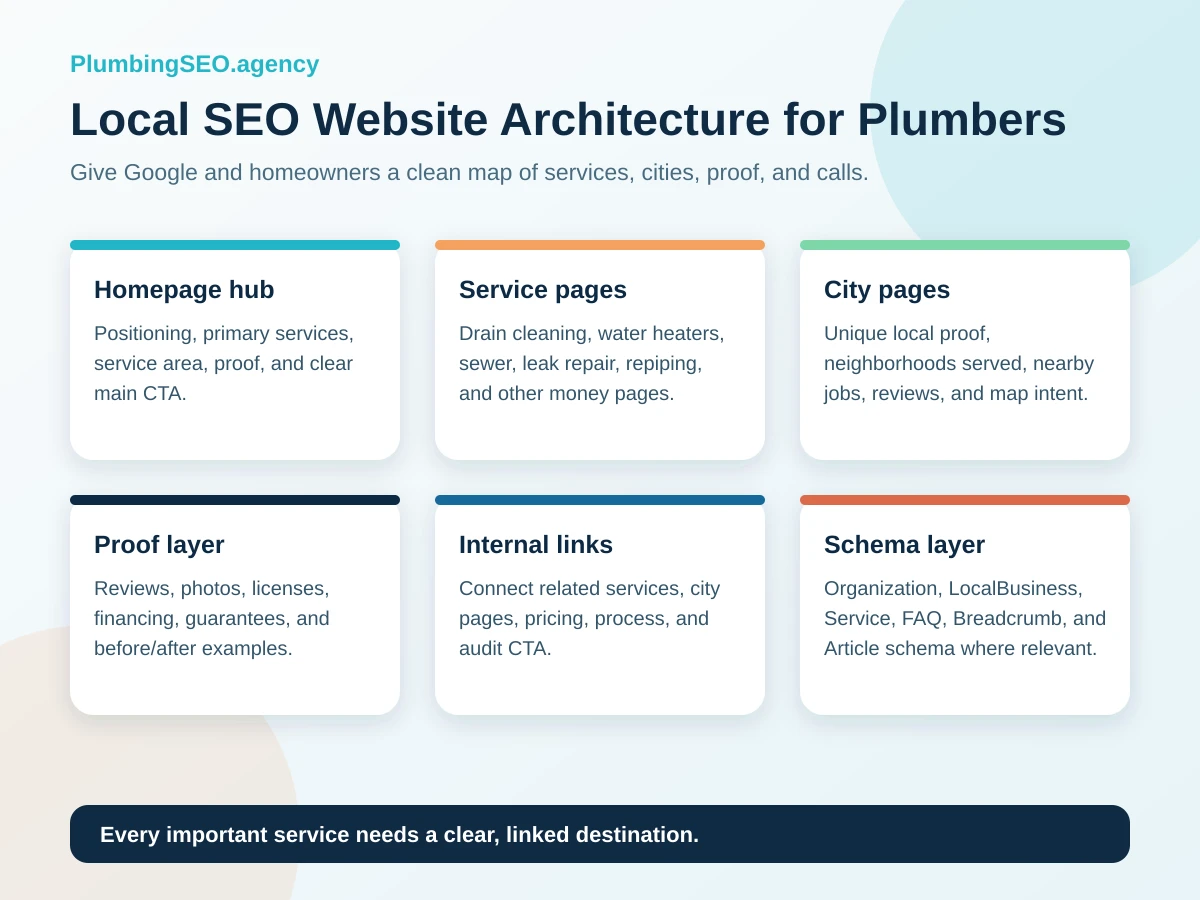
Professional web design for plumbers overlaps with SEO because the site structure tells Google and customers what the company does. One thin “services” page is not enough for a company that wants to rank for drain cleaning, water heater repair, sewer line replacement, slab leak detection, repiping, emergency plumbing, and city-specific searches.
A stronger structure uses the homepage as the trust hub, service pages as problem-specific landing pages, city or service-area pages as local relevance pages, and internal links to connect the whole system. This helps search engines understand the business and helps homeowners land on a page that matches their exact problem.
The design question is practical: can a visitor who searched for “water heater repair near me” land on a page that talks about water heater symptoms, repair versus replacement, service area, financing, warranty, reviews, and how to call? If not, the site is forcing a high-intent visitor onto a vague path.
This is why our plumbing web design work is tied to plumbing SEO. The design is not only a wrapper. It is the framework that supports rankings, trust, and conversion.
Every Major Service Page Needs a Job
A plumber service page should not read like a copied list of services. It should serve one search intent and move one type of visitor toward action. A drain cleaning page needs urgency, symptoms, camera inspection or clearing process, city coverage, and fast calling. A water heater page needs repair-versus-replacement guidance, tank and tankless language, warranty or financing details, and a quote path. A sewer page needs equipment proof, inspection language, risk explanation, and trust signals.
Useful service pages usually contain six layers: a problem-specific headline, service proof, local relevance, trust proof, a simple CTA, and FAQs. The surrounding design should make those layers easy to scan, especially on mobile. The best pages do not bury the phone number after the explanation. They let ready-to-call visitors act immediately while giving cautious visitors enough detail to become comfortable.
One strong service page can outperform a prettier homepage because the intent is sharper. That is the point of professional design: build pages around how plumbing customers actually decide.
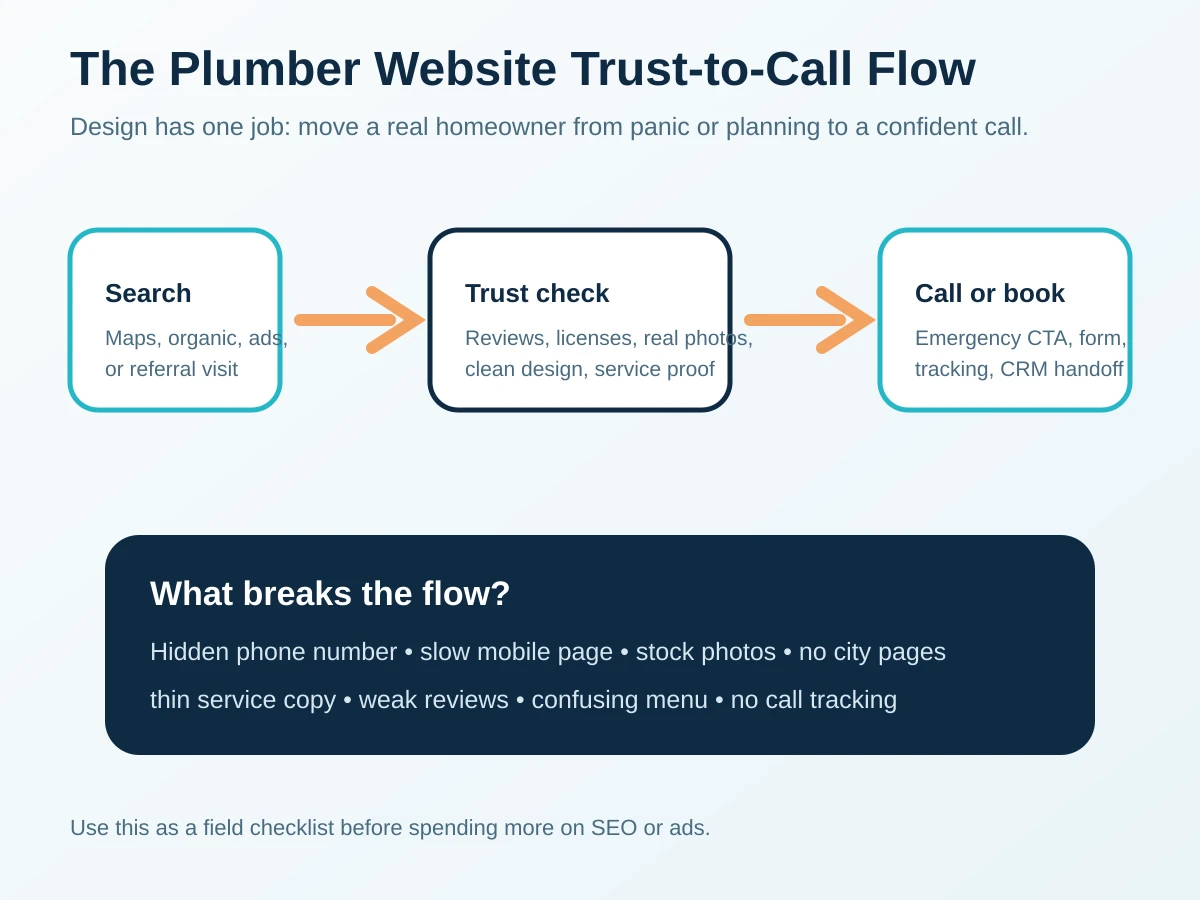
Templates Can Help, But Generic Templates Leak Calls
The SERP shows plenty of demand for plumbing website templates and examples. That makes sense. A new plumbing business may not need a large custom build on day one. A clean template can be a reasonable starting point if it is fast, mobile-friendly, and easy to edit.
The danger is using a template as a shortcut around strategy. A generic template with stock photos, thin service copy, no city structure, no proof, and no call tracking is still weak. It may look better than the old site, but it will not necessarily rank better or produce more calls.
If you use a template, customize the parts that matter: real service pages, actual service areas, real photos, proof near CTAs, emergency mobile call buttons, schema, internal links, and tracking. If those pieces are missing, the design is not finished.
Tracking Turns Web Design Into a Business Tool
A plumbing website should not be judged only by taste. It should be judged by whether it creates qualified calls, booked jobs, and better marketing decisions. That requires tracking. At minimum, a professional site should track calls, forms, important CTA clicks, thank-you pages, and page-level performance.
Without tracking, the owner sees traffic but not truth. You may know that visits increased, but not whether the water heater page generated booked jobs, whether the sewer page produced high-value calls, or whether a city page brought unqualified traffic. Tracking connects design choices to revenue behavior.
Before buying more SEO, ads, Local Services Ads, postcards, or directory placements, check whether your current site can convert and measure the traffic you already have. Our guide to lead tracking for plumbers explains the closed-loop view in more detail.
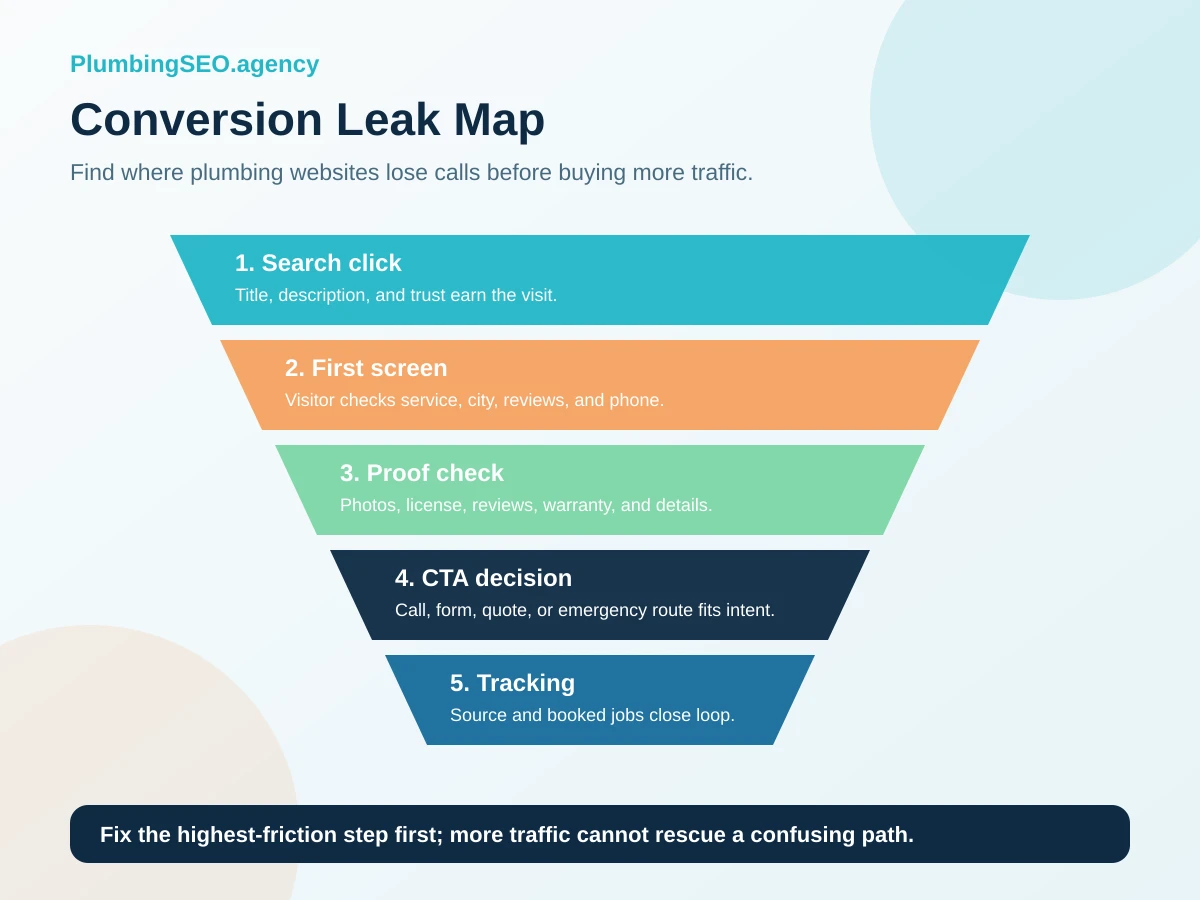
When a Plumbing Company Should Invest in Professional Design
You do not need an expensive custom website before you have a clear offer, service area, and proof. But professional design becomes important when the website is part of how the business gets calls. If you are paying for SEO, Google Ads, Local Services Ads, mailers, sponsorships, or referral traffic, the website is part of that spend.
Invest sooner if the site is slow on mobile, hides the phone number, has one generic service page, lacks city/service structure, uses fake-looking stock photos, has no tracking, or cannot show why a homeowner should trust you. Those issues waste demand that already exists.
For budgeting context, see our breakdown of how much a website costs for plumbers. The right budget depends on the business stage. A solo operator may need a simple, trustworthy foundation. A growing multi-truck company may need service pages, city architecture, content systems, and CRM handoff. A larger operation may need landing pages, recruiting pages, paid campaign pages, and deeper reporting.
A Practical Plumber Website Redesign Checklist
- Mobile first: test the homepage and top service pages on a phone before approving desktop polish.
- Call path: make the phone number and emergency CTA obvious without making planned-project visitors feel ignored.
- Service pages: build separate pages for the services that matter most to revenue and search demand.
- Service areas: show where you work in plain language and connect city pages to relevant services.
- Trust proof: place reviews, licenses, warranties, financing, real photos, and guarantees near decision points.
- Speed: compress images, avoid heavy sliders, and keep the mobile page fast.
- Tracking: track calls, forms, booked jobs, and page-level performance before declaring the redesign successful.
- Content ownership: make sure your team or agency can update service pages, FAQs, offers, and city content as the business changes.
The Best Plumbing Websites Feel Like a Calm Dispatcher
A strong plumber website does not overwhelm the visitor. It calmly answers the questions that matter: what you fix, where you work, why you can be trusted, what happens next, and how to call. It gives emergency customers a fast path and gives research-mode customers enough confidence to choose you later.
That is the real reason professional web design matters for plumbing businesses. It turns the website from an online brochure into a working part of the sales and service system. It supports local SEO, makes calls easier, reduces doubt, and gives the owner better data for the next marketing decision.
FAQs About Plumber Website Design
Plumber website design has to serve urgent, high-trust, local intent. The page must quickly show the service, service area, proof, and call path on mobile while also giving Google a clear structure for service and city relevance.
The first mobile screen should show the service promise, primary phone number, service-area confidence, emergency or booking option, and one strong proof signal such as reviews, license information, or years in business.
Major services should usually have dedicated pages because homeowners search by problem, not only by company type. Water heater repair, drain cleaning, sewer repair, repiping, and emergency plumbing each need different proof, FAQs, and calls to action.
A template can work as a starting point if it is customized around real services, real photos, service areas, fast mobile calling, tracking, and local SEO structure. A generic template with thin copy usually leaks trust and rankings.
If the current site is slow, confusing, hard to call from mobile, thin on service pages, or missing tracking, fixing the website can be more valuable than buying more clicks. More traffic only helps if the page can turn visitors into qualified calls.
Track calls, forms, booked jobs, service-page performance, city-page performance, and drop-off points. A good website is not just attractive; it helps the company see which pages and channels produce real plumbing revenue.
Want to Know If Your Website Is Losing Plumbing Calls?
We will review your site, mobile call path, service pages, local SEO structure, and tracking setup, then show you the biggest leaks.
Run My Free Website Audit