
- Start SEO before the panic month. If you wait until the phones are quiet, you are asking a 90- to 180-day channel to solve a this-week cash-flow problem.
- New plumbing companies should start with foundations first: Google Business Profile, tracking, service pages, reviews, and conversion-ready calls to action before heavy blog volume.
- Established shops should start SEO when growth pressure appears: adding trucks, expanding service areas, rising PPC/LSA costs, weak booked-call quality, or seasonal slowdowns on the calendar.
The best time for a plumbing company to start SEO is before it urgently needs leads. That does not mean every new plumber needs a giant retainer on day one. It means the business should start building the assets Google and homeowners need to trust the company before the owner is staring at an empty dispatch board.
Plumbing SEO is not a switch. It is a compounding system: a clean website, a trustworthy Google Business Profile, service pages that match real jobs, reviews from real customers, local citations, call tracking, and enough useful content to prove expertise. Google’s own guidance says local results are shaped by relevance, distance, and prominence. None of those signals mature overnight.
Use this guide as a timing map. Find your stage, fix the right fundamentals, and decide whether SEO should start now, wait a few weeks, or run alongside paid leads while organic visibility catches up.
What Current Search Results Say About SEO Timing
For this update, we reviewed additional live SERPs around plumber SEO timing, plumber SEO timelines, and SEO versus paid ads for plumbing companies, then scraped five ranking resources for common patterns. The useful consensus was clear: pages that satisfy this intent do not just say “SEO takes time.” They explain what should happen first, when paid channels are still needed, and how a plumbing owner can tell whether the campaign is building real assets or just publishing content.
The repeated themes were Google Business Profile work, service-specific pages, review velocity, citation/listing consistency, phone-first conversion paths, and call attribution. Several ranking pages framed SEO as a 3- to 6-month visibility system, with 6 to 12 months needed in tougher markets. That matches the practical answer here: start SEO before urgency peaks, but do not ask SEO to replace emergency lead flow in week one.

The timing test most plumbers should use
Ask one question: will you need more non-referral plumbing calls three to six months from now? If yes, SEO should already be moving. The work done this month may not book next week’s emergency call, but it can decide whether you are visible when the next season, truck, city, or service line needs demand.
If the answer is “I need calls this week,” the channel mix changes. Keep or start paid search, Local Services Ads, reactivation, referral asks, or direct outreach for immediate demand. Then start SEO foundations in parallel so the business is not still renting every lead six months from now.
Short Answer: Start Before You Need the Phone to Ring Tomorrow
If you need jobs this week, SEO alone is too slow. Use Google Local Services Ads, PPC, referrals, reactivation, or direct outreach to fill the immediate gap. But if you want lower-cost calls three to six months from now, start SEO now while those faster channels keep cash moving.
A plumber who starts SEO while the schedule is still healthy can make rational decisions: build the right service pages, improve tracking, request reviews consistently, and measure booked jobs instead of chasing vanity rankings. A plumber who waits until slow season often cuts corners, buys cheap backlinks, or publishes thin city pages that create cleanup work later.
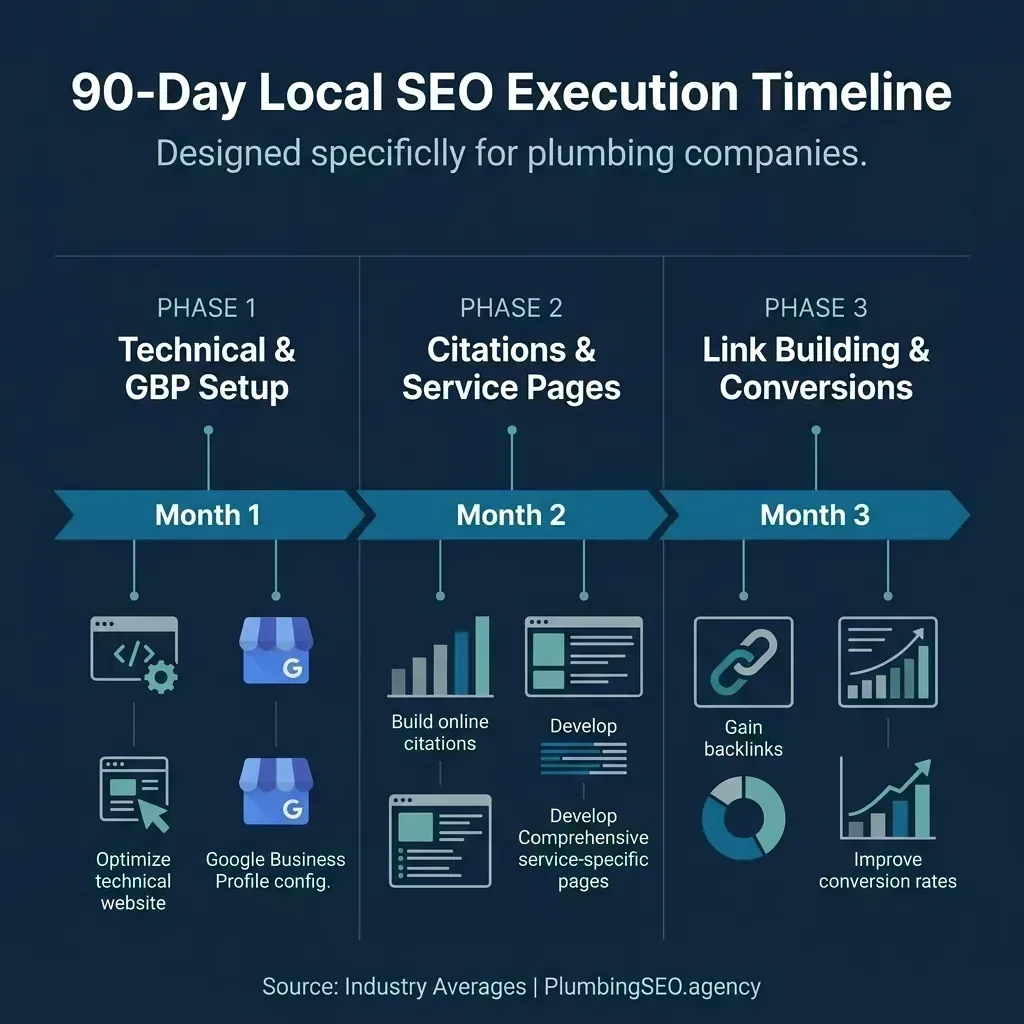
- 0-30 days: setup, tracking, crawl fixes, GBP tuning, high-intent service pages, and conversion leaks.
- 31-90 days: stronger local relevance, early content expansion, internal links, review velocity, and first measurable ranking movement.
- 91-180 days: broader service-area reach, stronger organic authority, more non-branded calls, and better cost-per-booked-job data.
Stage 1: Pre-Launch or Brand-New Plumbing Company
If your plumbing business is not open yet, you do not need a massive content machine. You need a foundation that lets Google and customers understand who you are, where you work, what you do, and how to contact you.
Start SEO during pre-launch if you already know your business name, service area, phone number, license information, core services, and launch timeline. That gives you time to build the plumbing website correctly instead of duct-taping search visibility onto a generic template after launch.
Pre-launch SEO checklist
- Create a crawlable website with a clean homepage, primary service pages, contact page, and free estimate or emergency call CTA.
- Prepare Google Business Profile details, categories, service areas, appointment links, photos, and opening date.
- Set up call tracking carefully so you can measure SEO calls without breaking NAP consistency.
- Write service pages for the jobs you actually want: drain cleaning, water heater repair, leak detection, sewer line repair, emergency plumbing, and any specialties.
- Build a simple review request process before the first completed job, not after the twentieth.
For a brand-new shop, the goal is not to outrank every established plumber in month one. The goal is to be technically ready, locally relevant, and conversion-ready so every future review, citation, backlink, and piece of content compounds instead of patching a weak base.
Stage 2: One to Three Trucks Needing Consistent Local Calls
This is usually the most urgent stage to start SEO. The company has real jobs, real customers, and enough proof to build trust, but it may still depend too heavily on referrals, home-service marketplaces, or paid leads.
At this stage, SEO should focus on high-intent visibility and booked-call quality. Do not start by publishing broad educational blogs if the core service pages are thin. Start with the pages and profile signals that support calls from homeowners who need help now.
What to prioritize first
- Google Business Profile: primary category, service list, service areas, photos, products/services, Q&A, and review responses.
- Money pages: plumbing repair, emergency plumber, drain cleaning, water heaters, sewer lines, leak detection, and any profitable niche.
- Conversion path: sticky phone CTA, mobile tap-to-call, trust proof, financing or emergency availability, and simple forms.
- Tracking: separate first-time calls, repeat customers, form fills, booked jobs, spam, and missed calls.
If you already have a site but it is not converting, read our plumber SEO diagnostic checklist before spending on more content. A ranking problem and a conversion problem can look similar when all you see is “not enough leads.”
Stage 3: Adding Technicians, Trucks, or Service Areas
Expansion is a strong signal to start or upgrade SEO. When a plumbing company adds a truck, a dispatcher, a new service line, or a nearby city, it needs demand before the payroll pressure arrives. SEO should start before the new capacity is fully idle.
The mistake is creating dozens of copy-paste city pages. Google’s SEO starter guidance emphasizes helpful, well-organized content for users. For plumbers, that means each service-area page should explain real coverage, local proof, emergency response expectations, nearby landmarks or neighborhoods where useful, and the services actually offered there.
Expansion SEO signals to build
- Internal links from core service pages to priority service areas.
- Service-area proof such as project examples, reviews, photos, and dispatch notes.
- Location-specific FAQs that answer homeowners’ real questions instead of stuffing city names.
- Updated GBP service areas and categories that match website pages.
- Tracking segmented by city, service, source, booked job, and revenue.
If the new area is competitive, start at least 90 days before you expect that truck to be fully booked. If the area is less competitive, the foundation can move faster, but you still need time for crawling, indexing, reviews, and local prominence to build.
Stage 4: PPC or Local Services Ads Costs Are Rising
Paid channels are useful, but they expose timing problems. If Local Services Ads or PPC are getting more expensive, SEO becomes a hedge against buying every call forever. The answer is not to turn off paid ads on day one. The answer is to build organic demand while paid keeps the schedule moving.
Run paid and SEO together when:
- Your cost per lead is acceptable but cost per booked job is drifting up.
- You are paying for calls outside your ideal services or service area.
- You rank for your brand but not for emergency, repair, water heater, sewer, or drain terms.
- Competitors are showing in Maps and organic results while you only appear when ads are funded.
This is also when attribution matters. See our guide to local SEO call attribution if you cannot tell which rankings, ads, pages, or calls are actually turning into booked plumbing jobs.

How to split effort when ads are already running
If PPC or Local Services Ads are producing profitable booked jobs, do not shut them off just because SEO begins. Use paid-search data to identify services and locations that convert, then build stronger organic pages for those same jobs. The fastest plumbing SEO wins often come from improving pages around proven demand: emergency plumber, water heater repair, drain cleaning, sewer backup, leak detection, and high-margin installation work.
If paid leads are producing calls but not revenue, fix tracking before adding more SEO content. Separate spam, wrong-area calls, existing customers, price shoppers, missed calls, and booked jobs. Otherwise, the owner may blame SEO timing when the real leak is dispatch, intake, service mix, or poor attribution.
Stage 5: Slow Season Is Coming
If your market slows down in predictable months, do not wait until the slowdown starts. Start SEO 90 to 180 days before the seasonal dip. That gives you time to publish and improve pages for seasonal services, strengthen reviews, repair technical issues, and build internal links before demand softens.
For example, a shop that wants better winter water heater calls should not start the water heater page in the middle of the cold snap. Build the page, FAQ, schema, photos, reviews, and internal links before homeowners begin searching heavily. The same applies to sewer backups, sump pumps, frozen pipes, leak detection, and spring drain cleaning.
- Wait a little if you do not have a stable business name, phone, service area, website budget, or ability to answer calls.
- Start now if you have real customers, a defined service area, a working phone process, and a goal to reduce paid-lead dependence.
- Fix fundamentals first if your site is not crawlable, calls are not tracked, or your GBP information is inconsistent.
The 180-Day Roadmap: What Should Happen After You Start?
Depth matters because “start SEO” can mean very different things. A plumbing company should not judge the first month by whether every target keyword jumped. It should judge whether the campaign removed the constraints that stop Google and homeowners from trusting the business.

Days 0-30: prove the foundation is not leaking
The first month should create visible work: a technical audit, crawl/indexing cleanup, tracking setup, GBP corrections, stronger title/meta alignment, service-page mapping, internal-link fixes, and a review-request process. This is also when the plumber should define what counts as a good lead. A booked water heater replacement is not the same as a wrong-city tire-kicker.
Days 31-90: build local relevance where money is made
The second phase should connect the company’s best services to the cities, suburbs, and neighborhoods it actually wants. This may mean improving core service pages, adding helpful FAQs, documenting local proof, strengthening internal links, and publishing practical content that supports service pages instead of chasing random blog volume.
Days 91-180: evaluate compounding business metrics
By months four to six, the discussion should move beyond “did we publish?” and into “what changed?” Review non-branded impressions, map visibility, service-page rankings, qualified calls, booked jobs, missed-call rate, and the blended cost per booked job across SEO, PPC, LSA, referrals, and repeat customers.
What Results Should Plumbers Expect in the First 30, 90, and 180 Days?
SEO timelines vary by market, competition, website history, reviews, and how much technical debt exists. Still, plumbing companies can use a practical timeline to judge whether work is moving in the right direction.
First 30 days: foundation and measurement
The first month should produce visible work, not necessarily dramatic ranking wins. Expect technical fixes, sitemap and indexing checks, GBP improvements, call tracking, conversion cleanup, and the first batch of service-page upgrades. If an agency cannot show exactly what changed in month one, that is a red flag.
Days 31-90: local relevance and early movement
By the second and third month, the site should have stronger internal links, improved service pages, more consistent reviews, better crawl health, and early movement for less competitive terms. You may see map-pack movement in suburbs or service niches before the hardest “plumber near me” terms move.
Days 91-180: compounding visibility
By months four to six, the campaign should be easier to evaluate through real business metrics: qualified calls, booked jobs, service-area growth, lead quality, and reduced dependence on low-quality paid leads. Rankings still matter, but booked revenue is the scoreboard.
Decision Checklist: Should You Start Plumbing SEO Now?
Use this checklist before signing a contract or delaying another quarter.
- Do you have at least one profitable service you want more calls for?
- Do you know the cities, neighborhoods, or service areas you actually want to win?
- Can someone answer calls quickly and professionally?
- Can you request reviews from satisfied customers every week?
- Can you measure calls, forms, booked jobs, and revenue by source?
- Are paid leads becoming more expensive or less predictable?
- Will you need more demand within the next three to six months?
If you answered yes to most of those, start SEO now. If you answered no because operations are not ready, fix the operational bottleneck first. SEO can create visibility, but it cannot save missed calls, bad dispatch, weak pricing, or poor service quality.
Red Flags That You Waited Too Long
Some timing problems are obvious only after the schedule gets quiet. If any of these are already true, start the foundation work now and use faster demand channels while SEO catches up:
- You are paying for every new call, and organic/non-branded calls are almost invisible.
- Your Google Business Profile has old photos, thin services, weak categories, or inconsistent service areas.
- Competitors have dozens or hundreds more reviews and are answering recent reviews consistently.
- Your website has one generic “plumbing services” page instead of strong pages for the jobs you actually want.
- You cannot tell which calls became booked jobs, which were missed, and which came from SEO versus paid.
- You are expanding into a new city after the truck is already on payroll.
What to Ask Before Hiring a Plumbing SEO Agency
Before signing, ask the agency what it will change in the first 30 days, how it will measure booked jobs, and which pages or GBP signals it will prioritize first. A good answer should be specific to your service area, services, review position, site condition, and urgency level.
Ask these questions:
- Which services should get improved pages first, and why?
- How will you separate rankings, calls, booked jobs, and revenue?
- What will we do while SEO is maturing if we need calls now?
- How will you use Google Business Profile, reviews, and service-area proof?
- What should we expect by day 30, day 90, and day 180?
- What work will be visible in the site, GBP, citations, internal links, and reports?
The Practical Answer by Business Stage
| Business stage | Best SEO timing | First priority | Use paid leads? |
|---|---|---|---|
| Pre-launch | Start foundations before opening | Website, GBP setup, tracking, service pages | Only if launch demand is urgent |
| 1-3 trucks | Start now if calls are inconsistent | High-intent service pages and review velocity | Yes, if the board needs calls this week |
| Adding service areas | Start 90+ days before capacity pressure | Service-area architecture and local proof | Use for the new area while SEO matures |
| Paid lead costs rising | Start while paid ads still fund demand | Organic alternatives and attribution | Do not cut profitable ads too early |
| Slow season coming | Start 90-180 days before the dip | Seasonal service pages, reviews, internal links | Use as a temporary demand bridge |
| Mature shop | Start or upgrade before competitors widen the gap | Content depth, local authority, conversion tracking | Use selectively for high-margin services |
The worst time to start plumbing SEO is when you need it to work instantly. The second-worst time is after competitors have already spent years building reviews, service pages, and local authority. Start when you can still be patient enough to build the right system.
Frequently Asked Questions
Most plumbing companies should plan for foundational work in the first 30 days, early movement in 60 to 90 days, and more meaningful call and booked-job gains in 90 to 180 days. Competitive markets can take longer, especially for map-pack terms.
Yes, if the business name, service area, phone number, licensing, and launch plan are stable. Pre-launch SEO should focus on the website, Google Business Profile preparation, service pages, tracking, and review process—not a huge blog campaign.
You can, but it is usually too late for SEO to solve that slow season. Start 90 to 180 days before predictable demand dips so pages, reviews, indexing, and local relevance have time to mature.
If you need leads immediately, start with PPC or Local Services Ads while building SEO in parallel. If you already have enough short-term demand, SEO can become the priority because it builds long-term visibility and reduces dependence on paid leads.
The first 30 days should focus on measurement and foundations: technical crawl issues, indexing, Google Business Profile improvements, call tracking, core service pages, conversion leaks, and a review request process. Heavy blog volume can wait until those basics are working.
Yes, if the company wants lower long-term dependence on paid leads. Keep profitable ads running for short-term demand, then use ad and call data to decide which services, cities, and pages SEO should strengthen first.
Not Sure If It Is Time to Start?
Run a plumbing-only SEO leak check. We will look at your website, Google Business Profile, service pages, tracking, and local search position so you can decide whether to start now, wait, or fix fundamentals first.
Run My Free SEO Leak Check