
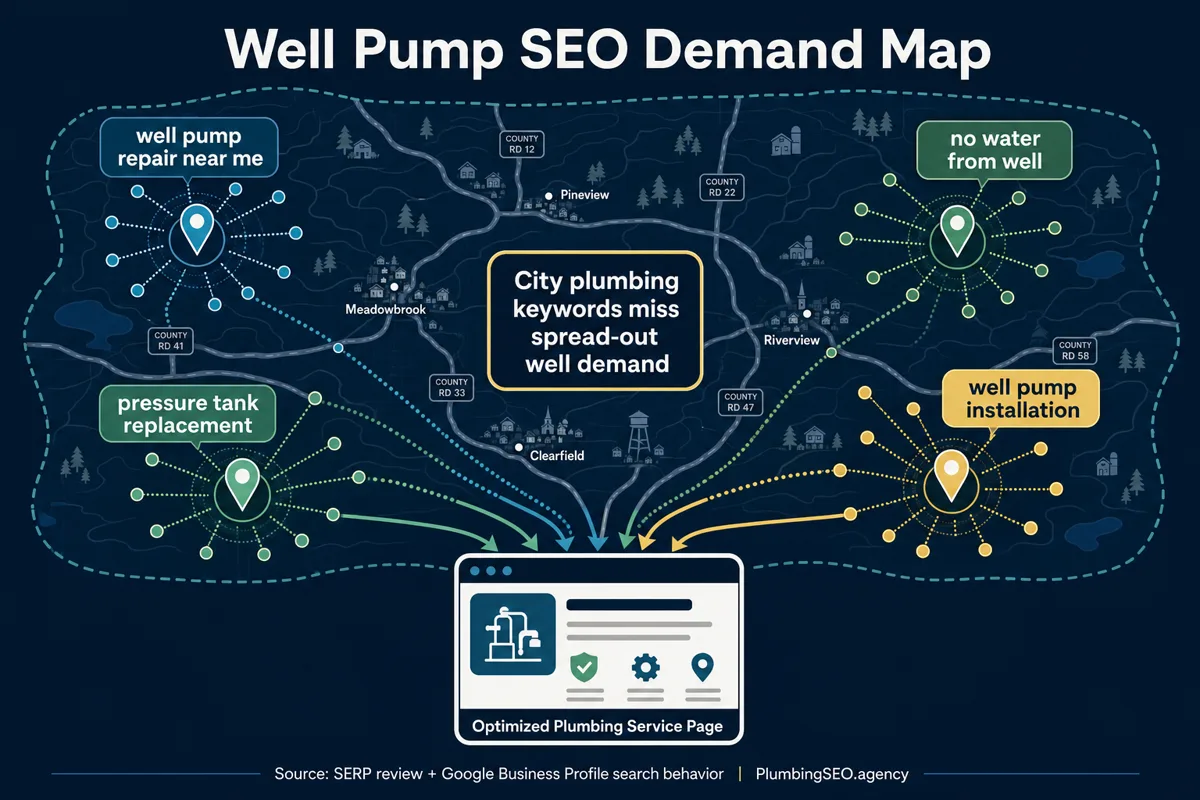
- Well pump searches are not just city plumbing searches. They come from rural roads, county lines, no-water emergencies, pressure problems, and replacement-cost questions.
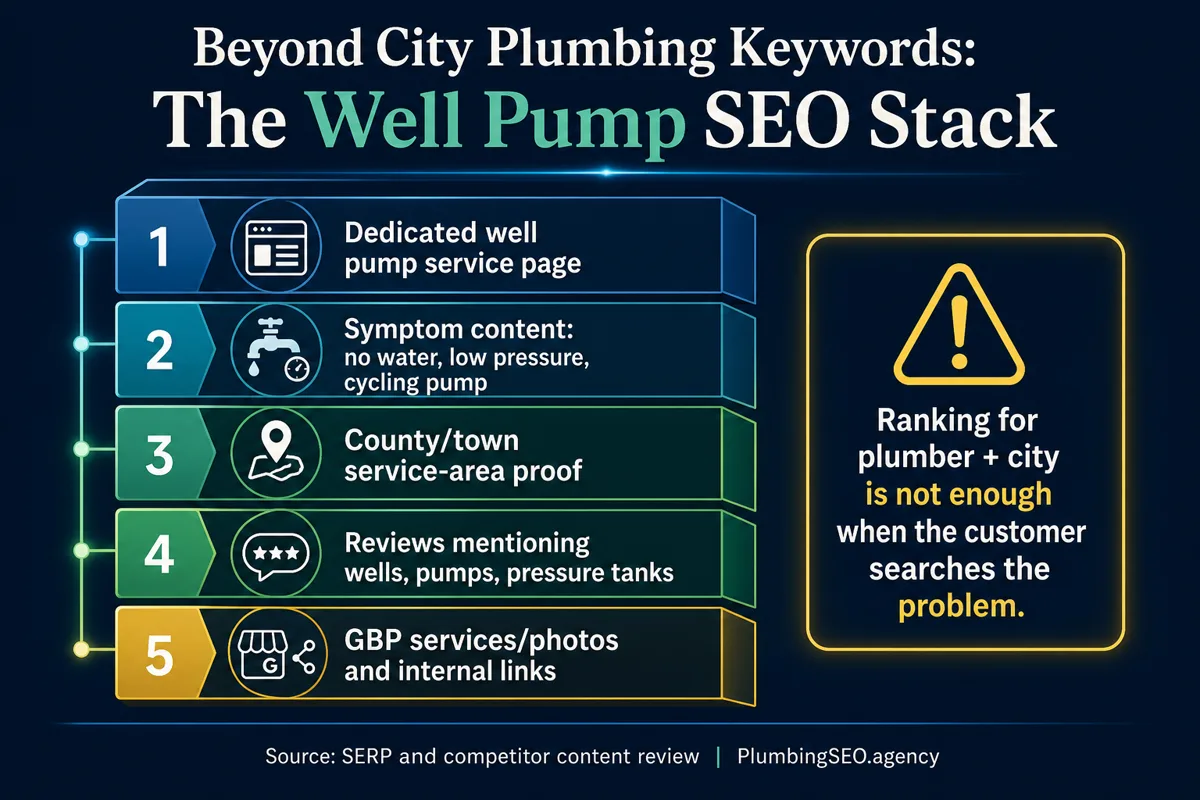
- A plumbing company that handles wells needs a dedicated well pump SEO plan: service page, symptom content, service-area proof, reviews, GBP services, and internal links.
- The best next step is to build a clear well pump content cluster that links into your main plumbing SEO services page and tracks calls by service line.
If your plumbing company works on well pumps, city plumbing keywords only tell part of the story. A homeowner with no water is not always searching "plumber in Dallas" or "plumber near me." They may search "well pump repair near me," "no water from well," "pressure tank replacement," or "well pump replacement cost." That is a different kind of call.
In my opinion, well pump SEO deserves its own plan because the work is usually higher trust, more urgent, and more spread out than a simple faucet repair search. The customer may be outside the city. The job may involve electrical checks, pump depth, pressure tanks, water testing, or coordination with a well driller. If your website treats all of that like a normal plumbing service, the right customer may never find you.
This guide shows how plumbing companies can rank beyond city plumbing keywords, build service-line authority around wells and pumps, and send that authority back into your main plumbing SEO services strategy.
Why well pump SEO is different from regular plumber SEO
Regular plumber SEO often starts with city terms: plumber in [city], emergency plumber [city], drain cleaning [city]. Those terms still matter. But well pump customers search the problem first because the problem stops the house from working.
When water stops at the tap, the customer is not thinking about your service menu. They are trying to figure out whether they need a plumber, a well company, an electrician, a pressure tank, or a new pump. Your content has to meet them at that messy moment and make the next call obvious.
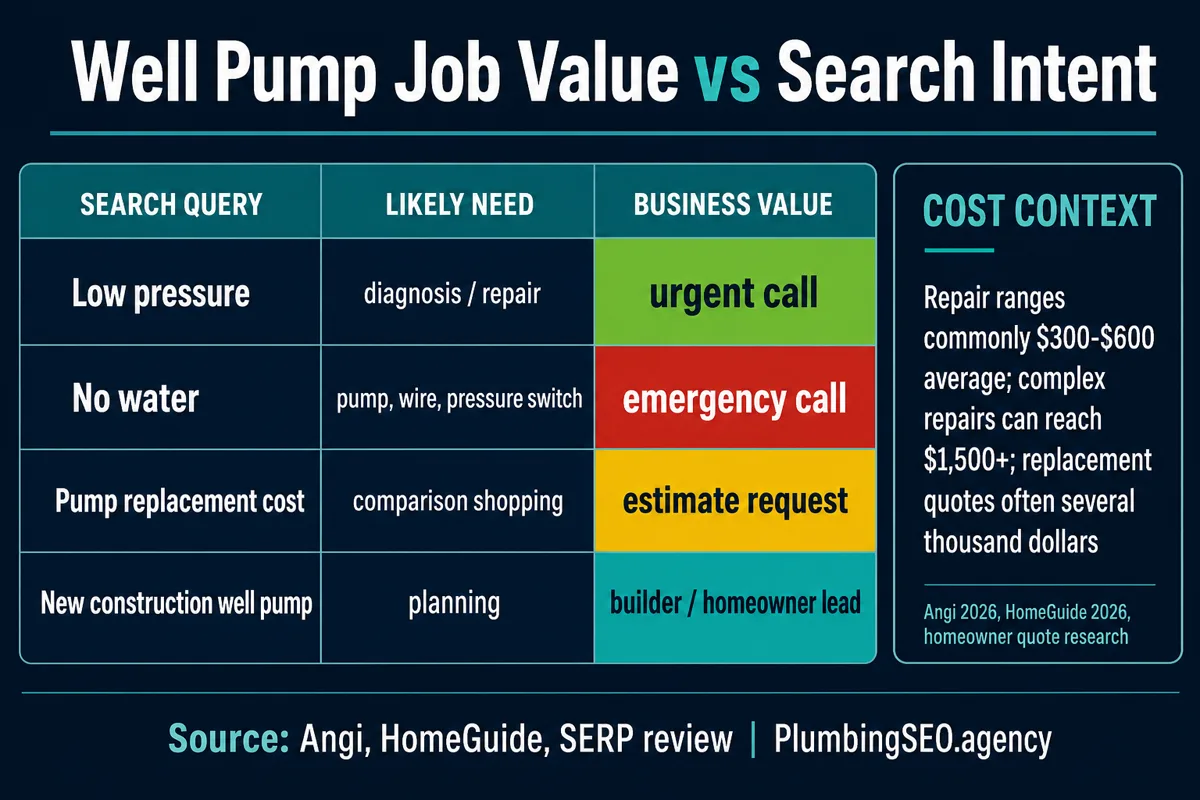
Those numbers matter because well pump calls are not throwaway clicks. A simple pressure switch may be modest. A deep-well pump replacement can be a serious job. Either way, the customer wants someone who sounds competent before they let that person touch their water system.
The search intent behind well pump keywords
Most well pump SEO problems come from treating every keyword the same. "Well pump repair" is not the same buyer as "how long does a well pump last." "No water from well" is not the same buyer as "well pump replacement cost." One is panicked. One is shopping. One is diagnosing. One is planning.
| Search pattern | Likely customer situation | Page that should answer it |
|---|---|---|
| well pump repair near me | Needs a local technician soon | Well pump repair service page with service-area proof |
| no water from well | Emergency symptom and confusion about who to call | Diagnostic blog or service section with clear call CTA |
| well pump replacement cost | Comparing price, warranty, parts, labor, and risk | Cost guide with ranges, variables, and estimate CTA |
| pressure tank replacement | May need pump-system troubleshooting, not just plumbing | Pressure tank page or section linked from well pump page |
| well pump installation for new home | Builder, rural homeowner, or property buyer planning ahead | Installation page with project photos and process proof |
Build the page around the job, not just the keyword
A strong well pump SEO page should not be a thin paragraph that says you fix pumps in every nearby city. That may have worked years ago. Today, the page needs to prove you understand the job before the customer calls.
Start with the service page. Make it clear whether you handle submersible pumps, jet pumps, pressure tanks, switches, wiring coordination, water pressure issues, inspections, replacements, and emergency no-water calls. If you do not handle one of those, say what you do handle. Nothing wastes time like a call that should have gone somewhere else. Dispatch already has enough puzzles.
What a useful well pump service page should include
- Common symptoms: no water, low pressure, short cycling, air in lines, tripped breaker, cloudy water after service.
- Clear service area language for towns, counties, townships, and rural routes.
- Photos of pump work, pressure tanks, trucks, equipment, and completed jobs when available.
- Review snippets that mention wells, pumps, pressure tanks, water pressure, or emergency service.
- Simple explanation of when the customer needs a plumber, a well driller, or another licensed specialist.
- Internal links to related plumbing SEO pages, pricing, and audit resources where they help the reader.
Google also lets businesses define services, categories, photos, and profile details in a Google Business Profile. For well pump companies, those details matter. If your profile only says plumbing, but your best jobs are well pump repair and pressure tank replacement, you are hiding the good stuff in the back of the truck.
Rural service-area proof beats city stuffing
Well pump demand often lives outside the neat city grid. A plumbing company may serve a county, several small towns, lake homes, farms, or a ring of rural properties around a metro area. That creates a different SEO problem. You need to show coverage without making doorway pages for every road sign.
The practical fix is service-area proof. Mention the counties and towns you truly serve. Add real project notes where appropriate. Use photos and reviews from those areas. Build one strong well pump page first, then add supporting content only where there is enough real demand and real proof.
Weak approach
One generic plumbing page repeats city names and hopes Google understands well pump work.
Better approach
A dedicated well pump page explains symptoms, repair types, rural service areas, proof, reviews, and next steps.
Use cost content carefully
Cost content can bring in good well pump leads, but only if it is honest. Angi reports well pump repair costs can range widely by part, location, and labor. HomeGuide lists a common average repair range and explains that tanks, injectors, and access can change the bill.
Do not turn those numbers into a hard promise. Use them to teach. Explain why depth matters. Explain why warranty matters. Explain why buying a pump online and asking someone to install it may change the risk. A homeowner comparing quotes is not always cheap. Sometimes they are scared of being taken for a ride. Clear content calms that down.
Well pump SEO needs a content cluster
One page can rank. A cluster can build trust. If well pump work is a real revenue line, build supporting pages or sections around the questions customers ask before they call.
Internal links help Google understand the service line
Your well pump article should not sit alone like a forgotten fitting in the bottom drawer. Link it to the pages that explain your broader SEO system. For PlumbingSEO.agency, this article supports the main plumbing SEO services for plumbers page because well pump searches are one example of service-line SEO done properly.
If you are building this for a plumbing company, link from the well pump page to related service pages like water treatment, pressure tanks, emergency plumbing, water lines, and service-area pages. Link back from related blogs when the topic naturally fits. Keep it useful. Two good links beat eight awkward ones every day.
Track well pump calls separately
Here is what most agencies miss: a ranking report does not tell you whether well pump SEO is making money. The phone tells the truth. Track calls from well pump pages, GBP actions, form fills, and ads separately from general plumbing leads.
That matters because well pump work has its own economics. Some calls are quick diagnostics. Some are deep-well replacements. Some need a driller. Some become water treatment or maintenance relationships. If every call is lumped into one "plumbing lead" bucket, you cannot tell what is keeping the trucks moving.
A practical 30-day well pump SEO plan
- Audit the current site. Check whether well pump repair, replacement, pressure tanks, and no-water symptoms appear on real crawlable pages.
- Build or strengthen the main page. Add service detail, service-area proof, photos, reviews, FAQ, and a clear call path.
- Update GBP services and photos. Make sure the profile reflects well pump work where it is accurate.
- Create one support article. Start with a symptom or cost topic that customers actually search before calling.
- Add internal links. Link from related service pages, blogs, and the main SEO page where it helps the reader.
- Track calls. Separate well pump calls from generic plumbing calls so you know whether the work is paying.
If you want the bigger process, our plumbing SEO process page shows how we connect technical fixes, service pages, Google Maps signals, and call tracking into one system. If you are still deciding whether the math works, our plumbing SEO pricing page explains the package structure without making you sit through a mystery sales call.
Final take: rank for the water problem, not just the city
Well pump SEO works when it matches how real customers search. They search symptoms. They search parts. They search costs. They search who to call when the water stops. If your website only chases city plumbing keywords, you can miss the exact jobs you are best built to handle.
Start with one useful well pump page. Make it specific. Link it properly. Track the calls. Then build the support content around what customers actually ask. That is not fancy. It is just good service translated into search.
Well Pump SEO FAQs
Well pump SEO is search optimization for plumbing companies, pump contractors, and well service providers that want to rank for well pump repair, replacement, installation, pressure tank, no-water, and rural service-area searches.
Yes, if well pump work is a real service line. A dedicated page can explain symptoms, repairs, replacements, pressure tanks, service areas, photos, reviews, and clear next steps better than a generic plumbing page.
Many well pump customers search by problem, part, cost, or rural location. They may live outside the main city and search phrases like no water from well, well pump repair near me, or pressure tank replacement.
Use natural links to the main plumbing SEO service page, related plumbing service pages, service-area pages, pricing, audit resources, and nearby articles such as sump pump, water heater, emergency plumbing, or drain cleaning SEO guides.
Track rankings, organic visits, GBP actions, form fills, and phone calls from well pump pages separately from general plumbing leads. The most important measure is whether the work creates qualified calls and booked jobs.
Want to find the service-line searches your plumbing site is missing?
Run a free SEO leak check and we will show where calls are leaking away, including service pages, Google Maps signals, internal links, and content gaps.
Run My Free SEO Leak Check