
- Water heater SEO needs separate intent paths for repair, replacement, tankless, and emergency searches. A generic plumbing page leaks good calls.
- The best pages prove service-area fit with city signals, reviews, project photos, warranty details, and clear call buttons.
- Use the blog to support the cluster, then link visitors toward the main plumbing SEO service page and the money pages that book jobs.
If your water heater calls are quiet, the problem may not be demand. It may be that Google cannot tell whether you are the right shop for a no-hot-water emergency, a planned replacement, a tankless upgrade, or a maintenance question.
That matters because water heater work is not one kind of search. A homeowner with a cold shower at 6 a.m. is not browsing the same way as a homeowner comparing tankless systems before a remodel. One wants help now. The other wants confidence before spending real money. Your SEO has to speak to both without making either person dig through a generic plumbing page.
The way I see it, water heater SEO should be treated like a service-line cluster, not a paragraph buried under "plumbing services." The page structure, Google Business Profile, reviews, photos, and internal links all need to point in the same direction. Otherwise, the call goes to the company that made the answer easier to trust.
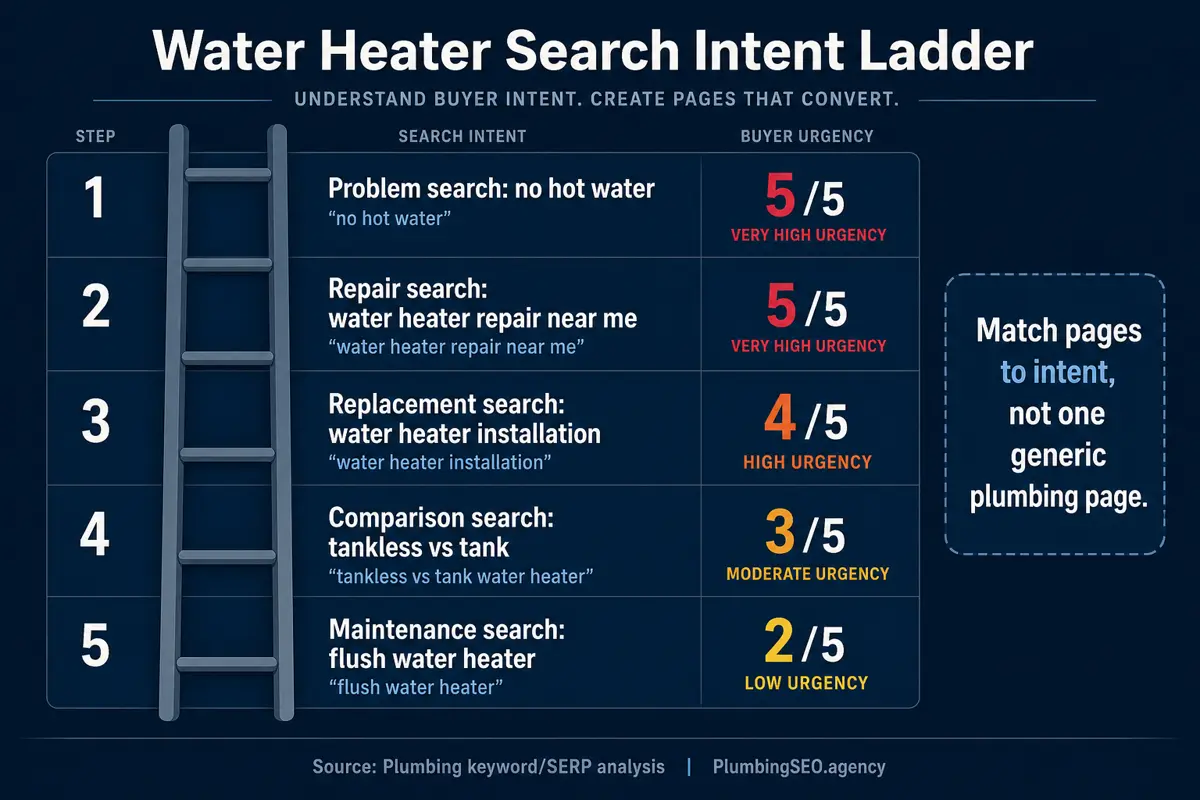
Why water heater searches deserve their own SEO plan
Water heater keywords show real service-line demand. One plumbing keyword dataset lists "water heaters" at 1,830,000 monthly searches, "tankless water heaters" at 301,000, "water heater repair" at 49,500, and "water heater installation" at 40,500. Treat those numbers as directional, not a promise for your city, but they show the point clearly. Customers search water heater problems by name.
That is why a plumbing company should not rely on one broad page to catch every water heater job. Broad pages often rank for broad terms. Service-line pages win the specific calls. If somebody searches "water heater repair near me," the page should quickly answer: Do you repair my type of unit? Do you come to my area? Can you come today? Do other homeowners trust you? What should I do before calling?
For a plumbing owner, this is not about making Google happy for fun. It is about getting the right job on the board while your techs are still close enough to run the call profitably. Bad routing wastes fuel, dispatcher time, and patience. Nobody gets rich sending a truck across town for the wrong kind of lead.
| Search type | Customer situation | Page that should answer |
|---|---|---|
| No hot water | Urgent problem, likely repair call | Water heater repair page with same-day language |
| Water heater installation | Replacement or planned upgrade | Installation page with options, permits, warranty, financing |
| Tankless water heater | Comparison and upgrade research | Tankless page with pros, limits, and service-area proof |
| Flush water heater | Maintenance question, lower urgency | Helpful guide that links to service and inspection options |
Recent local SEO guidance also supports this split. Semrush explains that local keywords can trigger both map results and organic results, but those areas rank from different signals. In plain English, your website and your Google Business Profile both have to carry the water heater story.
The page map that wins repair and installation searches
A strong water heater cluster usually has one support blog and several money pages. The blog explains the search problem and builds topical support. The service pages do the hard conversion work. Then the main plumbing SEO service page gets a natural internal link from the blog because it explains the broader system behind the ranking work.
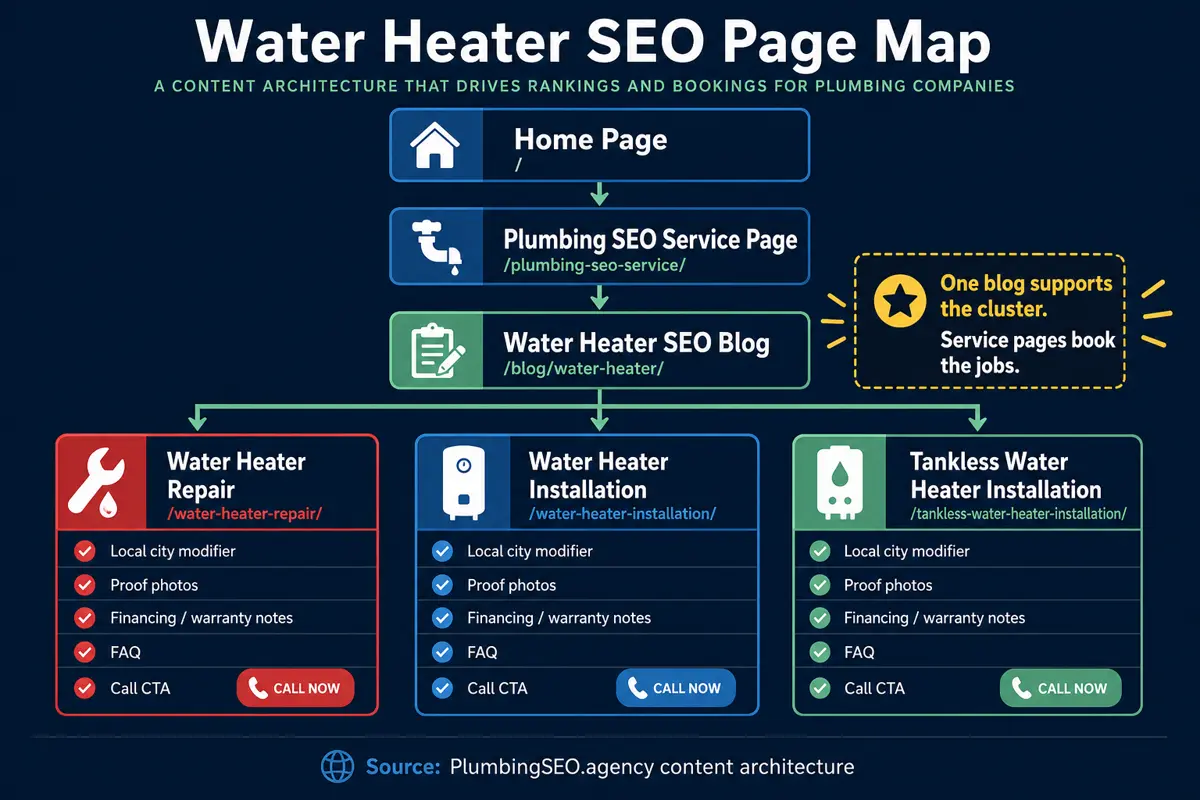
Here is the clean structure I would use for a plumbing company that wants more water heater calls:
- Water heater repair page: no hot water, leaking tank, pilot light, error codes, same-day help, emergency routing.
- Water heater installation page: replacement signs, tank size, permit notes, warranty, financing, old unit removal.
- Tankless water heater page: install requirements, gas line sizing, maintenance, realistic pros and cons.
- Helpful blog content: buyer questions, troubleshooting, replacement timing, and local search education.
- Google Business Profile alignment: services, photos, reviews, posts, and Q&A that reinforce the same service line.
If this sounds like a lot, remember the alternative. A competitor writes clearer pages, shows proof, answers the worry, and gets the call. Google is not sending a trophy. It is sending a customer with a wet floor or a cold shower.
What the water heater page must prove
Top water heater pages do not just say "we repair water heaters." They prove the company can handle the call. That proof should show up above the fold and throughout the page.
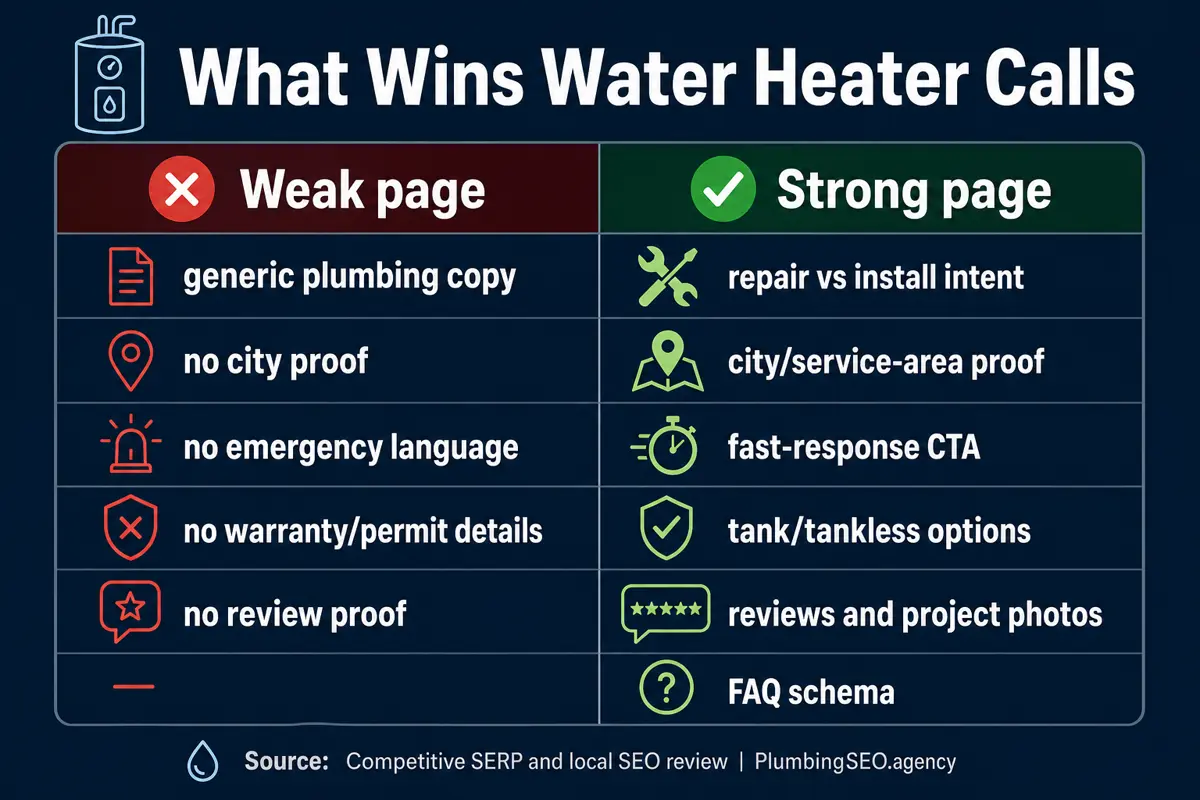
In my opinion, the most important proof is local proof. A stock photo of a shiny tank is not enough. Use job photos from real neighborhoods, review snippets that mention water heaters, service-area copy that names nearby cities naturally, and short explanations of common local issues like hard water, older homes, tight utility closets, or code requirements.
Your Google Business Profile also needs to support the same story. ServiceTitan's plumbing GBP guide points to categories, services, reviews, and profile completeness as visibility drivers. For water heater SEO, that means your profile should not look like a mystery shop that maybe does water heaters if somebody asks nicely.
How to optimize Google Business Profile for water heater calls
Start with the basics. Add water heater repair, water heater installation, tankless water heater service, and related services where the profile allows it. Use photos from actual jobs. Ask happy customers to mention the work performed, without scripting or paying for reviews. Answer common Q&A in plain language.
Then keep the website and GBP consistent. If the website says you offer tankless installation but the profile never mentions tankless, you are asking Google and customers to connect dots that should already be connected. Plumbing owners have enough to do. Do not make the search engine play detective too.
Want the full service-line SEO system?
See how our plumbing SEO services connect service pages, Google Maps visibility, reviews, content, and call tracking into one ranking plan.
Content that supports the water heater cluster
Not every water heater search deserves a sales page. Some searches are research-stage questions. Those are useful because they build trust and create internal links to the pages that book the job.
Good supporting topics include:
- How long does a water heater last?
- Should I repair or replace my water heater?
- Tankless vs tank water heater for older homes
- Why does my water heater keep running out of hot water?
- What size water heater does my house need?
- Signs a water heater leak needs urgent plumbing help
The job of that content is not to bury the owner in textbook plumbing. It should help the homeowner understand the problem, then route them to the right service page. If the answer is dangerous, expensive, or needs a licensed plumber, say that clearly. Helpful content should not pretend every homeowner needs a weekend project and a prayer.
Internal links that actually help
Internal links are where many plumbing websites get sloppy. They either skip links completely or stuff every page with the same anchor. Neither helps the customer.
Use links where the next click makes sense. A water heater SEO blog can naturally link to the main plumbing SEO service page, the drain cleaning SEO guide when explaining service-line clusters, and the sewer repair SEO guide when showing how high-value services need their own search strategy.
On the plumbing company's own site, the water heater repair page should link to installation when replacement makes more sense. The installation page should link back to repair for smaller issues. The tankless page should link to maintenance. That is not just SEO. That is basic customer routing.
What to measure after publishing
After the pages are live, do not judge the work only by rank screenshots. Track the owner-side signals:
- Calls from water heater pages and GBP interactions
- Repair versus installation lead mix
- Booked-job rate by page
- Service-area calls that are inside the profitable radius
- Review growth mentioning water heater work
- Search Console queries for repair, installation, tankless, and city modifiers
Water heater SEO is working when the phone tells the same story as the report. Better rankings are nice. Better booked jobs keep the trucks moving.
The practical first move
If you only do one thing this week, check whether your site has a real water heater repair page and a real water heater installation page. If both services are squeezed into one generic paragraph, split the intent. Add proof. Add photos. Add FAQs. Link the pages together. Then make sure your Google Business Profile backs it up.
That is how you stop hoping a broad plumbing page will catch everything and start building a service-line system that wins the jobs you actually want.
Water Heater SEO FAQs
Water heater SEO is the process of optimizing plumbing website pages, Google Business Profile signals, reviews, photos, and internal links so the company can rank for water heater repair, replacement, installation, tankless, and local emergency searches.
Usually, yes. Repair and installation searches have different urgency, questions, proof needs, and calls to action. Separate pages make it easier for Google and the homeowner to understand the exact service.
Your profile can reinforce water heater relevance through services, photos, posts, Q&A, and reviews that mention water heater work. That helps map visibility and gives customers confidence before they call.
Include service-area proof, repair or installation details, tank and tankless options, warranty and permit notes, real project photos, reviews, FAQs, clear call buttons, and links to related services.
It depends on competition, site strength, reviews, and local market history. Many plumbing companies should watch Search Console queries, GBP actions, calls, and booked jobs over several months instead of judging from one rank check.
Find the leaks in your water heater search visibility
If your plumbing company wants more repair, replacement, and installation calls, start with a clear look at the pages and signals Google is seeing.
Run My Free SEO Leak Check