
- Topical authority for plumbers means proving your company is useful and trustworthy across the services, cities, questions, and proof points customers search before they call.
- Fix the money pages first. Emergency plumbing, drain cleaning, water heaters, leak detection, reviews, and local proof should be stronger before you publish more blog posts.
- Measure authority by service-page clicks, calls, forms, map visibility, and booked jobs. Rankings alone do not pay payroll.
If your phone is quiet, topical authority can sound like another agency phrase built to make a simple job confusing. It is not magic. It is the work of making your website the clearest local answer for the plumbing services you actually want to sell.
For a plumbing company, topical authority means Google and customers can see the same thing: you know emergency plumbing, drain cleaning, water heaters, leak detection, service areas, pricing questions, reviews, and booking paths. The site is not a pile of random posts. It is organized like a good truck. Every tool has a place.
The generic definition is useful, but it misses the owner-side point. A broad marketing glossary can explain topical authority. Your plumbing website has to turn that idea into calls, booked jobs, and fewer wasted clicks. That is the difference.
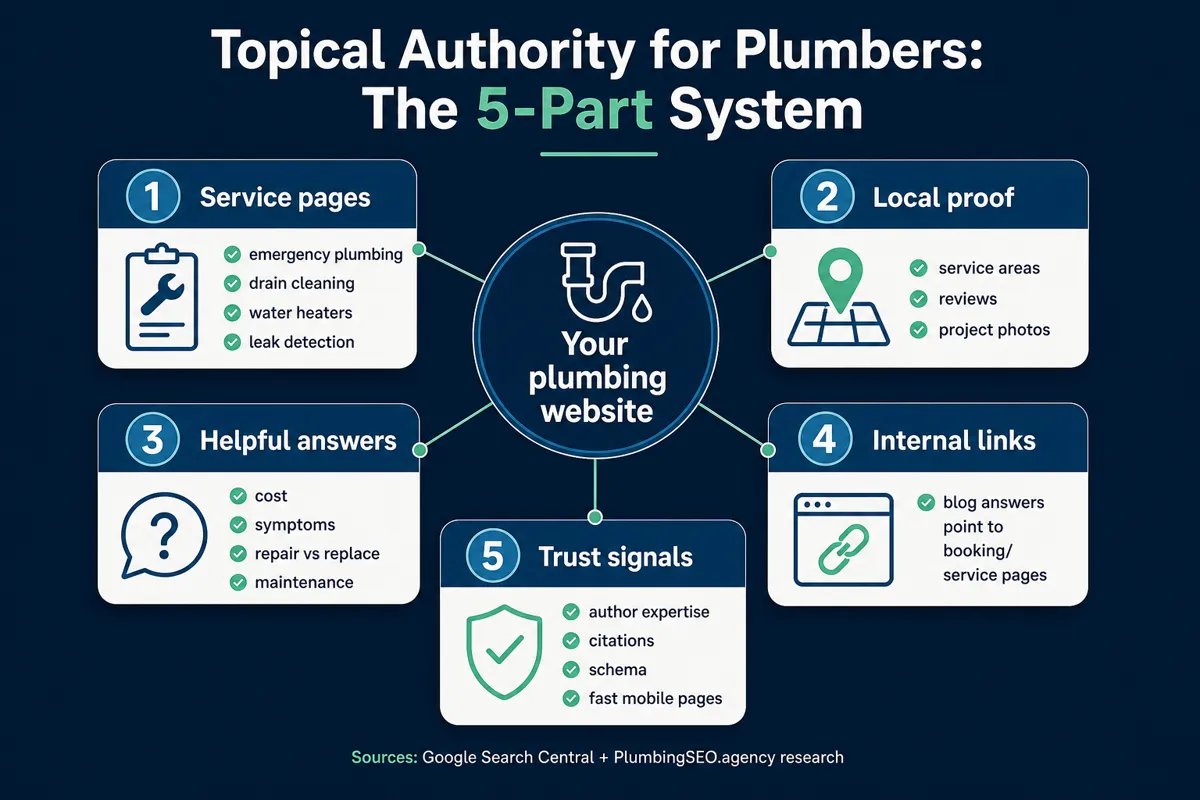
What topical authority means for a plumbing company
Topical authority is the pattern search engines see when your site covers a subject with depth, accuracy, internal links, and proof. Google's helpful content guidance says content should be created for people, provide original value, and leave the reader feeling they learned enough to reach their goal. That is a good standard for plumbers too.
So the question is not, "Can we publish 40 blog posts?" The better question is, "Can a homeowner or property manager understand why we are the right company for this service in this city?" If the answer is no, publishing more does not fix the leak. It just makes the puddle bigger.
A real plumbing topical authority build has five parts:
- Service depth: strong pages for the work you want most, such as emergency plumbing, drain cleaning, sewer line repair, water heater installation, leak detection, and repiping.
- Local proof: service areas, reviews, project photos, team details, and local references that show the work is real.
- Helpful support content: plain answers to cost, symptoms, repair vs replace, safety, maintenance, and timing questions.
- Internal links: helpful articles pointing customers toward the right service page, not trapping them in a blog maze.
- Trust and technical signals: schema, citations, page speed, mobile layout, clear author or company information, and accurate contact details.
What the generic SEO advice misses for plumbers
Most articles explain topical authority as pillar pages, clusters, and internal links. That is true, but a plumbing owner has a different problem. You do not need to become the internet's encyclopedia of pipes. You need to become the trusted local choice for jobs that keep trucks moving.
RankMeTop's glossary page defines topical authority around expertise, content depth, content clusters, E-E-A-T, backlinks, and intent mapping. That is a useful baseline. The plumber-specific version has to go further and answer these questions:
| Generic topical authority advice | What a plumber should do with it |
|---|---|
| Build a pillar page and cluster posts. | Make each profitable service page strong first, then publish support posts that answer real customer questions and link back naturally. |
| Cover every subtopic. | Cover the subtopics that affect calls: symptoms, urgency, price ranges, repair options, service areas, permits, warranties, and when to call. |
| Use contextual internal links. | Move the reader from "why is my drain backing up" to the drain cleaning or sewer inspection page without making them hunt. |
| Show expertise. | Use job photos, owner notes, process details, licensed team information, local reviews, and clear service standards. |
| Track rankings and traffic. | Track calls, forms, booked jobs, service-page clicks, and map movement by service area. |
That is why this work belongs next to your broader plumbing SEO strategy, not off in a content silo. The blog should support the services. The services should support the calls. The calls should support the crew.
The order I would fix it in
In my opinion, most plumbers should not start topical authority with a blog calendar. Start with the pages that make the phone ring. If those pages are thin, slow, unclear, or disconnected from local proof, support articles will have a hard time carrying the load.
Here is a practical 90-day order. It is not fancy. It is just the work that stops calls from leaking away.
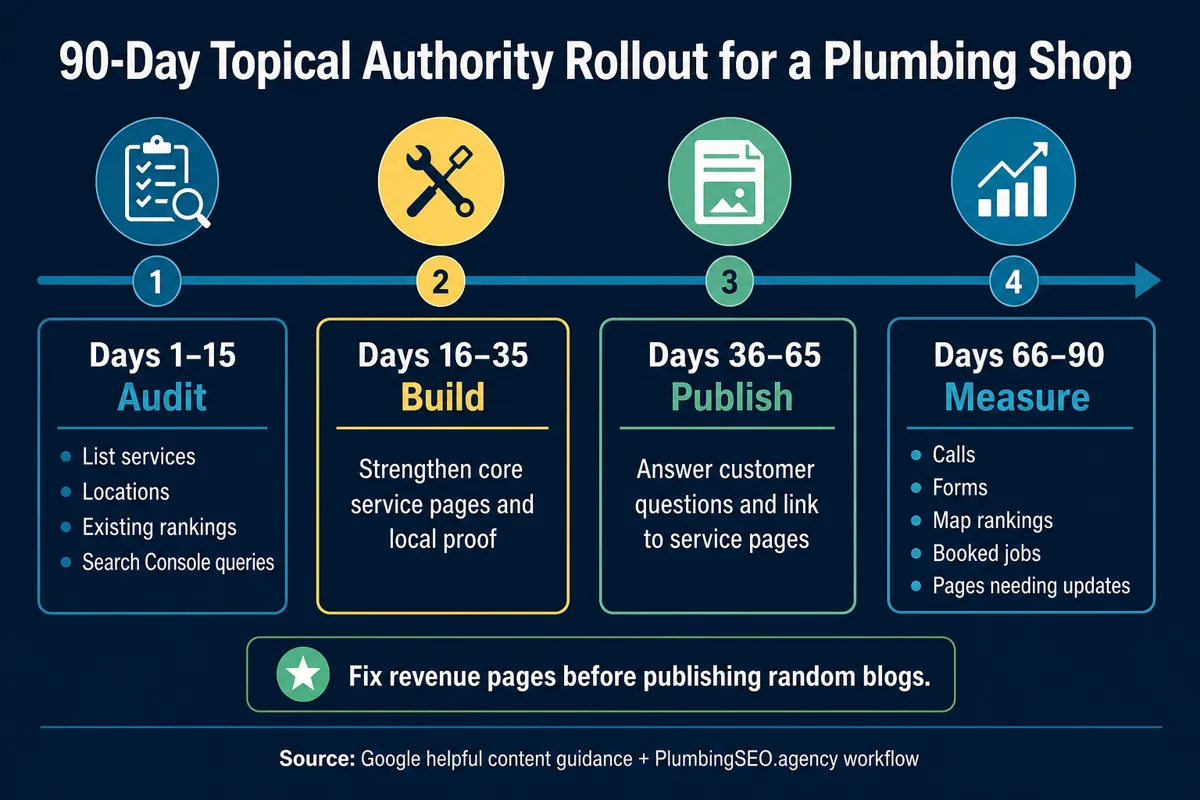
Days 1-15: Map the business before writing
List your real services, real service areas, current pages, current rankings, and the questions customers ask before booking. Use Google Search Console if it is installed. Pull search queries by service topic. A drain cleaning page that already gets impressions but few clicks may need a better title, proof, or call path before you need another article.
This is also where you find gaps. If the site offers water heaters but has one vague paragraph buried on a services page, that is not topical authority. That is a note on a napkin.
Days 16-35: Strengthen the core service pages
Each main service page should answer what the customer cares about: what counts as urgent, what the repair usually involves, what signs they should not ignore, what cities you serve, how scheduling works, and why your company is trustworthy. The page should include calls to action that are easy to find on mobile.
When local SEO comes into play, connect the service page to your service-area and Google Business Profile work. Our advanced local SEO guide for plumbers explains why service-area architecture, reviews, and map diagnostics matter once the basics are done.
Days 36-65: Publish support content with a job to do
Now publish the helpful answers. Good support topics for plumbers include "why does my drain keep backing up," "tankless vs tank water heater," "main line clog signs," "water heater repair vs replacement," and "what to do before calling an emergency plumber." Each post should help the reader and naturally link to the service page that solves the problem.
Semrush describes topical authority as expertise and credibility around a subject, built through high-quality content. For a plumbing company, quality means the reader can make a better decision and knows how to get help if they need it.
Days 66-90: Measure and tighten the system
Look at impressions, clicks, calls, forms, map rankings, and booked jobs. If a support article gets traffic but no one clicks through to the service page, improve the internal link and CTA. If a service page ranks but does not convert, add proof, clearer pricing context, better mobile calls, or stronger reviews. The report may look good, but the phone tells the truth.
Common mistakes that weaken topical authority
- Publishing random posts because competitors have blogs. A blog about "fun plumbing facts" will not help much if your sewer repair page is weak.
- Making city pages with no local proof. A list of cities is not authority. Reviews, job photos, routes, local notes, and service details make it believable.
- Targeting every keyword once. One thin page for each phrase creates clutter. Build a useful hub around the service and connect the supporting questions.
- Forgetting conversion paths. Content that teaches but never points toward the right service page leaves the customer standing in the aisle.
- Only tracking rankings. Rankings matter, but calls, forms, and booked jobs decide whether the work helped the business.
Not sure where your site is leaking calls?
We can review your service pages, local proof, internal links, and call paths so you know what to fix before adding more content.
Run My Free SEO Leak CheckHow to measure topical authority without guessing
A lot of SEO reports celebrate impressions. Impressions are useful, but they are not the finish line. A plumber needs to know whether the right services are getting found, whether the right people are clicking, and whether the site is helping turn that interest into calls and booked work.
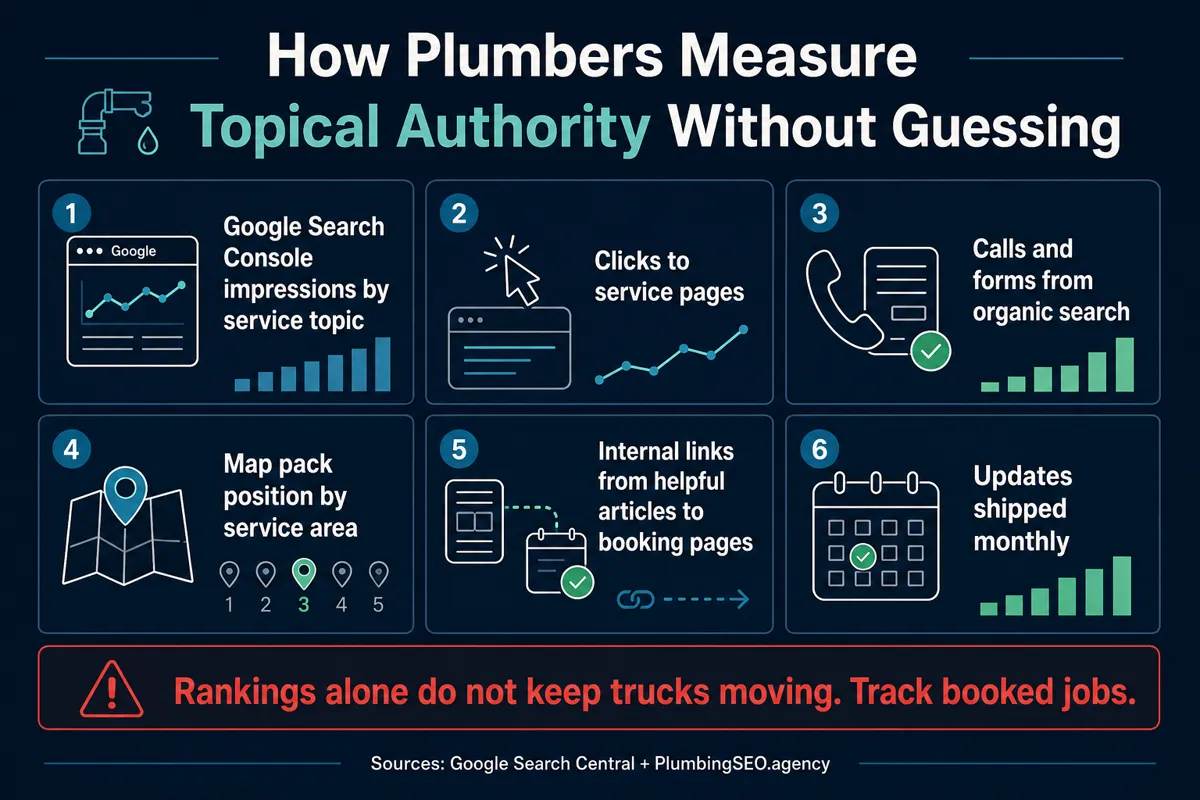
Use a simple monthly scorecard:
- Search Console impressions by service topic: are drain, water heater, emergency, leak, and sewer topics gaining visibility?
- Clicks to service pages: are support articles sending visitors to pages where they can book?
- Calls and forms from organic search: are people taking action after they land?
- Map Pack position by service area: are you moving where real customers search, not only near the office?
- Internal link coverage: do helpful articles point to the correct service pages?
- Updates shipped: did the team improve pages this month, or just talk about improving them?
If you want a deeper measurement setup, pair this with lead tracking and call attribution. Our lead tracking guide for plumbers shows how to follow calls, forms, chats, and booked jobs without relying on guesswork.
Can a plumber do this without an agency?
Yes, if someone on the team has time to write, edit, update pages, check Search Console, keep service details accurate, and measure results. Many owners can handle the first pass better than an agency because they know the work, the customers, the neighborhoods, and the service calls.
The hard part is consistency. The owner still has payroll, dispatch, callbacks, inventory, estimates, reviews, and people waiting on decisions. If topical authority keeps getting pushed behind truck problems and emergency calls, hiring help can make sense. The key is hiring someone who starts with your services and calls, not someone selling a mystery content package.
The next safe action
Pick one service cluster this week. For most plumbing companies, that might be drain cleaning, water heaters, emergency plumbing, leak detection, or sewer repair. Then check three things:
- Does the main service page answer the customer's real questions and show local proof?
- Do at least three helpful support pages or sections link to it naturally?
- Can you track whether visitors from that topic turn into calls, forms, and booked jobs?
If the answer is no, fix that cluster before chasing another keyword. That is how topical authority starts paying the bills instead of just filling a spreadsheet.
Frequently Asked Questions
It helps Google and customers understand what services you offer, where you offer them, and why your company is trustworthy. When service pages, support content, reviews, local proof, and internal links all line up, more of the right searches can turn into service-page visits, calls, forms, and booked jobs.
Yes. A plumber or office manager can start by improving service pages, adding local proof, answering real customer questions, and linking helpful articles to booking pages. Hiring an agency can make sense when the owner does not have time to keep the system updated and measured.
Early improvements can show up in a few weeks through better impressions, more internal clicks, and clearer service-page performance. Meaningful ranking, call, and booked-job movement usually takes several months because Google has to crawl, compare, and trust the improved pages over time.
Service pages should usually come first because they are closer to the call. Blogs and guides are useful when they answer real questions and support the service pages. Publishing a pile of articles before the main revenue pages are clear is usually backward.
Track impressions by service topic, clicks to service pages, calls, forms, map rankings by service area, internal links, and booked jobs. Rankings are useful, but the business needs to know whether the work creates qualified opportunities.
Want to know which service cluster to fix first?
We will review your service pages, local proof, content gaps, and call paths so you can stop guessing and start fixing the pages closest to revenue.
Get My Free SEO AuditNo pressure. Just a clear look at where calls may be leaking.