
- Tankless water heater SEO needs its own intent map. Installation, repair, maintenance, and comparison searches should not all point to one thin page.
- Build one strong tankless hub, then support it with cost, symptoms, flushing, and local installation content that earns the right calls.
- Link the tankless plan back to your main plumbing SEO service page so Google and homeowners can see how the work connects.
If tankless water heater work is a good ticket for your shop, do not bury it under a generic plumbing services page and hope Google figures it out. Homeowners search differently when they want a tankless install, a replacement quote, an error-code repair, or a flush. Your website has to match that difference before the phone rings.
The mistake I see is simple. A plumbing company writes one page called "water heaters," lists tankless once, and then wonders why the calls go to the company down the road. That is like sending one truck with one fitting to every job. Sometimes it works. Most days, somebody is driving back to the supply house.
This article is the tankless-specific companion to our broader water heater SEO guide. The difference is focus. A regular water heater page can cover broad replacement and repair demand. A tankless SEO plan has to handle higher research pressure, more installation complexity, stronger homeowner objections, and repair questions that often come with brand names, error codes, flushing, and venting concerns.
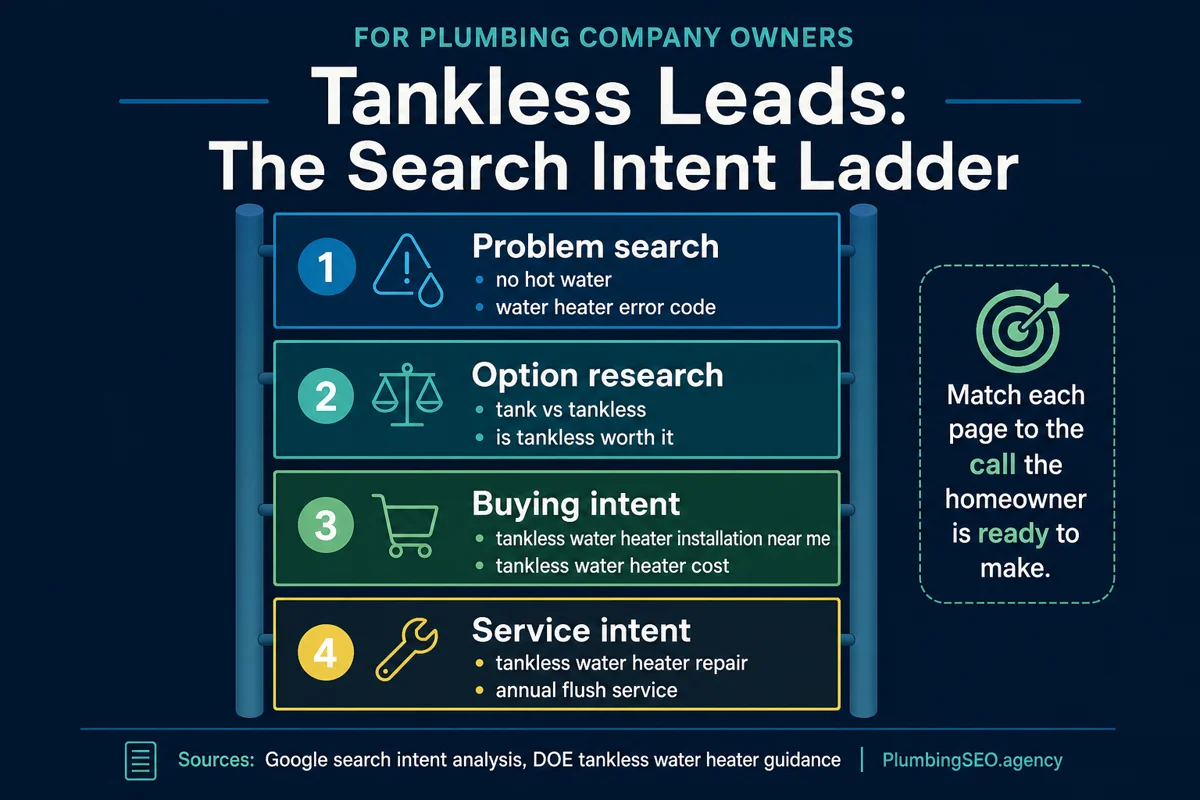
Start With the Calls You Actually Want
Before you write a tankless page, pick the business outcome. Do you want installation calls? Replacement quotes? Annual flushing work? Repair calls for existing units? Each one needs different proof, different language, and different calls to action.
Installation pages need to calm the homeowner down. They are asking about cost, sizing, gas lines, electric panels, rebates, permits, brands, and whether tankless is worth the jump. The Department of Energy explains that tankless systems can be more efficient because they avoid standby losses, but also notes flow-rate limits and installation considerations. That is exactly the kind of nuance a good plumber page should explain.
Repair pages are different. A homeowner with no hot water does not want a five-paragraph lecture on efficiency. They want to know what the blinking code means, whether the unit can be fixed, and whether somebody can come out. If your repair copy reads like a sales brochure, you lose the urgent call.
Those numbers matter because they shape the page. A tankless install page should talk about efficiency and flow rate in plain English. A cost page should explain why a simple swap is different from a conversion. A repair page should explain maintenance and diagnostics without making the customer feel stupid.
Build a Tankless Content Map, Not One Catch-All Page
The main tankless service page should be the money page. It needs the quote path, trust proof, service area cues, review language, photos if you have them, and a clear call button. Supporting articles should answer the questions that make a homeowner ready to call that page.
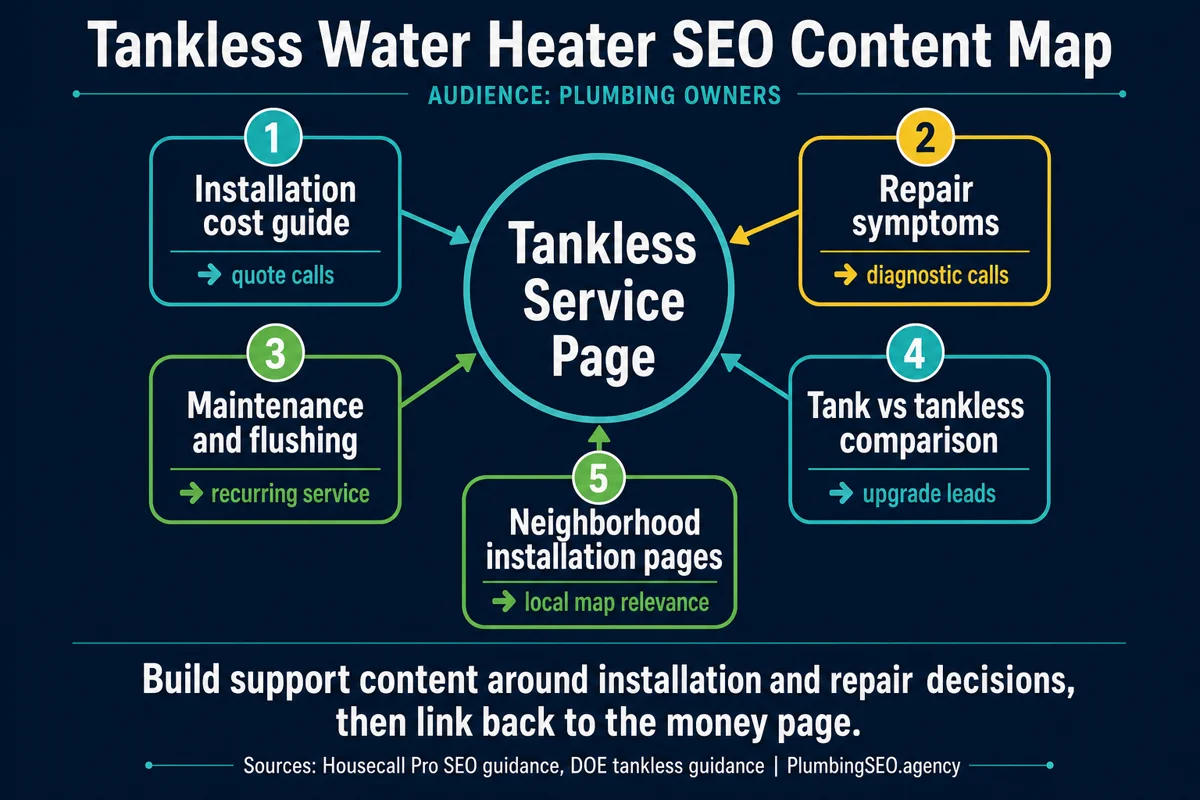
Here is the practical structure I would build for a plumbing company that wants tankless installation and repair leads:
| Page or section | Searcher intent | What it must prove | Best internal link |
|---|---|---|---|
| Tankless installation service page | Ready to compare contractors | Licensing, sizing process, venting, gas or electrical readiness, quote path | Main plumbing SEO service or city plumbing page |
| Tankless cost guide | Budgeting before a quote | Why conversions cost more, what changes the price, what a visit confirms | Tankless installation page |
| Repair symptom guide | No hot water, code, leak, ignition issue | What is safe to check, when to stop, when to call | Tankless repair page |
| Maintenance and flushing article | Annual service or hard-water concern | Why maintenance protects the heat exchanger and performance | Maintenance booking page or contact page |
| Local installation pages | Nearby installer search | Neighborhood availability, reviews, real service-area language | Primary tankless service page |
That structure also keeps the broader site clean. Your homepage and main plumbing SEO services page can explain the system. The tankless articles do the supporting work by showing Google that this service line is covered in detail.
Separate Installation Leads From Repair Leads
Installation and repair are both profitable, but they are not the same search. Installation has more planning. Repair has more urgency. If you write one page for both, the page usually becomes too vague to win either one.
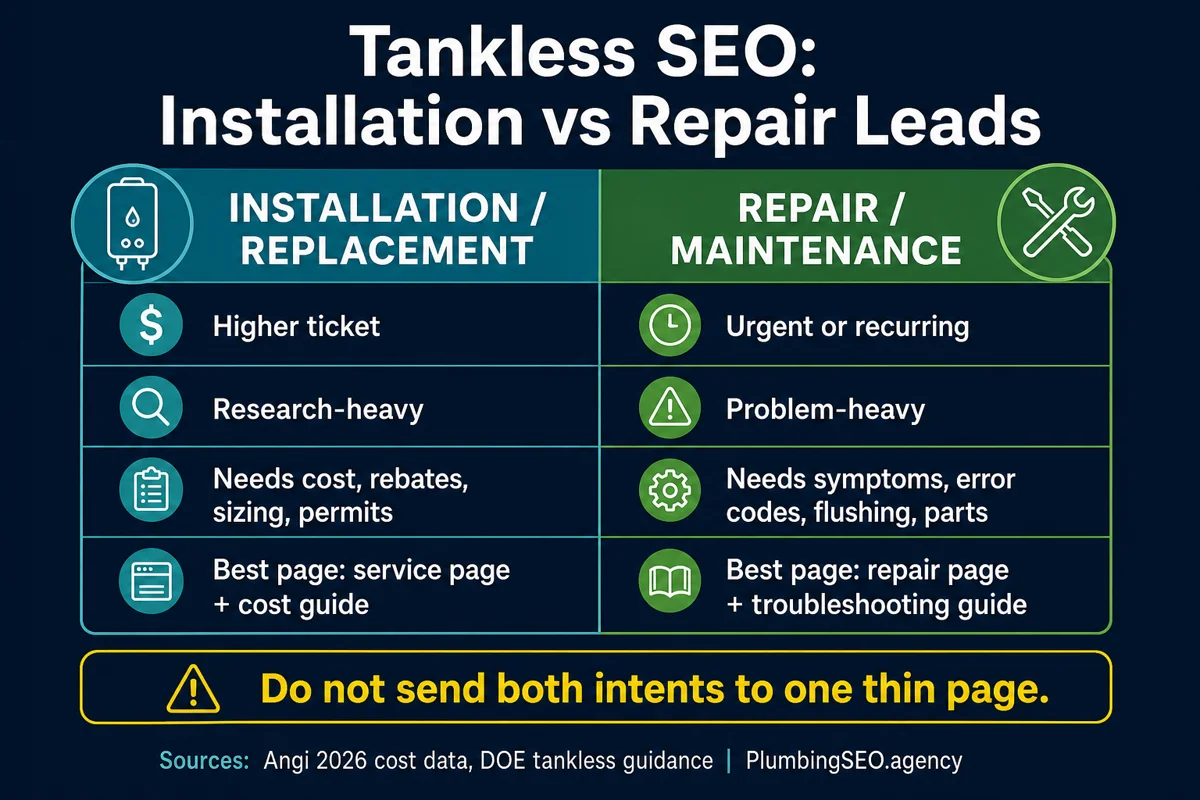
Angi's 2026 water heater replacement data puts tankless systems in a higher-cost range than many tank replacements. That means installation copy has to justify the visit before it asks for the call. Explain what affects price. Mention gas line capacity, venting, electrical load, brand choice, water hardness, recirculation, and access. A homeowner may not know those words yet, but they know they do not want a surprise after the plumber arrives.
Repair copy should move faster. It should cover no hot water, inconsistent temperature, mineral buildup, error codes, ignition problems, venting warnings, leaks, and when to shut the unit down. Give enough information to build trust, then make the next step obvious. Do not turn it into a DIY manual for gas, venting, or electrical work. That is not helpful, and it is not worth the risk.
What the Tankless Service Page Should Include
Your tankless money page should be built like a field checklist. If it does not help the homeowner decide you are safe, qualified, nearby, and easy to call, it probably does not belong above the fold.
Above the fold
- Clear service name: tankless water heater installation or repair
- Phone, booking, and service-area language visible without hunting
- Trust proof: licensed plumbers, local reviews, warranty or workmanship language
- One practical promise, such as same-week estimate or diagnostic appointment
Below the fold
- Gas, electric, indoor, outdoor, and brand considerations
- Cost factors without fake exact pricing
- Maintenance, flushing, and water hardness guidance
- FAQs that answer the questions your office hears every week
If your shop handles both standard and tankless systems, link naturally between those pages. A homeowner comparing options should be able to move from tankless to general water heater installation and repair SEO examples without hitting a dead end.
Use Google Business Profile and Reviews to Reinforce the Page
Good tankless SEO is not only the page. Your Google Business Profile, reviews, photos, and service categories should support the same message. Housecall Pro's plumber SEO guidance points plumbers toward service-specific keywords, Google Business Profile work, reviews, on-page titles, and useful content. That lines up with what I would do here.
Ask for reviews after tankless jobs and make the request specific. A review that says "installed our tankless water heater and explained the venting" is more useful than a generic "great service." Add real job photos when possible. Make sure your office uses the same service language in calls, invoices, reviews, and pages. Consistency is boring until it starts paying bills.
The Internal Link Plan
Internal links should feel like dispatch, not decoration. Send the reader to the next helpful page. For this topic, the main support link should point to the plumbing SEO service page because this article is teaching the service-line strategy behind the page build. A secondary link can point to the SEO process page when you explain how pages, Maps, calls, and reporting connect. If the owner is comparing budget, link to SEO pricing only where it helps.
The owner-side test is simple. If a link helps the reader make the next decision, keep it. If it is there only because somebody wanted another anchor, cut it. Google has enough junk to crawl already.
How to Measure Whether It Is Working
Do not judge this only by rankings. Rank tracking matters, but the phone tells the truth. Watch the service-line calls, form fills, quote requests, booked installation estimates, repair diagnostics, and maintenance appointments. Look at which page the call came from. Listen to call recordings if you have them. Ask your techs what customers mention.
After the page is live, I would check four things every month:
- Which tankless queries are getting impressions and clicks.
- Whether installation and repair searches are landing on the right page.
- Whether the page is earning calls from the right service area.
- Whether new content is needed for cost, symptoms, maintenance, or local neighborhoods.
If you want help finding the leaks in your plumbing site, start with a free plumbing SEO audit. We will look at the service pages, content support, internal links, and call path. No magic. Just the stuff that helps the right customer find you before they call the other shop.
Tankless Water Heater SEO FAQs
Tankless water heater SEO is the process of building service pages, support articles, internal links, Google Business Profile signals, and local proof around tankless installation, replacement, repair, and maintenance searches.
They can share a hub, but strong sites usually separate the intent. Installation pages need cost, sizing, venting, gas, electrical, and quote information. Repair pages need symptoms, diagnostics, error codes, maintenance, and urgent call language.
Link to the main plumbing SEO service page, the broader water heater SEO guide, relevant process or pricing pages, and any tankless service page that the article supports. Use links where they help the reader make the next decision.
Good support topics include tankless installation cost, tank versus tankless comparisons, rebates, sizing, gas line requirements, electrical requirements, brand comparisons, local installation pages, and permit questions.
Repair support topics include no hot water, error codes, ignition problems, mineral buildup, flushing, annual maintenance, leaks, venting warnings, and when a homeowner should shut the unit down and call a plumber.
Track rankings and clicks, but also track calls, booked estimates, repair diagnostics, maintenance appointments, service area, and call quality. The best sign is not only more traffic. It is more of the tankless work your shop actually wants.
Want tankless pages that bring in better calls?
We can inspect your current plumbing site, find which service-line searches are leaking away, and show you what to build first.
Run My Free SEO Leak Check