
- A combined plan does not mean one catch-all page. Plumbing, drain cleaning, sewer, water heater, and emergency work each need clear pages that feed the same call strategy.
- Google local visibility comes from relevance, distance, and prominence. You can influence relevance and prominence with complete service pages, GBP services, reviews, photos, and links.
- Judge the plan by booked calls, not vanity traffic. Use call tracking, job notes, and page-level reporting so you know which searches keep the trucks moving.
If you run a plumbing and drain company, SEO can get messy fast. One day you are trying to rank for emergency plumbing. The next day you need drain cleaning calls, sewer camera work, water heater jobs, and the odd customer who types the whole problem into Google like they are writing a novel.
The fix is not to smash every service onto one page and hope Google figures it out. The fix is a combined growth plan. One strategy, one tracking setup, one review loop, but separate pages for separate jobs.
That is the difference between "we do plumbing" and a site that helps the right customer find the right service before they call the other shop.
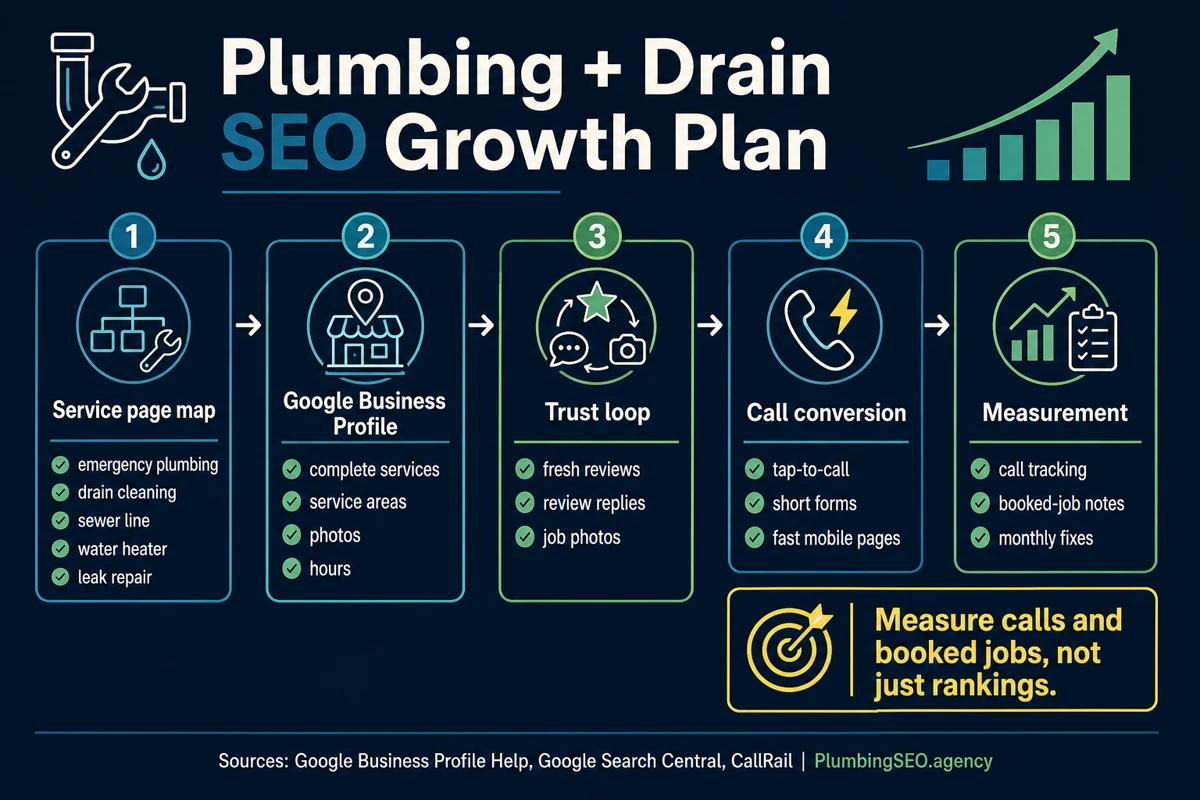
What combined SEO means for a plumbing and drain company
Combined SEO means your plumbing company has one clear search strategy across the whole business. It does not mean every service fights for space on the same page.
Drain cleaning has different urgency than repiping. Sewer line repair has different proof than fixture installation. Emergency plumbing has a different call pattern than a planned water heater replacement. Google and customers both need those differences spelled out.
Use the main plumbing SEO services page as the business-level hub, then support it with focused service pages and helpful blog posts. If you want that commercial page built for a plumbing-and-drain mix, use the SEO for plumbing and drain companies service. The service pages catch ready-to-call demand, including urgent topics like emergency plumber SEO. The blogs answer questions and pass internal links back to the commercial pages.
How Google sees local plumbing intent
Google says local results are mainly based on relevance, distance, and prominence. A plumber cannot move closer to every searcher, but you can improve how clearly your business matches the job and how trusted it looks.
That is why a drain company needs more than a homepage. Your Google Business Profile should list drain cleaning as a service. Your website should have a drain cleaning page. Your photos, reviews, and FAQs should back up that service. Otherwise, the whole setup asks Google to connect the dots with one eye closed.
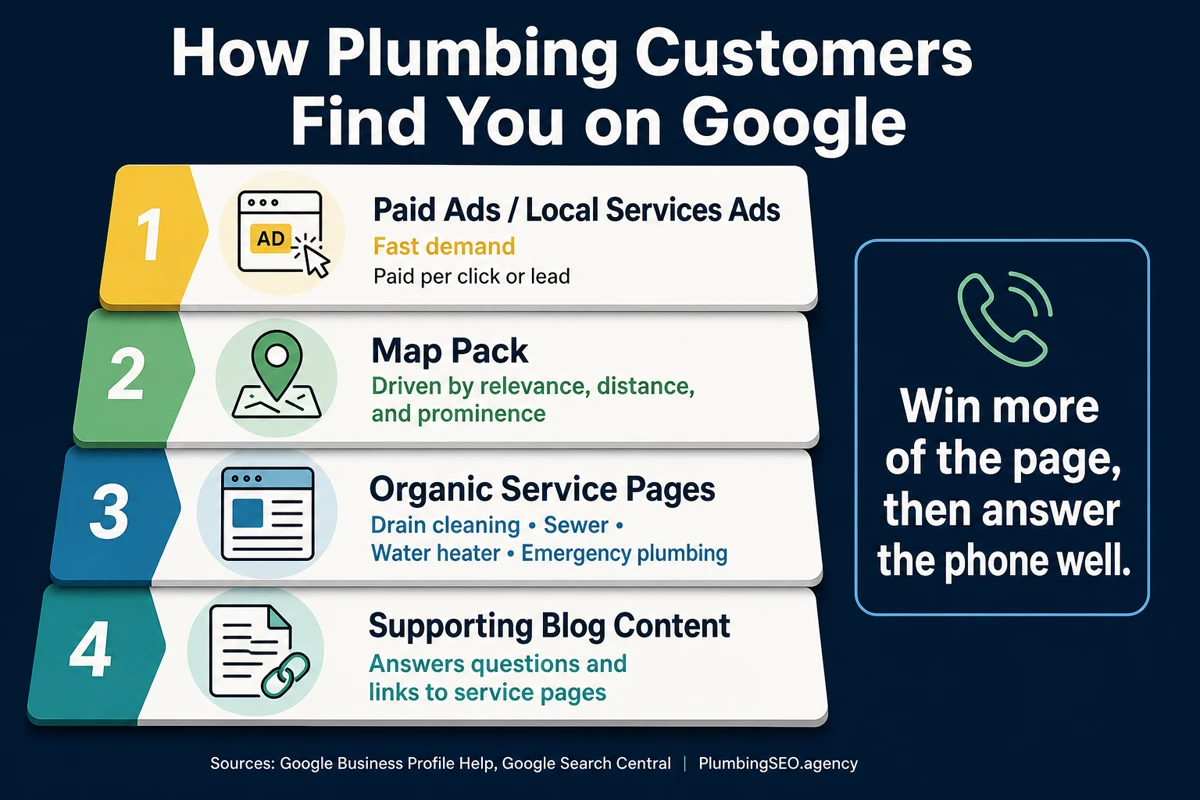
Build the service map before writing more content
Most weak plumbing SEO starts with a messy service map. The company offers good work, but the website does not show it cleanly. Customers search for a clogged drain, sewer backup, leak repair, or water heater issue, and the site gives them a general plumbing page with a paragraph or two. That is thin soup.
Start by deciding which services deserve their own page. For a plumbing and drain company, the core map usually looks like this:
| Service intent | Best page type | What the page must prove |
|---|---|---|
| Emergency plumbing | High-urgency service page | Fast response, service area, phone visibility, after-hours expectations |
| Drain cleaning | Dedicated drain service page | Clog types, equipment, before-and-after proof, review language |
| Sewer line repair | Higher-ticket service page | Inspection process, camera work, repair options, permit or excavation context |
| Water heaters | Install and repair page or page pair | Brands, tank versus tankless, replacement timing, warranty and safety notes |
| Leak detection | Problem-led service page | Symptoms, diagnostic process, moisture risk, how to request help |
Do not build this map for Google only. Build it for the person with water on the floor and a phone in their hand. They do not want a lecture. They want to know you handle this exact problem in their area.
Give drain cleaning its own proof
Drain cleaning is not just another bullet under plumbing. It is often urgent, mobile, and service-area sensitive. A homeowner with a backed-up kitchen sink is not browsing your brand story. They are checking whether you handle clogs, main lines, sewer backups, roots, recurring drains, and same-day calls.
A strong drain page should include the common symptoms, the service areas you actually cover, the tools you use, when camera inspection makes sense, and what the customer should do before the tech arrives. Keep it practical. Nobody needs a poem about wastewater.
Then support that page with nearby content. A blog about why drains clog in older homes can link to the drain service page. A sewer camera guide can link to sewer inspection. A pricing explainer can link to your main plumbing service page. That is how internal linking starts to feel useful instead of forced.
Make the Google Business Profile match the website
The website and Google Business Profile should tell the same story. If the site says you do drain cleaning, sewer work, leak repair, emergency plumbing, and water heaters, the profile should not sit there with a bare "Plumber" category and three old photos from 2019.
Update the services, hours, service areas, business description, photos, and review responses. When Google explains local ranking, it points to complete and detailed business information, reviews, and prominence signals. That lines up with what a plumbing owner sees in real life. Trust gets built before the call.
Reviews matter here. BrightLocal's 2026 local consumer review survey reports that 97% of consumers read online reviews for local businesses. For plumbing, review recency and service detail can be the difference between "maybe" and "call them now."
Track calls like an owner, not a report writer
Rankings are useful, but they do not pay payroll by themselves. A page that ranks and sends bad calls is not doing its job. A page that sends fewer visits but more booked drain jobs may be the better page.
Call tracking helps connect marketing channels to phone calls. CallRail explains that call tracking assigns unique phone numbers to campaigns so businesses can understand which marketing activity drives calls. Used carefully, it helps a plumbing company see whether organic search, ads, Maps, or a page update is producing real conversations.
The owner-level question is simple: which page, keyword, or channel led to a call we could book? If the answer is missing, you are driving with the dashboard covered.
Use paid search to cover gaps, not hide SEO problems
Paid ads can help when the phones need to ring now, especially for drain cleaning and emergency work. But paid traffic should not become a patch over a weak website. If the landing page is thin, the phone number is buried, or nobody tracks booked jobs, the ad budget just runs out faster.
One common owner-side pattern is easy to recognize: money goes into ads, clicks come in, the page does not match the job, and nobody knows which calls turned into work. That is not a plumbing problem. That is a tracking and landing-page problem.
Build the SEO foundation first, then use paid search where speed matters. The same drain cleaning page that supports organic search can also become the better paid landing page. That is where the combined plan saves money.
A practical 90-day growth plan
The page-to-call checklist
Before you publish another plumbing blog or spend another dollar on ads, run the page through a simple check. Does the page rank the right service? Does it earn trust? Does it make calling easy? Does your office know where the lead came from?
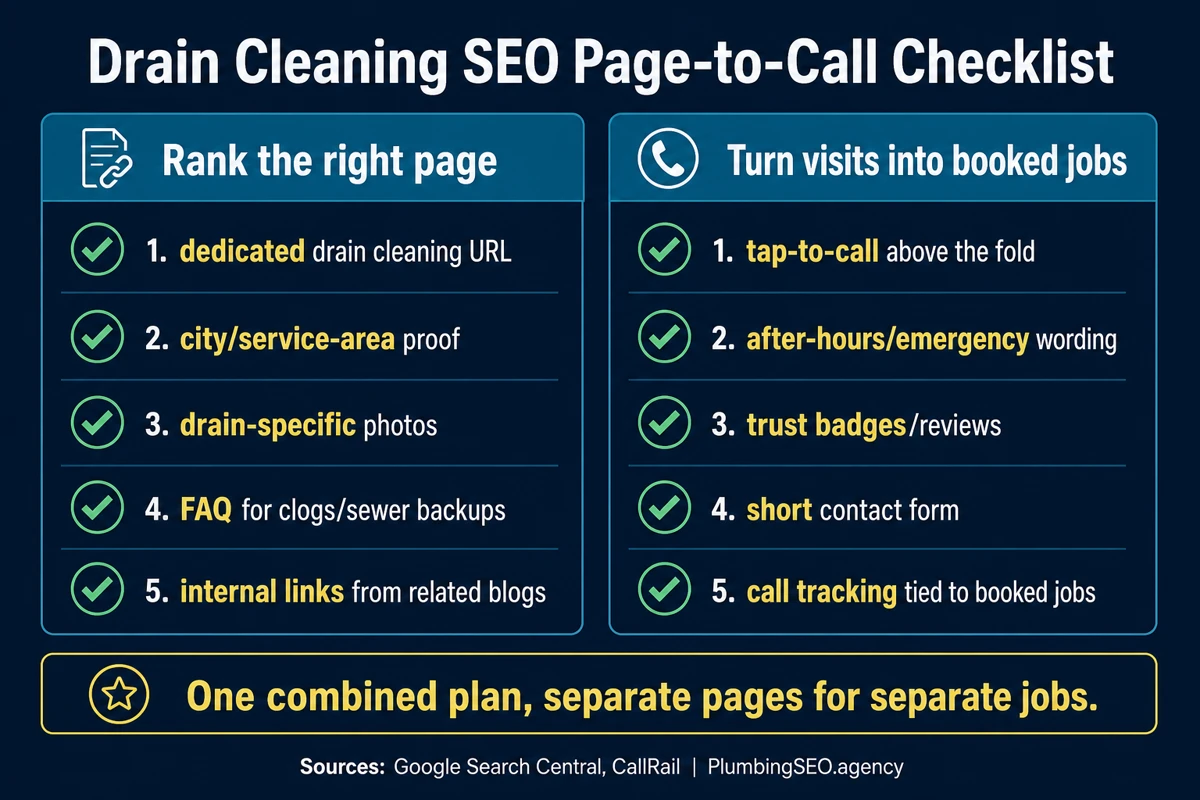
What to measure each month
Monthly SEO reporting should be short enough for an owner to read and specific enough to make a decision. Track these five things:
- Calls from organic search and Maps. Separate total calls from qualified calls.
- Booked jobs by service. Drain cleaning, sewer, water heater, emergency, and general plumbing should not all blur together.
- Top service pages. Watch which pages bring leads and which pages need stronger proof.
- Google Business Profile actions. Calls, direction requests, website clicks, photo activity, and review growth all matter.
- Fixes completed. Content added, links improved, reviews answered, photos uploaded, and technical issues cleaned up.
If a report cannot help you decide what to fix next, it is just paperwork wearing a nice shirt.
Final take
SEO for plumbing and drain companies should not feel like a pile of disconnected tasks. The homepage, service pages, Google Business Profile, reviews, blogs, ads, and call tracking all need to pull in the same direction.
The plan is simple. Make every important service findable. Make every page trustworthy. Make every call easy. Then measure booked work so you know what actually kept the trucks moving.
FAQs About SEO for Plumbing and Drain Companies
Use one overall strategy, but give major services their own pages. Drain cleaning, sewer repair, water heaters, emergency plumbing, and leak repair usually deserve separate pages because customers search for them differently and need different proof before calling.
Start with a dedicated drain cleaning page, a complete Google Business Profile, drain-specific photos, fresh reviews, tap-to-call buttons, and call tracking. After that, add supporting content around clogged drains, sewer backups, camera inspections, and service-area questions.
Google says local results are based mainly on relevance, distance, and prominence. You cannot control every distance factor, but you can improve relevance and prominence with complete business information, focused service pages, reviews, photos, citations, and helpful content.
Use both when budget allows, but do not use ads to hide a weak page. SEO builds durable visibility. Paid ads can fill urgent gaps and test offers. The best setup sends both organic and paid visitors to strong service pages with clear calls to action and tracking.
Measure qualified calls, booked jobs, service-page performance, Google Business Profile actions, review growth, and completed fixes. Rankings matter, but the phone and job board tell the truth.
Want a plumbing and drain SEO plan that tracks real calls?
We will review your service pages, Google Business Profile, internal links, and call tracking so you can see where search demand is leaking away.
Run My Free SEO Leak Check