
- Builder, remodeler, and construction searches are not the same lead. Build separate proof paths instead of stuffing them into one generic plumbing page.
- The winning page proves capacity: project types, service areas, licenses, insurance, photos, reviews, and a clear way to request a bid or call.
- Use the blog to support the main plumbing SEO service page, then measure calls, forms, bid requests, and booked work, not vanity traffic.
A lot of plumbing companies say they want more contractor work. What they usually mean is, "I want builders, remodelers, property managers, and general contractors to find us before the bid list is already full." That is a different job than ranking for emergency drain cleaning.
Plumbing contractor SEO is about showing up when a project buyer is looking for a capable plumbing contractor, not just the nearest service truck. The buyer may be a builder planning rough-in work, a remodeler who needs a reliable trade partner, a property manager with tenant improvements, or a GC trying to fill a scope gap before the schedule gets ugly.
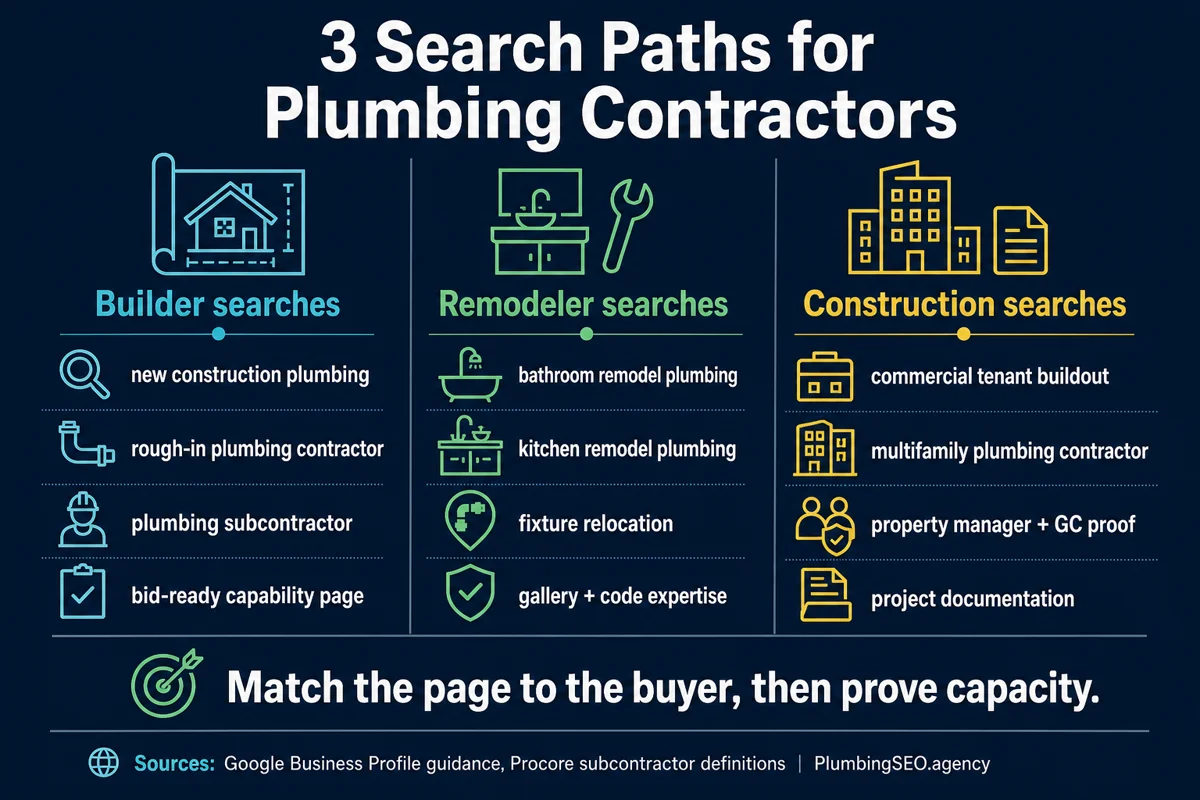
The mistake is treating all those searches like one bucket. A builder search, a remodeler search, and a construction search each carry different proof requirements. If your website gives them the same thin paragraph, you are making the buyer do the sorting. Busy buyers do not sort. They move on.
What Makes Plumbing Contractor SEO Different?
Most plumbing SEO advice focuses on homeowner searches. That matters. A shop still needs to show up for water heater repair, leak detection, emergency plumbing, and drain cleaning. But contractor intent is a little different. The person searching may not be the final property owner. They may care less about a coupon and more about whether you can show up, document the work, coordinate with other trades, and protect the schedule.
Procore describes plumbing subcontractors as the trade that installs waste lines, vents, water pipes, and often ties systems into city water or well water on building and renovation projects. That definition matters because the buyer is not only asking, "Can you fix a leak?" They are asking, "Can you carry this scope without slowing down the job?"
That is why a contractor-focused page needs proof a normal service page may skip:
- Project types you actually handle, such as rough-in, remodel plumbing, multifamily, tenant buildout, or commercial repair.
- Real service areas and dispatch coverage, not a giant list of cities copied from a map.
- Licensing, insurance, safety, crew capacity, and documentation language.
- Photos or project notes that show clean work, not only smiling stock-photo homeowners.
- A clear path for calls, forms, bid requests, plan review, or site walks.
If you already have a general plumbing SEO services for plumbers page, this blog supports it. The blog explains the buyer paths. The service page explains how the full SEO system gets built. That is how internal links should work: one page helps the reader understand the problem, the next page shows the service path.
The Three Search Paths You Need to Separate
In my opinion, the first fix is not more content. The first fix is separation. One generic "plumbing contractor" page trying to serve every project type usually turns into a junk drawer. It holds everything, and nobody can find the right wrench when they need it.
| Buyer path | Search examples | What the page must prove |
|---|---|---|
| Builders | new construction plumbing contractor, rough-in plumbing contractor, plumbing subcontractor | Crew capacity, scheduling, plans, rough-in experience, inspections, and jobsite coordination. |
| Remodelers | bathroom remodel plumber, kitchen remodel plumbing, fixture relocation plumber | Clean work, occupied-home care, fixture knowledge, code awareness, photos, and communication. |
| Construction and property teams | commercial plumbing contractor, tenant buildout plumber, multifamily plumbing contractor | Documentation, insurance, response process, service area, commercial proof, and decision-maker contact options. |
The same plumbing company may serve all three. The search result should not look the same for all three. A remodeler wants to know you will not wreck the finished tile. A builder wants to know you can hit the rough-in window. A property manager wants to know you can communicate, document, and not disappear after the first call.
How Google Decides Whether Your Page Fits the Search
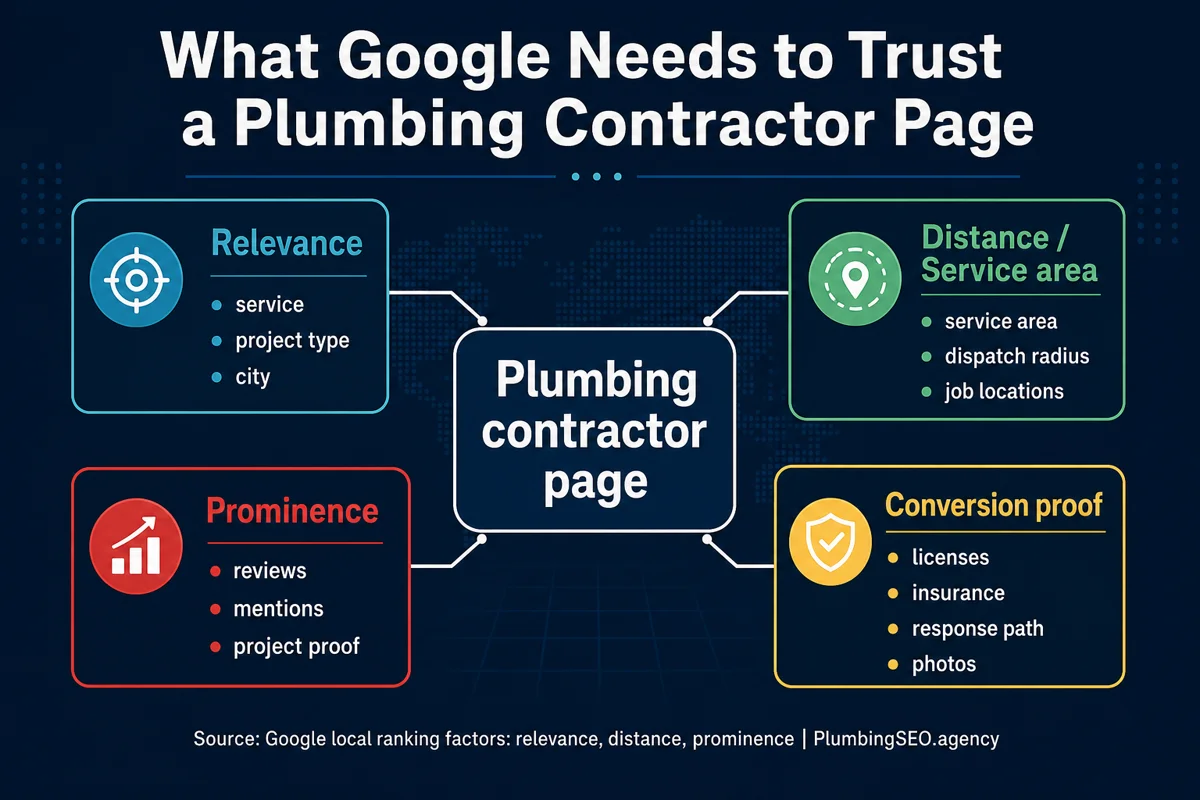
Google says local results are mainly shaped by relevance, distance, and prominence in its local ranking guidance. That is simple enough to say. It is harder to earn.
For plumbing contractor SEO, relevance means the page speaks directly to the project type. Distance means the business and service area make sense for the buyer. Prominence means the company has real-world proof around it: reviews, mentions, links, photos, citations, project pages, and a brand people can verify.
Blue Corona cites almost 2.9 million monthly U.S. online searches for plumbers and plumbing companies on its plumber SEO page. ServiceTitan also notes that many consumers use search engines when looking for plumbing services. Those numbers explain the pressure, but they do not mean every click is equal. Contractor searches can be lower volume and higher value. That is why the page has to filter for the right buyer, not just attract everyone with a pulse and a browser.
Build the Page Around Buyer Proof, Not Keyword Repetition
Keyword repetition is the lazy version of plumbing contractor SEO. It is like adding more pipe dope when the fitting is cross-threaded. More does not fix wrong.
Start by deciding what the page is supposed to win. If the target is builder work, the H1, intro, proof blocks, photos, FAQ, and CTA should all speak to builder concerns. If the target is remodel plumbing, show finished-space care, clean work, fixture expertise, and how you coordinate with a remodeler. If the target is commercial or property work, explain insurance, response times, documentation, and after-hours process.
Weak page
"We handle residential and commercial plumbing. Call today for great service." That could describe a thousand shops. It gives the buyer no reason to trust you with a project.
Stronger page
"We handle rough-in plumbing for builders in active service areas, coordinate with site schedules, document inspection milestones, and provide a clear bid request path." That gives the buyer something to work with.
What to Include on a Plumbing Contractor SEO Page
Here is the practical page build. You do not need fancy language. You need useful proof in the right order.
| Page element | Why it matters | Owner-side note |
|---|---|---|
| Specific service headline | Matches the project buyer's search intent. | Use "rough-in plumbing contractor" or "bathroom remodel plumber" when that is the real work. |
| Project scope list | Shows what you can actually handle. | Keep it honest. Do not list multifamily or commercial work if the crew cannot support it. |
| Proof photos and short notes | Helps buyers picture your work before calling. | Photos of trucks, crews, mechanical rooms, rough-ins, clean remodel work, and finished installs beat generic graphics. |
| Licenses, insurance, and safety | Reduces risk for GCs, builders, and property managers. | Use real credentials and update them when they change. |
| Service area and response path | Connects distance and capacity to the search. | Explain where you work, how bids are requested, and how urgent calls are routed. |
| FAQ schema | Answers buyer objections cleanly. | Write FAQs around bids, project types, service areas, emergency work, and proof. |
Need the service-page side built too?
This post explains the search strategy. Our plumbing SEO service builds the page structure, internal links, schema, and tracking that turn that strategy into a useful asset.
See the plumbing SEO serviceDo Not Forget the Google Business Profile
Your website and your Google Business Profile should back each other up. Google tells businesses to keep profile information accurate, useful, and representative of the real business. If the page says commercial plumbing contractor but the profile only looks like emergency residential repair, the story is thin.
Profile support for contractor SEO includes service categories where appropriate, service entries that match real work, photos from the field, review requests after qualified jobs, and owner responses that mention the kind of work performed. This is also where a lot of shops leak trust. They do good work all week, then leave the profile looking like nobody has touched it since the old truck decals.
If you need a deeper review system, our Google reviews for plumbers guide explains how reviews support trust without begging, bribing, or annoying customers.
Internal Links That Make This Topic Stronger
A supporting blog should not float alone. It should help the reader move from "I understand the problem" to "I know what to fix next." That is why this page links up to the main plumbing SEO services page. It also connects sideways to related posts where the reader needs more detail.
If the reader serves property managers or larger facilities, the next step is our commercial plumbing SEO guide. If they are comparing what an agency should actually do, the practical follow-up is what plumbing SEO services include. If they are deciding whether to hire help or handle the basics in-house, the agency comparison in plumbing SEO agency vs DIY gives them a cleaner decision path.
How to Measure Contractor SEO Without Fooling Yourself
Do not judge this work by traffic alone. Contractor searches may not flood the site with visits. The question is whether the right people are finding you and taking a serious next step.
- Calls from contractor-focused pages and Google Business Profile interactions.
- Form submissions that mention builder, remodel, commercial, property, or bid work.
- Qualified bid requests, site walks, scope calls, or plan review requests.
- Ranking movement for real project terms in real service areas.
- Internal links pointing to the page from relevant blogs and service pages.
- Reviews and mentions that support project capability, not only emergency repairs.
The phone still tells the truth. If rankings improve but every call is for work you do not want, the page is too broad. If the page gets impressions but no calls, the proof may be weak. If calls come in but do not book, the response path may be unclear. SEO does not end when the page ranks. It ends when the right job gets on the board.
The Practical Next Step
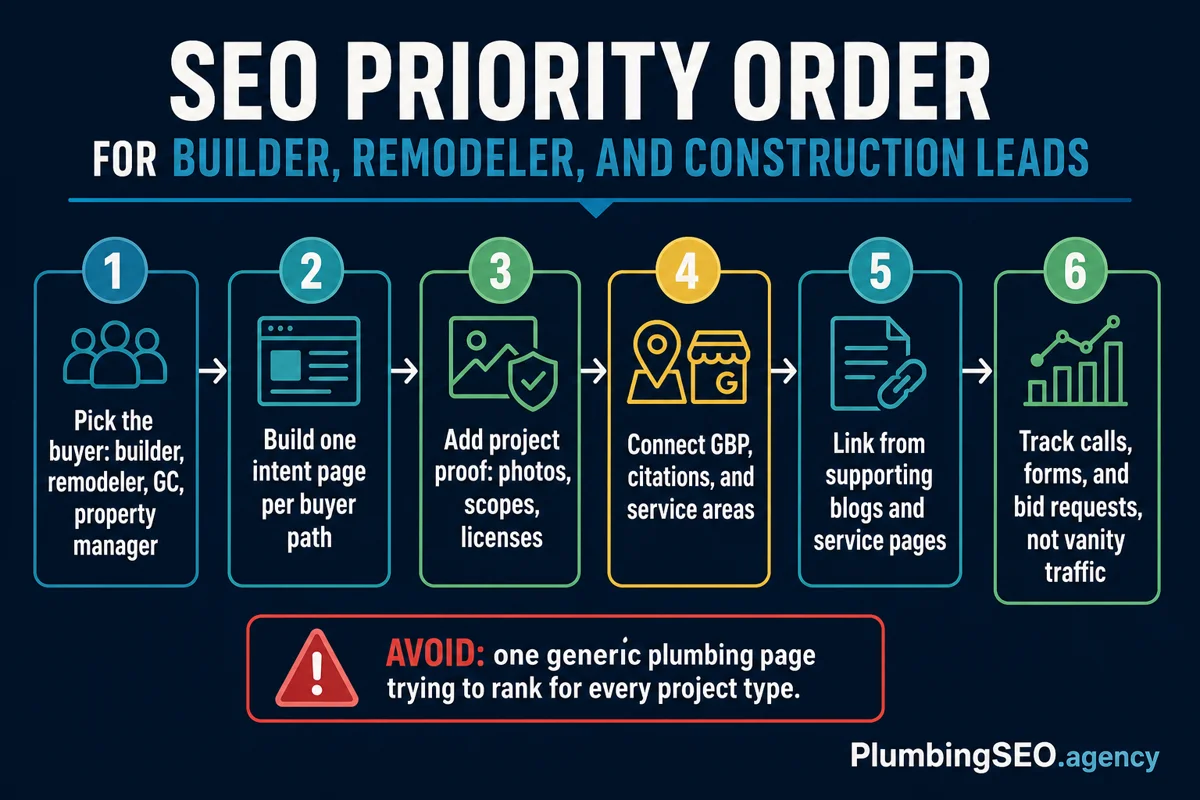
Pick one buyer path first. Not all of them. If builder work is the best opportunity, build the builder page and support it with proof. If remodelers bring better margins, write the remodel plumbing page and show finished-space trust. If commercial property work is the goal, prove response, documentation, and capacity.
Then link that page from related content, tighten the Google Business Profile, add photos and reviews, and track the next 60 to 90 days. That is not fancy. It is just solid plumbing contractor SEO. Figure out who is searching, prove you can handle the work, and make it easy for the right buyer to call before they call someone else.
Plumbing Contractor SEO FAQs
Plumbing contractor SEO is the work of helping a plumbing company rank for contractor-style searches such as plumbing contractor, plumbing subcontractor, rough-in plumbing contractor, commercial plumbing contractor, and remodel plumbing services. It focuses on buyer intent, local proof, service pages, Google Business Profile alignment, reviews, internal links, and lead tracking.
Often yes. Builders, remodelers, GCs, and property managers look for different proof. A builder may care about rough-in scheduling and inspections, while a remodeler may care about clean finished-space work and fixture expertise. Separate pages make the search intent clearer.
It should include a specific headline, service area, project types, proof photos, licenses and insurance, crew or capacity notes, reviews, bid or call options, FAQs, schema, and internal links to related service pages or blog posts.
The profile reinforces local relevance, service area, trust, and conversion. Use accurate business information, real service entries, photos, reviews, and owner responses that support the work shown on the website.
Yes. Supporting blog posts can explain buyer intent, project proof, local SEO, and mistakes to avoid, then link naturally to the main plumbing SEO or contractor service page. The link should help the reader, not just satisfy an SEO checklist.
The biggest mistake is using one generic plumbing page for every buyer and every project type. It usually fails to prove relevance, capacity, service area, and trust for the specific person searching.
Want contractor searches to turn into real calls?
We build plumbing SEO around the work you actually want: service pages, internal links, Google Business Profile support, tracking, and proof that helps the right buyer call.
Run My Free SEO Leak Check