
- Commercial plumbing SEO is not residential SEO with bigger job tickets. It has to prove capacity, paperwork, response process, and commercial experience before the buyer calls.
- Build a commercial hub, then support it with buyer pages for facility managers, property managers, general contractors, restaurants, schools, and retail sites.
- Link the article and related service pages back to your main plumbing SEO service page so commercial-intent readers have a clear next step.
A commercial plumbing lead usually does not sound like a homeowner with a leaking faucet. It sounds like a facility manager trying not to have a tenant complaint turn into a building problem. It sounds like a property manager who needs a vendor that answers, documents the work, carries the right insurance, and does not make their phone ring twice for the same issue.
That is why commercial plumbing SEO needs a different setup. The page cannot just say "fast plumber near me" and hope the right person calls. It has to make a business buyer comfortable enough to put your company in front of an owner, a tenant, a board, or a general contractor.
The goal is simple: rank for the searches commercial buyers actually use, filter out the wrong residential calls, and show enough proof that the right buyer can move forward without guessing.
What commercial plumbing SEO really means
Commercial plumbing SEO is the work of making your company visible for business-buyer searches such as commercial plumber, facility plumbing maintenance, apartment plumbing contractor, restaurant plumbing repair, backflow testing, commercial water heater service, and plumbing contractor for build-outs.
The mistake I see a lot is treating all plumbing searches the same. A homeowner wants speed, price, and a friendly voice. A commercial buyer wants proof that you can handle the building, the paperwork, the schedule, and the risk. Same trade. Different buying pressure.
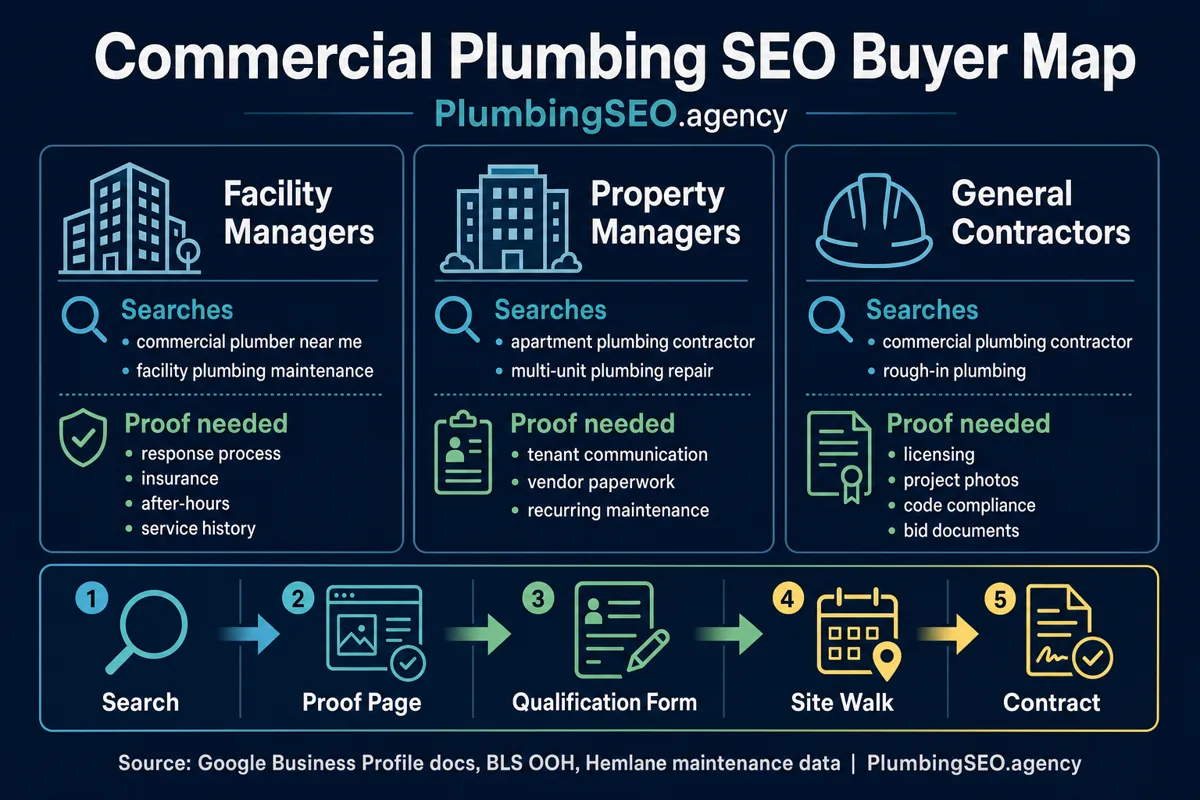
For a plumbing owner, this matters because one good commercial relationship can mean recurring work, planned maintenance, after-hours calls, and referrals to other buildings. It can also mean more paperwork, slower payment, and higher expectations. SEO should help qualify that before dispatch gets dragged into the mud.
Commercial buyers search with proof in mind
A facility manager may start with Google, but they are not only looking for a phone number. They are checking whether the company looks safe to hand to their boss. Your website, Google Business Profile service areas, reviews, photos, and service pages all have to answer the same quiet question: can this plumber handle our building?
| Commercial buyer | Likely searches | Proof they need | Best page type |
|---|---|---|---|
| Facility manager | commercial plumber near me, facility plumbing maintenance | Response process, after-hours coverage, insurance, service history | Commercial plumbing hub plus maintenance page |
| Property manager | apartment plumbing contractor, multi-unit plumbing repair | Tenant communication, vendor paperwork, recurring service, clear billing | Property manager or multi-family plumbing page |
| General contractor | commercial plumbing contractor, rough-in plumbing contractor | Licensing, code knowledge, project photos, bid readiness | Commercial contractor capability page |
If your page only says "we do commercial plumbing," it makes the buyer do the sorting. That is not their job. Your page should separate the search intent for them, like a clean parts tray on the truck.
Build the commercial page architecture first
Before you chase more keywords, build the structure. A commercial plumbing SEO plan should have one main commercial hub, then supporting pages by job type, buyer type, and proof type. This gives Google a clearer map, and it gives buyers a path that matches their pressure.
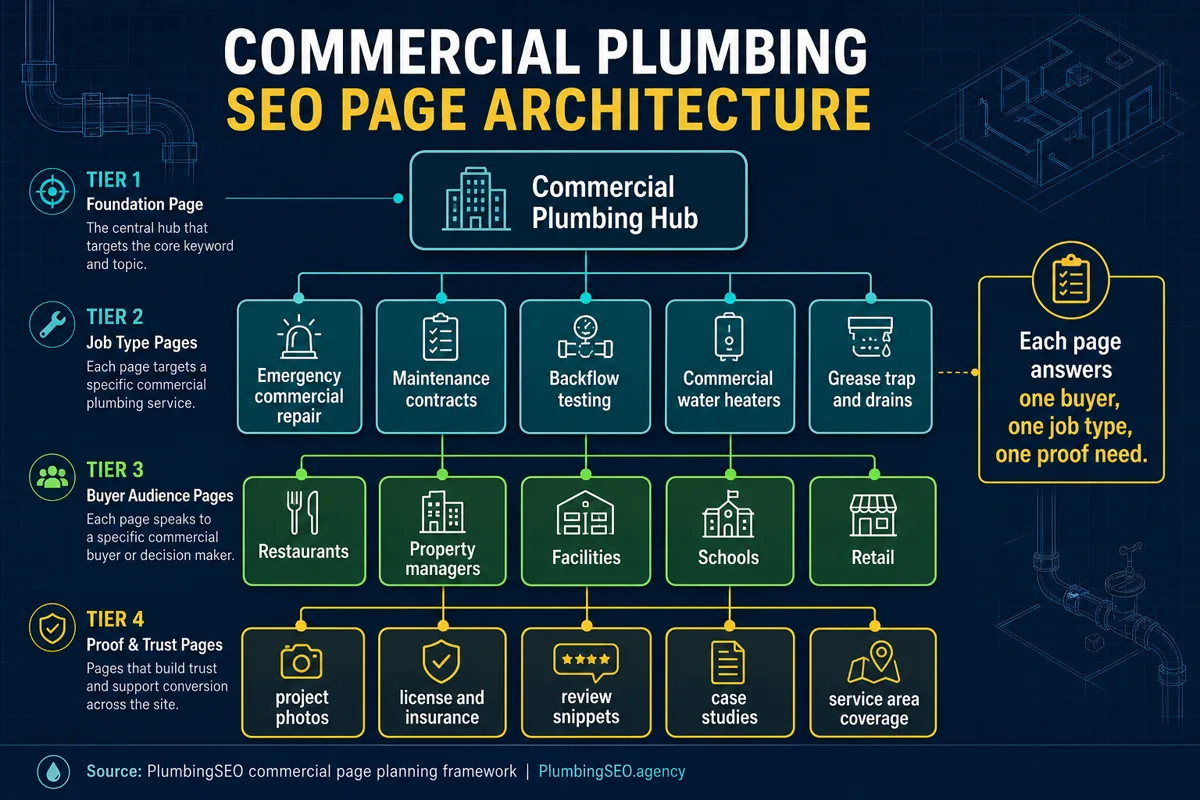
Start with a strong commercial plumbing hub. Then add pages for the services that create commercial work: backflow testing, commercial water heaters, grease traps, drain jetting, pipe repair, emergency commercial repair, and maintenance contracts. After that, add buyer pages where there is enough demand and enough real experience to support them.
Do not make thin city pages or duplicate pages with swapped-out words. That may look busy, but it does not build trust. Build fewer pages that show real work, real photos, real process, and clear next steps.
Separate commercial leads from residential noise
Commercial SEO has a filtering problem. A lot of people type broad plumbing terms even when they need something specific. If your title, headings, form, photos, and copy do not make the commercial fit obvious, dispatch gets calls that should never have reached the board.
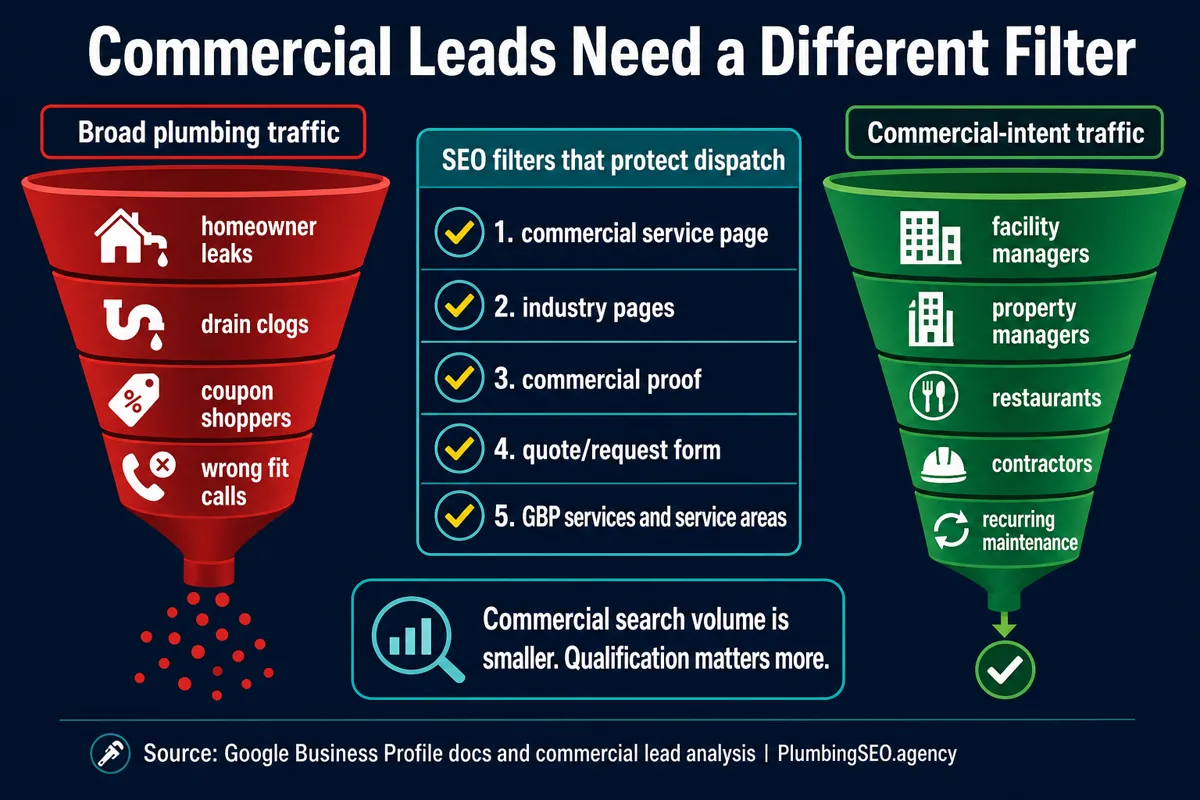
Good commercial pages tell the wrong buyer to self-select out and the right buyer to lean in. Say who you serve. List the commercial systems you handle. Show the buildings you understand. If you do not do residential coupon work, do not make the page look like a coupon page. That is how call quality leaks away.
Put trust signals where the buyer can verify them
The commercial buyer is often protecting someone else: a tenant, a school, a restaurant, a building owner, a GC schedule, or their own job. Trust signals need to be visible before the form, not buried in a footer.
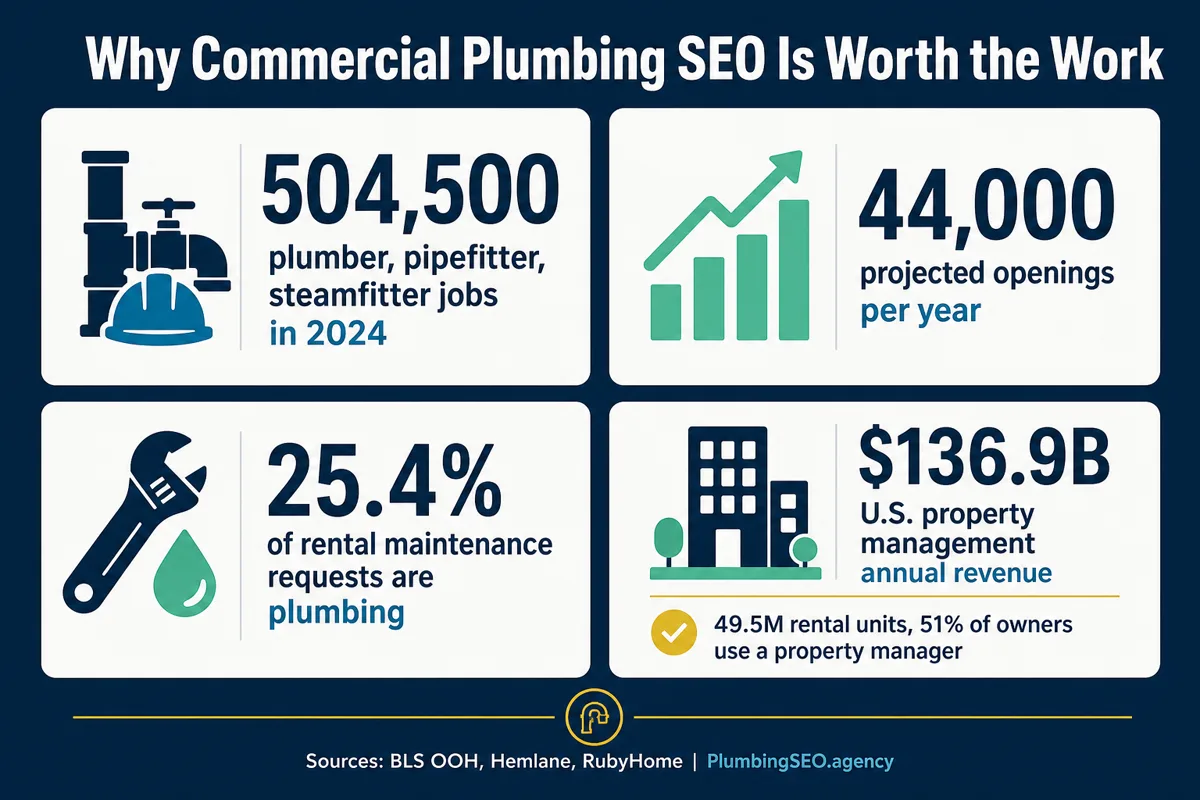
Those numbers are not there to impress the owner at breakfast. They show why commercial SEO deserves its own lane. Plumbing is a recurring maintenance need. Property managers are a real buyer class. Commercial buildings do not stop needing drains, water heaters, backflow work, and emergency repair just because residential demand is busy this week.
The page should show licenses, insurance language, commercial service photos, response expectations, areas served, industries served, review snippets, and a clear way to request service. If you have maintenance agreements, say how they work. If you have after-hours commercial response, explain it without puffing it up.
Map keywords by buyer, not just by volume
Commercial plumbing searches can be lower volume than residential searches. That does not make them weak. A low-volume search from a property manager with 80 doors can be worth more than a dozen price-shopping drain calls. The phone tells the truth.
| Keyword group | Example terms | Page to build | Conversion goal |
|---|---|---|---|
| Core commercial | commercial plumber, commercial plumbing company, commercial plumbing contractor | Main commercial plumbing hub | Commercial service inquiry |
| Buyer-specific | property manager plumber, facility plumbing maintenance, apartment plumbing contractor | Buyer page or section | Vendor conversation |
| Service-specific | commercial water heater repair, backflow testing, grease trap plumbing, drain jetting | Commercial service page | Booked job or estimate |
| Proof-specific | licensed commercial plumber, insured plumbing contractor, emergency commercial plumber | Trust and process content | Reduce buyer risk |
Once that map is clear, link naturally from supporting content into the main plumbing SEO services page. That is the page that should explain the broader program, while this article handles the commercial angle.
Make your Google Business Profile match the commercial story
Your website and profile should not tell two different stories. If the page says you handle commercial water heaters, backflow testing, restaurants, schools, and multi-unit properties, your profile categories, services, photos, reviews, and service areas should support that story where Google allows it.
Do not stuff the business name. Do not fake addresses. Do not list areas you cannot serve. That is not strategy. That is asking for a cleanup job later, and nobody enjoys those except the person billing by the hour.
Use internal links like a dispatcher, not a link farm
Commercial readers should have a route through the site. If they want the full process, send them to the plumbing SEO process. If they need to understand budget, point them toward plumbing SEO pricing. If they are not sure what is leaking, offer the free plumbing SEO audit.
A practical 30-day commercial SEO action plan
If I were fixing this for a plumbing company that wants more facility, property manager, and contractor work, I would not start with 50 pages. I would start with the leaks closest to the phone.
- Audit the current commercial page. Check whether it names the buyers, services, service areas, proof, and next step clearly.
- Build or improve the commercial hub. Make it the main page for commercial plumbing intent, not a thin paragraph on a generic services page.
- Add two or three high-value service pages. Choose the commercial jobs you actually want, such as backflow, water heaters, grease traps, or maintenance contracts.
- Collect commercial proof. Photos, project notes, review snippets, license details, insurance language, and response process all help.
- Fix the conversion path. Use a form that asks building type, service need, urgency, location, and contact preference. A commercial buyer often needs more than a click-to-call button.
- Track lead quality. Count qualified commercial inquiries, not just calls. Raw volume can lie to you.
Commercial plumbing SEO is slower than emergency drain traffic, but it can build a steadier board when it is done cleanly. The trick is not shouting louder. It is proving that your company is the safe choice for the building, the schedule, and the person making the recommendation.
Commercial Plumbing SEO FAQs
Commercial plumbing SEO is the work of ranking a plumbing company for business-buyer searches such as commercial plumber, facility plumbing maintenance, property manager plumbing contractor, backflow testing, commercial water heater repair, and maintenance contracts.
Residential SEO usually leans on speed, location, reviews, and simple booking. Commercial SEO needs stronger proof, including licensing, insurance, building experience, after-hours process, commercial photos, vendor paperwork, and service pages that match business buyers.
Start with a commercial plumbing hub, then add pages for maintenance contracts, emergency commercial repair, backflow testing, commercial water heaters, grease traps, and buyer-specific pages for facilities, property managers, restaurants, schools, or retail sites where you have real service experience.
Yes, when the keyword clearly shows commercial intent. A search with low volume but strong buyer fit can be more valuable than broad residential traffic that creates wrong-fit calls and wastes dispatch time.
Use clear commercial wording in the title, headings, services, photos, FAQs, and form. Name the building types you serve, show commercial proof, and make the inquiry form ask qualifying questions such as building type, service need, urgency, and site location.
Link it to the main plumbing SEO service page, the SEO process page, pricing where budget is discussed, and a free audit or consultation page. Internal links should guide a real buyer to the next useful step, not just check an SEO box.
Want commercial plumbing leads without clogging dispatch?
Run the page through a plumbing SEO leak check. We will look at the commercial page, internal links, local proof, and whether the site is attracting the right kind of buyer.
Run My Free SEO Leak Check