
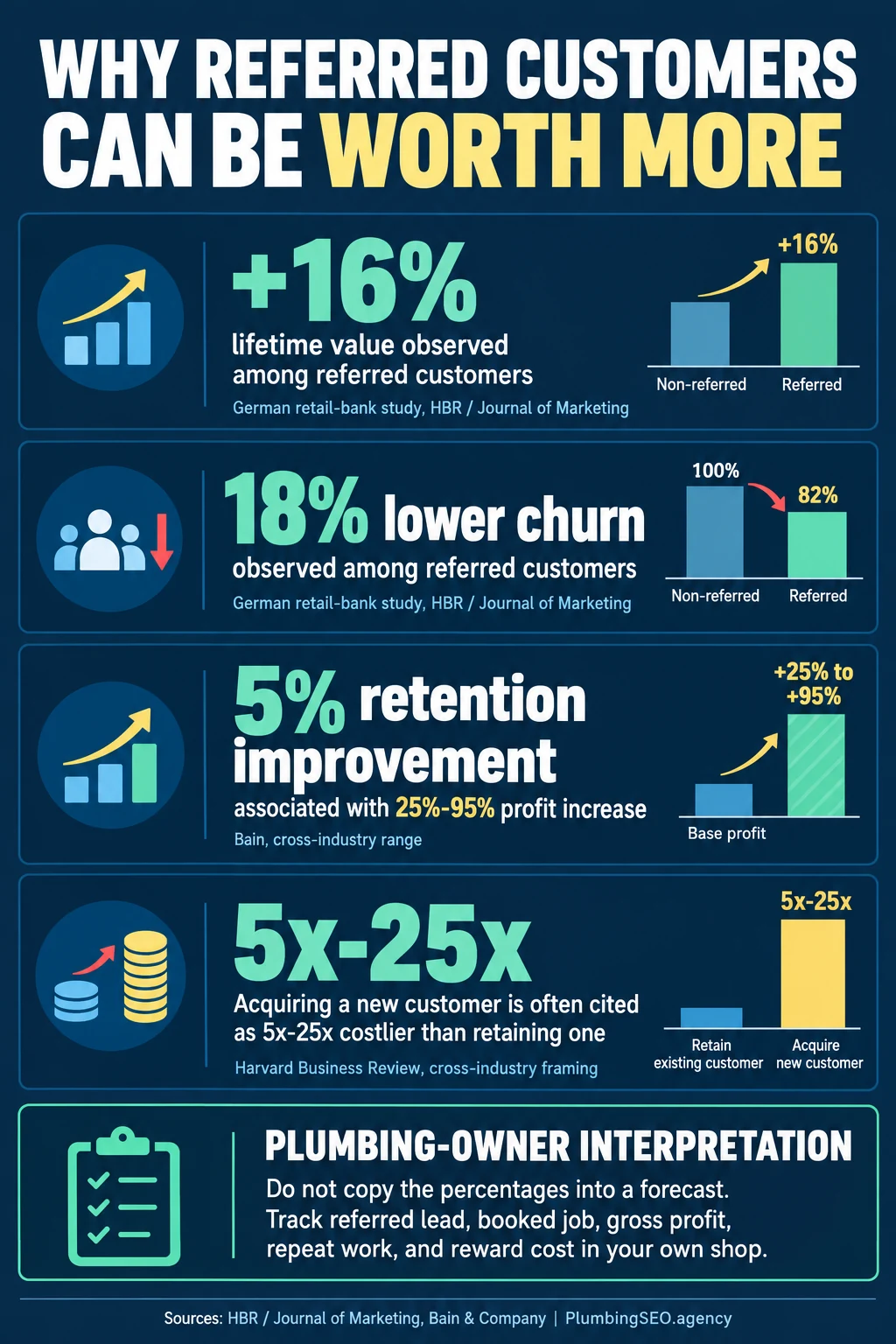
- Referral is a major home-service lead source: 59% of businesses in Jobber's 2026 survey reported referrals as a lead source, ahead of every other channel shown in that report.
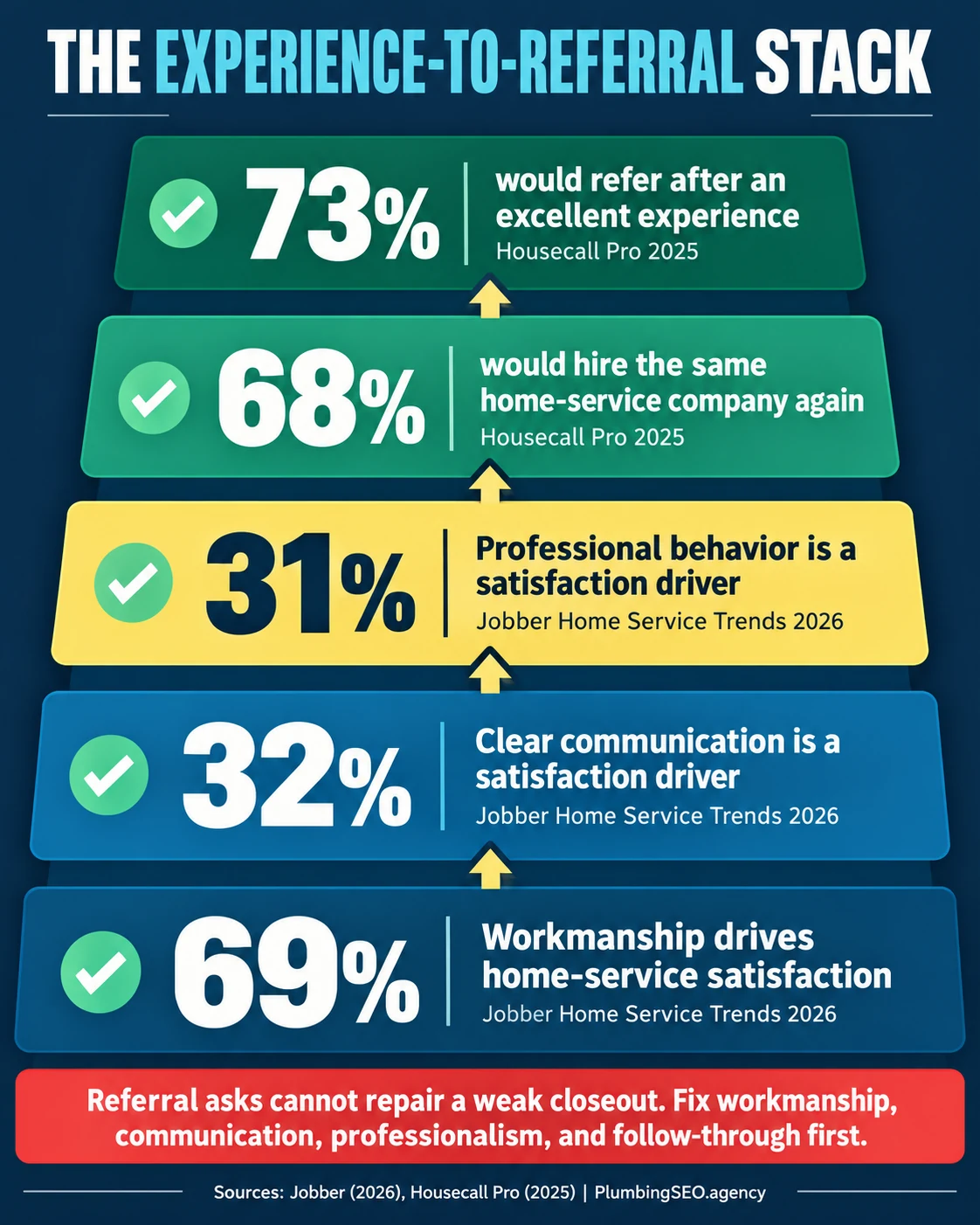
- The experience creates the recommendation: 73% of surveyed homeowners said they would refer a pro after an excellent experience, while Jobber identified workmanship, communication, and professionalism as satisfaction drivers.
- Trust does not remove evaluation: 88% of consumers in Nielsen's global study trusted recommendations from people they know, but referred prospects still check reviews, websites, responsiveness, and availability.
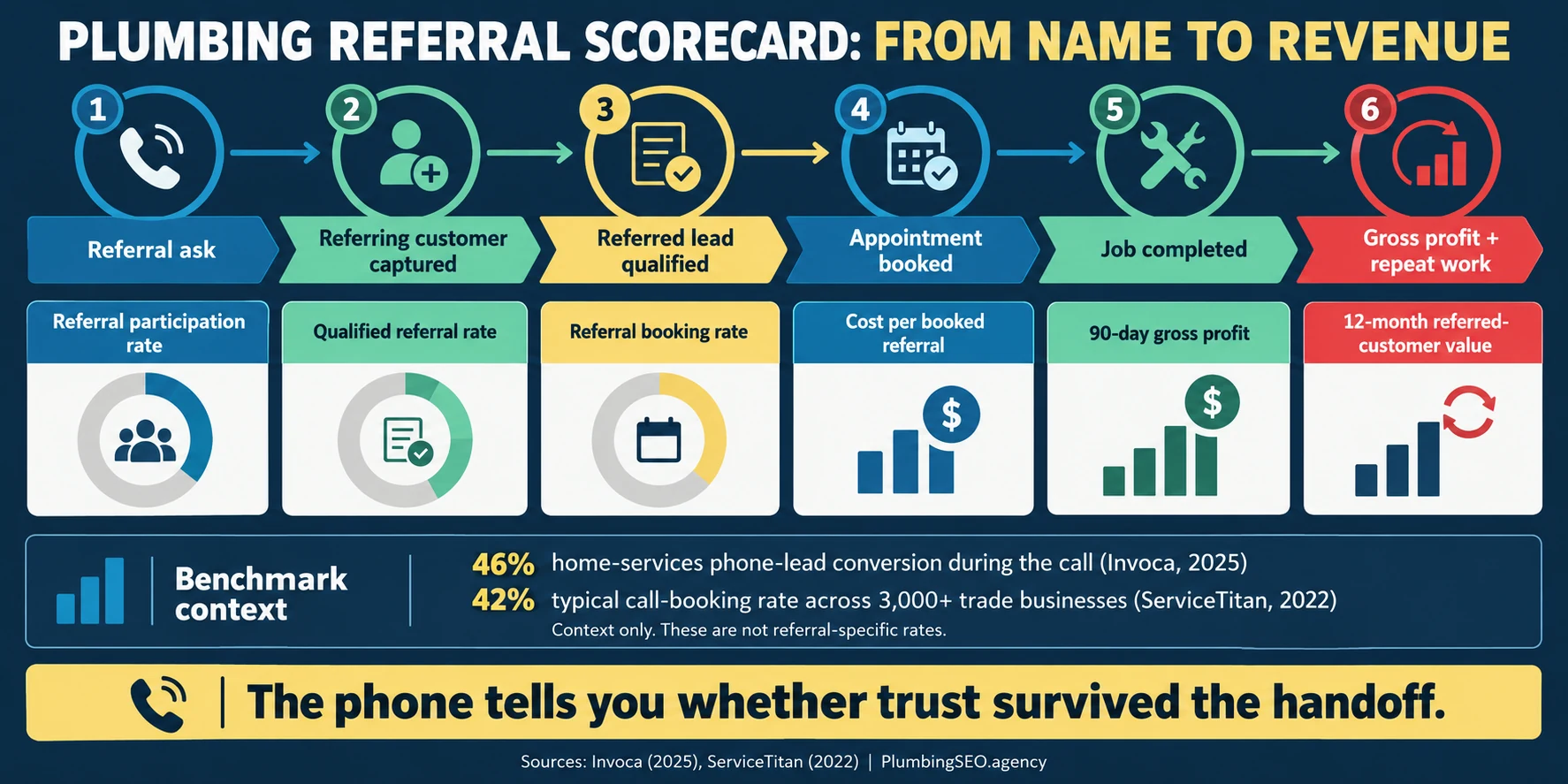
- Measure the full path: track the referring customer, the referred prospect, qualification, booking, completed revenue, gross profit, repeat work, and reward cost—not just names passed along.
For a plumbing company, word of mouth can shorten the distance between “I need help” and “call this crew.” A neighbor, relative, real estate agent, property manager, or complementary contractor transfers some of their trust to the business. That introduction is valuable, but it is not the same as a booked, profitable job.
This guide brings together 75 numbered referral marketing benchmarks from home-service surveys, recommendation-trust research, local-review studies, customer-experience research, call datasets, and digital-channel reporting. Direct plumbing-only referral studies are rare. Every table therefore labels scope, and no cross-industry percentage should be treated as a guaranteed result for one shop.
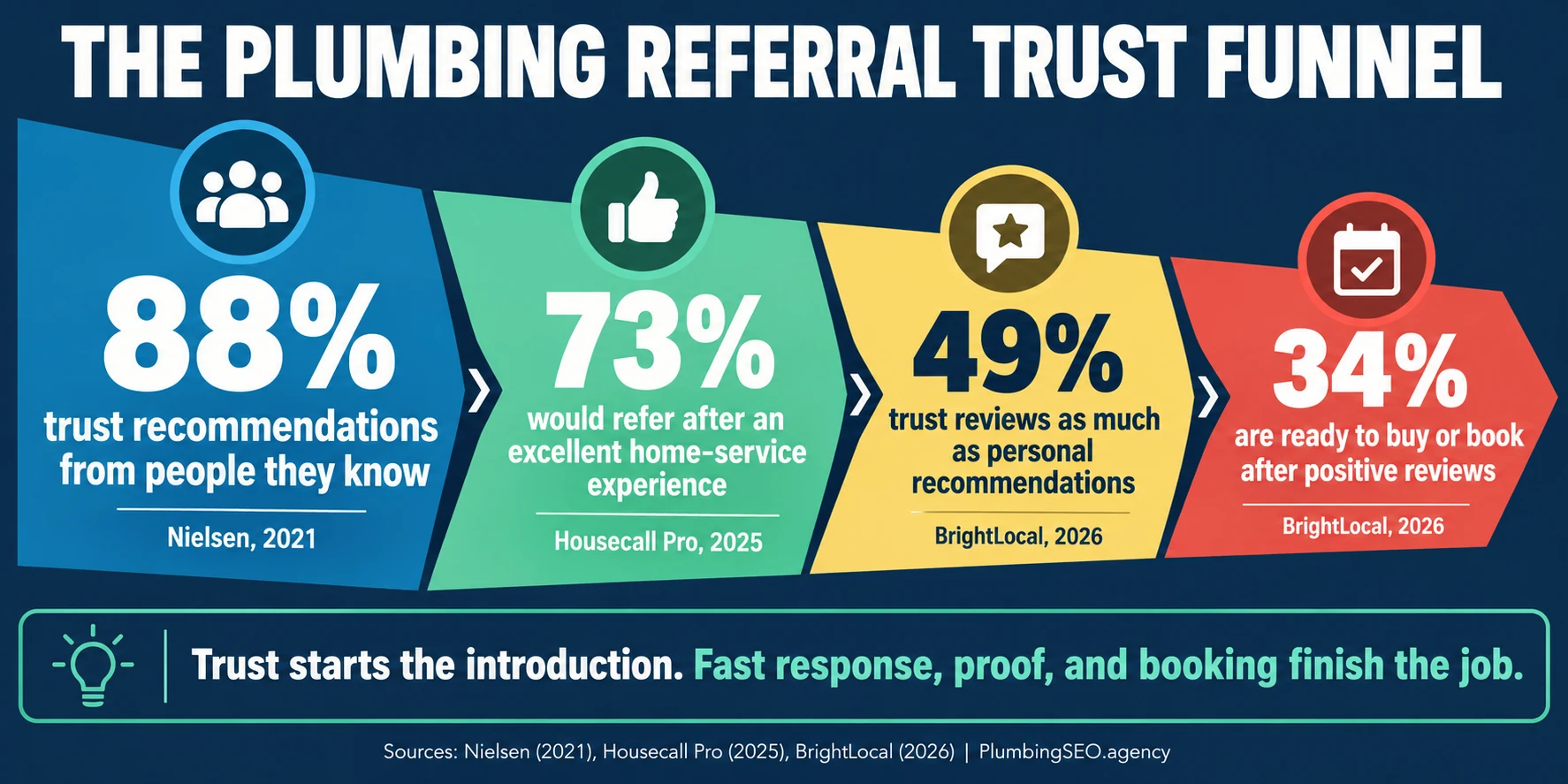
1. Referral channel and home-service demand statistics
Jobber surveyed more than 1,000 U.S. home-service business owners for its 2026 report. Respondents could report more than one lead source, so the channel percentages overlap and do not add to 100%. The useful comparison is relative prevalence—not an industry-wide attribution model.
| # | Home-service benchmark | Value | Source | Referral interpretation |
|---|---|---|---|---|
| 1 | Home-service business owners surveyed | 1,000+ | Jobber, 2026 | Survey context, not plumbing-only |
| 2 | Businesses reporting referrals as a lead source | 59% | Jobber | Highest reported source in the cited comparison |
| 3 | Businesses reporting Facebook as a lead source | 32% | Jobber | Community visibility can reinforce word of mouth |
| 4 | Businesses reporting Google Search as a lead source | 20% | Jobber | Referred prospects may still verify the company |
| 5 | Businesses reporting Google Local Services Ads as a lead source | 19% | Jobber | Paid local visibility sits beside referral demand |
| 6 | Owners expecting revenue growth | 75% | Jobber | Growth expectations raise the need for channel tracking |
| 7 | Owners expecting a significant revenue jump | 1 in 5 | Jobber | A referral target should still be capacity-aware |
| 8 | Customers expecting a same-day response | Over 70% | Jobber | Borrowed trust can disappear during a slow handoff |
| 9 | Customers expecting a response within one hour | More than half | Jobber | Route referred calls and forms to a named owner |
| 10 | Workmanship identified as a satisfaction driver | 69% | Jobber | The repair outcome earns the recommendation |
| 11 | Clear communication identified as a satisfaction driver | 32% | Jobber | Customers need an easy story to retell |
| 12 | Professional behavior identified as a satisfaction driver | 31% | Jobber | Respect inside the home affects advocacy |
Owner takeaway: ask “How did you first hear about us?” and “What made you call today?” as separate questions. A neighbor may create the demand while Google, reviews, or the website supplies the final verification. Preserve both influences in your plumbing lead CRM.
2. Recommendation, review, and trust statistics
Nielsen's figure is global advertising-trust research. BrightLocal's figures come from a 2026 U.S. local-consumer survey. Together they show two layers of referral behavior: private recommendations start with unusually strong trust, while public reputation helps the prospect verify that recommendation.
| # | Trust benchmark | Value | Source | Plumbing relevance |
|---|---|---|---|---|
| 13 | Consumers trusting recommendations from people they know above other channels | 88% | Nielsen, 2021 | Personal trust is the referral advantage |
| 14 | Consumers who read reviews for local businesses | 97% | BrightLocal, 2026 | Referrals still meet public proof |
| 15 | Consumers who always read reviews while browsing businesses | 41% | BrightLocal | Review verification is routine for many |
| 16 | Average review sites used when choosing a business | 6 sites | BrightLocal | Trust evidence is distributed |
| 17 | Consumers using Google for local reviews and recommendations | 71% | BrightLocal | Google remains a key verification surface |
| 18 | Consumers using ChatGPT or other AI tools for local recommendations | 45% | BrightLocal | Consistent business information matters beyond search |
| 19 | Consumers who will not use a business with fewer than 20 reviews | 47% | BrightLocal | A thin profile can weaken a warm introduction |
| 20 | Consumers who care about star ratings | 92% | BrightLocal | Rating is a fast trust filter |
| 21 | Consumers who will only use businesses with 4.5 stars or more | 31% | BrightLocal | Some referred prospects apply a high threshold |
| 22 | Consumers focused on reviews from the last three months | 74% | BrightLocal | Current performance matters |
| 23 | Consumers more likely to use a business after positive reviews | 85% | BrightLocal | Public proof can reinforce a referral |
| 24 | Consumers deterred by negative reviews | 77% | BrightLocal | Reputation friction can cancel borrowed trust |
| 25 | Consumers ready to buy or book after positive reviews | 34% | BrightLocal | The rest may need more research |
| 26 | Consumers trusting reviews as much as personal recommendations | 49% | BrightLocal | Reviews and private recommendations overlap |
| 27 | Consumers visiting the business website after positive reviews | 54% | BrightLocal | The website must continue the trust |
A useful referral system and a useful review system are different. Ask every eligible customer for honest feedback, avoid review gating, and respond calmly. Use our plumber review response templates to create a consistent process without turning replies into generic scripts.
3. Homeowner experience and referral-readiness statistics
Housecall Pro surveyed 1,040 U.S. homeowner decision-makers in 2025. These are reported expectations and intentions across home services, not audited plumbing transactions. They are useful because a customer recommends the whole experience: discovery, booking, arrival, communication, work proof, pricing, and closeout.
| # | Homeowner benchmark | Value | Source | Referral implication |
|---|---|---|---|---|
| 28 | Homeowner decision-makers surveyed | 1,040 | Housecall Pro, 2025 | U.S. home-service survey |
| 29 | Homeowners willing to pay more for a pro with a better service reputation | Over 70% | Housecall Pro | Reputation can support perceived value |
| 30 | Homeowners who would refer a pro after an excellent experience | 73% | Housecall Pro | Intent is high after excellence, but intent is not action |
| 31 | Homeowners factoring online booking into provider choice | 80% | Housecall Pro | A referred prospect may still compare convenience |
| 32 | Homeowners expecting a professional, user-friendly website | 96% | Housecall Pro | The website validates the recommendation |
| 33 | Millennials' likelihood versus boomers to rehire based on ease | Over 3× | Housecall Pro | Convenience affects future advocacy |
| 34 | Homeowners appreciating a technician name and photo before arrival | Nearly 60% | Housecall Pro | Pre-arrival identity reduces anxiety |
| 35 | Homeowners comfortable with AI handling initial inquiries | 53% | Housecall Pro | Automation should create a clear human next step |
| 36 | Homeowners expecting photo or video proof after work | 68% | Housecall Pro | Documented closeout gives customers proof to share |
| 37 | Homeowners saying visual work proof would be nice to receive | 28% | Housecall Pro | A separate group still values proof |
| 38 | Homeowners saying they would hire the same company again | 68% | Housecall Pro | Repeat intent supports referral potential |
| 39 | Homeowners influenced by visuals of past work | 92% | Housecall Pro | Real job evidence can help a referral convert |
| 40 | Homeowners saying instant estimates influence hiring | 93% | Housecall Pro | Price communication remains part of selection |
| 41 | Homeowners frustrated by hidden costs | 77% | Housecall Pro | Surprise charges can stop future referrals |
4. Referral value, retention, and loyalty statistics
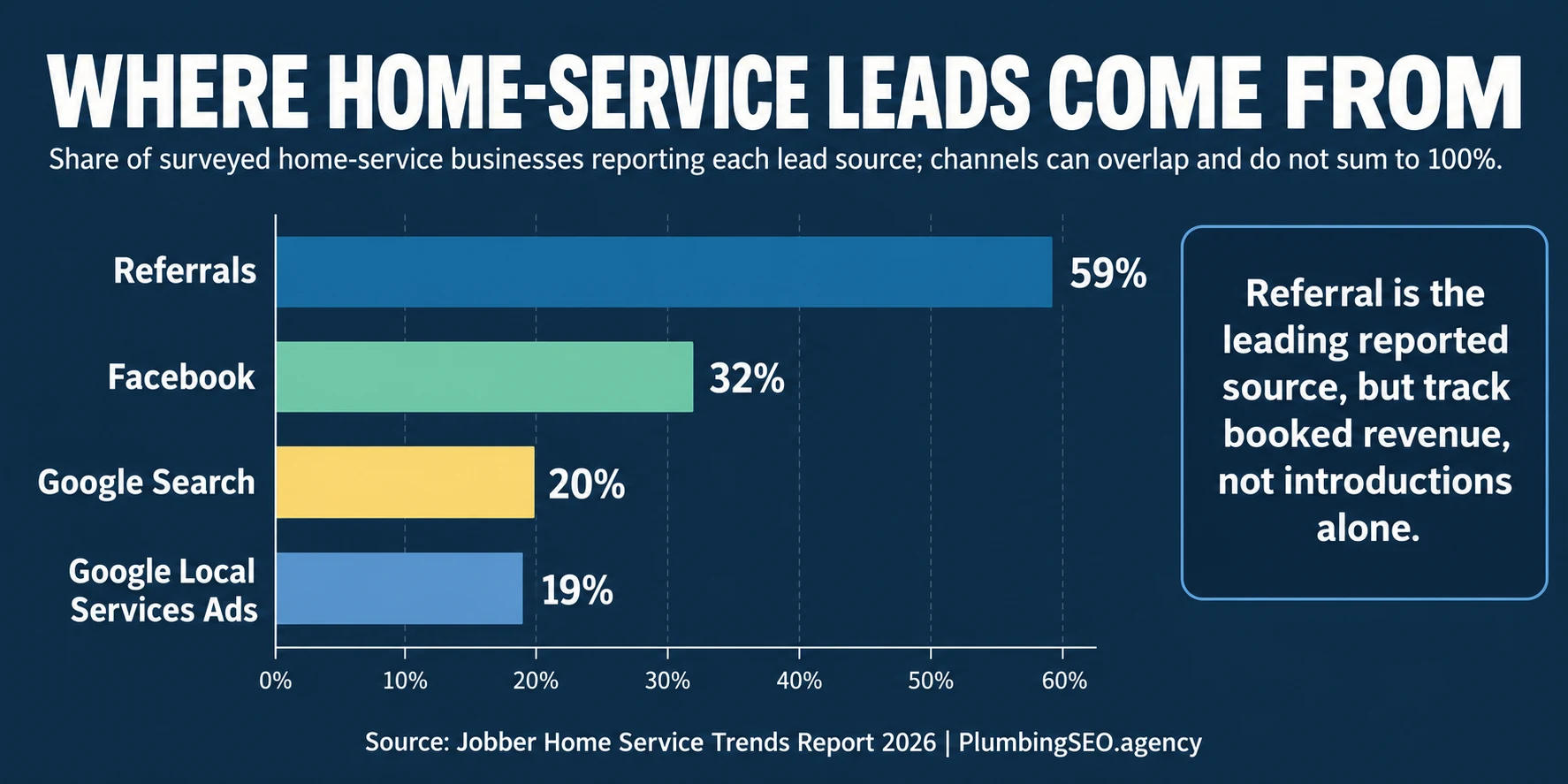
The best-known referral-economics evidence comes from a German retail-bank study reported in the Journal of Marketing and Harvard Business Review. The Bain, HBR, Adobe, and PwC figures below are also cross-industry. None is a plumbing forecast. They explain why referred-customer quality and long-term behavior deserve measurement beyond the first booked job.
| # | Value or loyalty benchmark | Value | Source | Scope warning |
|---|---|---|---|---|
| 42 | Higher lifetime value observed among referred customers | 16% | HBR / Journal of Marketing | German bank study, not plumbing |
| 43 | Lower churn observed among referred customers | 18% | HBR / Journal of Marketing | Observed program cohort |
| 44 | Retention improvement used in Bain's economics example | 5% | Bain & Company | Cross-industry scenario |
| 45 | Profit increase associated with that retention improvement | 25%–95% | Bain & Company | Range, not a guaranteed outcome |
| 46 | Frequently cited acquisition cost relative to retention cost | 5×–25× | Harvard Business Review | Broad business framing |
| 47 | Online visitors classified as returning or repeat purchasers | 8% | Adobe Digital Index | Online retail, not home services |
| 48 | Online revenue attributed to that returning or repeat group | 41% | Adobe Digital Index | Retail revenue concentration |
| 49 | Consumers saying experience is an important buying factor | 73% | PwC | Cross-industry consumers |
| 50 | Consumers who would leave a brand they love after one bad experience | 32% | PwC | Global finding |
| 51 | Consumers who would leave after several bad experiences | 59% | PwC | Repeated friction compounds |
| 52 | U.S. consumers who would leave after one bad experience | 17% | PwC | U.S. subgroup |
| 53 | Consumers willing to pay more for greater convenience | 43% | PwC | Ease can carry perceived value |
| 54 | Consumers willing to pay more for a friendly, welcoming experience | 42% | PwC | Tone is part of experience |
Compare referral cohorts with the same discipline used for plumbing customer retention: service type, first invoice, gross margin, callbacks, repeat work, review behavior, and 12-month value. A low-cost lead is not valuable if it creates poor-fit work or excessive reward expense.
5. Phone response and referral-booking statistics
A warm introduction can still leak at the phone. Invoca's 2025 reporting covers more than 60 million calls and includes a home-services segment. ServiceTitan's analysis covers more than 3,000 trade businesses. The 99 Calls study examines missed-call text-back behavior. These are not referral-specific conversion rates, so use them only as handoff context.
| # | Response or booking benchmark | Value | Source | Referral use |
|---|---|---|---|---|
| 55 | Calls included in Invoca's reporting | 60M+ | Invoca via Supply House Times, 2025 | Large cross-industry call dataset |
| 56 | Home-services phone leads converting during the call | 46% | Invoca | Home-services context, not referral-only |
| 57 | Phone leads converting during the call across industries | 37% | Invoca | Cross-industry comparison |
| 58 | Callers who spoke with a person | 61% | Invoca | Live contact remains a basic leak point |
| 59 | Calls from digital marketing that were qualified leads | 35% | Invoca | Define qualification before comparing sources |
| 60 | Range in call answer rates across measured industries | 54%–69% | Invoca | Industry range, not a target |
| 61 | Agents who asked leads to buy or book | 35% | Invoca | A trusted caller still needs a clear next step |
| 62 | Trade businesses in ServiceTitan's booking analysis | 3,000+ | ServiceTitan, 2022 | Multi-trade platform dataset |
| 63 | Typical call-booking rate in that trade-business analysis | 42% | ServiceTitan | Not a referral-specific benchmark |
| 64 | Illustrative annual revenue tied to a five-point booking improvement for shops with 5–14 technicians | About $100K | ServiceTitan | Source estimate, not a guarantee |
| 65 | Missed-call text-back messages analyzed | 14,354 | 99 Calls, 2026 | Study sample |
| 66 | Home-service businesses represented | 192 | 99 Calls | Multi-trade sample |
| 67 | Reply rate to missed-call text-back messages | 32.7% | 99 Calls | A recovery tactic, not a booking rate |
If a referred caller reaches voicemail, use routing, overflow coverage, text-back, and urgency tags. Our missed-call recovery guide for plumbers shows how to assign ownership without making promises dispatch cannot keep.
6. Digital convenience and referral-amplification statistics
Referrals do not happen only in face-to-face conversations. Customers share names in neighborhood groups, direct messages, community pages, and project-planning boards. ServiceTitan's online-booking figures show the convenience layer; Pew's survey shows potential platform reach. Platform use does not mean a person is looking for a plumber.
| # | Digital benchmark | Value | Source | Practical meaning |
|---|---|---|---|---|
| 68 | Consumers reported as expecting to book online | 70% | ServiceTitan, 2024 | Give referred prospects a monitored digital path |
| 69 | New-contractor shoppers more likely to choose one offering online booking | 94% | ServiceTitan | Convenience can influence provider choice |
| 70 | Online appointments booked in the source's platform context | 500,000+ | ServiceTitan | Platform scale, not a typical shop result |
| 71 | Revenue attributed to those online appointments | $30M+ | ServiceTitan | Source-wide total, not referral revenue |
| 72 | U.S. adults who say they use YouTube | 85% | Pew Research Center, 2024 survey | Searchable education and proof |
| 73 | U.S. adults who say they use Facebook | 70% | Pew Research Center | Community groups and repeat audiences |
| 74 | U.S. adults who say they use Instagram | 50% | Pew Research Center | Shareable jobs, crews, and project proof |
| 75 | U.S. adults who say they use Pinterest | 35% | Pew Research Center | Remodeling and fixture-planning context |
Make the company easy to share: use a stable business name, consistent phone number, clear service area, memorable domain, and service pages that explain the work. A referral link should help the new prospect verify the recommendation, not send them to a vague homepage with no next step.
How to build a measurable plumbing referral program
A referral program does not have to begin with points, apps, or discounts. It begins with a reliable service experience and a consistent way to recognize introductions. Add incentives only after the company can attribute and fulfill them without confusing customers.
1Choose eligible moments
Ask after a completed, paid job when the customer has confirmed satisfaction. Pause the ask after callbacks, disputes, unresolved damage, or unclear outcomes.
2Make sharing easy
Give the customer one memorable instruction: share the company name, direct phone number, short referral link, or contact card. Avoid a multi-step process.
3Capture both people
Record the referring customer's ID and the referred prospect's ID. Preserve consent and avoid adding either person to marketing lists without a lawful basis.
4Define the conversion
Separate introductions, qualified leads, appointments, completed jobs, and collected revenue. Decide whether a reward is earned at booking, completion, or payment.
5Close the loop
Thank the referring customer without revealing private details about the new customer's job. Deliver any promised reward accurately and on time.
6Review quality monthly
Compare service mix, average ticket, gross margin, cancellation, callback, repeat work, and complaints by source. Stop incentives that attract poor-fit work.
Referral metrics worth tracking
Use plain source codes such as customer referral, trade partner, realtor, property manager, neighborhood group, and employee referral. Add campaign tags only where they help attribution. Do not overwrite the human source because the prospect later clicked a Google result.
Summary of all 75 referral marketing statistics
| Rows | Category | Count | Primary sources | Best use |
|---|---|---|---|---|
| 1–12 | Home-service lead channels and demand | 12 | Jobber | Channel mix and experience drivers |
| 13–27 | Recommendation, review, and trust | 15 | Nielsen, BrightLocal | Trust and verification path |
| 28–41 | Homeowner experience | 14 | Housecall Pro | Referral readiness and service design |
| 42–54 | Value, retention, and loyalty | 13 | HBR, Journal of Marketing, Bain, Adobe, PwC | Cohort economics and limitations |
| 55–67 | Phone response and booking | 13 | Invoca, ServiceTitan, 99 Calls | Referral handoff and recovery |
| 68–75 | Digital convenience and reach | 8 | ServiceTitan, Pew Research Center | Booking and referral amplification |
Methodology and source inventory
This article was published October 21, 2026. The promised total is the 75 numbered table rows only. Hero cards, infographic labels, formulas, summary rows, and FAQ answers do not inflate the count. We prioritized original survey publishers, established research organizations, first-party platform analyses, and sources with visible scope.
No public dataset in this inventory establishes a universal referral rate, close rate, acquisition cost, or lifetime value for U.S. plumbing companies. Home-service figures combine trades. Recommendation-trust, retention, and customer-experience research is broader still. Use each statistic with its population and definition attached.
- Jobber Home Service Trends Report (2026) — survey of more than 1,000 U.S. home-service business owners covering lead sources, demand, response, and satisfaction.
- Nielsen Trust in Advertising (2021) — global recommendation and advertising-trust research.
- BrightLocal Local Consumer Review Survey (2026) — U.S. local-review discovery, trust, count, rating, recency, and next-action behavior.
- Housecall Pro Home Service Customer Service Report (2025) — online survey of 1,040 U.S. homeowner decision-makers.
- Harvard Business Review: Why Customer Referrals Can Drive Stunning Profits — summary of a referred-customer study published in the Journal of Marketing.
- Journal of Marketing: Referral Programs and Customer Value — underlying academic study on value and churn in a German bank program.
- Bain & Company retention economics — cross-industry retention and profit framing.
- Harvard Business Review: The Value of Keeping the Right Customers — acquisition-versus-retention cost context.
- Adobe Digital Index: The ROI from Marketing to Existing Online Customers — repeat-visitor and retail-revenue concentration.
- PwC Future of Customer Experience — cross-industry buying, convenience, experience, and customer-loss research.
- Invoca call benchmarks via Supply House Times (2025) — reporting based on more than 60 million calls.
- ServiceTitan Call Booking Rate Analysis (2022) — platform analysis of more than 3,000 trade businesses.
- 99 Calls Missed-Call Text-Back Study (2026) — 14,354 messages across 192 home-service businesses.
- ServiceTitan Online Booking Research (2024) — contractor booking expectations and platform-scale context.
- Pew Research Center Social Media Fact Sheet — stated social-platform use among U.S. adults.
- FTC Endorsement Guides FAQ — first-party disclosure guidance for material connections.
- Google Maps user-contributed content policy — first-party rules covering fake engagement and incentivized review content.
- Google Business Profile review guidance — first-party guidance for requesting and replying to reviews.
- Salesforce State of the Connected Customer — supporting cross-industry context on trust and connected service.
Plumbing referral marketing statistics FAQ
Jobber's 2026 survey found that 59% of surveyed home-service businesses reported referrals as a lead source, ahead of Facebook, Google Search, and Local Services Ads in that comparison. The channels overlap, and the finding is not a plumbing-only attribution rate.
Ask after value is clear: the work is complete, the outcome has been explained, the property is clean, billing questions are resolved, and the customer has confirmed satisfaction. Pause referral requests when a callback, complaint, or unresolved concern remains open.
One German retail-bank study reported 16% higher lifetime value and 18% lower churn among referred customers. That is credible evidence from a different industry, not a universal plumbing benchmark. Measure first-job margin, repeat work, callbacks, and 12-month value in your own shop.
It can, but rewards are not required. Begin with a reliable experience, a simple sharing method, attribution, clear eligibility, and accurate fulfillment. Keep referral rewards separate from review requests, publish the terms, and disclose material connections where required.
Choose one definition and keep it stable. Referral booking rate is booked referred jobs divided by qualified referred leads. Also report contact rate, completed-job rate, collected revenue, gross profit, reward cost, and repeat work so one percentage does not hide lead quality.
No. A referral is an introduction or recommendation from a person or partner. A review is public feedback on a platform. They reinforce each other: BrightLocal found 49% trust reviews as much as personal recommendations, but each has different policies, attribution, and measurement.
Are referred prospects checking your plumbing company and finding leaks?
We can review the local visibility, website trust, call path, service pages, and tracking that help recommendations turn into booked plumbing work.
Run My Free SEO Leak Check