
- If your plumber website is not ranking, fix the closest leak first: crawl/index status, local fit, service-page quality, or call readiness.
- A pretty website does not earn calls by itself. Google has to discover it, trust the business, match it to local searches, and see that customers can act fast.
- Before hiring SEO help, ask for a plain diagnostic that ties each fix to calls, booked jobs, and the service areas you actually want.
If your plumber website is not ranking, the problem usually is not one magic SEO setting. It is usually a leak somewhere between Google finding the page and a homeowner choosing your shop over the next one.
That matters because rankings are not the real prize. The real prize is the phone ringing with the right jobs in the right service area. Search and Maps are just the roads customers use to get there.
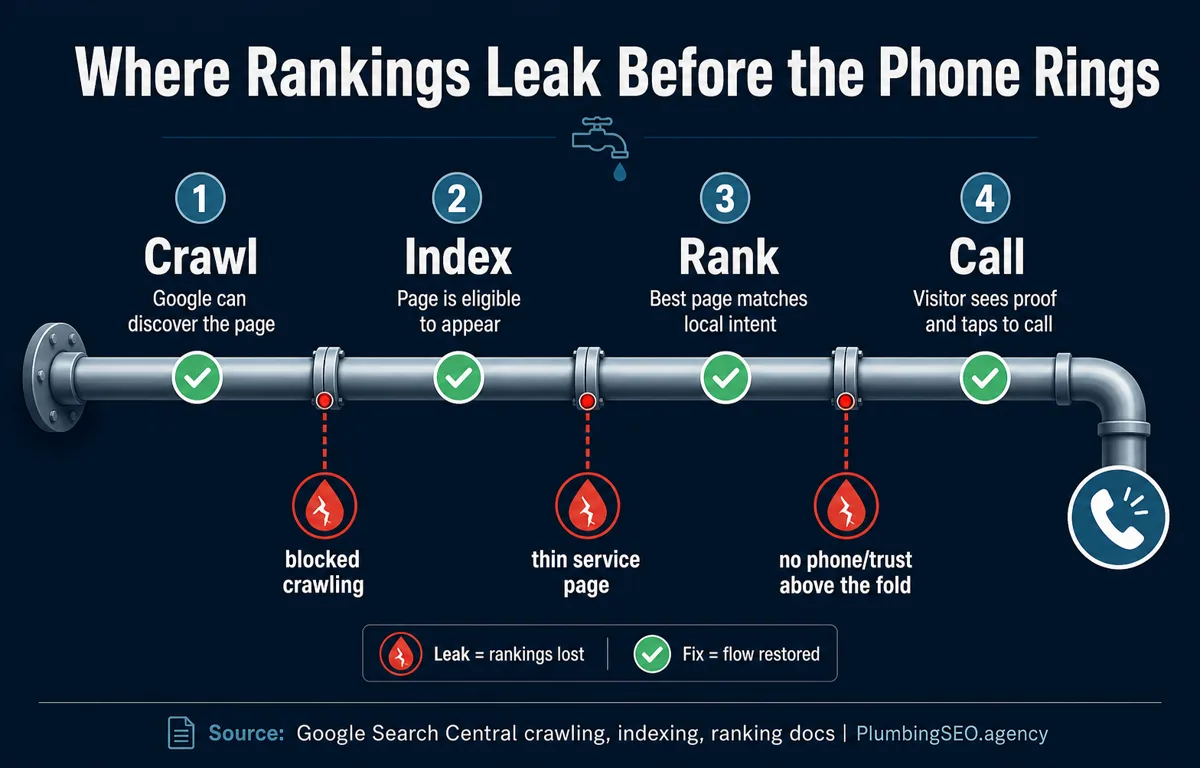
Here is the way I look at it. A plumbing website has to pass four checks before it can turn into booked work: Google can crawl it, Google can index it, Google can rank the right page for the right local search, and the visitor can quickly trust you enough to call.
First, make sure Google can find and keep the page
Start with the boring stuff. Boring saves money. Google explains that Search works through crawling, indexing, and ranking. If your important plumbing pages fail in the first two steps, no amount of clever copy will make them pull calls.
Open Google Search Console and inspect the exact URL you care about. Do not only check the homepage. Check the drain cleaning page, water heater page, sewer repair page, emergency plumber page, and your main city pages. Look for whether the page is indexed, whether Google chose a different canonical, whether crawling is blocked, and whether the sitemap includes the page.
If you want the official version, Google has a plain explanation of how Search crawls, indexes, and ranks pages. The short version for a plumbing owner is this: if Google cannot reach the page, understand the page, or decide it belongs in the index, customers will not see it when the sink backs up.
Fix these before you rewrite everything
- Make sure important pages are not blocked by robots.txt or a noindex tag.
- Submit a clean XML sitemap and include every page that should bring service calls.
- Check canonical tags so Google does not send signals to the wrong URL.
- Repair broken internal links and redirects that waste crawl paths.
- Make sure the page loads normally without a pile of script errors.
For a deeper step-by-step check, keep our plumbing website indexing checklist open while you inspect your highest-value pages.
Second, check whether Google understands where and what you serve
A plumber website can be technically fine and still not rank because the local fit is fuzzy. Google does not just ask, "Is this a plumbing company?" It also has to figure out which services you perform, which area you serve, and whether your business looks prominent enough to show above other shops.
Google Business Profile Help names three big local ranking ideas: relevance, distance, and prominence. For plumbers, those three show up in very practical ways.
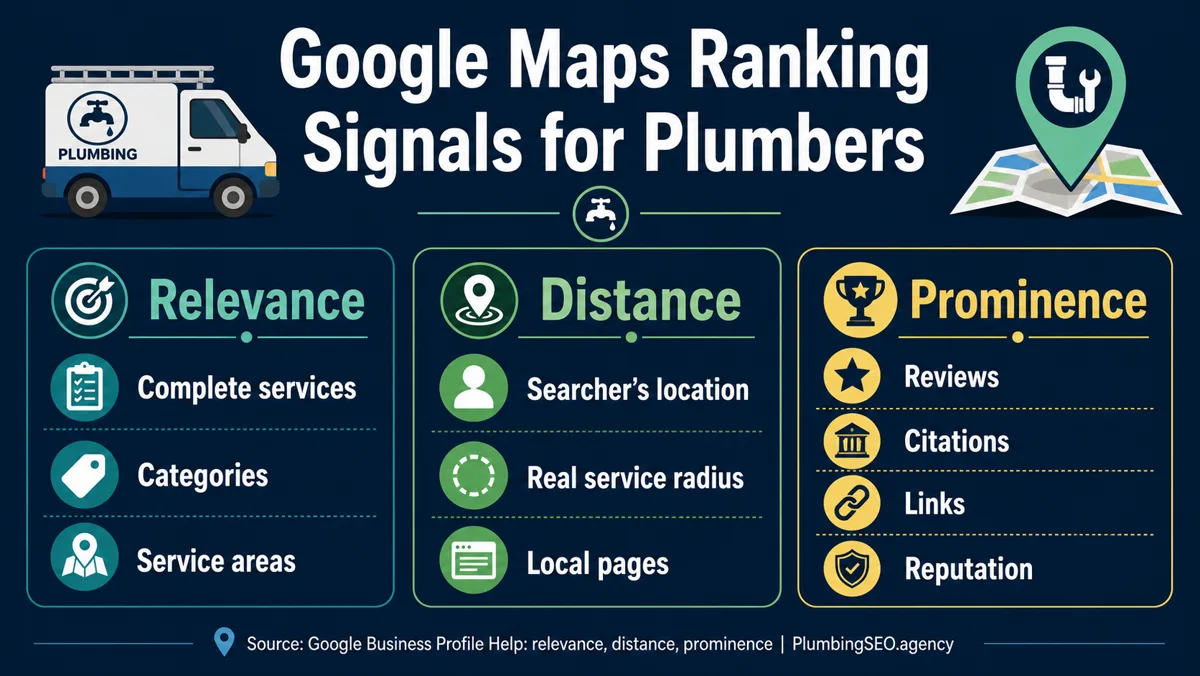
Relevance means your website and Business Profile clearly match the job. If you want water heater replacement calls, you need a real water heater replacement page. If you want emergency calls, that service needs to be obvious. Google should not have to guess. Customers should not have to guess either.
Distance means location still matters. A single homepage trying to rank across every city in a county usually runs out of road. You may need service-area pages, but they have to be useful pages with local proof, not copy-paste city swaps. The copy should explain what you do in that area, what nearby customers usually need, and how fast you can respond.
Prominence means your business looks real and trusted around the web. Reviews, citations, local links, photos, and brand mentions all help. If your website says one phone number, your directories show another, and your Business Profile has old hours, you are asking Google to trust a story with missing pages.
Google's own guide to improving local ranking is worth reading because it keeps the focus where it belongs: complete information, accurate business details, and real-world prominence.
Third, look at the page that should be ranking
This is where a lot of plumbing websites leak calls. The owner asks, "Why is my website not ranking?" but the real question is, "Which page should rank for which job?"
If the homepage is trying to rank for every service, every city, and every emergency, it gets stretched thin. If ten city pages all say almost the same thing, Google may not know which one deserves the call. If blog posts rank instead of service pages, the visitor may learn something but never book the job.
| Symptom | What it usually means | Fix first |
|---|---|---|
| Homepage ranks weakly for everything | No dedicated service intent or weak internal links | Build or strengthen the service pages that drive calls |
| Wrong page shows in Search Console | Google is confused about the best URL | Fix page titles, headings, canonicals, and internal anchors |
| City pages exist but do not move | Thin local copy or duplicated area pages | Add local proof, services, reviews, and unique details |
| Traffic exists but calls stay quiet | The page does not build trust or make calling easy | Improve above-the-fold proof, phone visibility, and offer clarity |
In my opinion, this is the biggest difference between an SEO report and a useful repair plan. A report says "optimize pages." A useful plan says "this drain cleaning page should own drain cleaning calls in these towns, and these three internal links need to point to it." One is a fog machine. The other helps dispatch.
Fourth, make sure the content is actually helpful to a homeowner
Google's helpful content guidance says content should be made for people first. For plumbers, that does not mean writing a 2,500-word essay on what a pipe is. It means the page answers the real customer questions before they call.
A useful plumbing service page usually answers:
- Do you handle this exact problem?
- Do you serve my area?
- Can I call now, and what happens next?
- What proof shows you have done this work before?
- What should I do if this is urgent?
- What factors affect price, timing, or repair options?
That kind of content helps ranking because it helps the customer. It also gives your office fewer tire-kicker calls because the page does some of the explaining before the phone rings.
Google's helpful content guidance is not plumbing-specific, but the lesson fits the trade: write pages that help the person with the problem, not pages that only exist because somebody wanted another keyword.
Fifth, test the mobile path like a customer with water on the floor
Most emergency plumbing searches do not happen from a calm desk with coffee and a 27-inch monitor. They happen on a phone. The customer is annoyed, the floor is wet, and your competitor is one tap away.
Google's AdSense Help documentation says its research found that 53% of visits are likely to be abandoned if pages take longer than 3 seconds to load. That is not just a web performance stat. For a plumber, it is a missed call window.
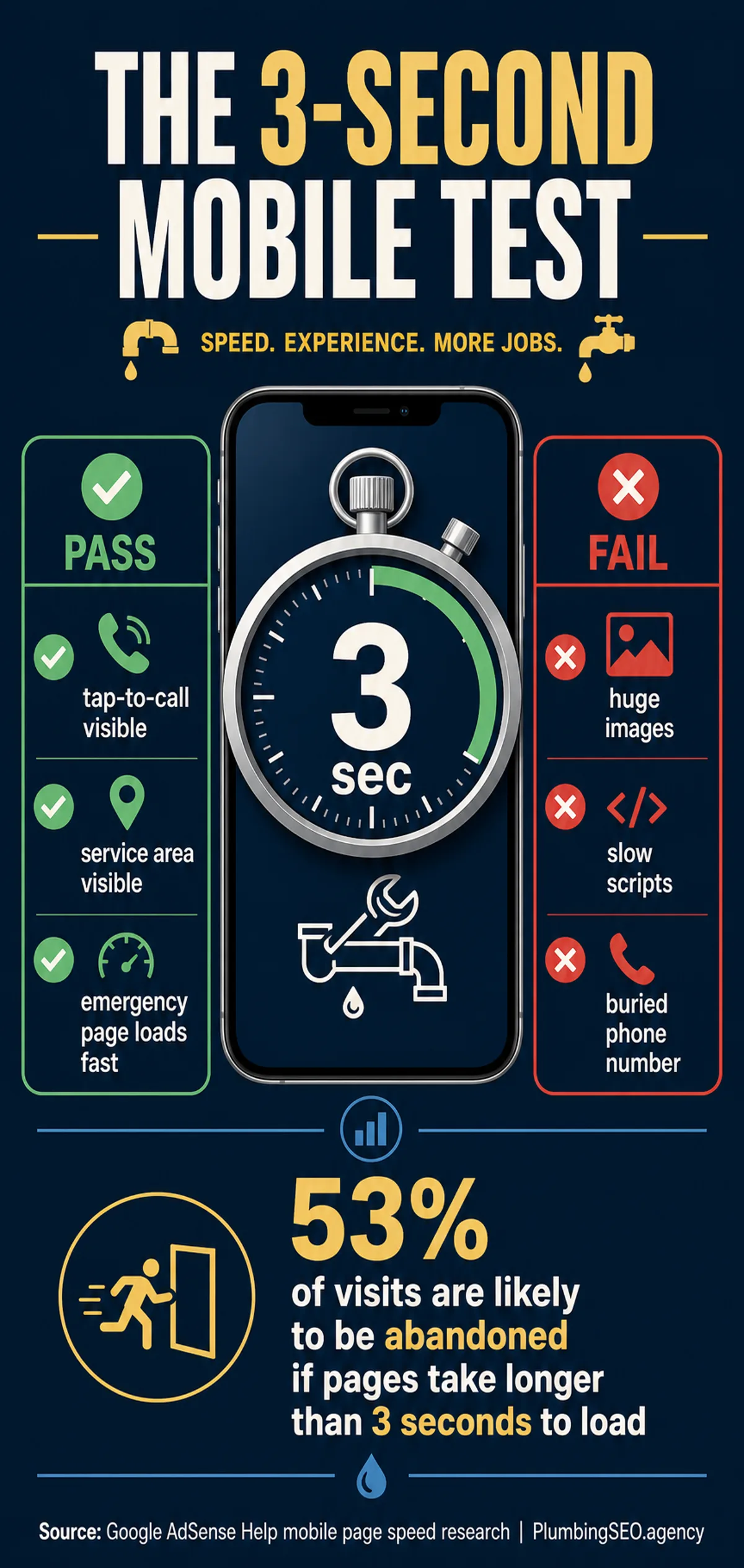
Do this from your own phone, not only a desktop tool. Search for your main service. Tap your result. Count how long it takes before you can see the phone number, service area, and reason to trust you. Then tap the number. If any of that feels clunky, fix it.
If speed is one of your weak spots, our plumber website speed guide breaks down what to clean up without turning the site into a science project.
Sixth, separate ranking problems from call problems
Sometimes the website is ranking, but it is not earning calls. That is a different leak. Do not let an agency sell you more rankings when the page is already getting visitors who leave without calling.
Check Search Console, call tracking, form submissions, and recorded lead sources together. If impressions are rising but calls are flat, look at trust and conversion. If calls are rising from the wrong towns, look at service-area targeting. If Maps gets views but no action, look at reviews, photos, categories, and Business Profile completeness.
Our broader plumber SEO diagnostic checklist is useful when the problem spans both Maps and organic search. This page is focused tighter on the website leaks that stop rankings and calls before you spend more.
The 11 fixes I would check before hiring SEO help
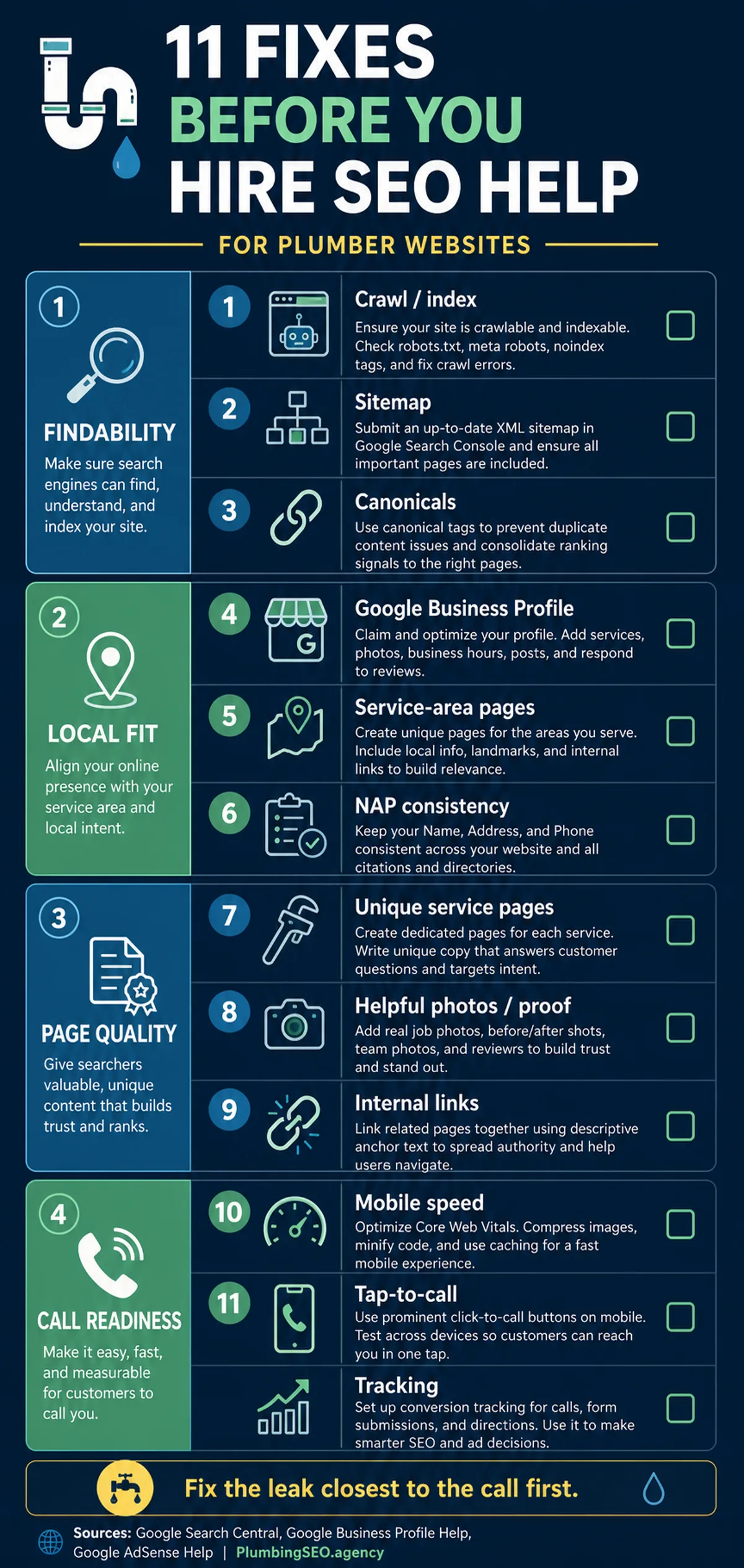
If I owned the shop and the phone was too quiet, I would not start by asking for a 40-page SEO proposal. I would ask for this repair list, in order, with evidence for each item.
Fix now
Indexing blockers, wrong canonicals, missing phone visibility, broken service pages, bad Business Profile details, and slow mobile pages.
Fix next
Internal links, local proof, reviews, citations, service-area depth, job photos, FAQ improvements, and call tracking cleanup.
Once those basics are covered, then talk about content strategy, links, new pages, and bigger SEO work. That is when SEO for plumbers can become a growth channel instead of another monthly bill you are hoping will work.
When you should get help instead of fixing it yourself
You can check plenty of this on your own. You do not need a vendor to tell you whether your phone number is buried, your service pages are thin, or your Business Profile has old hours.
Get help when the problem crosses into technical diagnosis, page mapping, content consolidation, analytics, or local ranking strategy. That is where mistakes get expensive. Moving the wrong page, deleting a URL that already has signals, or creating duplicate city pages can set you back longer than a slow week.
The right help should make the problem clearer. It should show the URLs, the search terms, the service areas, the calls, and the order of repairs. If all you get is jargon, screenshots, and promises, keep your wallet in your pocket. You have enough leaks to chase already.
Frequently Asked Questions
Your plumber website may not rank because Google cannot crawl or index important pages, the pages do not match local service intent, your Business Profile signals are weak, the site is slow on mobile, or the wrong page is competing for the keyword.
It depends on the market, competition, site history, and quality of the fixes. Simple indexation or mobile issues can show improvement faster. Competitive service and city rankings usually need steady work across pages, reviews, local proof, and links.
Your homepage should usually carry the broad company-level offer, while dedicated service pages should rank for specific jobs such as drain cleaning, water heater repair, sewer repair, and emergency plumbing in relevant locations.
Yes. A site can look polished and still have thin pages, slow mobile load time, weak internal links, missing local proof, bad canonicals, or unclear service-area signals. Google and customers need usefulness, trust, and speed, not just design.
Check whether key pages are indexed, whether the right pages target the right services, whether your Business Profile is complete, whether mobile visitors can tap to call fast, whether reviews and citations are consistent, and whether call tracking proves which pages generate jobs.
Reviews help local prominence and customer trust. They do not replace strong service pages or technical basics, but they support Maps visibility and can improve the chance that a searcher chooses your company when you appear.
Want the leak check done for you?
We will look at the pages, Maps signals, mobile path, and call tracking that decide whether your plumbing website turns searches into booked jobs.
Run My Free SEO Leak Check