
- Your Google Business Profile service area helps customers understand where you work, but Maps rankings still lean hard on relevance, distance, and prominence.
- To win suburbs outside your main city, build useful suburb pages with real proof, not copy-paste doorway pages with the city name swapped.
- The fastest practical stack is a clean GBP, a service-area hub, suburb proof, local reviews, local links, and call tracking by town.
If your plumbing company is based in one city but the good calls are coming from the suburbs around it, SEO can feel unfair. You will drive 35 minutes for a water heater replacement, but Google may still act like your truck is bolted to the shop floor.
Here is the practical truth. You can rank in suburbs outside your main city, but not by pretending you have offices everywhere. You do it by proving where you actually work, building pages that help customers in those towns, and making your local signals stronger than the shops sitting closer to the searcher.
This is where a lot of plumbing SEO goes sideways. Somebody builds twenty thin city pages, swaps the town name, adds a stock photo of a wrench, and calls it a strategy. That is not local SEO. That is a slow leak with a nice invoice.
The Main Problem: Google Does Not Rank Service Areas Like a Dispatch Board
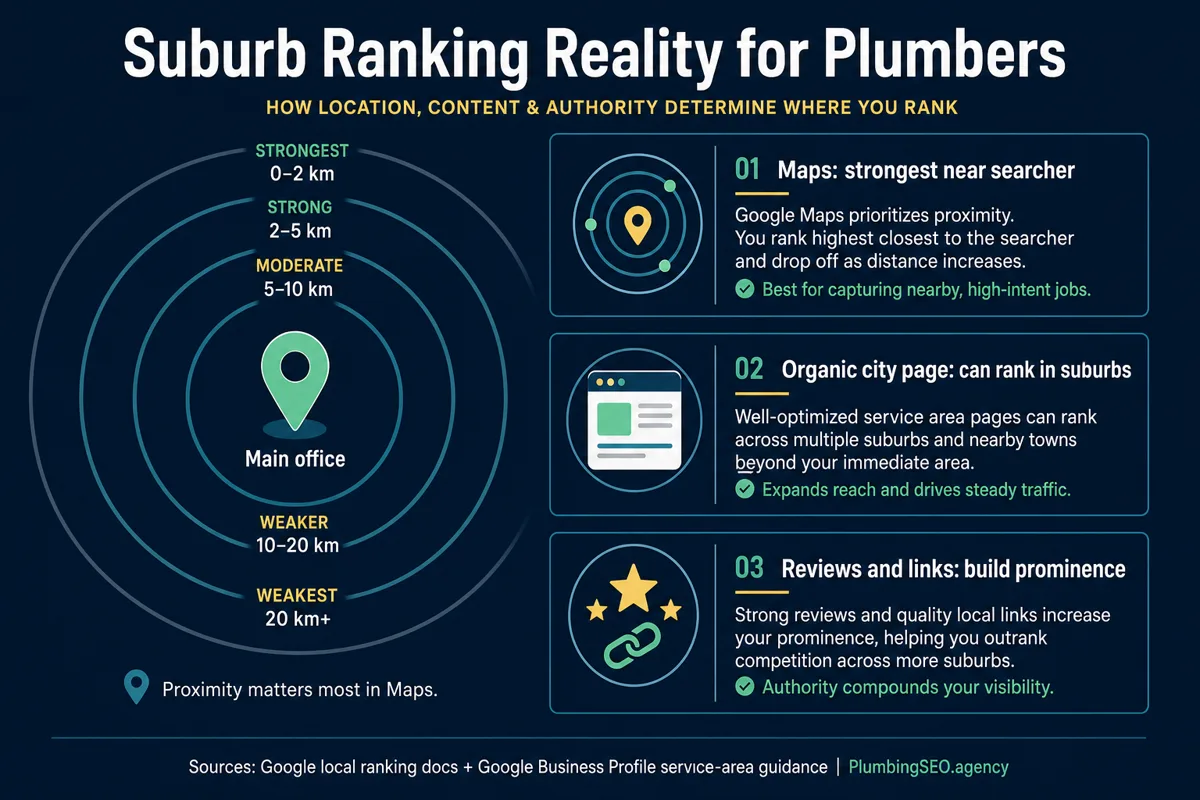
A plumbing owner thinks in drive time. Google thinks in relevance, distance, and prominence. Google says local results are mainly based on relevance, distance, and prominence. That means your willingness to serve a suburb is only one part of the picture.
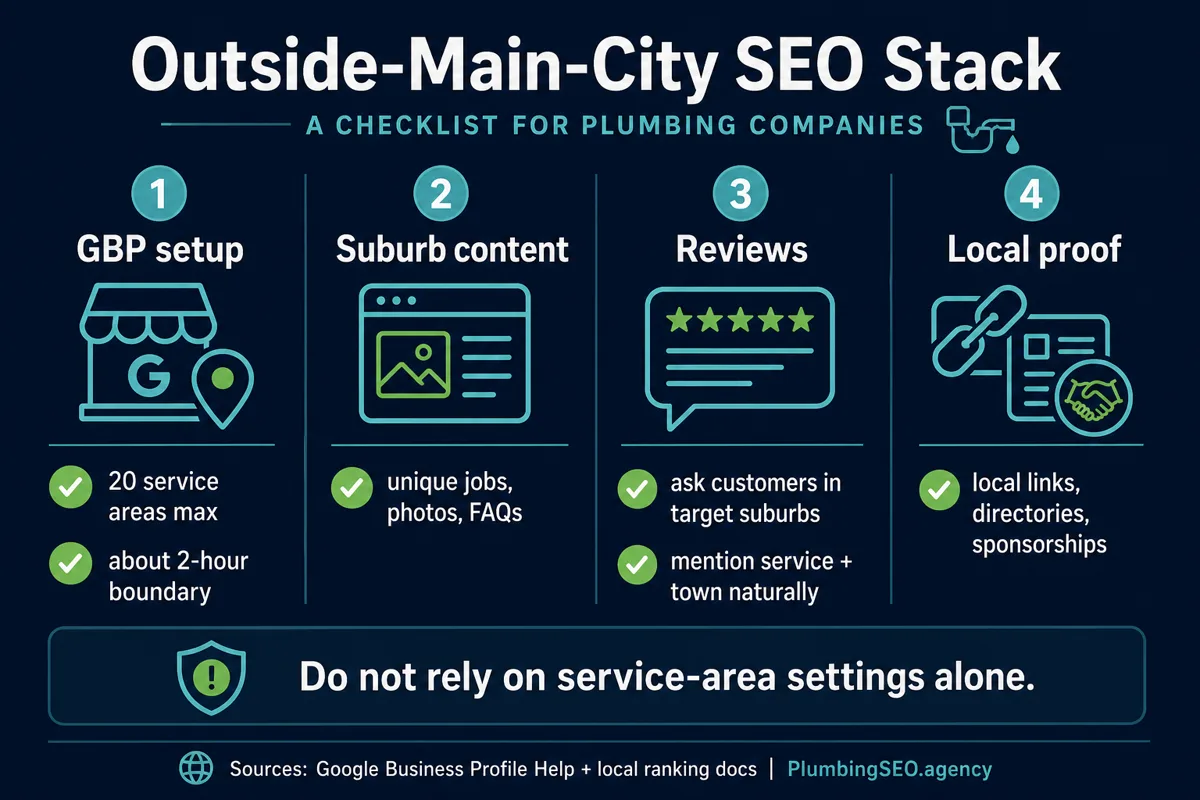
Your Google Business Profile service-area settings matter because they tell customers where you work. Google says service-area businesses like plumbers can set cities, postal codes, or other areas, with up to 20 service areas, and the overall boundary should usually stay within about two hours of where the business is based. It also says you cannot set the service area as a radius anymore.
But service areas are not a magic switch. Listing a suburb in GBP does not mean you suddenly outrank every plumber physically closer to that searcher. Maps is still a proximity-heavy animal. Organic pages, reviews, links, and website content are where you can earn more suburb visibility over time.
Start With the Suburbs That Can Actually Pay You Back
Do not build suburb SEO around every place you are willing to drive. Build it around places that make business sense. A suburb is worth targeting when it checks at least three boxes: you already serve it, the jobs are profitable, the drive time works, and customers there search for the services you want more of.
For example, if your shop is in the main city but your best water heater installs come from two higher-income suburbs, those suburbs deserve attention before a tiny town where you only take emergency calls twice a year.
Pick the first five to ten suburbs like you would pick jobs for a packed Friday. You want the routes, margins, and call types that keep the trucks moving, not just a longer list on the website.
Build One Strong Service-Area Hub Before You Build Suburb Pages
Before you create individual suburb pages, make sure your main local SEO page explains the service area clearly. A good hub page should list the core cities and suburbs, explain what plumbing services you provide there, show how far you travel, and link to the most important supporting pages.
For PlumbingSEO, that hub is the local SEO for plumbers service page. For a plumbing company, the equivalent might be a page called "Local Plumbing Services" or "Service Areas" that customers and Google can both understand.
Then, when a suburb deserves its own page, the page has somewhere logical to live. The structure should feel like a clean parts shelf, not a box of fittings dumped on the floor.
| Page type | When to use it | What it must prove | Risk if done badly |
|---|---|---|---|
| Service-area hub | Every plumber serving multiple towns or suburbs | Where you work, what you do, how customers book | Low, if helpful and accurate |
| Suburb page | Priority suburb with real jobs, reviews, photos, or demand | Unique local proof and service detail for that suburb | Medium, if pages become thin or repetitive |
| Service plus suburb page | High-value services in high-value suburbs | Specific service intent, not just a town name | High, if multiplied without substance |
What Makes a Suburb Page Useful Instead of Doorway Risk
Google warns against doorway abuse, including pages targeted at specific regions or cities that funnel users to one destination, and substantially similar pages made mostly to catch search traffic. That matters for plumbers because city and suburb pages are easy to abuse.
A safe suburb page should help a homeowner decide whether you are the right plumber for that area. It should not be a duplicate page with "Main City" replaced by "North Suburb." Google is not the only one that notices thin pages. Customers do too.
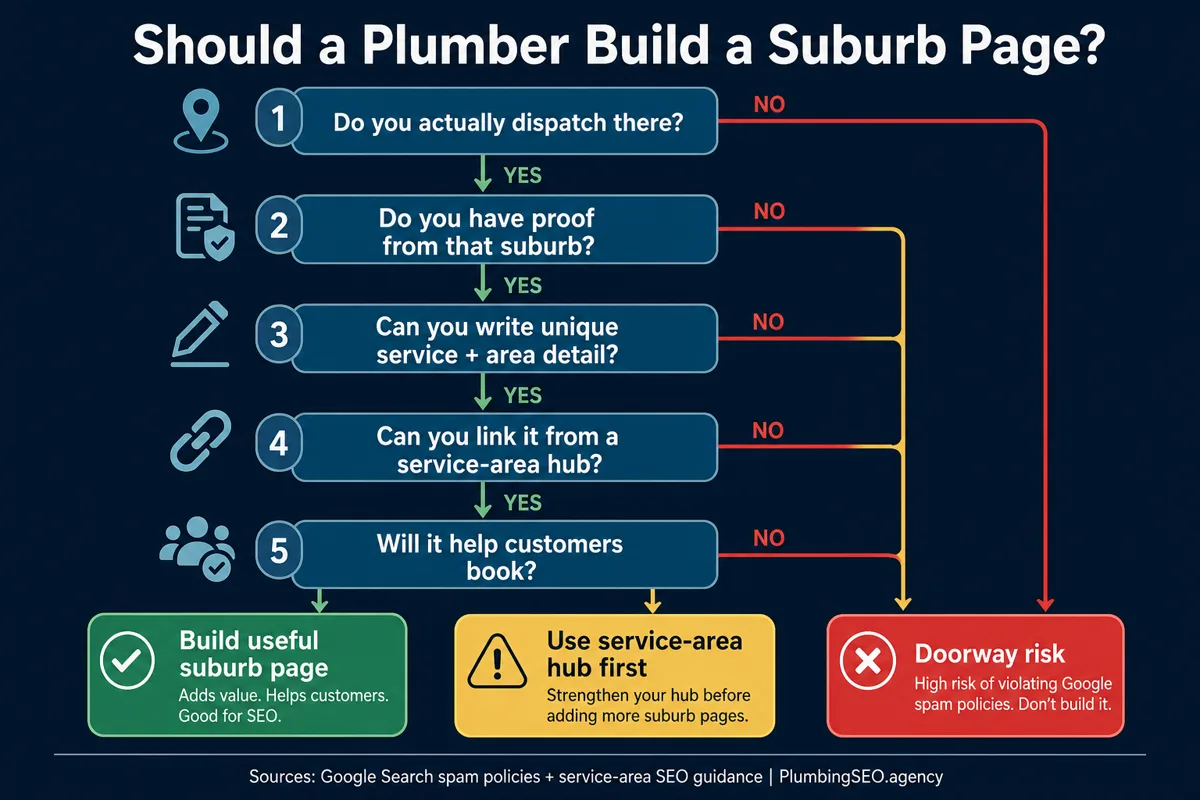
A strong suburb page includes:
- Real services you provide in that suburb, such as drain cleaning, slab leak detection, water heater replacement, or emergency plumbing.
- Specific dispatch details, including neighborhoods, roadways, landmarks, or common property types you actually serve.
- Photos from nearby jobs when available, with descriptive alt text.
- Reviews from customers in or near that suburb, when you have permission and the review is public.
- FAQs that match the area, such as older homes, hard water, septic, basements, crawlspaces, high-rise condos, or storm-related calls.
- A clear call button, not a maze of internal links.
If you cannot write that page without making things up, do not build it yet. Get more proof first. Take job photos. Ask for reviews. Track which towns produce booked work. Then write the page when you have something useful to say.
Reviews Are the Suburb Signal Most Plumbing Companies Underuse
Google tells businesses to respond to reviews because positive reviews and helpful replies can help the business stand out. For suburb SEO, reviews can also reinforce where you actually work.
Do not coach customers to stuff keywords. That looks bad and reads worse. But it is fair to ask happy customers to mention the service they received and the town if it is natural. A review that says "They replaced our water heater in Plano and cleaned up after themselves" is more useful than "Great company." It helps future customers trust you, and it gives Google another real-world clue.
If reviews are a weak spot, use a simple process from our plumber review response templates and make suburb proof part of the office workflow. The tech finishes the job, the office sends the request, and the owner is not trying to remember it at 9 p.m.
Set Up Google Business Profile the Right Way
Your GBP should match how the company really operates. If customers do not come to your address, Google says service-area businesses should remove the address from the profile. If you have a staffed storefront or office with signage and customers can visit, that is different.
For suburb SEO, check these basics first:
GBP trust basics
- Correct primary category, usually plumber or plumbing service.
- Accurate hours, phone, services, and booking link.
- Service areas listed by real cities or postal codes.
- Photos from trucks, jobs, team, equipment, and real work.
Service-area settings alone
- They do not override distance in Maps.
- They do not replace suburb pages.
- They do not create local prominence.
- They do not prove you deserve to rank in every town.
If your GBP categories are uncertain, start with the basics in Google Business Profile categories for plumbers. Categories are not exciting, but neither is checking a shutoff valve. You still do it because it matters.
Build Local Proof in the Suburbs You Want
Prominence is the part most plumbing companies forget. If another plumber is closer to the searcher, your proof has to work harder. Local proof can include chamber listings, local sponsorships, supplier mentions, neighborhood association pages, local news, partnerships, and citations that match the suburb.
This does not mean buying a pile of junk directory links. It means becoming easier to verify. If you sponsor a Little League team in a target suburb, help at a community event, or join a local trade association, make sure the web reflects it. If your trucks are already there every week, your online footprint should not look like you never leave the main city.
Track Calls by Suburb, Not Just Rankings
Ranking in a suburb is only useful if it produces the right calls. Track form fills, calls, and booked jobs by town. If a suburb page gets traffic but only sends price shoppers outside your service radius, it may need better copy or it may not be worth pushing.
I would rather see a plumber rank third in a suburb and book two good jobs than rank first for a town that sends long drives and low-ticket work. Rankings look good in a report. The phone and the dispatch board tell the truth.
A Practical 30-Day Plan
After that, review the numbers. Which suburbs got impressions? Which pages got calls? Which calls became booked jobs? That decides the next round better than any generic keyword list.
Where This Fits With the Rest of Local SEO
Suburb SEO is not separate from local SEO. It sits on top of it. If your main GBP is weak, your reviews are thin, your site is slow, or your service pages are unclear, suburb pages will not save you.
Use this article as the outside-main-city layer. Then connect it to your broader service area SEO plan and your safe local landing page framework. That keeps the work useful instead of turning the site into a stack of city-name duplicates.
The way I see it, the winning plumber is not always the one with the closest pin. It is the one Google can trust, customers can verify, and homeowners can call without wondering if the truck will actually come to their neighborhood.
FAQs About Plumber Suburb SEO
Yes, but it is easier in organic results than in the Map Pack. Maps rankings lean heavily on the searcher location and your business location. Useful suburb pages, reviews, photos, local links, and a strong service-area hub can help you earn visibility outside your main city.
No. Service-area settings help customers see where you work, but they do not guarantee rankings in every listed town. Google local results still consider relevance, distance, and prominence.
Start with the suburbs that already produce profitable jobs or have strong demand for your best services. Five useful pages with real proof are better than fifty thin pages that all say the same thing.
They can be if they are substantially similar pages made only to catch city searches and push visitors to the same destination. They are safer when each page has unique local service detail, proof, photos, reviews, FAQs, and a clear benefit for customers in that suburb.
Include the services offered in that suburb, real local proof, job photos when available, reviews from nearby customers, common local plumbing issues, a clear call button, and internal links from your main service-area hub.
No. Build pages only where you can add useful local detail and where the business case is strong. If a town is low margin, rarely served, or too far from normal routes, keep it on the service-area hub instead of creating a thin page.
Want to know which suburbs are worth chasing first?
Get a plumbing SEO audit that checks your GBP, suburb visibility, service-area pages, reviews, and call-tracking leaks.
Run My Free SEO Leak Check