
- Quiet phones usually come from one of four leaks: weak Maps visibility, thin service pages, low trust, or calls that are not being answered and tracked.
- Fix the fastest bottleneck first. Do not rewrite the whole site if the real problem is a hidden phone button, stale reviews, bad GBP categories, or missed after-hours calls.
- SEO should support booked jobs, not just rankings. Measure calls by source, review call quality, and link every fix back to jobs on the board.
If you are a plumber not getting calls, the first instinct is usually to blame Google, the website, the ads, or the last marketing person who touched anything with a login. Sometimes that is fair. A lot of the time, the problem is more specific.
The phones get quiet when a customer cannot find you, does not trust you, cannot call you fast, or calls and nobody catches it. That is not one problem. That is a line of small leaks. Bad SEO is like a slow drain. You can ignore it for a while, but eventually it backs up somewhere ugly.
This guide is for plumbing owners who want practical fixes. Not theory. Not a 40-page audit nobody reads. You should be able to walk through this, check the obvious leaks, and know whether your next move is Maps, website work, reviews, ads, tracking, or call handling.
If you want someone to find the leaks for you, start with a free plumbing SEO audit. If you want to understand the system first, keep reading.
First, figure out where the call leak starts
Do not start by asking, "Do we need more traffic?" Start by asking, "Where does the customer fall out before a booked job happens?"
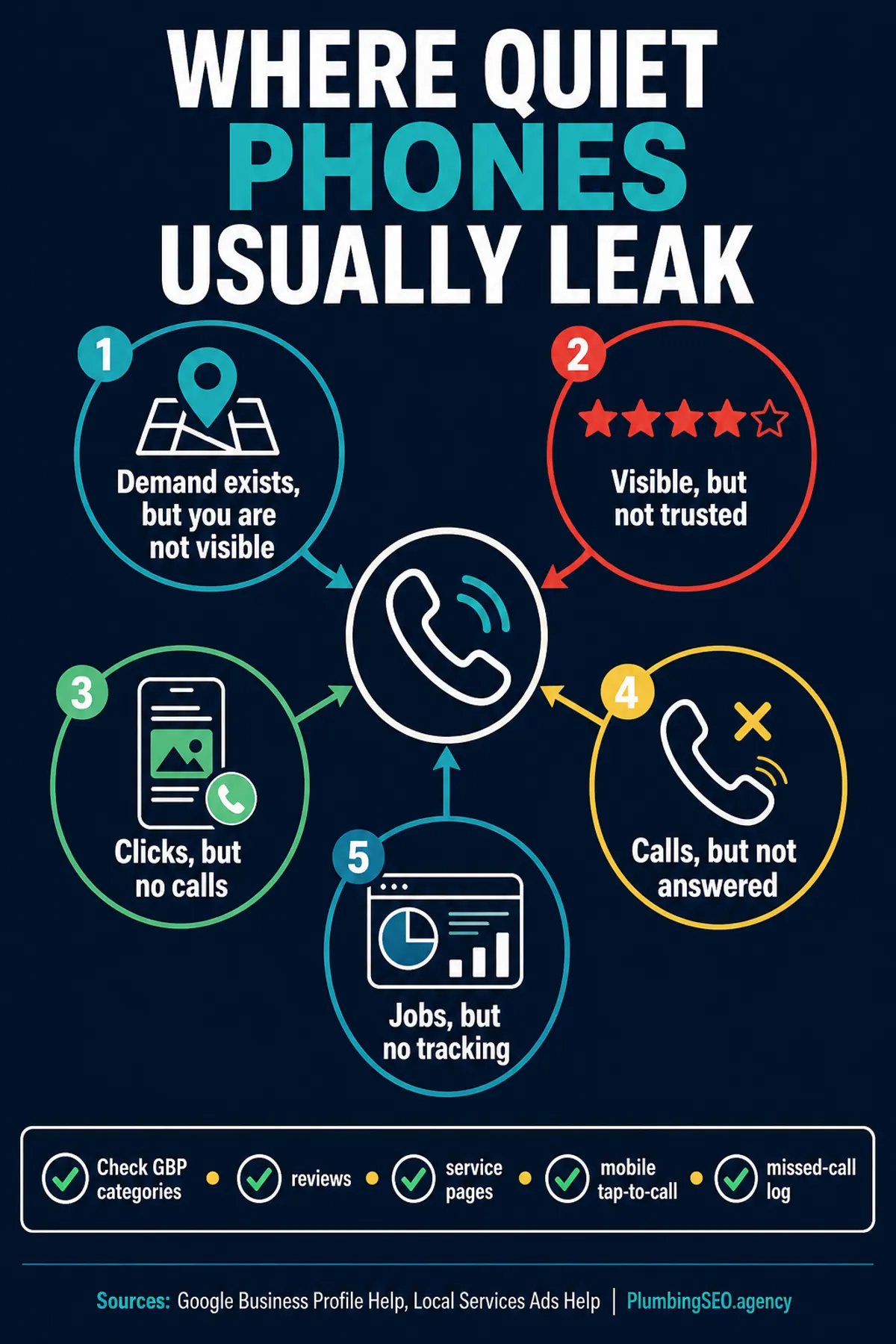
The fix depends on the leak. If you are buried in Google Maps, a new homepage headline will not do much. If you already get clicks but no calls, more blog posts may not help until the mobile page makes the phone number obvious. If calls come in but the office misses them, SEO can bring opportunity to the door and still lose the job at the handset.
Use a simple four-part check
Do you show for the service and town the customer is searching?
Do reviews, photos, licenses, and proof make you the safe choice?
Can a mobile visitor call or book in one or two taps?
Are missed calls, form fills, and lead sources reviewed every week?
Check Google Maps before you blame the whole website
For emergency and local plumbing searches, Maps is often where the phone call starts. A homeowner with water on the floor is not reading your About page like a novel. They are looking at who is nearby, trusted, open, and easy to call.
Google tells business owners to represent the real business accurately, choose the fewest categories needed to describe the core business, and provide a phone number that connects to the business location. Those basics matter because Maps is built on trust and clarity, not just keywords. Read Google's own Business Profile guidelines if you want the source straight from the horse's mouth.
Here is what I would check first:
- Primary category: Make sure the main category fits the company. Do not get cute if "Plumber" is the clearest description.
- Services: List the real jobs you want more of, such as drain cleaning, water heater repair, sewer repair, leak detection, and emergency plumbing.
- Hours: If you advertise emergency work, the hours and call handling need to match. Nothing irritates a customer faster than a 24-hour claim that rings into a wall.
- Photos: Add real job photos, trucks, team shots, and shop photos. Stock photos do not build much confidence when the customer is trusting you with their home.
- Reviews: Ask consistently, reply like a human, and never offer incentives for reviews. Google's review guidance is clear that reviews must reflect genuine experiences.
If Maps has gone quiet after months of working well, compare your profile against the top three competitors. Look at review freshness, categories, service wording, photos, service area clarity, and whether their websites back up the same services. You are looking for the gap a customer can see before they ever call.
Make sure your service pages match the calls you want
A plumbing website can rank for the company name and still fail to bring service calls. That happens when the site does not have clear pages for the work people actually search for.
If your best jobs are water heaters, drain cleaning, sewer repair, repiping, leak detection, or emergency calls, each core service needs a useful page. Not a thin page with the city name repeated until it sounds like a broken disposal. A useful service page explains the problem, signs the homeowner sees, what your company does, service area fit, proof, and how to call.
This is where PlumbingSEO's service page process ties back to booked jobs. The page should help a homeowner choose you and help Google understand which job, town, and urgency the page fits.
| Symptom | Likely leak | Fix first |
|---|---|---|
| Ranking for brand name only | Weak service coverage | Add or improve core service pages with real job proof |
| Traffic but few phone calls | Poor mobile conversion | Move phone CTA up, add proof, simplify booking |
| Many calls but wrong jobs | Broad or mismatched intent | Tighten service wording and paid keyword targeting |
| Good weeks followed by dead weeks | Overdependence on ads or referrals | Build Maps, organic pages, reviews, and follow-up together |
Fix in the right order, or you will waste money
One of the easiest ways to waste money is to fix the wrong thing first. I have seen owners buy more ads when the site could not convert a mobile visitor. I have seen owners rewrite every page when the real issue was stale Google reviews. I have seen owners blame SEO when calls were coming in after hours and nobody knew they were missed.
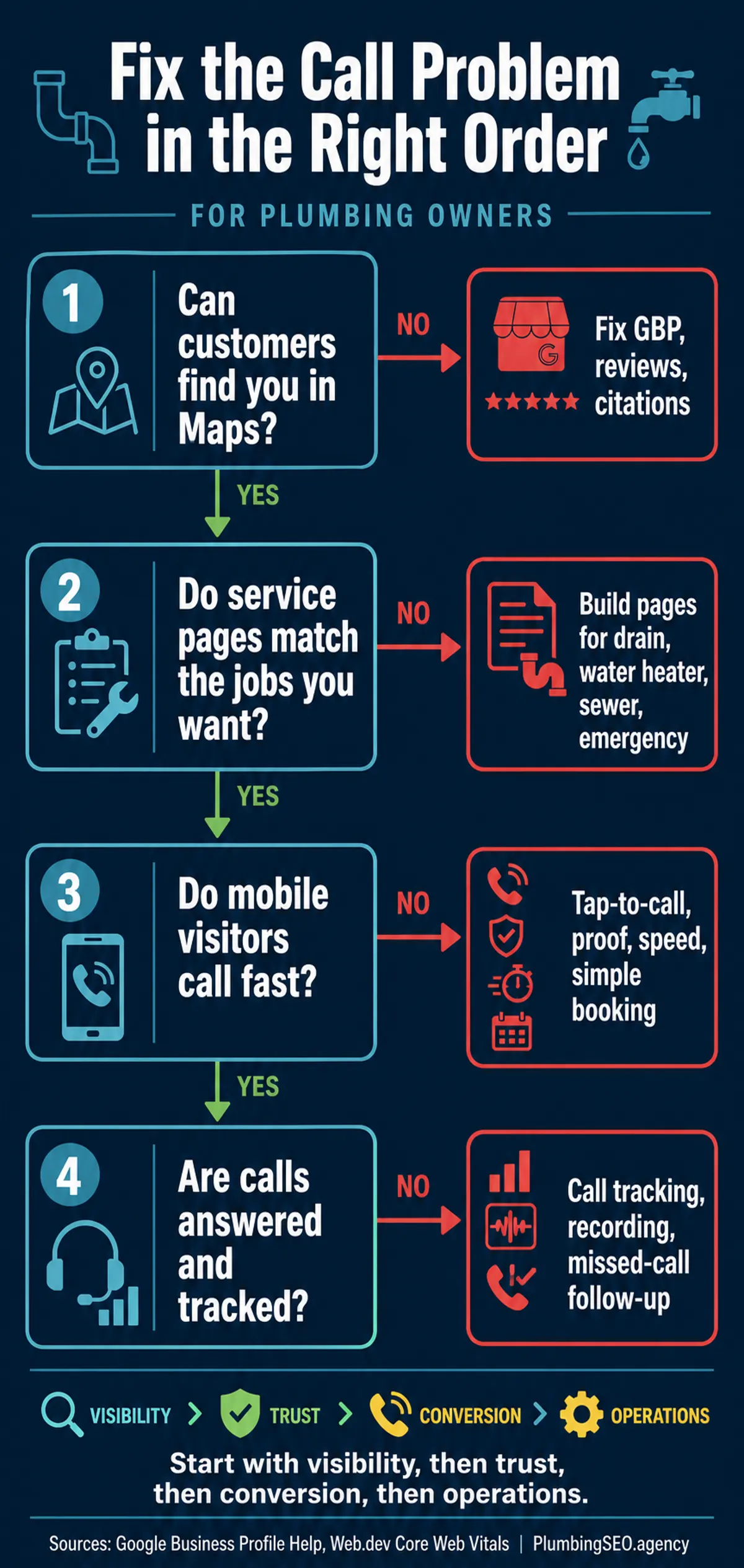
Google Local Services Ads can bring leads as phone calls and messages, and Google notes that potential customers can tap to call or send a message request from those ads. Google also says regular failure to answer calls or respond to messages may affect ad ranking. That matters even if you are focused on SEO, because the same owner habit applies everywhere. If calls are valuable, they need to be answered and measured.
Use paid channels when you need fast demand, but do not let ads hide the basics. A plumbing company that cannot answer, track, and convert calls will waste money whether the lead came from SEO, Maps, Local Services Ads, or a postcard on a fridge.
Test the mobile path like a stressed homeowner
Open your website on a phone. Pretend the water heater just quit, the tenant is texting, and you have about twelve seconds of patience. Can you call with your thumb? Can you see service area, reviews, emergency fit, and a reason to trust the company without hunting?
Google's Web Vitals guidance says site owners should measure user experience outcomes across real users, with Core Web Vitals focused on loading, interaction, and visual stability. You do not need to talk like a developer to care about that. If a page jumps around, loads slowly, or hides the call button, customers leave. The phone does not ring out of sympathy.
Check these items:
- Tap the phone number from the homepage and top service pages.
- Submit the form and make sure someone receives it.
- Check the top service pages on mobile data, not just office Wi-Fi.
- Look for trust proof above the first long scroll: reviews, photos, licenses, financing, warranties, or service guarantees.
- Remove generic filler that pushes the call button down the page.
Run a 7-day call recovery audit
You do not have to fix everything this week. You do need to stop guessing. This seven-day check gives you a clean first pass before you spend another dollar.
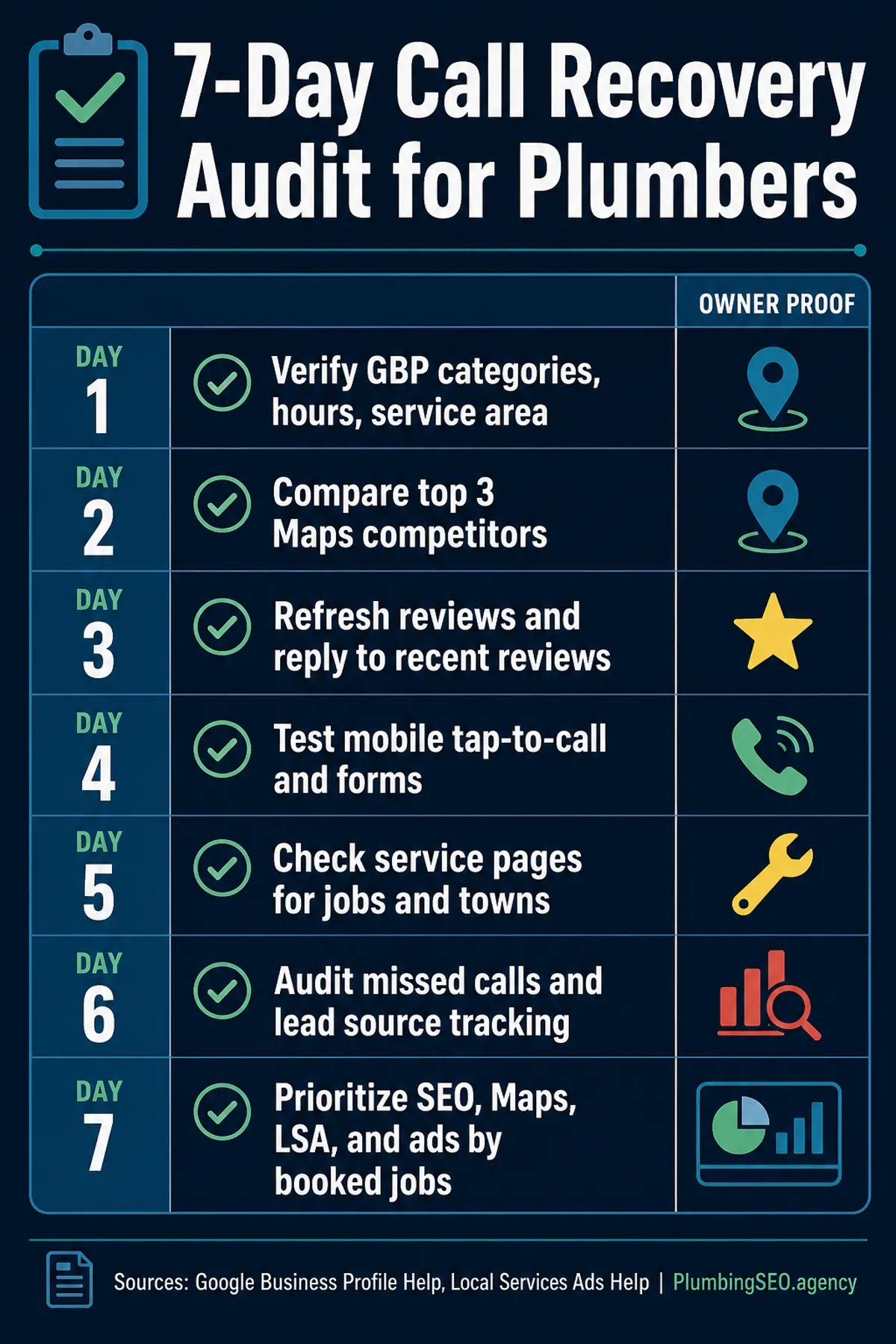
Day 1: Verify the business profile
Check categories, hours, service area, phone number, website URL, services, photos, and profile access. Make sure the owner has access. If an agency controls the profile and you do not, fix that before anything else.
Day 2: Compare the top three Maps competitors
Search your main town and service. Compare review count, review freshness, photos, categories, service wording, and website depth. Do not copy them blindly. Use the comparison to see why a customer might trust them first.
Day 3: Refresh reviews the right way
Ask happy customers after the job, make the link easy, and reply to reviews. Do not buy reviews or trade discounts for them. The goal is steady proof from real customers.
Day 4: Test mobile calls and forms
Call from the website. Fill out the form. Check the thank-you path. If you use call tracking, make sure the number forwards correctly. If nobody knows where the form goes, that is not a marketing problem. That is a bucket with no bottom.
Day 5: Check service pages against real jobs
List the jobs you want more of. Then check whether each one has a page strong enough to win trust. If drain cleaning brings profit but the drain page is two paragraphs, that is a leak.
Day 6: Review missed calls
Look at call logs by time of day. Separate missed calls, spam calls, price shoppers, and booked jobs. If calls are missed after 5 p.m., decide whether answering service coverage, better scheduling, or clearer emergency routing is needed.
Day 7: Prioritize by booked jobs
Do not prioritize by vanity traffic. Prioritize fixes that lead to the right calls and the right work. If the site gets visitors but no calls, fix conversion. If the profile does not show, fix Maps. If leads are bad, fix targeting and tracking.
When SEO is the right fix
SEO is the right fix when customers are searching, competitors are getting the calls, and your company is not showing clearly enough in Search and Maps. It is also the right fix when ads are keeping the phone alive but cost too much to be the only source of calls.
A practical plumber SEO plan should cover:
- Google Business Profile categories, services, photos, reviews, and owner access.
- Service pages for the jobs and towns that matter.
- Internal links that help Google and customers understand your strongest pages.
- Technical basics like speed, indexability, canonical URLs, schema, and mobile usability.
- Call tracking and lead quality review so rankings connect to booked jobs.
That is why the homepage promise matters. PlumbingSEO is built around getting more calls and booked jobs from Search and Maps, not just making reports look busy. If you want the whole approach, read how we help plumbing companies get more calls or compare the work in our plumbing SEO pricing.
The owner's quick call-leak checklist
- If you do not show in Maps: fix profile categories, reviews, citations, service wording, photos, and local page relevance.
- If you show but do not get calls: strengthen reviews, proof, photos, offers, and mobile tap-to-call placement.
- If you get calls but not jobs: review call recordings, spam sources, pricing objections, dispatch fit, and follow-up speed.
- If ads are expensive: use SEO and Maps to reduce dependence on paid calls over time.
- If nobody owns the numbers: assign weekly call review to one person. A dashboard nobody reads is just wall art with passwords.
The phone tells the truth. If the calls are slow, find the leak closest to the money first. Then fix the next one. That is how you get the trucks moving again without throwing the whole marketing budget into a ditch.
Frequently Asked Questions
Your plumbing company may not be getting calls because customers cannot find you in Maps, your service pages do not match the jobs they search for, your reviews or proof look weak, the mobile site makes calling hard, or incoming calls are being missed. Start by checking Maps visibility, mobile call buttons, reviews, and call logs.
Yes, SEO can help plumbers get more phone calls when it improves visibility for real service searches, strengthens Google Maps signals, builds useful service pages, and tracks calls back to booked jobs. SEO should not be measured by rankings alone. It should be measured by qualified calls and jobs on the board.
Fix the bottleneck closest to the lost call. If you are not visible in Maps, start with Google Business Profile and reviews. If you get visits but no calls, fix mobile CTAs, trust proof, and page speed. If calls come in but do not book, fix tracking, answering, and follow-up before buying more ads.
Track rankings, Maps visibility, organic traffic, call volume, call quality, booked jobs, and revenue by source. A report that shows traffic but no qualified calls needs a conversion or targeting review. A good plumbing SEO program connects Search and Maps visibility to real phone calls.
First check that your phone number, website forms, Google Business Profile hours, call tracking number, and forwarding rules are working. Then compare recent reviews, Maps visibility, and paid campaign status. Many sudden call drops come from a tracking, profile, or paid-channel issue before a full SEO problem.
Find the Leak Before You Spend More on Marketing
If the phone is quiet, do not guess. We will check your Maps visibility, website conversion, service pages, tracking, and call path so you know what to fix first.
Run My Free SEO Leak Check