
- On-page SEO for plumbers is the work inside each page: titles, headings, service details, proof, internal links, images, FAQs, and a clear path to call.
- Start with the pages that can put jobs on the board: water heater repair, drain cleaning, emergency plumbing, sewer line repair, and your main service areas.
- Measure the work by qualified clicks, calls, booked jobs, and which service pages earn the right local customers. Rankings alone do not pay payroll.
If your plumbing website gets visits but the phone still feels light, the leak may be on the page itself. Not the whole website. Not some mysterious Google curse. One service page may be confusing, thin, slow, missing proof, or asking a nervous homeowner to hunt for the phone number.
That is what on-page SEO fixes. For a plumbing company, on-page SEO means making each page clear enough for Google to understand and useful enough for a real homeowner to trust. A good page should answer the job, the location, the urgency, the proof, and the next step before that person backs out and calls the next shop.
Google says title links are often the main thing people use to decide what to click, and it looks at signals like the title element, visible H1, headings, and prominent page text when creating those links. You can read that in Google Search Central's title link guidance. That matters because a plumber service page is not just a page. It is a sales conversation happening before your dispatcher ever hears the phone ring.
Generic on-page SEO advice talks about keywords, tags, and URLs. That is fine, but plumbing is its own animal. A drain cleaning page has to show fast availability. A water heater page has to cover repair, replacement, emergency symptoms, brands, warranties, and service areas. A sewer repair page has to build trust before someone lets you dig near the house. Bad SEO is like a slow drain. You can ignore it for a while, but eventually it backs up somewhere ugly.
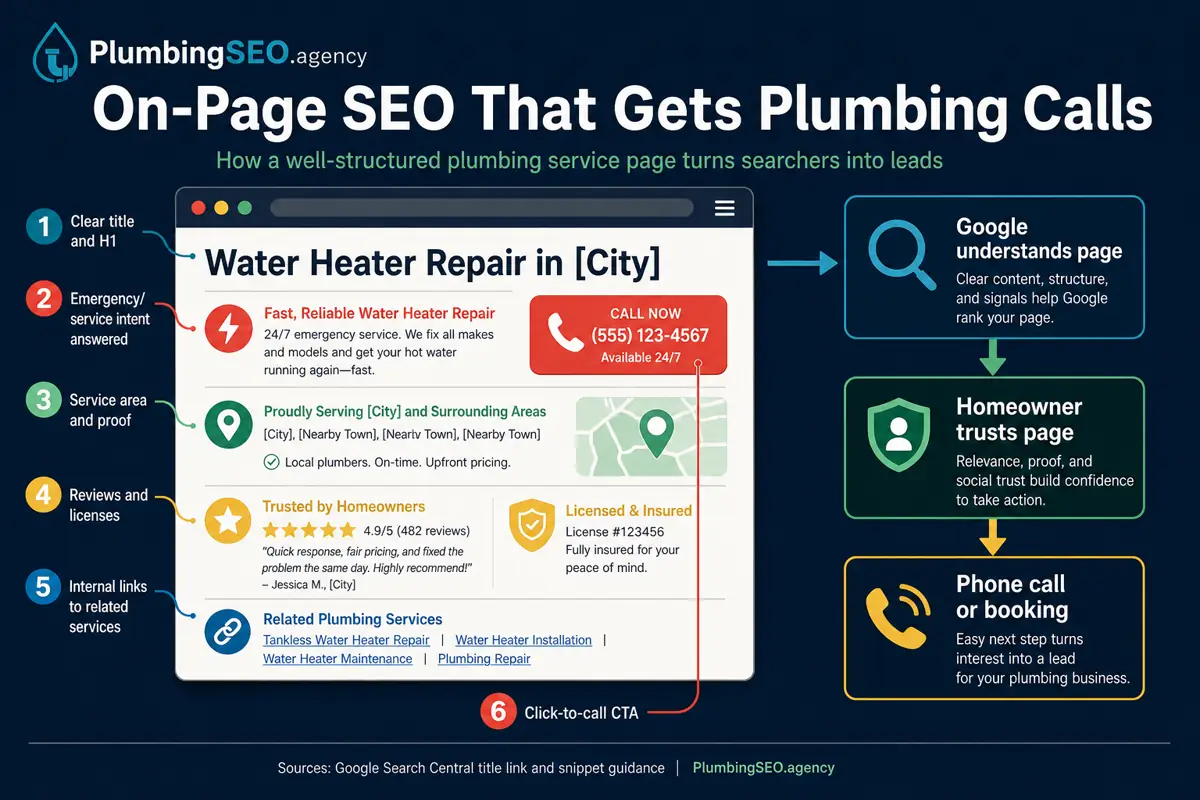
What on-page SEO includes for a plumbing company
The simple version: every important page should make one job clear. If the page is about water heater repair in Dallas, the title, H1, opening paragraph, photos, FAQs, reviews, internal links, and CTA should all support that job. If the page tries to be every plumbing service in every city at once, it usually helps nobody.
Industry references define on-page SEO as optimizing content, HTML tags, keywords, URLs, internal links, images, user experience, and mobile friendliness. That framework is useful, but for plumbing businesses it is still too broad unless every element ties back to calls, dispatch readiness, and booked work.
| On-page element | What it means on a plumbing page | Owner-side question |
|---|---|---|
| Title tag | Clear page topic like "Emergency Plumber in Austin" or "Water Heater Repair in Phoenix". | Would I click this if water was on the floor? |
| H1 and headings | One main page title, then sections for symptoms, service area, process, proof, pricing notes, and FAQs. | Can a homeowner scan this in ten seconds? |
| Service content | Specific details for the job, not a copied paragraph that could fit any contractor. | Does this explain why we are the right crew? |
| Internal links | Links from related services, city pages, and guides that help Google and customers understand the page. | Can people move to the next helpful page naturally? |
| Trust proof | Reviews, licenses, insurance, photos, service-area facts, guarantees, and real process details. | Would I trust this company with my house? |
| CTA and tracking | Visible phone number, quote form, mobile click-to-call, and call tracking tied to booked jobs. | Can we tell whether this page made money? |
Start with pages that can turn into jobs
Do not begin by polishing every blog post while your main drain cleaning page is weak. Start where money and urgency meet. For most plumbing companies, that means your homepage, top service pages, and top service-area pages.
If you need the bigger strategy, our SEO for plumbers page explains how service pages, Maps visibility, and tracking fit together. This article stays focused on the page-level work.
Recent competitive analysis of top plumbing SEO pages shows recurring strengths: mobile usability, clear service pages, Google Business Profile alignment, reviews, relevant keywords, and reliable tracking. Housecall Pro's plumbing SEO guide also frames measurement around traffic, local rankings, click-through rate, bounce rate, and conversion metrics. That is a good reminder: page work is not finished when the page publishes. It is finished when you know whether it helped the phone ring.
The fix order I would use
The order matters. If the search result is confusing, fewer people click. If the page is vague, fewer people trust. If the call path is weak, fewer people book. Fixing those out of order wastes time.
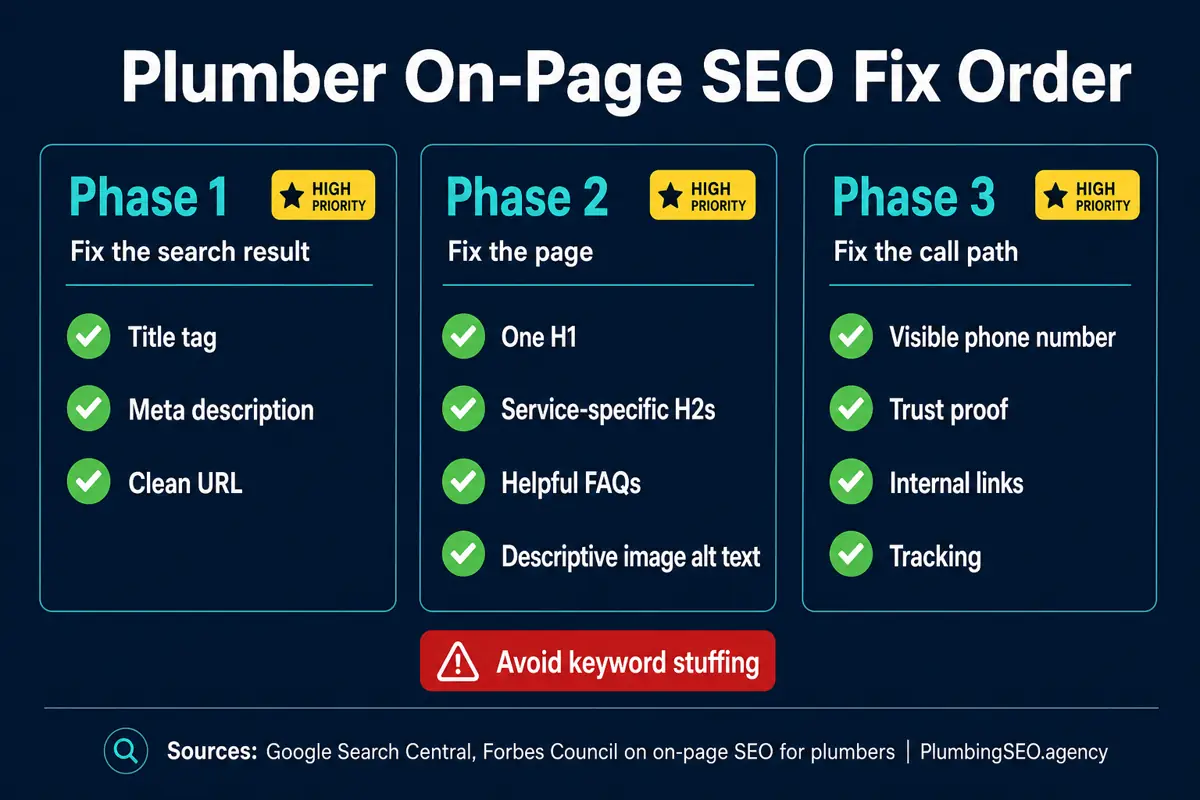
1. Fix the search result
Your title tag and meta description are not decoration. They are the small promise a homeowner sees before they click. Google's meta description guidance says descriptions should be unique, specific, and useful for the page. For plumbers, that usually means service, city or service area, urgency when relevant, and a plain reason to choose you.
Example: "Water Heater Repair in Austin | Same-Day Plumbing Help" is better than "Services | Best Plumbing Company" because it tells the customer exactly what is behind the click.
2. Fix the page itself
Use one H1. Use H2s that match real questions: symptoms, repair process, brands, service area, pricing factors, emergency availability, reviews, and FAQs. Do not stuff "plumber near me" into every line. Forbes' on-page SEO guide for plumbers warns against keyword stuffing and recommends useful content, page titles, formatting, alt text, URLs, internal links, and schema. That matches what good owner-focused pages need.
Here is the practical test: if a homeowner reads only the headings, can they tell you handle their problem, in their area, with a crew they can trust?
3. Fix the call path
SEO can bring the person to the page. The page still has to earn the call. Put a click-to-call button where mobile visitors can find it. Show your office hours or emergency availability. Add review snippets, licenses, insurance, photos, financing notes if relevant, and a short explanation of what happens after they call.
If your team uses call tracking, make sure the number still works cleanly on mobile and that you can connect calls back to service pages. The phone tells the truth. A page that ranks but never produces a qualified call needs more than a pat on the back.
Common on-page mistakes that cost plumbers calls
Thin service pages
A generic "we do plumbing" page does not prove you handle slab leaks, drain cleaning, water heaters, or emergency calls. Build specific pages for the services that matter.
City pages with copied text
Changing only the city name is not local proof. Add real service-area notes, neighborhoods, photos, reviews, travel context, and links to related services.
Hidden phone numbers
If a mobile visitor has to pinch, scroll, and hunt, you are making the customer work. That is not a funnel. That is a maze.
Unclear internal links
Link related pages in a way that helps people. Drain cleaning can link to sewer line repair. Water heater repair can link to replacement. Do not force random links.
How local SEO connects to on-page SEO
Local SEO and on-page SEO are not separate buckets. Your Google Business Profile may get the Maps click, but your website often earns the trust after that click. If your pages do not match your services, cities, reviews, photos, and business details, Google and customers both have less to work with.
When local SEO is the bigger issue, read our guide to advanced local SEO for plumbers. The short version is simple: your page should back up what your Maps listing claims. If your profile says sewer repair but your site barely explains sewer repair, you are asking Google and customers to fill in the blanks.
A practical checklist for your next service page
Use this before publishing a new page or refreshing an old one. It is not fancy, but it catches the leaks that usually hurt calls.
- Pick one primary job. Do not make one page rank for every service you sell.
- Write a clear title and H1. Put the service and city or service area where it makes sense.
- Answer the customer's real problem early. Mention symptoms, urgency, what you fix, and how to get help.
- Add local proof. Use reviews, neighborhoods, photos, license details, and service-area notes.
- Use helpful internal links. Connect related services and supporting guides only where they help the reader.
- Optimize images honestly. Use compressed WebP images and alt text that describes the image, not keyword soup.
- Add FAQs from real questions. Pricing, timing, emergency availability, service area, and whether repair or replacement makes sense.
- Make the next step obvious. Click-to-call, quote form, free audit, or scheduling CTA should be easy to find on a phone.
- Track the outcome. Use Search Console, analytics, and call tracking to see whether the page is earning useful demand.
How to measure whether on-page SEO is working
I would not judge this work by rankings alone. A ranking report can look pretty while the board stays light. Watch the full path: impressions, clicks, calls, booked jobs, and updates made to the page.
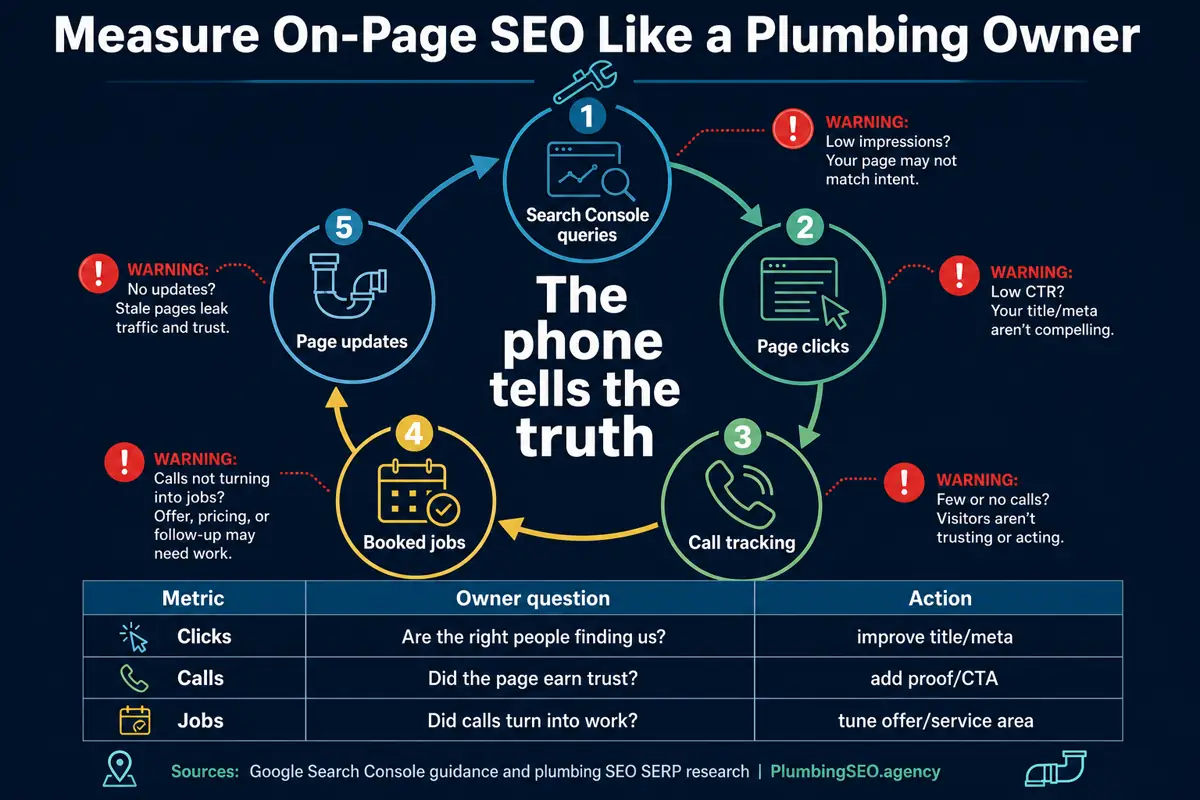
Housecall Pro's plumbing SEO guide recommends tracking traffic, local rankings, CTR, bounce rate, and conversion metrics. I would add one owner-level filter: did the page help create the kind of jobs you actually want? If a page brings price shoppers from outside your service area, the SEO report may look good but dispatch still suffers.
Review the page monthly. Look at Search Console queries. If people search for "tankless water heater repair" but your page barely mentions tankless systems, update it. If clicks are fine but calls are weak, improve proof, photos, reviews, and CTAs. If calls come in but do not book, check pricing language, service-area expectations, and office handoff.
Can plumbers do on-page SEO themselves?
Yes, at least the basics. A plumbing owner or office manager can check titles, headings, phone numbers, service-area language, reviews, and whether each page clearly explains the service. You do not need a huge agency meeting to fix a confusing H1.
Where help becomes useful is scale and judgment. If you have dozens of services, many cities, weak tracking, and competitors already investing in SEO, you need a system. That is where a plumbing-specific SEO partner can map pages, prioritize updates, add schema, improve internal links, and connect the work to calls instead of vanity traffic.
If you want us to check where your service pages are leaking calls, start with a free SEO leak check. We will look at the page, the search result, the local intent, and the call path before recommending more work.
On-Page SEO for Plumbers FAQs
It helps Google understand each service page and helps homeowners trust what they find. Better titles, headings, service details, local proof, FAQs, internal links, and clear CTAs can turn more qualified searches into calls and booked jobs.
Plumbers can handle basics like checking titles, headings, phone numbers, reviews, service-area wording, and whether each page explains one job clearly. Hire help when you need keyword mapping, technical cleanup, schema, internal linking, tracking, and steady execution across many pages.
Small improvements can affect click-through rate and conversions quickly, but search visibility usually takes a few days to a few weeks after Google recrawls and reprocesses the page. Competitive plumbing markets may take longer because content, reviews, links, and local trust all matter.
Start with pages closest to revenue: homepage, emergency plumbing, drain cleaning, water heater repair or replacement, sewer line repair, and your most important service-area pages. Fix pages that already get impressions or calls before creating a pile of new thin pages.
The biggest mistake is treating every page like a keyword container instead of a customer help page. A strong plumbing page should explain the service, prove local trust, answer common concerns, and make calling or booking easy on mobile.
Want a plumber service page checked before it leaks more calls?
Send us the page. We will review the search result, headings, service proof, mobile call path, and tracking setup so you know what to fix first.
Run My Free SEO Leak Check