
- For a plumber, conversion rate is the share of visitors, clicks, or callers who become real leads or booked jobs. Do not measure it only as form fills.
- A low rate usually means one of five leaks: weak search intent, slow mobile pages, buried phone numbers, low trust, or poor call handling.
- Fix tracking before changing everything. Calls, forms, chat, booked jobs, and revenue need to connect back to SEO, Google Ads, Maps, and referral traffic.
What Conversion Rate Means for a Plumbing Company
If the phone is quiet, most owners ask for more traffic. More rankings. More ad clicks. More impressions. Sometimes that is right. But a lot of plumbing companies already have people finding them, then losing those people before they call, book, or become profitable work.
That loss is what conversion rate measures. In plain English, it tells you how many people took the next useful action after seeing your website, ad, Google Business Profile, or landing page. For plumbers, that useful action is usually a phone call, form fill, chat, booking request, or a scheduled job.
The generic definition is simple. A conversion rate is the percentage of visitors who complete a desired action. That is how broad marketing glossaries explain it, including the competitor source behind this topic. The plumber-specific version is more practical: did the right homeowner contact you, and did your office turn that contact into a job worth sending a truck to?
That last part matters. A website can show a pretty conversion rate and still waste your dispatch board. Ten coupon hunters are not better than three homeowners who need water heater replacement, sewer repair, or emergency service in your actual service area.
The Conversion Rates Plumbers Should Actually Watch
There is no single perfect conversion rate for every plumbing business. Emergency drain cleaning, commercial plumbing, remodel work, and water heater installs all behave differently. So does traffic from SEO compared with Google Ads or Local Services Ads.
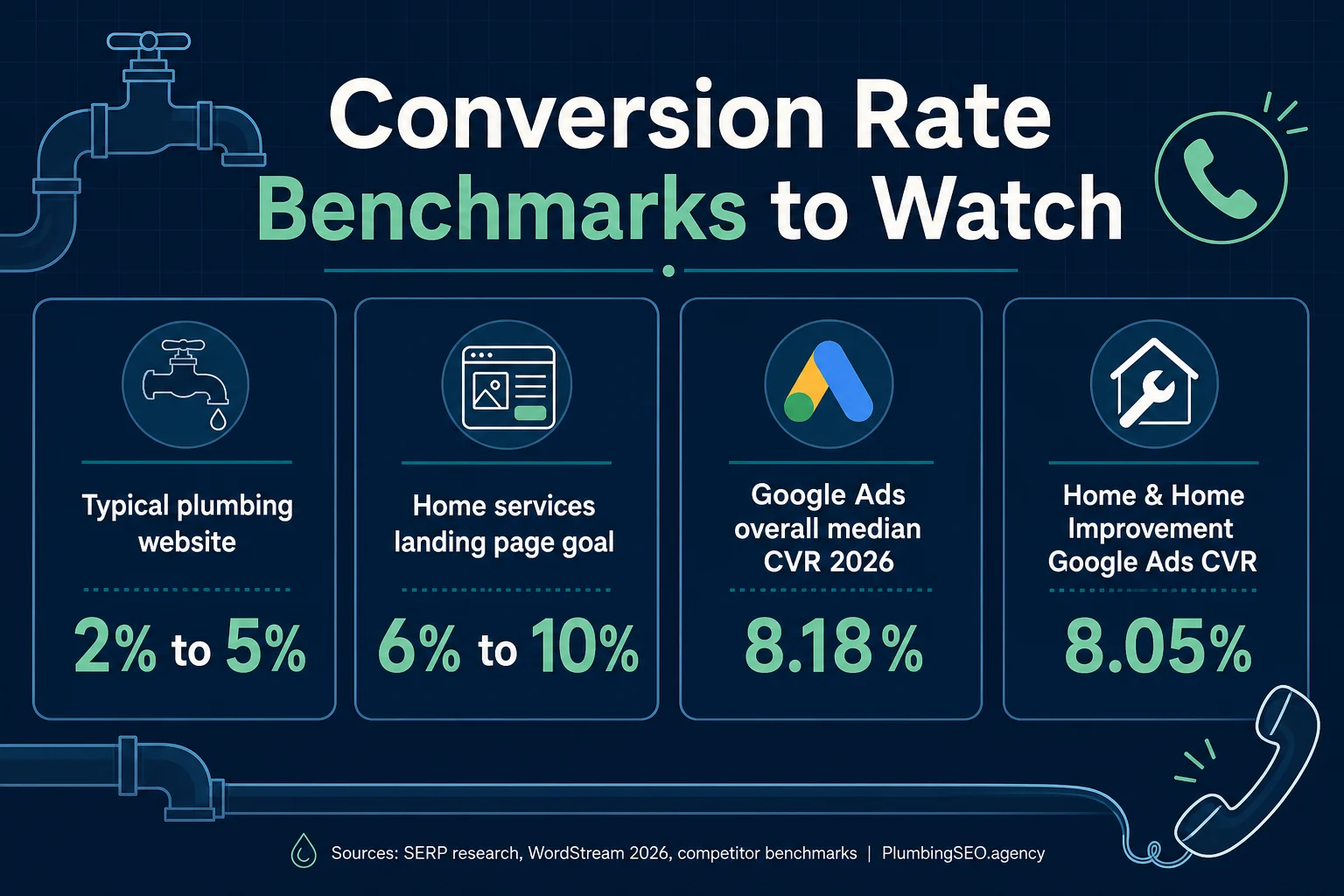
Industry examples commonly put plumbing website conversion benchmarks around 2% to 5%, home services landing page goals around 6% to 10%, and WordStream's 2026 Google Ads benchmark reporting an 8.18% overall median conversion rate, with Home & Home Improvement at 8.05%. Those are useful guardrails, not promises.
The better question is this: where does your own number drop compared with the step before it? If SEO traffic is climbing but calls are flat, the page may not be doing its job. If calls are strong but booked jobs are weak, the problem may be answer rate, lead quality, pricing fit, or dispatch follow-up.
| Conversion point | What it tells you | What to fix first |
|---|---|---|
| Visitor to call or form | Whether the page earns enough trust to get contact. | Phone visibility, service-area proof, reviews, mobile speed, page offer. |
| Click to qualified lead | Whether the keyword or ad matched the job you want. | Negative keywords, city targeting, service wording, emergency versus non-emergency intent. |
| Lead to booked job | Whether your office and follow-up process are converting demand. | Answer rate, call scripts, booking windows, missed-call texts, CRM reminders. |
| Booked job to revenue | Whether marketing is bringing profitable work, not just noise. | Average ticket, close rate, service mix, job notes, source reporting. |
Where Plumbing Leads Usually Leak
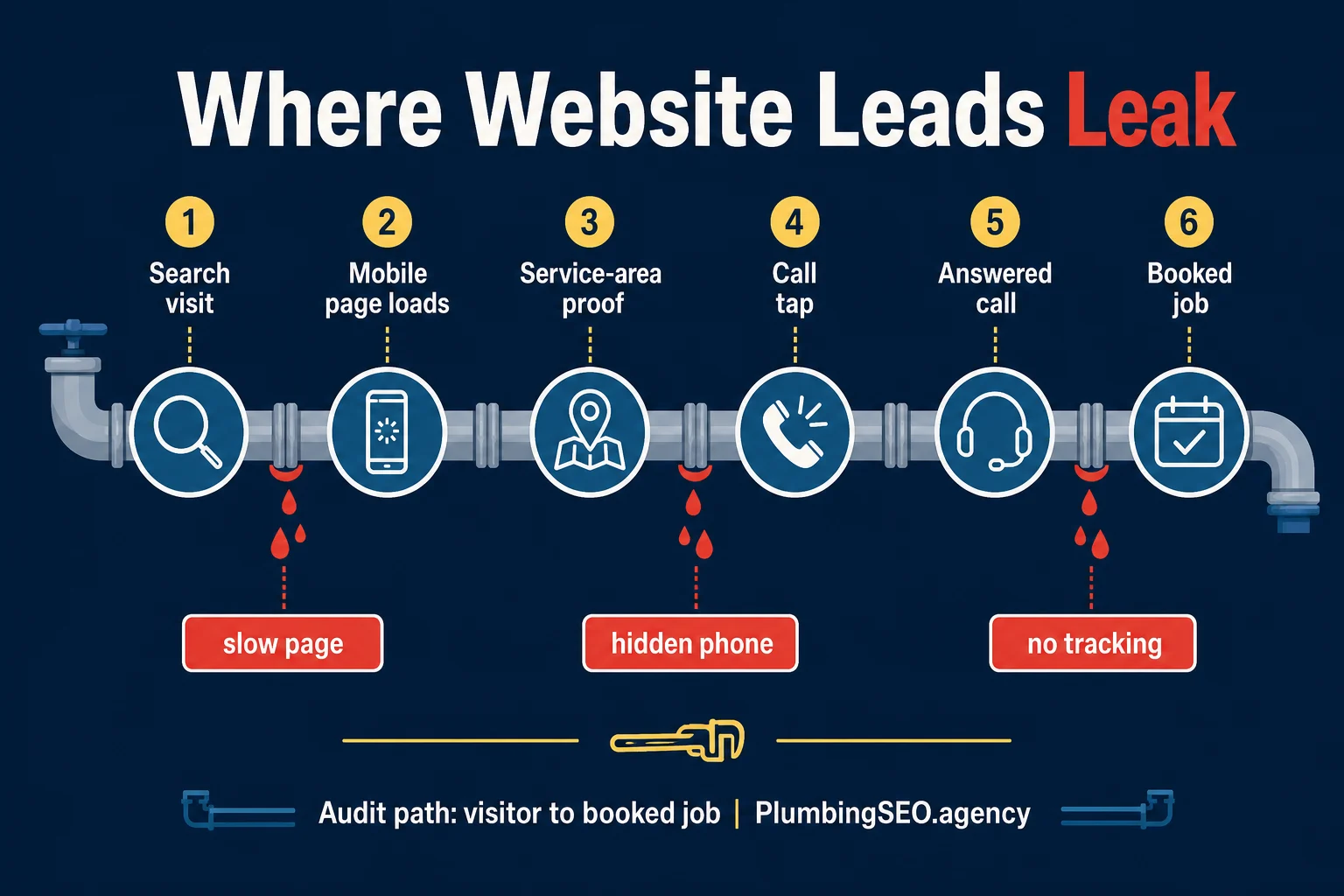
Conversion problems are rarely one big dramatic failure. They are usually small leaks. The phone number is visible on desktop but buried on mobile. The page says you serve the county, but not the city the homeowner searched from. Reviews are on Google but missing from the landing page. Nobody knows which calls came from SEO because tracking was never set up right.
Here is the owner-side test: ask whether a tired homeowner with water on the floor can understand who you are, where you work, why they should trust you, and how to call you in less than ten seconds. If not, the page is asking too much.
Start with tracking, not button colors
Changing a button from blue to green is not a strategy. First, make sure the numbers are honest. Google Analytics key events can mark important actions like forms or call clicks, but a plumbing company also needs call tracking and job outcome tracking if it wants the full picture.
If you are new to that, our lead tracking for plumbers guide explains how to connect calls, forms, chats, and booked jobs without guessing. That is the difference between "the website got 40 leads" and "SEO produced 14 booked water heater jobs at a profitable cost." The second sentence helps you make payroll decisions. The first one just fills a report.
Separate website conversion rate from call booking rate
A website conversion rate usually stops at the lead. A plumbing owner cannot stop there. If ten people call and six go to voicemail, the website may look fine while revenue leaks through the office process. If ten people call and eight ask for work outside your service area, the issue is traffic quality and page targeting.
This is why we like measuring a simple chain: visitor to lead, lead to qualified lead, qualified lead to booked job, booked job to paid revenue. Our plumber marketing ROI guide goes deeper on that math.
How SEO Affects Conversion Rate for Plumbers
SEO is not just about getting higher on Google. Good SEO for plumbers should bring the right homeowner to the right page with the right proof. A drain cleaning search should not land on a generic homepage. A slab leak search should not land on a blog post that never shows your service area or phone number.
Local SEO also changes trust before the visitor ever reaches your website. Reviews, map visibility, business categories, photos, and service-area relevance all shape whether a customer clicks you or the other shop. If you are working on map visibility, read our advanced local SEO for plumbers guide next.
A 14-Day Conversion Rate Tune-Up for Plumbers
You do not need a six-month rebrand to improve conversion rate. Start with a two-week tune-up. Keep it boring. Boring is good when trucks need real jobs and not a science project.
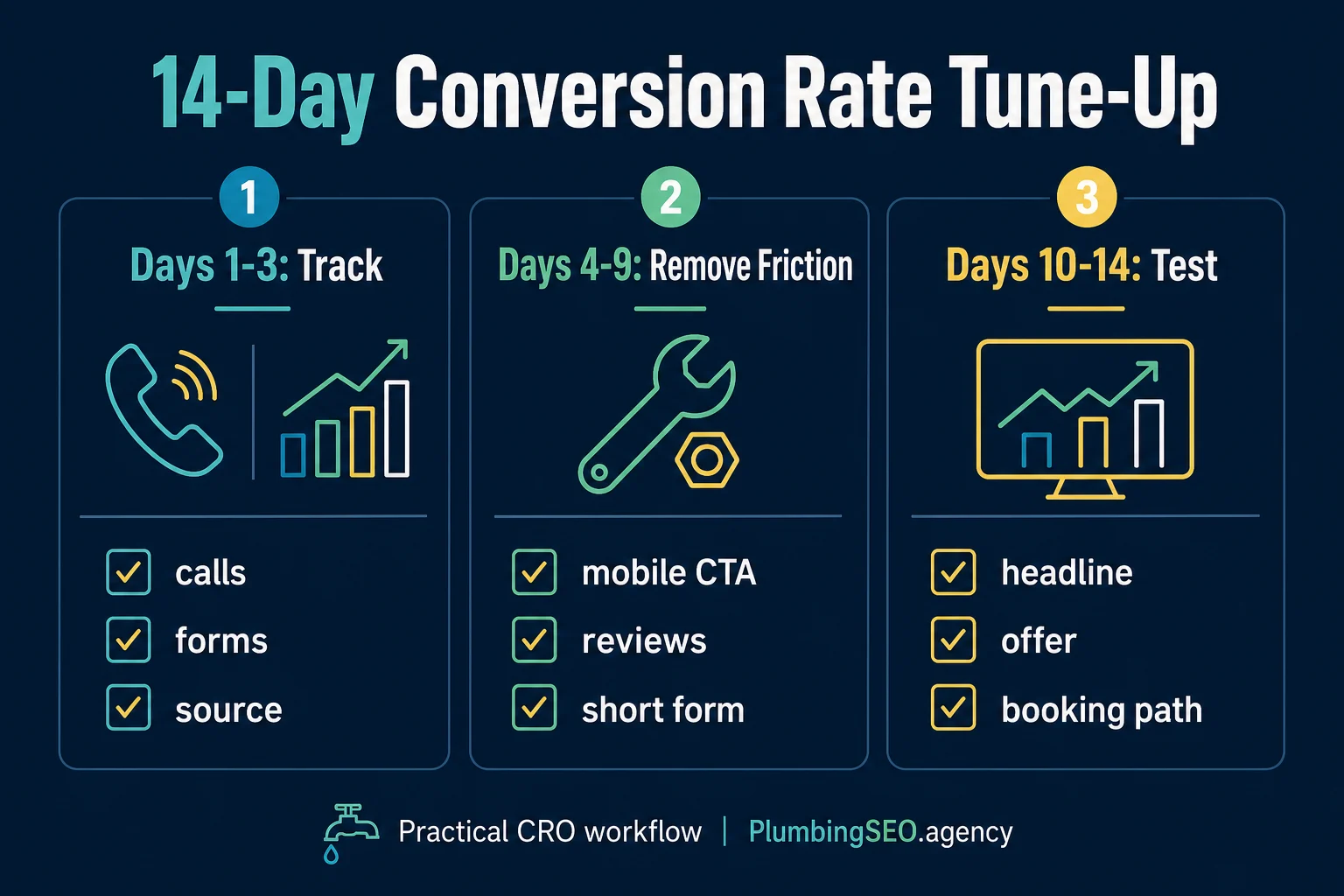
Days 1 to 3: make the numbers honest
- Confirm form submissions are tracked as key events.
- Confirm phone taps are tracked on mobile.
- Separate SEO, Google Ads, Maps, LSA, referral, and direct leads.
- Tag calls as booked, not booked, spam, wrong area, or price shopper.
Days 4 to 9: remove friction from the page
- Put a click-to-call button near the top of every important service page.
- Show real service areas, not a vague "serving the metro" line.
- Add review proof near the first call-to-action.
- Shorten forms. Name, phone, ZIP code, and issue are usually enough to start.
- Make emergency and non-emergency next steps clear.
Days 10 to 14: test one thing at a time
Pick one change and measure it. Test the headline. Test the first call-to-action. Test a service-area proof block. Test whether a short form beats a long form. Do not change the headline, layout, offer, form, and tracking all at once. That is how you end up staring at a report and guessing like a man listening for a leak inside a wall.
Want a plumber-specific conversion audit?
Send us the page you rely on for calls. We will check tracking, mobile call paths, local trust signals, and the spots where good leads may be slipping away.
Request a Conversion AuditCommon Conversion Rate Mistakes Plumbers Make
Mistake 1: counting every lead as equal
A $49 drain coupon lead, a commercial repipe request, and a homeowner asking for a second opinion are not the same. Track source, service type, service area, booked status, and revenue when possible.
Mistake 2: using one landing page for every service
Plumbing is too specific for one generic page. Emergency plumbing, sewer line repair, tankless water heaters, and leak detection all need different proof and different urgency.
Mistake 3: ignoring mobile
Most urgent plumbing searches happen on a phone. If the call button is hard to tap, the page loads slowly, or the form is painful, the customer will call the next listing.
Mistake 4: chasing benchmarks instead of profit
A 12% conversion rate sounds better than 4%, but not if the 12% is low-ticket work outside your best routes. Measure booked jobs and revenue, not just leads. The phone tells the truth.
What to Do Next
Start with one page that matters. Usually that is your homepage, emergency plumbing page, drain cleaning page, water heater page, or the landing page tied to paid search. Pull the last 30 days of traffic, calls, forms, booked jobs, and revenue if you have it. Then look for the first leak in the chain.
If you do not have that data yet, your first job is not conversion optimization. Your first job is measurement. Once the numbers are honest, the fixes get much clearer.
Conversion Rate FAQs for Plumbers
A useful target depends on the channel and service. Competitor and search-result research often puts typical plumbing website conversion around 2% to 5%, while focused home services landing pages may aim higher. The better benchmark is your own visitor-to-lead, lead-to-booked-job, and revenue trend over time.
It shows whether marketing traffic turns into calls, forms, booked jobs, and revenue. Improving conversion rate can help a plumbing company get more value from existing SEO, Google Ads, Maps, and referral traffic without immediately increasing ad spend.
Plumbers can fix basics themselves: clear phone buttons, shorter forms, better reviews, service-area proof, and faster follow-up. An agency helps when tracking, landing page testing, SEO intent, call attribution, and revenue reporting need to work together.
Simple fixes can show signs within a few weeks if the page already has enough traffic. Bigger improvements, such as better local SEO traffic, new service pages, call tracking cleanup, and testing, usually need 30 to 90 days to measure with confidence.
Fix tracking and obvious conversion leaks first. Then grow traffic. More visitors help only if the page, phone process, and service-area targeting can turn those visitors into profitable booked jobs.
Find the leak before you buy more traffic
If your rankings, ads, or Maps listing are sending visitors but the phone is not turning into booked jobs, we can help you see where the chain breaks.
Talk to PlumbingSEO.agency