
- Google Ads can bring plumbing calls fast, but only when campaigns are split by service, city, landing page, and tracked booked jobs.
- Use Search Ads for control, Local Services Ads for verified local leads, and SEO so paid clicks do not become your only source of calls.
- The biggest leaks are broad keywords, weak negative lists, homepage traffic, wrong location settings, and reports that stop at clicks.
If the phones are quiet, Google Ads looks tempting. You can launch a campaign, show up near the top of Google, and get in front of homeowners who need a plumber today. That is useful when payroll is due, trucks are open, and waiting six months for SEO to mature is not an option.
But Google Ads can also drain money faster than a bad shutoff valve. The difference is not whether the platform works. The difference is whether your campaign is built around real plumbing jobs, real service areas, and real booked revenue.
This guide is for plumbing owners who want the phone ringing without guessing. We will cover the setup, budget, keywords, Local Services Ads, landing pages, tracking, and the mistakes that make paid leads feel expensive. If you also want the long-term side, pair this with our SEO for plumbing companies work so paid ads are not carrying the whole company forever.
What Google Ads Should Do for a Plumbing Company
Google Ads should not just make the report look busy. It should put your company in front of a homeowner with a real problem, in a service area you can reach, for a job your crew actually wants to book.
That sounds simple, but many campaigns are built around broad terms like "plumber" and one generic homepage. That setup can buy clicks from homeowners, renters, DIY searchers, job seekers, and people two cities outside your service area. The report may look good, but the phone tells the truth.
In my opinion, a plumbing Google Ads account should answer five owner-level questions every month:
- Which services produced qualified calls?
- Which towns or ZIP codes booked real jobs?
- Which keywords wasted money?
- Which landing pages turned calls into appointments?
- Which ads created revenue, not just leads?
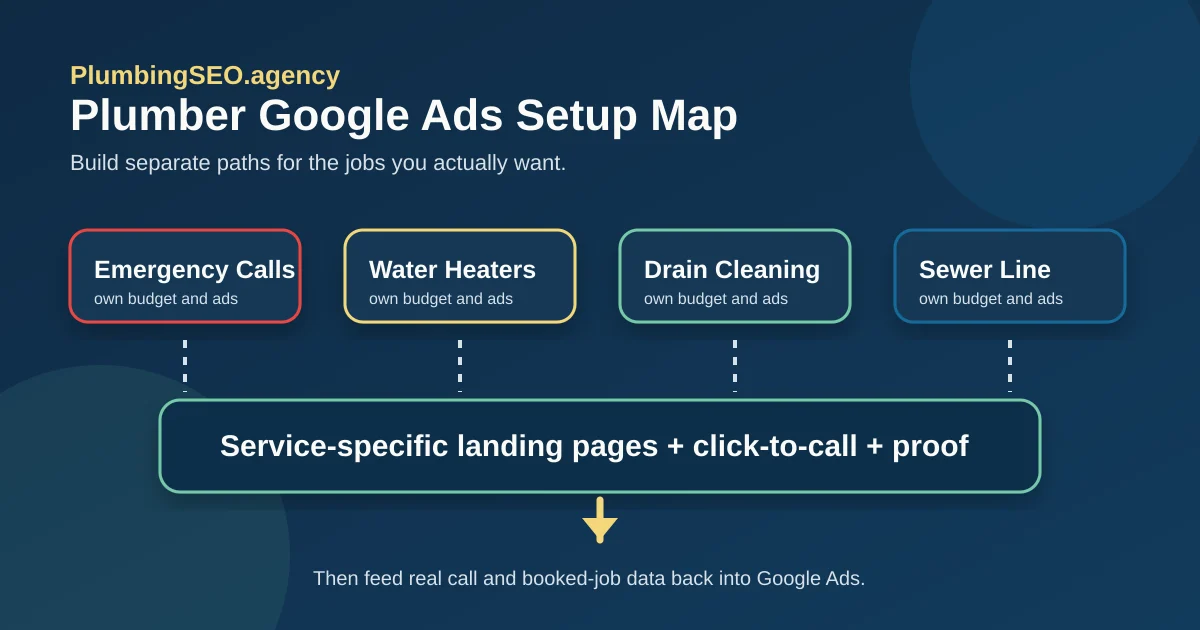
Separate the campaign by the kind of job you want. Then send each click to a page that matches the problem.
Search Ads, Local Services Ads, and SEO Are Not the Same Tool
Plumbers often lump paid search together, but the parts behave differently. Search Ads charge per click and give you more control over keywords, ad copy, landing pages, and budget. Google Local Services Ads are pay-per-lead ads for local service businesses where Google says advertisers pay when potential customers get in touch through the ad. Google lists plumber as an eligible home service category.
SEO is different again. It builds organic visibility in Maps, local pages, and service pages over time. Ads can fill the schedule this month. SEO helps reduce the pressure to buy every call. If local SEO is part of your plan, read our guide to advanced local SEO for plumbers so the paid and organic sides do not fight each other.
| Channel | Best use | Owner caution |
|---|---|---|
| Google Search Ads | High-control campaigns for emergency, drain, water heater, and service-area searches. | Costs rise fast if keywords, negatives, and landing pages are loose. |
| Local Services Ads | Verified local calls and messages through Google's LSA unit. | You get less control over keywords and volume than Search Ads. |
| Local SEO | Long-term Maps, organic, and service page visibility. | It takes time, so it should not be the only plan if trucks are empty today. |
The Budget Math: Do Not Stop at Cost Per Lead
Cost per lead matters, but it is not the finish line. A lead is only useful if the call is qualified, answered, booked, completed, and profitable. A $70 lead that turns into a tire kicker is expensive. A $220 water heater lead that books and pays can be a good day.
SearchLight's Q1 2026 plumbing benchmark reported an average non-branded plumbing Google Ads cost per lead of $183 across 524 plumbing contractors, plus a median cost per paying customer of $333 and a median closed ROAS of 5.54x when revenue was tracked. That is useful because it moves the conversation from clicks to jobs.
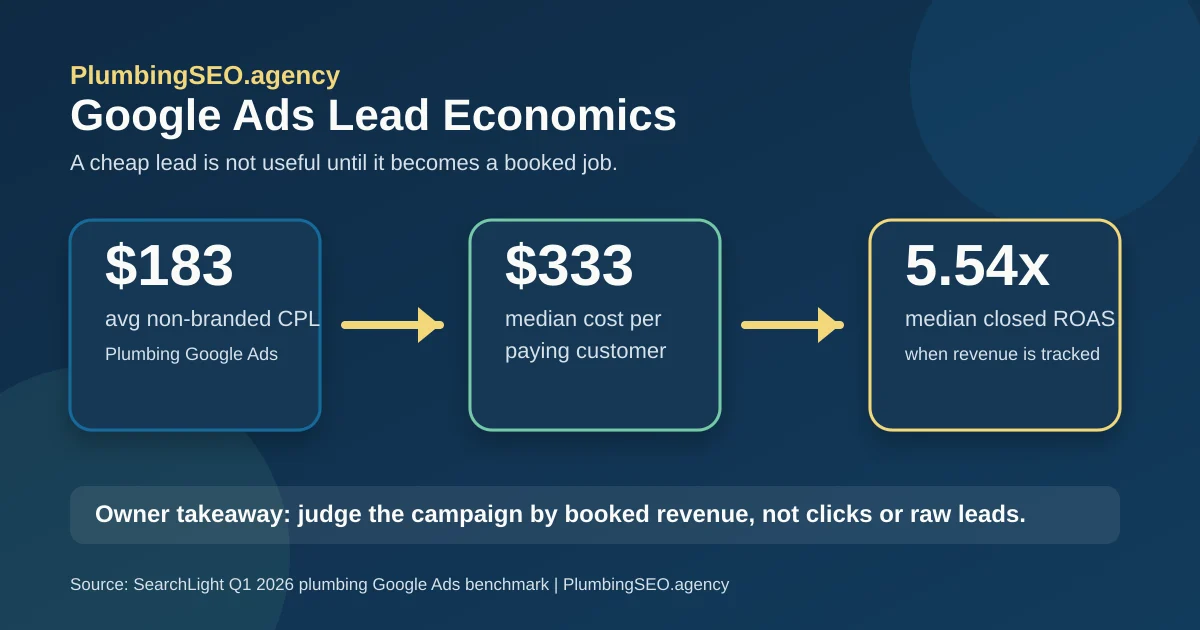
The campaign is not healthy because leads are cheap. It is healthy when booked revenue supports the spend.
For a plumbing owner, the practical question is this: after ad spend, management, payroll, parts, fuel, callbacks, and warranty risk, did the campaign put good work on the board? That is why call tracking and booked-job attribution matter. Our lead tracking guide for plumbers explains how to connect calls, forms, chats, and booked jobs before the numbers get fuzzy.
Build the Campaign Around Services, Not Around Google
The easiest way to waste money is to let one campaign chase every plumbing search. Emergency repair, water heater replacement, sewer line work, and drain cleaning behave differently. They have different urgency, job value, closing rates, and dispatch rules.
Start with the work you want most. If you need higher-ticket replacement jobs, do not let a broad drain campaign eat the whole budget. If your best margin is emergency repair inside a tight radius, build around that. Google does not know your crew schedule, your parts inventory, or which routes make sense. You do.
A simple plumber campaign structure
- Campaign 1: Emergency plumbing. Tight radius, phone-first ads, after-hours rules, urgent landing page.
- Campaign 2: Water heaters. Replacement and repair ad groups, pricing context, financing or same-day proof if offered.
- Campaign 3: Drain cleaning. Separate clogged sink, main drain, sewer backup, and hydro jetting where volume supports it.
- Campaign 4: Core local service areas. Only the cities or ZIP codes you can serve profitably.
That is not fancy. It is just good dispatch thinking applied to ads. Do not send every truck to every neighborhood for every job and call it strategy.
Keywords and Negative Keywords Decide Who You Pay For
Your keyword list tells Google who you want. Your negative keyword list tells Google who you refuse to pay for. Both matter. Google says negative keywords let you exclude search terms and focus on the keywords that matter to customers. For plumbers, that means blocking a lot of expensive noise.
Start with phrase and exact match around buyer terms. Then build negatives from the search terms report every week. The first list usually includes jobs, hiring, salary, school, apprenticeship, license lookup, DIY, free, supplies, parts, Home Depot, snake rental, how to fix, YouTube, template, and wholesale. Your market will add its own weird ones. Google has a talent for finding weird. Bless its heart, but check the report.
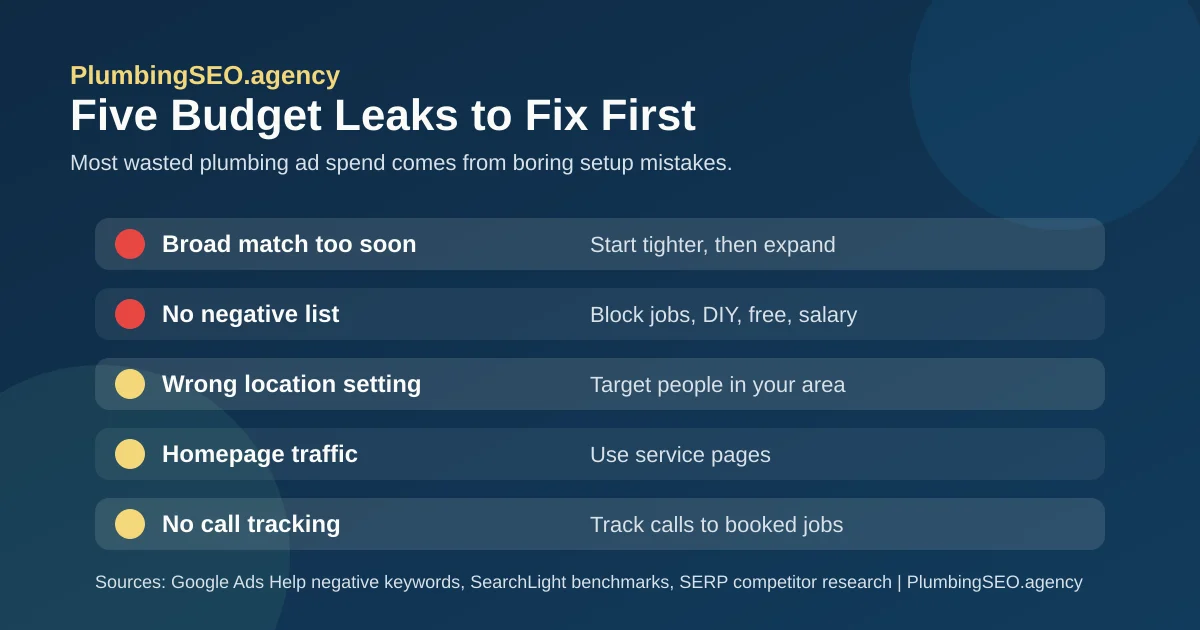
Fix these leaks before you raise the budget. More spend does not repair bad setup.
The Landing Page Has One Job: Make the Right Customer Call
A click from "water heater leaking" should not land on a homepage that talks about every service since 1998. The page should match the search, prove you handle that exact job, show where you work, and make the phone number impossible to miss.
A good plumbing ad landing page usually needs:
- A headline that repeats the service problem in plain English.
- A click-to-call button near the top on mobile.
- Service area proof, reviews, license or insurance trust signals, and real truck or crew photos.
- Short pricing context or inspection expectations where possible.
- A form for non-urgent jobs, but not at the expense of phone calls.
- Fast load speed. Emergency callers are not waiting around.
If your landing page is weak, Google Ads will make that weakness expensive. Every extra second, confusing CTA, or missing service detail gives the customer a reason to back out and call the next shop.
Tracking: The Report Should Follow the Money
Clicks are not enough. Form fills are not enough. Even calls are not enough if half of them are outside your service area or asking for work you do not do. The report needs to follow the lead into the office and, when possible, into the invoice.
Track at least these numbers:
| Metric | Why it matters | Owner question |
|---|---|---|
| Qualified call rate | Separates real customers from spam, jobs, vendors, and wrong-area calls. | Are we buying calls we can actually serve? |
| Booking rate | Shows whether the office is converting calls into scheduled work. | Is dispatch leaking jobs after the ad did its part? |
| Cost per booked job | Connects ad spend to jobs on the board. | Can this job type carry the cost? |
| Revenue and gross profit | Prevents low-ticket jobs from looking better than they are. | Did the campaign help the company, not just Google? |
If the agency report stops at impressions, clicks, and average CPC, ask for more. You do not pay payroll with impressions. You pay it with booked work.
When Plumbers Should Run Google Ads Themselves
Some owners can run their own ads, especially in a smaller market with a simple service mix. But you need time every week. Not once a month. Every week. Search terms, budgets, calls, landing pages, and bids need attention.
DIY is reasonable if you can commit five focused hours a week, understand your numbers, and keep the campaign narrow. Hiring help makes sense when your spend is high, your market is competitive, your service areas are complicated, or nobody in the company is watching the details. If you want a second set of eyes, you can ask us to review the setup before you raise the budget.
A 30-Day Fix-It Checklist
If your Google Ads account is already running, do not rebuild everything before checking the basics. Start here:
- Day 1: Confirm location targeting uses people in or regularly in your area, not people merely interested in it.
- Day 2: Export search terms and add obvious negatives.
- Day 3: Split high-value services into their own campaigns or ad groups.
- Day 4: Send each main ad group to a matching service page, not the homepage.
- Day 5: Test mobile click-to-call, forms, and tracking numbers.
- Week 2: Listen to calls and mark qualified, booked, missed, spam, and wrong-area leads.
- Week 3: Move budget toward services and locations producing booked jobs.
- Week 4: Compare paid results with Maps and organic opportunities so SEO can start carrying more weight.
The goal is not to master every Google Ads setting. The goal is to stop paying for the wrong people, send the right people to the right page, and measure whether the phone calls become work your crew should be doing.
Frequently Asked Questions About Google Ads for Plumbers
It helps a plumbing company show up when local homeowners are actively searching for help, then turns that search demand into calls, booked jobs, and measurable revenue. The boost only lasts if campaigns are built around the right services, service areas, landing pages, and call tracking.
Yes, if the account is narrow and someone can review it every week. DIY works best with tight service areas, phrase or exact match keywords, strong negative keywords, and simple tracking. If the spend is high or the market is competitive, hiring a specialist usually prevents expensive mistakes.
Traffic can start the same day a campaign launches, but useful performance data usually takes a few weeks. Most plumbing campaigns need 30 to 90 days of search term cleanup, landing page testing, call review, and budget adjustments before the numbers are stable.
Most plumbing companies should consider both. Search Ads give more control over keywords, landing pages, and messaging. Local Services Ads can bring verified local leads through Google, but they offer less keyword control. The right mix depends on budget, market, licenses, reviews, and service area.
The biggest mistake is paying for broad traffic without proving it becomes booked work. Broad match keywords, weak negative lists, homepage landing pages, wrong location settings, and no call tracking can make a campaign look active while it quietly wastes budget.
Yes. Google Ads can create faster calls, but SEO builds long-term visibility in Maps, organic search, and service pages. Using both gives a plumbing company short-term lead flow and a path to lower dependence on paid clicks over time.
Want to know where your Google Ads budget is leaking?
We will review your plumbing ads, landing pages, tracking, and local SEO setup so you can see what is producing calls and what is just spending money.
Request a Google Ads Leak Check