
- Start with jobs, not tools. List your real services, emergency calls, profitable installs, and service areas before you open a keyword tool.
- Map each keyword to one page. Emergency, service, city, and question keywords need different URLs or your own pages will compete.
- Track calls and booked jobs. Rankings and impressions matter, but the scorecard is whether the right customers call from the right areas.
If the phone is quiet, keyword research can feel like busywork. You are already dealing with payroll, dispatch, callbacks, trucks, and customers who do not care what a "search intent cluster" is. Fair enough. But the words people type into Google are still a map of where the next jobs can come from.
The problem is that most keyword lists are built backward. They chase the biggest search volume first. For a plumbing or HVAC company, that usually means DIY traffic, students writing homework, or homeowners looking for a five-minute fix instead of a service call. That can make a report look good while the board stays empty.
This keyword research checklist is built for owners and managers who need calls, not vanity traffic. It uses current search-result patterns, competitor review, Google documentation, and service-area SEO examples to show how to turn keyword research into a page plan your team can actually ship.
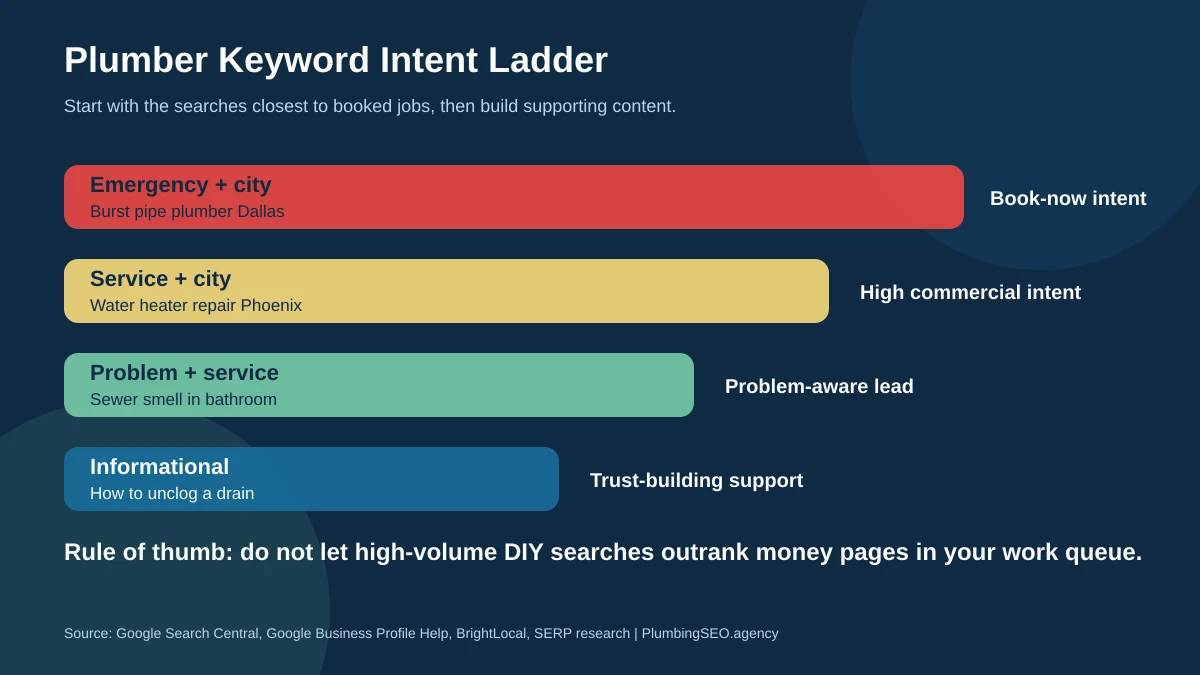
What Most Keyword Research Checklists Miss for Plumbers
The ranking pages for this topic cover the usual steps: define goals, brainstorm seed keywords, expand with tools, check volume, review competitors, group terms, and monitor performance. That is useful, but it is not enough for a service business that drives to the customer.
Plumbing and HVAC keyword research has to answer owner-side questions before it answers SEO questions:
- Which services do we actually want more of?
- Which cities and neighborhoods are profitable routes?
- Which calls can we answer fast enough to win?
- Which problems need a service page, a city page, a blog post, or no page at all?
- Which keywords are stealing time because they attract DIY searchers?
Google's own SEO Starter Guide says SEO is about helping search engines understand your content and helping users decide whether to visit. For a plumber, that means Google and the customer should both understand what you fix, where you go, how quickly you respond, and why you can be trusted.
That is why this checklist starts with services, service areas, and call quality. Tools come later. Tools are useful, but they do not know which jobs your crew hates, which suburbs burn drive time, or which installs carry the margin that keeps the trucks moving.
The Keyword Research Checklist
Work through these steps in order. If you skip the early business filters, the keyword tool will happily hand you a giant list that looks impressive and solves nothing.
1. List the jobs you want more of
Start with your real work order history, not Google. Write down the services that are profitable, repeatable, and worth building pages for. For plumbers, that might include emergency plumbing, drain cleaning, sewer line repair, water heater replacement, leak detection, repiping, sump pumps, and gas line repair. For HVAC, it might include AC repair, furnace repair, heat pump installation, maintenance plans, ductless mini splits, and indoor air quality.
Then mark each service as emergency, repair, installation, maintenance, or commercial. This matters because a homeowner searching "burst pipe plumber near me" is in a different frame of mind than someone searching "tankless water heater pros and cons." Same website, different page job.
2. Build seed keywords from customer language
Use the words customers say on calls. If they say "water heater leaking from bottom," do not force them into "residential water heating system failure." If they say "AC not blowing cold," do not hide that behind HVAC jargon. A good seed list includes trade terms, homeowner terms, brand terms, and problem terms.
Keep the first list simple: service, problem, city, near me, emergency, repair, replacement, installation, cost, and company. The goal is not to be clever. The goal is to make sure the right customer can find you before they call the other shop.
3. Separate money keywords from support keywords
This is where a lot of SEO campaigns leak calls. Money keywords belong on service pages or service-area pages. Support keywords belong on blog posts, FAQs, and comparison guides. Mixing them creates weak pages that do not fully serve either searcher.
| Keyword type | Example | Best page | Owner decision |
|---|---|---|---|
| Emergency + location | emergency plumber in Tampa | Emergency service page | Build first if you can answer fast. |
| Service + city | water heater repair Plano | Service-area page or service page section | Use only for real service areas. |
| Problem question | why does my drain keep backing up | Blog or FAQ support page | Use to warm up future callers. |
| Price research | cost to replace sewer line | Pricing guide or service page section | Qualify serious buyers with ranges. |
| Brand trust | company name reviews | Homepage, review page, GBP | Improve proof before spending more. |
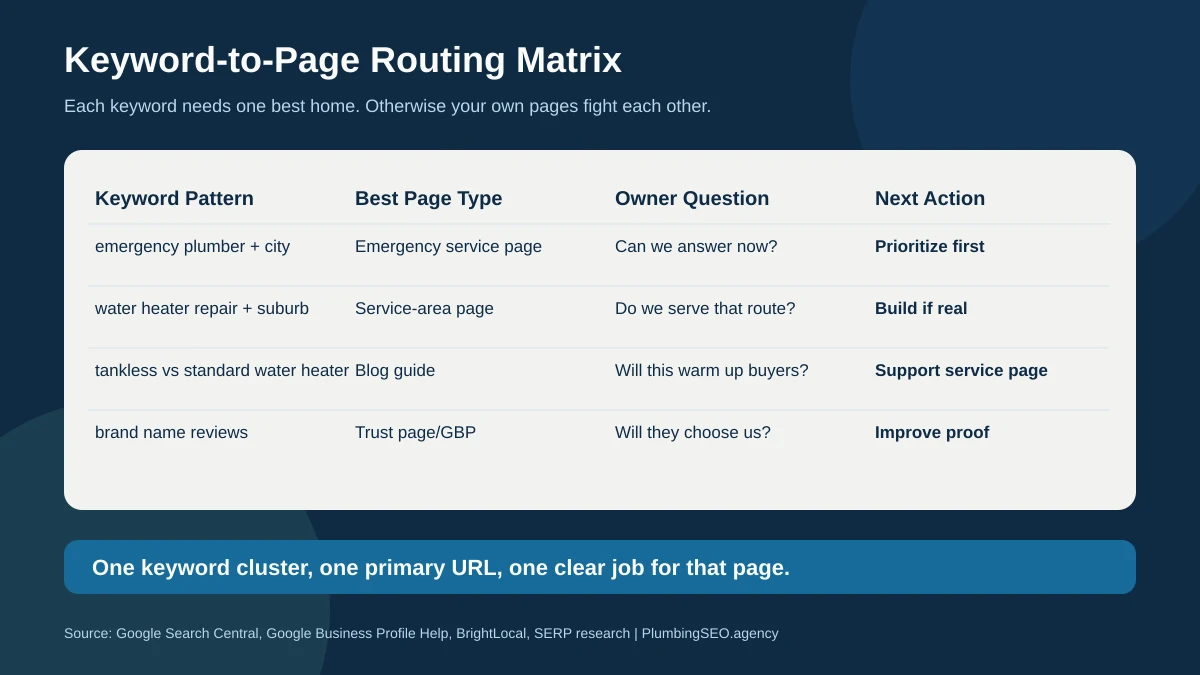
4. Validate local intent before building pages
Search the keyword and look at what Google is actually showing. If the results are mostly local businesses, Maps results, directories, and service pages, the keyword probably has local commercial intent. If the results are how-to videos and national blogs, it probably belongs in support content.
For service-area businesses, this step matters even more. Google's Business Profile service-area guidance says service-area businesses include plumbers, should list specific cities or postal codes, can have up to 20 service areas, and should keep the overall area within about two hours of where the business is based. Your keyword map should follow the same reality. Do not build pages for places your crew cannot serve well.
When local SEO is the main battle, pair this checklist with our advanced local SEO guide for plumbers. Keyword research tells you what people search. Local SEO decides whether Google trusts you in that market.
5. Check competitors, but do not copy their mess
Open the top ranking pages and write down their page types, headings, services covered, city structure, internal links, and calls to action. The goal is to find gaps, not clone their outline. If every competitor has a generic keyword list, your advantage is making the page useful for a real owner: which keyword gets which page, which page gets built first, and which keyword is a distraction.
BrightLocal's service-area page guide explains that service-area pages help mobile businesses show relevance in specific cities or neighborhoods without pretending to have storefronts there. That is the kind of outside evidence worth using. It supports a page strategy tied to real coverage, not doorway pages stuffed with city names.
6. Score each keyword before it enters the work queue
A keyword should earn its spot. Before you assign it to a writer, developer, or SEO person, score it against business fit. This keeps your team from spending three weeks on traffic that does not turn into the right calls.
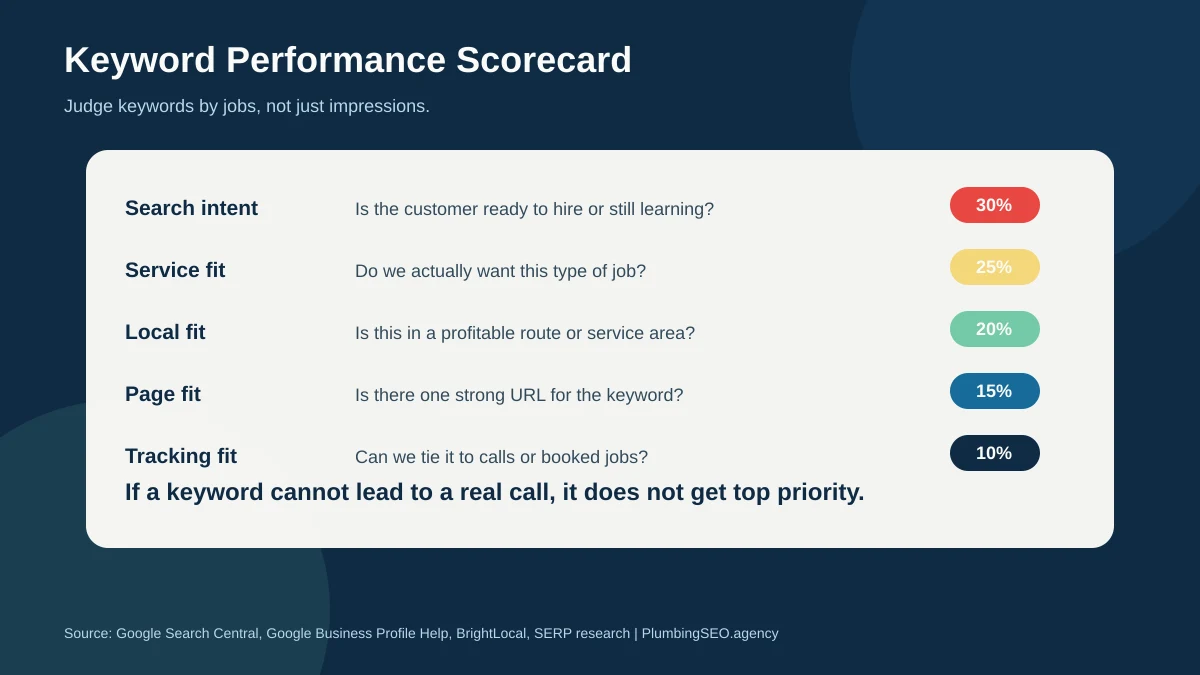
In my opinion, the best plumbing keyword is not the one with the biggest number beside it. It is the one that points to a job you want, in an area you serve, with a page you can make stronger than the current results. The report may look good, but the phone tells the truth.
The 30-Day Implementation Plan
Keyword research should not turn into a binder nobody opens. Use a 30-day cadence. It is long enough to gather real information and short enough to keep momentum.
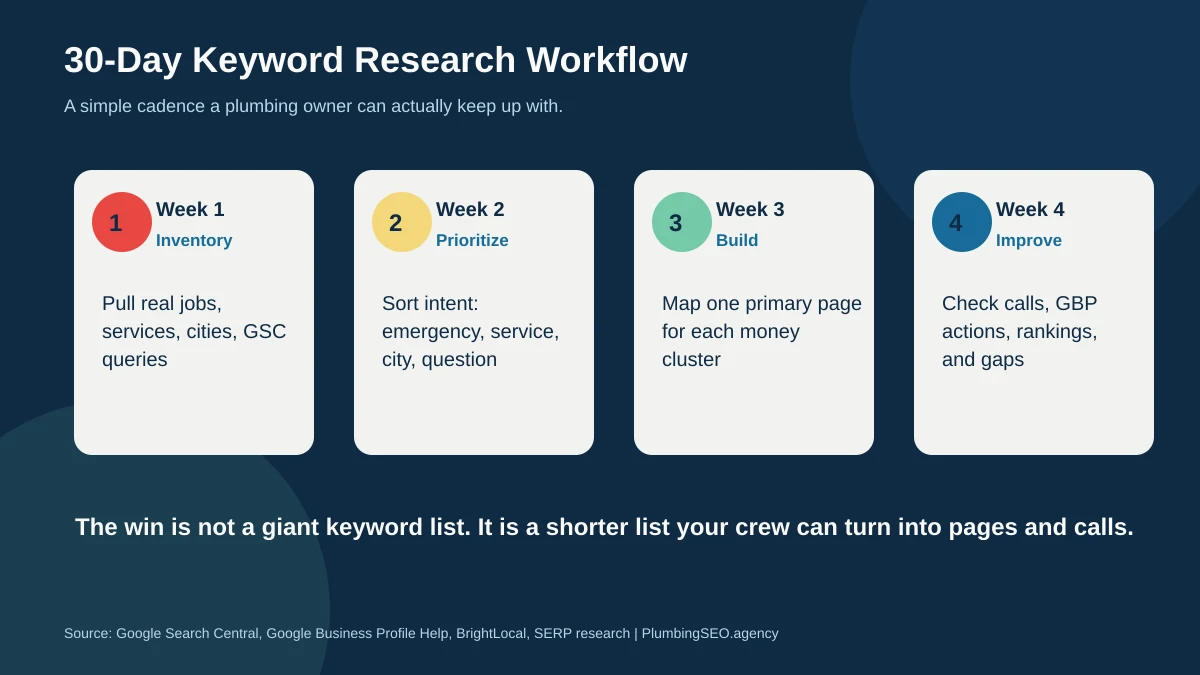
Week 1: Pull the raw inputs
Gather the last few months of booked jobs, missed calls, form leads, Google Business Profile actions, Search Console queries, PPC search terms if you run ads, and the services your team wants more of. If you work with an agency, ask them to show the source data, not just the final list.
Week 2: Sort by intent and page type
Create buckets: emergency, service, city, question, comparison, cost, brand, and competitor. Then assign a likely page type. If two keywords belong to the same searcher and the same page job, keep them together. If they serve different decisions, separate them.
Week 3: Build or improve the pages closest to revenue
Start with pages that can drive calls now. That usually means emergency services, core repairs, profitable replacements, and service-area pages for real routes. If you need help turning this into a campaign, our SEO for plumbing companies work is built around service pages, city coverage, tracking, and Maps visibility, not generic blog volume.
Week 4: Measure and adjust
Check rankings, but do not stop there. Review calls, booked jobs, lead quality, answer rate, form submissions, GBP actions, and whether the page attracted the right service area. Google's guide notes that SEO changes can take a few weeks to several months to show impact, so use early signals without panicking after one slow week.
Common Keyword Research Mistakes for Plumbing and HVAC Companies
| Mistake | Why it hurts | What to do instead |
|---|---|---|
| Chasing only search volume | High-volume DIY terms can fill reports without filling the schedule. | Prioritize intent, service fit, and route value. |
| Building one page for every tiny variation | Thin pages compete with each other and look copied. | Group related terms into one strong service page. |
| Ignoring service areas | You may rank for places you cannot serve profitably. | Map city keywords to real routes and crew capacity. |
| Using trade jargon only | Customers search by symptoms, not always by technical names. | Mix homeowner language with proper service terms. |
| Never checking calls | A ranking can look like a win while leads stay weak. | Track calls, forms, booked jobs, and close quality. |
What to Do Next
Do not start by buying another tool. Start by choosing the next five pages that would help the right customer find you before they call somebody else. For many companies, that means one emergency page, two high-margin service pages, one real service-area page, and one support article that answers a sales question your office hears every week.
If your current website already has pages but they are not producing calls, run the same checklist against what is live. You may find keyword cannibalization, missing city intent, weak titles, thin proof, or no call tracking. Our technical SEO checklist for plumbing websites can help you make sure the pages can actually be crawled, loaded, and understood.
Need a second set of eyes? Send us the site. We will look for the keyword leaks that are costing calls and show you what to fix first.
Frequently Asked Questions
It is a step-by-step process for finding the searches that can turn into real service calls, then mapping those searches to the right pages. For plumbers and HVAC companies, it should include services, emergency intent, city coverage, customer language, competitor gaps, and tracking.
Good keyword research shows which services and locations customers are already searching for. When each important keyword cluster has a focused page, Google can understand what you offer and customers can quickly see that you handle their problem in their area.
Yes, especially the first pass. Owners usually know the profitable jobs, bad routes, seasonal patterns, and customer language better than anyone. An agency or SEO specialist can help with SERP analysis, page mapping, technical fixes, and ongoing tracking.
There is no magic number. A small local shop may need a tight map of core services and nearby cities. A larger company may need many more service and service-area clusters. The better question is whether each keyword has a clear page, business value, and tracking path.
No. Build city or service-area pages only for real areas you serve and can support with useful local content, reviews, proof, and service information. Thin copied city pages can hurt trust and waste crawl attention.
Some page improvements can be reflected quickly, but meaningful SEO progress often takes weeks to several months. Track early indicators like impressions, crawl/indexing, calls, GBP actions, and lead quality while the pages mature.
Want the Keyword Map Built for You?
We will review your services, service areas, rankings, and page gaps, then show which keyword clusters should be fixed first to get more qualified plumbing calls.
Run My Free SEO Leak Check