
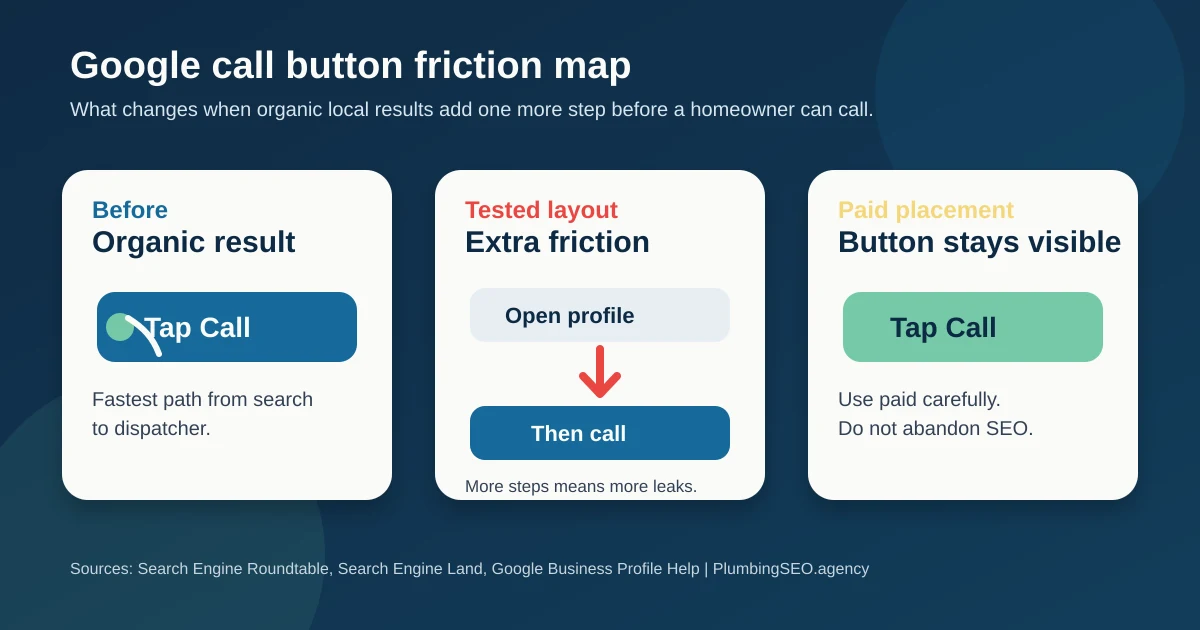
- Google appears to be testing local result layouts where organic listings lose the one-tap call button, while paid placements can still keep fast call actions visible.
- For plumbers, the fix is not panic. Protect calls with a stronger Google Business Profile, faster mobile website, clear click-to-call CTAs, review momentum, and clean tracking.
- Use paid coverage as a pressure valve for emergency calls, but keep building organic local SEO so every lead does not depend on buying the next click.
If your rankings look steady but the phone feels quieter, do not assume the market dried up overnight. Google has been seen testing local result layouts where the direct Call button is less visible on organic business listings. That matters because plumbing is not a casual shopping category. A homeowner with water on the floor is not building a spreadsheet. They want the fastest trustworthy plumber they can reach.
Search Engine Roundtable reported the local SEO community spotting Google local results without a call button and questioned whether it was tied to a Web Guide interface test or a bug. Search Engine Land also covered a broader problem: local rankings can look fine while calls and actions shrink because local search interfaces, AI packs, paid placements, and missing action buttons change how users behave.
That is the owner-side issue. You can be in the Map Pack and still lose calls if Google adds one more step between the customer and your dispatcher. One extra click does not sound like much until it happens during a burst pipe, a sewer backup, or a no-hot-water call before work.
What changed, and what has not changed
The careful wording is important: this appears to be a test or interface change, not a clean official announcement saying every organic call button is gone forever. Some searches still show call actions. Some markets may see different layouts. Google tests constantly. Sometimes the test sticks, sometimes it disappears like a 10mm socket.
What has not changed is the job of local SEO. Google still needs to understand who you are, what plumbing services you provide, where you serve customers, whether people trust you, and whether your business information is accurate. Google's own Business Profile help explains that profiles let businesses provide hours, website, phone number, location or service area, photos, videos, and reviews on Search and Maps.
The problem is conversion access. Ranking is visibility. A call button is action. If Google changes the action path, a plumber can keep visibility but lose speed to call.
Why this hits plumbing harder than most industries
A restaurant can survive a customer browsing photos. A consultant can wait for a form. Plumbing is different. A lot of valuable jobs start with urgency, trust, and speed. If the customer has to click into a profile, scan for a number, wait on a slow website, and then find a call button, you have already created openings for the next company.
Here is the practical risk for plumbing owners:
- Emergency intent leaks first. Burst pipes, backups, water heaters, and leak detection calls reward the company that is easiest to reach.
- Paid competitors can look easier to contact. If paid units keep stronger call actions, ad-heavy competitors may win calls even when your organic SEO is stronger.
- Reports can mislead you. Rank trackers can say you are still top three while GBP calls, website clicks, and booked jobs tell a different story.
- Weak websites get exposed. If Google pushes more users through your profile or website, a slow mobile page with a buried phone number becomes a real sales leak.
This is where advanced local SEO for plumbers matters. It is not just ranking the listing. It is making sure the listing, website, reviews, tracking, and service pages all work together when Google changes the playing field.
What the generic advice misses for plumbing companies
Generic marketing posts usually stop at, “optimize your GBP and try ads.” That is not wrong, but it is too thin for a service company carrying trucks, payroll, dispatch, after-hours calls, and reviews from real jobs. A plumber needs a lead-protection system, not a motivational paragraph.
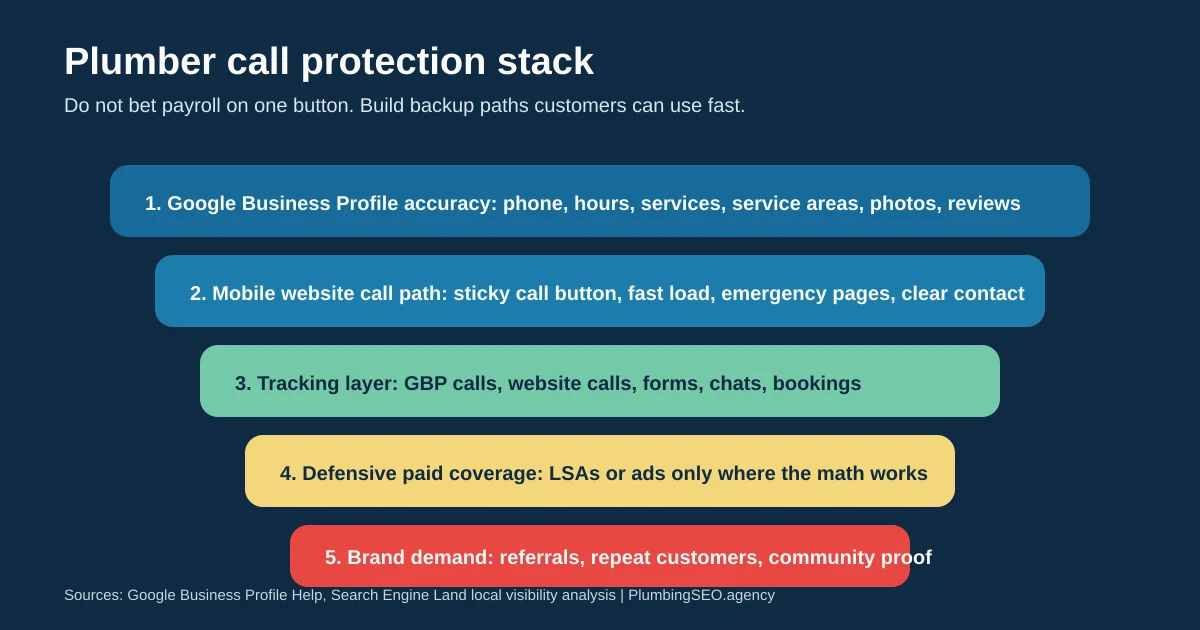
The way I see it, this change forces plumbing companies to answer five questions:
- Can a customer still call you quickly from every mobile page?
- Can Google clearly match your profile to the services you actually want?
- Can you tell whether lost GBP calls became website calls, forms, chats, or lost leads?
- Do you have paid coverage for emergency terms if organic action buttons get weaker?
- Are you building enough brand demand so customers search your name, not just “plumber near me”?
The plumber-specific response plan
1. Audit the Google Business Profile like calls depend on it
Start with the basics because broken basics get punished first when friction rises. Check the phone number, business hours, holiday hours, categories, services, service area, appointment link, website link, photos, products if used, and business description. Do not stuff fields. Make them accurate enough that Google and a tired homeowner both understand what you do.
Google says a Business Profile can show phone number, hours, website, location or service area, photos, videos, reviews, and other ways for customers to connect. That is your control panel. Treat it like dispatch, not like a brochure drawer.
2. Make the website the fastest backup call path
If Google makes users click through before calling, your website has to catch the lead. The phone number should be visible high on mobile. The header should have click-to-call. Emergency pages should have obvious call buttons above the fold. The contact page should not ask a panicked homeowner to solve a puzzle.
For the service pages themselves, connect local SEO to conversion. A good drain cleaning page should not only rank. It should make the next step clear, show proof, explain availability, and make calling easy. If you need the service-page foundation, start with SEO for plumbers and build outward from there.
3. Track calls by source, but do not break NAP consistency
When the call button changes, your reporting can get messy. GBP calls may drop while website calls rise. Or total calls may drop. Or paid calls may grow while organic still looks visible. Without tracking, you are guessing from a quiet phone.
Keep your primary public NAP consistent where it matters, then use safe tracking methods for website calls, forms, chat, and ad sources. Compare booked jobs, not just leads. A ringing phone is good. A booked sewer job is better.
4. Use LSAs or paid search as a guardrail, not a crutch
If paid placements keep stronger call actions, some plumbers will need paid coverage for high-intent emergency searches. That does not mean throwing money at every keyword. Start with a small test, define service areas, set intake rules, track cost per booked job, and pause what does not produce.
In my opinion, the right posture is hybrid. Organic SEO earns trust, service-area coverage, and long-term visibility. Paid search protects immediate call volume when the search page changes or when you are trying to fill a short-term gap. Do both with numbers attached.
| Lead path | What can break | Owner response |
|---|---|---|
| Organic Map Pack | Call button less visible or buried behind profile click | Strengthen GBP, photos, reviews, website CTA, and tracking |
| Website visit | Slow load, hidden phone number, weak emergency page | Add sticky click-to-call, clear service pages, trust proof, fast mobile UX |
| Local Services Ads | Higher costs or poor lead quality | Use tight service filters, answer fast, track booked jobs and disputes |
| Repeat and referral calls | No follow-up system or review flywheel | Ask for reviews, build email/SMS lists, promote maintenance reminders |
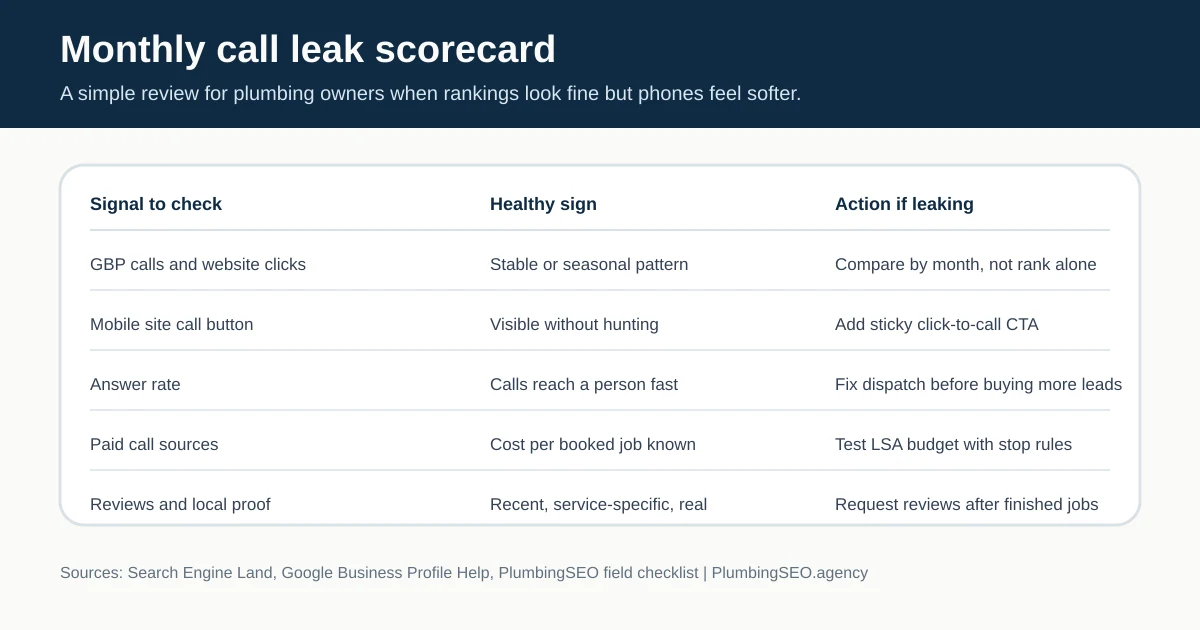
Monthly measurement: do not judge this by rankings alone
The biggest mistake is checking your Map Pack position once and declaring everything fine. That is like checking one fitting and ignoring the water stain on the ceiling. If SERP actions change, the phone tells the truth before the ranking report does.
Every month, review GBP calls, website clicks, website call tracking, forms, chats, paid calls, booked jobs, answer rate, missed calls, close rate, and revenue by source. If GBP calls fall but website calls rise, the lead path changed. If all calls fall while rankings hold, friction may be hurting you. If paid calls rise but booked jobs do not, the ad channel may be filling the board with tire-kickers.
Implementation checklist for this week
Here is the simple version. You can do this without waiting for Google to explain every test.
- Search from mobile. Check your main terms from a phone: “plumber near me,” “emergency plumber [city],” “water heater repair [city],” and your brand name.
- Screenshot the results. Save whether organic listings show call buttons, website buttons, ads, LSAs, or AI-style summaries.
- Pull GBP performance. Compare calls, website clicks, direction requests, and profile interactions over the last 12 months.
- Test your website call path. From mobile, count how many seconds and taps it takes to call from the homepage, top service pages, and contact page.
- Fix the obvious leaks. Add or improve sticky call CTAs, service-page CTAs, contact options, emergency copy, and local trust proof.
- Run a small paid test if needed. If calls are slipping on emergency work, test LSA or search ads with a fixed budget and booked-job tracking.
- Review after 30 days. Look at calls answered, booked jobs, revenue, and cost per booked job. Do not celebrate cheap leads that do not turn into work.
Common mistakes to avoid
Panic and buy everything
- Launching ads without call tracking.
- Ignoring missed-call rate and dispatch process.
- Letting paid leads hide weak website conversion.
Build a balanced call system
- Keep local SEO strong for long-term trust.
- Use paid only where the booked-job math works.
- Make every mobile page easy to call from.
Final takeaway for plumbing owners
Google tests removal of call button from organic listings because Google controls the search layout. You control how ready your business is when that layout changes. The winning plumbing companies will not rely on one button, one ranking report, or one ad channel.
Build the boring stuff well: accurate GBP, strong service pages, fast mobile site, click-to-call CTAs, reviews from real jobs, clean tracking, and a measured paid backup. That is not flashy, but neither is a pipe wrench. It works because it solves the problem in front of you.
FAQs About Google Call Button Changes for Plumbers
Not as a confirmed universal rollout. Search industry reports show Google testing or displaying local layouts where organic listings do not show the same direct call button. Treat it as a risk to plan for, not a reason to panic.
Plumbing calls are often urgent. If a homeowner has to take extra steps to find your number, some will call the easier option. That can reduce booked emergency work even when your rankings still look good.
No. Local SEO still builds trust, visibility, reviews, service-area relevance, and website traffic. The smarter move is to pair SEO with better mobile conversion paths and selective paid coverage when the numbers support it.
Fix the fastest call paths first: GBP accuracy, mobile website click-to-call, service-page CTAs, contact page clarity, and call tracking. Then evaluate paid coverage for emergency terms if call volume is slipping.
A small shop can handle the basic audit: check mobile search results, GBP settings, website call buttons, and monthly calls. Hire help if you need service-area SEO, tracking setup, conversion fixes, or paid campaigns tied to booked-job ROI.
Website call-path fixes can help as soon as they go live. GBP and review improvements usually need weeks to months. Paid tests can produce faster call data, but you still need 30 days or more to judge booked-job quality.
Worried Google Changes Are Costing You Calls?
We will check your GBP, mobile call path, service pages, tracking, and local SEO so you can see where calls are leaking before you spend more on ads.
Run My Free SEO Leak Check