
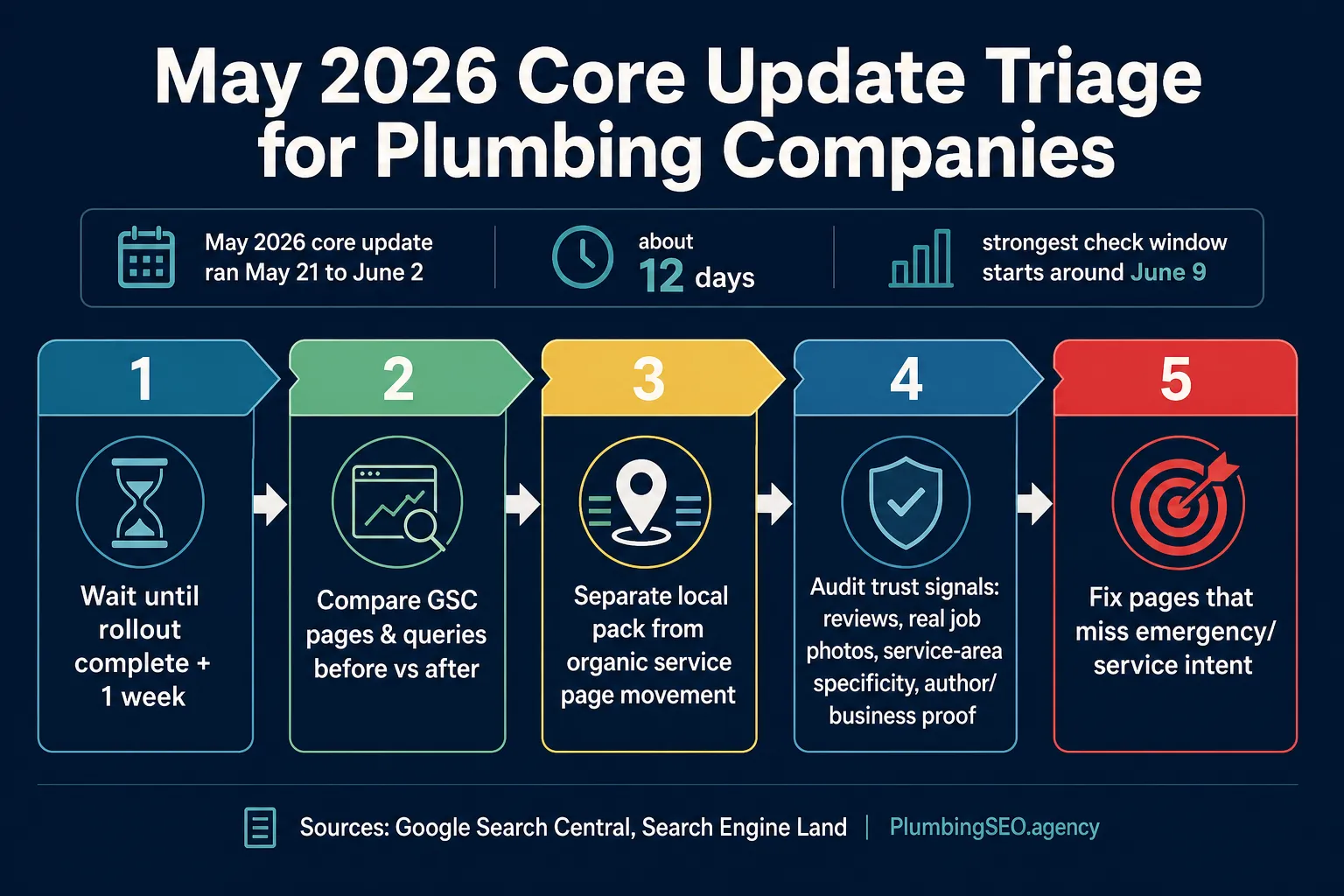
- The May 2026 core update ran May 21 through June 2. Do not panic edit every page. Wait for clean Search Console data, then compare the right windows.
- For plumbing companies, the first checks are service-page clicks, local pack calls, Google Business Profile accuracy, reviews, photos, and whether each page matches the exact job intent.
- Fix pages that lost the right calls first. Thin city pages, copied service copy, weak trust proof, and vague emergency pages deserve attention before chasing every ranking wiggle.
If your rankings moved during Google's May 2026 core update, take a breath before you start tearing apart the website.
The update started on May 21, 2026 and finished on June 2, according to reporting from Search Engine Land. Industry trackers saw heavy volatility during the rollout. That matters, but it does not mean every plumbing company should rewrite every service page by Friday.
For a plumber, the real question is simpler: did the update cost you the right calls, in the right service area, for the jobs you actually want?
What changed, in plain English?
A Google core update is a broad reassessment of what deserves to rank. Google explains that core updates are not aimed at one website or one page. They are designed to better surface helpful and reliable results as the web changes. Their own advice is to wait at least a full week after completion before judging a traffic drop in Search Console.
That waiting part is hard when the phones are quiet. I get it. But making panic edits during a rollout is like replacing every pipe in the wall because one fixture gurgled. You might fix something. You might also create three new leaks.
The May update looks important for local intent
One useful signal from the early discussion was the pressure on thin middleman and directory-style pages for local searches. A community thread tracking the rollout reported steep movement on several "near me" directory queries, including plumber searches. That is not a scientific industry study, but it fits the bigger pattern local business owners should care about.
If someone searches for an emergency plumber, Google has a choice. Show a page that scraped a list of contractors, or show an actual plumbing company with a real Business Profile, reviews, service proof, photos, and a page that answers the job. For a real shop doing good work, that can be an opening.
The key is proving you are the useful answer, not just another page with the words "plumber near me" stuffed into the title.
Check the right numbers first
Do not start with a rank tracker screenshot. Start with business impact.
| Check | What to compare | Why it matters for a plumber |
|---|---|---|
| Google Search Console pages | One clean week after rollout vs the week before May 21 | Shows whether a specific service page lost qualified search demand. |
| Queries by intent | Emergency, repair, installation, price, and city/service-area terms | A drop on a research query is different from a drop on "water heater repair near me." |
| GBP calls and direction actions | Calls, profile views, and Maps actions before and after the update | Local pack changes can hurt calls even if website clicks look steady. |
| Booked-job quality | Call tracking notes, dispatch area, and job type | The phone tells the truth. Rankings that bring wrong-area calls do not pay payroll. |
What plumbing pages usually move after a core update?
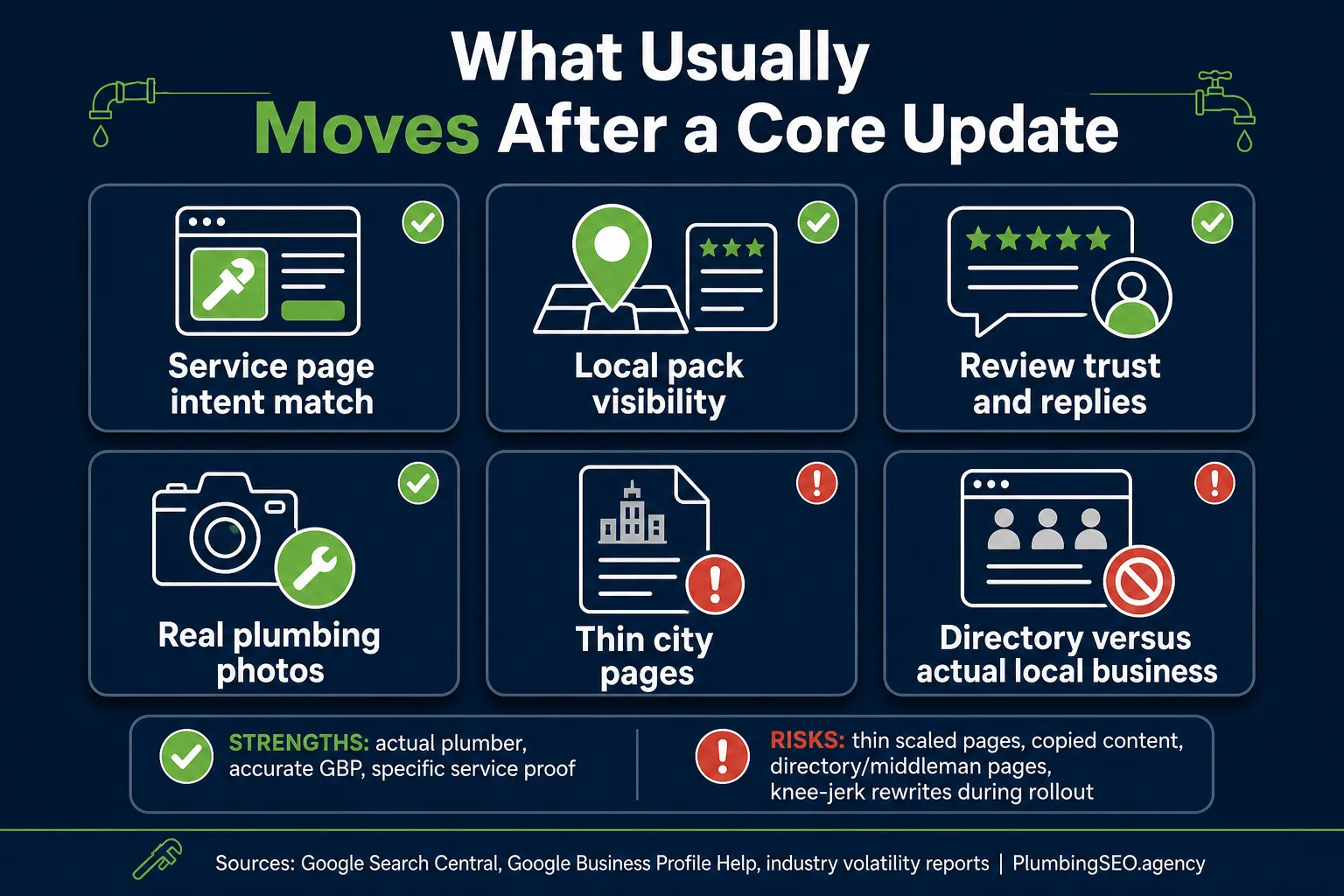
Core updates tend to expose weak spots that were already there. For plumbing sites, those weak spots usually fall into a few buckets: intent mismatch, thin local pages, weak trust proof, stale service details, and poor internal links between helpful pages.
1. Service pages that do not match the job
A customer with water backing up in the tub does not want a broad essay about plumbing. They want to know if you handle drain backups, how fast you respond, what area you cover, and how to call you. If your emergency page reads like a generic brochure, it may not deserve the call when Google reassesses results.
This is where a focused free plumbing SEO audit helps. You are not looking for every possible SEO issue. You are looking for the leaks that cost calls.
2. Thin city pages
City pages can work when they show real service-area knowledge. They become a problem when every page is the same paragraph with the city swapped out. If your "Plano water heater repair" page says the exact same thing as your "Frisco water heater repair" page, Google has little reason to treat either one as special.
Good local pages should include real service details, neighborhoods or landmarks when helpful, photos from nearby jobs, review proof, dispatch notes, and links to the core service page. The page should sound like your company actually works there.
3. Google Business Profile trust signals
Google's own local ranking guidance points to complete business information, verification, accurate hours, review responses, and photos. That lines up with common sense. If two shops are close by, the one with current hours, strong reviews, job photos, and a clear service category gives customers more confidence.
Do not treat your Business Profile as a side chore. For many plumbing searches, it is the front door.
4. Content that sounds like it was made for a ranking report
Google's helpful content guidance asks whether the page gives original, useful information and whether it provides value compared with other search results. A plumbing company does not need to become a newspaper. It does need pages that answer the customer's real question better than the next shop.
For example, a sewer line page should explain symptoms, when a camera inspection is needed, what can wait, what cannot, and how the owner can book the right help. That is useful. A page that says "we offer quality sewer line services in your area" fifteen different ways is not.
Not sure which page lost calls?
Start with the pages tied to booked jobs: emergency plumbing, drain cleaning, water heater repair, sewer line repair, leak detection, and your biggest service areas.
See the plumbing SEO processWhat to fix first after the May 2026 update
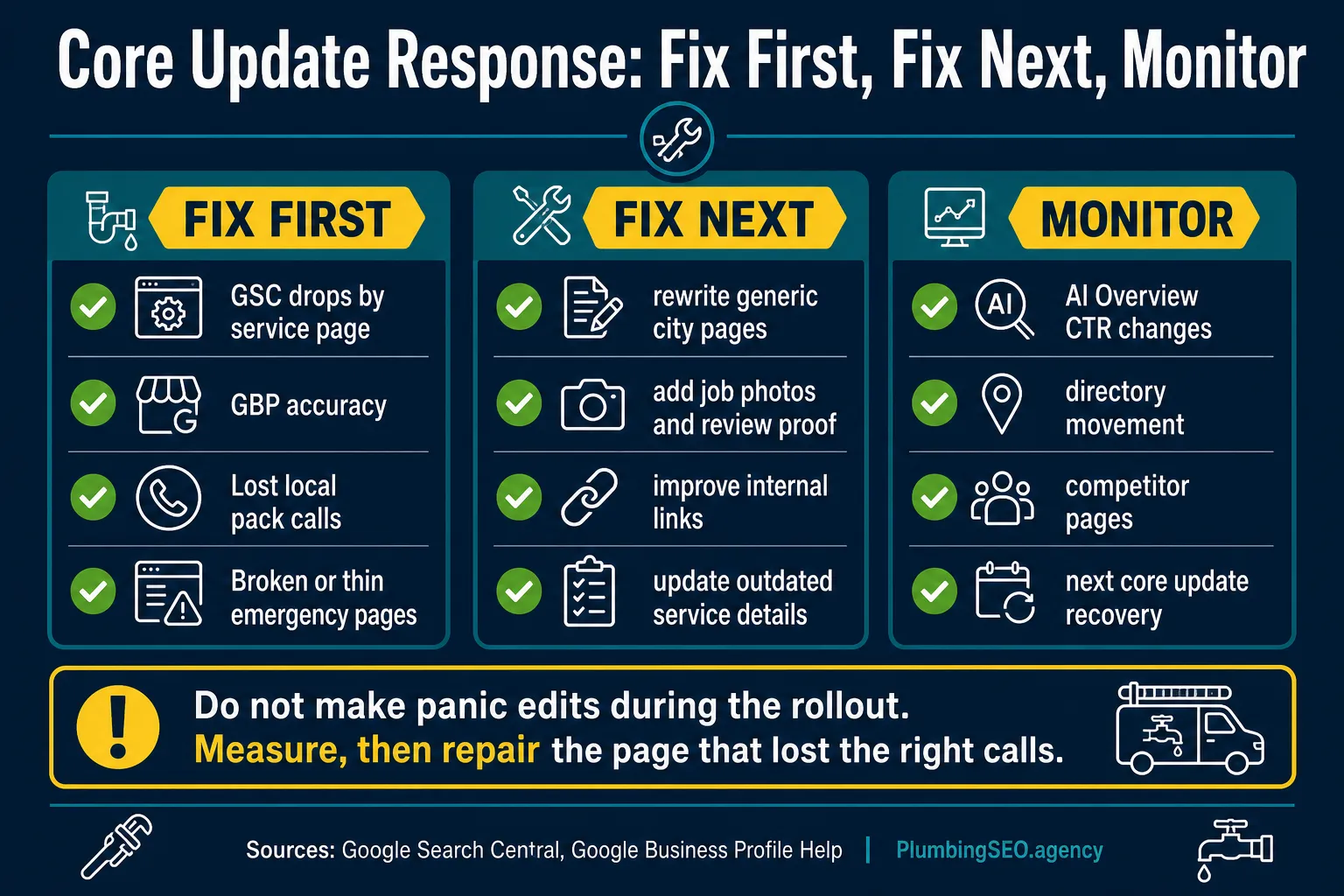
The best response is not "do more SEO." That is too vague to help anyone. The best response is to sort your work by what protects calls.
Fix first: pages that lost money intent
If an emergency service page lost clicks and calls, work there before you polish a blog post. Make sure the page answers the exact search, shows the service area, has a clear phone CTA, uses real plumbing photos, and links to related services. If the page is thin, rewrite it around the actual job.
Our guide to professional plumbing SEO services breaks down the kind of monthly work that should support this, from service-page improvements to tracking.
Fix next: trust proof and internal links
Once the urgent pages are covered, strengthen the proof around them. Add job photos with descriptive alt text. Add review themes where appropriate. Link supporting blog posts and related services to the money page. If your water heater page connects naturally to pricing, installation, repair, and maintenance content, Google and customers both get a clearer picture.
If you want the whole site working together, the foundation matters. That is where plumbing SEO services should connect content, maps, technical health, and conversion tracking instead of treating rankings as a standalone report.
Monitor: AI Overviews, directories, and competitors
Search results are not just ten blue links anymore. AI Overviews, map packs, directories, ads, and review-rich profiles can all change how many people click. If rankings look flat but calls changed, inspect the whole search result before blaming one page.
Also watch whether directories fall or rise in your local SERPs. If middleman pages lose ground and actual plumbing companies move up, that is your chance to make your pages and Business Profile look like the best real-world answer.
What not to do
- Do not rewrite every page at once. You will not know what helped or hurt.
- Do not delete pages just because rankings bounced. Core updates can settle in stages.
- Do not copy competitor pages. If they move up, figure out the intent they satisfy, then build a better answer from your own proof.
- Do not chase vanity rankings. The goal is booked plumbing work, not a pretty report.
The practical takeaway for plumbing owners
The May 2026 core update is a reminder that plumbing SEO has to be grounded in real service. The companies most likely to come out stronger are the ones that can prove who they are, where they work, what they fix, and why customers trust them.
Measure first. Fix the pages tied to calls. Strengthen the Business Profile. Add proof from real jobs. Then keep the trucks moving.
FAQ: May 2026 Core Update for Plumbing Companies
Google's May 2026 core update finished on June 2, 2026 after starting on May 21. Google's guidance is to wait at least a full week after completion before analyzing Search Console changes.
No. Wait for a clean comparison window, then check which pages and queries actually lost qualified calls or clicks. Panic edits during rollout noise can make diagnosis harder.
Check service pages, emergency queries, city and service-area terms, and pages tied to booked jobs. Compare the clean post-rollout week with the week before the update began.
Core updates are organic search updates, but plumbing owners should still review local pack visibility, Business Profile actions, reviews, photos, and calls because customers often find plumbers through Maps and local results.
Thin city pages, generic service pages, copied content, outdated emergency pages, and pages without real trust proof are usually the first places to inspect.
Improve the page that lost qualified service demand. Make the job intent clear, add real proof, strengthen the call CTA, update service-area details, and connect it with relevant internal links.
Want to know which plumbing page is leaking calls?
Run a focused plumbing SEO audit. We will look at the pages, queries, and local signals that actually affect booked jobs.
Run My Free SEO Leak Check