
- Backflow testing searches are compliance searches. The customer usually has a notice, a deadline, or a failed device, so the page must prove certification fast.
- A strong backflow SEO page should connect the Google Business Profile, service-area wording, device types, report filing, repairs, and clear phone booking.
- Use this blog to support your main plumbing SEO strategy, then link the backflow page into commercial plumbing, irrigation, fire protection, and local SEO content.
If a plumbing company offers backflow testing but only mentions it once on a general services page, calls are probably leaking away.
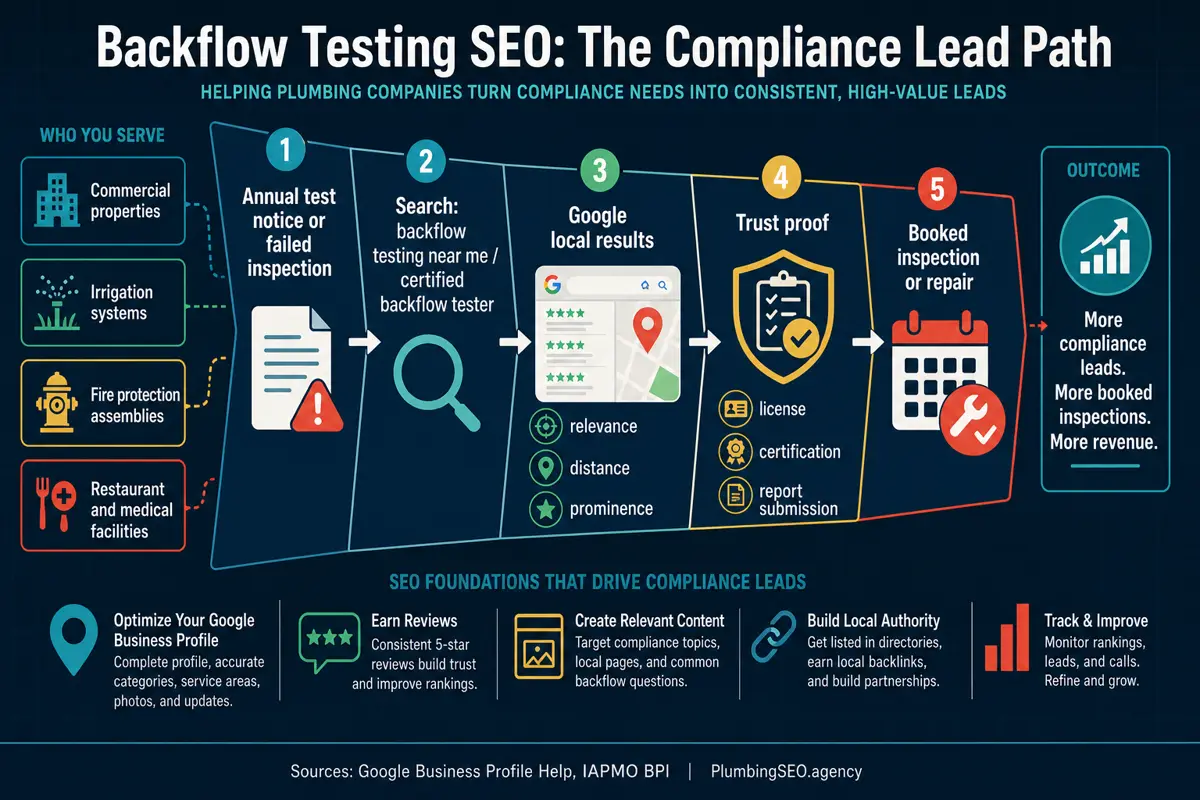
Backflow work is not like a loose faucet search. The customer may have an annual notice from the water authority, a commercial tenant asking for proof, a failed assembly, or a deadline before water service becomes a problem. They are not browsing. They are trying to get compliant and get back to work.
That is why backflow testing SEO needs its own plan. The page has to show Google what you do, show the customer you are qualified, and make the next step simple enough that the office manager can book it between invoices.
The way I see it, the right goal is not just ranking for backflow testing SEO as a topic. The real goal is ranking for the inspection, certification, report, and repair searches that turn into booked calls.
Why backflow testing searches behave differently
Most local plumbing SEO is built around need. Drain clogged. Water heater failed. Pipe leaking. Backflow testing is built around need plus compliance. That changes the page.
A customer searching this topic may need a certified tester, an annual inspection, a report filed with the city, a failed-test repair, or proof for a property manager. If your page only says, "we do backflow testing," it is doing the bare minimum. Bare minimum is not much of a lead machine. It is more like a wrench left in the truck when the job is inside.
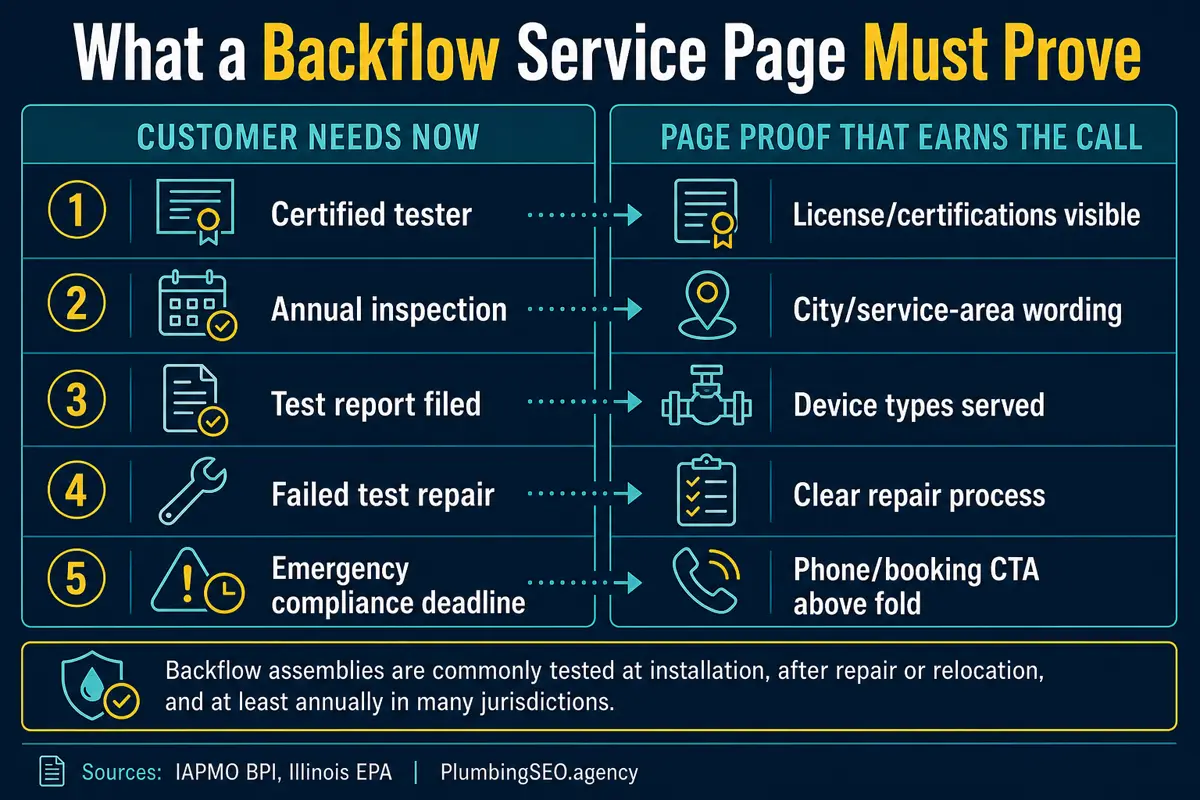
Industry guidance backs up why this service deserves clear treatment. IAPMO BPI notes that backflow prevention assemblies are commonly tested at installation, after repair or relocation, and at least annually in many jurisdictions. Illinois EPA also states that facilities with backflow prevention devices must have them inspected and tested at installation and at least annually thereafter.
That means the demand is not random. It comes back on a schedule. If your plumbing company is certified to do the work, the SEO plan should turn that recurring need into a recurring call path.
The page must prove certification before it sells
For a lot of plumbing services, the customer wants speed and price. For backflow testing, they also want proof. They need to know the person showing up can test the device, understand the paperwork, and avoid making their compliance problem worse.
Put that proof high on the page. Do not bury it under a long company story. A practical backflow testing page should answer these questions near the top:
- Are you a certified or licensed backflow tester in this service area?
- Do you handle annual tests, new installation tests, failed tests, and retests?
- Which properties and assemblies do you work on?
- Do you file or help submit the test report?
- Can the customer call, text, or book quickly?
If you cannot answer those questions, the page may rank someday, but the phone will still tell the truth.
Build the backflow page around the jobs you actually want
Backflow SEO gets messy when the page tries to chase every phrase with the same paragraph. A better approach is to build around the jobs your company can truly perform.
| Search intent | What the customer needs | What your page should show |
|---|---|---|
| Backflow testing near me | A local certified tester | Service area, phone CTA, certification proof, Google review language |
| Backflow certification | A valid test and report | How testing works, what documentation is provided, who receives the report |
| Commercial backflow inspection | Property compliance | Commercial property examples, scheduling process, deadline handling |
| Failed backflow test repair | Repair plus retest | Repair steps, replacement options, retest process, urgency language |
| Irrigation backflow testing | Seasonal device testing | Irrigation assembly wording, neighborhoods served, annual reminder option |
This is where plumbing SEO services for plumbers should get specific. A general SEO plan can improve traffic, but a service-line SEO plan should make the right job easier to find and easier to book.
Tune your Google Business Profile for backflow relevance
Google says local results are mainly based on relevance, distance, and prominence. That matters here because backflow searches often happen inside a city or utility service area. Your site and your Google Business Profile need to tell the same story.
Start with the simple things. Add backflow testing to services where appropriate. Keep your business hours accurate. Use photos that show commercial plumbing work, test kits, labeled trucks, and clean jobsite proof. Ask happy backflow customers to mention the service by name in reviews when they are comfortable doing so.
Then connect the profile to the page. If the profile says you provide backflow testing, the website should explain backflow testing. If the page says you serve commercial properties in a city, your local signals should support that city. That is how you avoid the classic SEO mess where every part of the system points in a different direction.
For the broader local visibility stack, our Google Maps SEO for plumbers guide explains how Maps visibility, reviews, categories, and service pages work together.
Use compliance content without pretending to be the regulator
Your page should be useful, but it should not act like the final legal authority for every city, county, and water district. Regulations vary by jurisdiction. Say that plainly.
A strong backflow testing page can explain the common workflow, then tell customers to confirm local requirements with their water authority. The EPA describes cross-connections as actual or potential connections between potable and nonpotable water plumbing, and backflow as the unintended reversal of water flow. That is enough to educate the customer without overstepping.
Use simple wording. "We test the assembly, document the results, explain any failure, and help with the report process where local rules allow." That sounds a lot better than ten paragraphs of code language nobody wants to read on a lunch break.
Internal links should support the call path
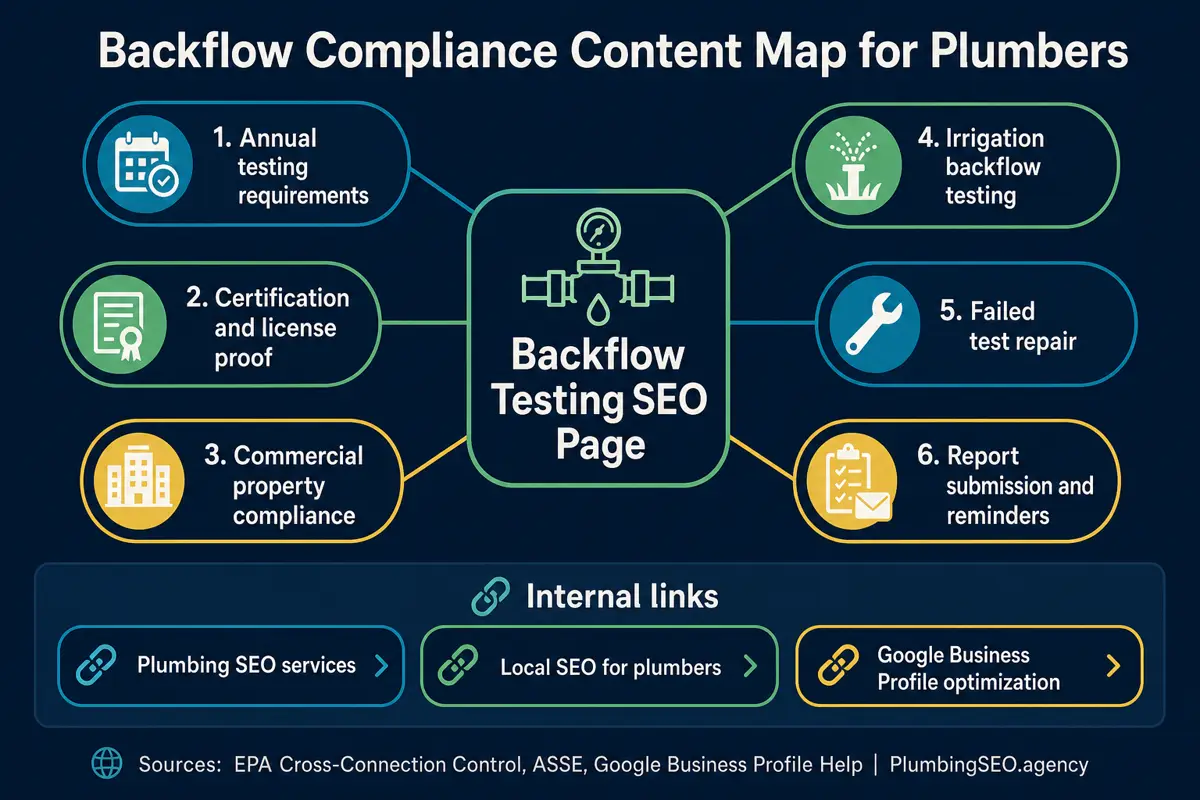
Backflow testing sits at the crossroads of plumbing skill, local search, and compliance trust. Internal links should reflect that. Do not dump ten links under a "related services" heading and call it strategy.
Use links where they help the reader make the next decision:
- Link from commercial plumbing content to the backflow page when you mention annual property testing.
- Link from irrigation or sprinkler pages when you mention seasonal backflow checks.
- Link from the backflow page to a free plumbing SEO audit if the reader is a plumbing owner checking their own visibility.
- Link from educational blogs to the main plumbing SEO service page when the next step is fixing the whole search system.
The point is not to pass magic link juice. The point is to help Google and the customer understand the service cluster. If a page earns a call, it should be tied into the rest of the shop, not sitting alone like a spare part nobody labeled.
Track backflow calls separately
Backflow leads can look small if they are mixed into one generic "plumbing" bucket. Separate them. Track calls from the page, form submissions, booked inspections, failed-test repair follow-ups, and repeat annual customers.
That is especially important because backflow testing can open doors. A test can lead to a repair, a replacement, commercial maintenance, or a better relationship with a property manager. If the first call is measured as a tiny ticket and the follow-up work is ignored, the marketing report will undersell the service.
In my opinion, this is where a plumbing company should be stubborn. Do not judge the page only by page views. Judge it by qualified calls, booked tests, compliance jobs completed, and whether the customer comes back next year.
What I would fix first
If your plumbing company already offers backflow testing, I would not start with a dozen blog posts. I would fix the core page first.
Fix first
- One dedicated backflow testing page.
- Certification and service-area proof above the fold.
- Clear sections for annual testing, failed tests, repairs, and reports.
- Strong call and booking CTA.
Fix next
- Google Business Profile service details.
- Internal links from commercial, irrigation, and local SEO pages.
- FAQ schema for common compliance questions.
- Call tracking that separates inspection leads from general plumbing.
After that, build support content only where it helps. A guide for commercial property managers may make sense. A city-specific backflow page may make sense if you truly serve that city and have proof. A thin spun page for every suburb does not make sense. Google is confusing, but it is not completely asleep.
Backflow testing SEO works best when the page is useful, the proof is real, and the next step is obvious. That is what gets the right customer to call before they hand the job to another shop.
Backflow Testing SEO FAQs
Backflow testing SEO is the process of helping a plumbing company rank for searches tied to backflow inspection, certification, annual testing, failed-test repair, and local compliance needs.
Yes, if the company is certified or licensed to provide backflow testing in its service area. A dedicated page can show qualifications, device types, annual testing language, repair options, reporting steps, and local service coverage better than a generic plumbing page.
It should include certification proof, service areas, annual testing details, commercial and irrigation examples, failed-test repair steps, report submission guidance, FAQs, phone or booking CTAs, and internal links to related plumbing SEO or commercial plumbing pages.
They need a complete Google Business Profile, consistent service-area signals, a dedicated backflow testing page, local proof, reviews that mention relevant services naturally, clean citations, and strong internal links from related plumbing content.
Yes. Commercial properties, restaurants, medical buildings, irrigation systems, and fire protection assemblies often create compliance-driven searches. The page should speak to those use cases without overpromising legal or regulatory outcomes.
Track rankings, clicks, calls, form fills, booked inspections, failed-test repair work, and repeat annual testing customers. Backflow SEO should be judged by qualified compliance calls, not just traffic.
Want more service-line calls from Google?
If backflow testing, commercial plumbing, drain cleaning, or water heater work matters to your company, start by finding the SEO leaks that keep those pages from earning calls.
Run My Free SEO Leak Check