
- AEO is not a magic AI trick. It is clear service-page structure, direct answers, local proof, and clean schema that help machines trust what customers can already see.
- Fix one money page at a time. Start with drain cleaning, water heater repair, sewer line repair, or another service that actually keeps trucks busy.
- The page still has to sell the call. If the answer is easy to quote but the phone number, service area, reviews, and next step are weak, the job can still leak away.
Answer engine optimization for plumbers means making your service pages easy for search engines, AI answers, voice assistants, and real homeowners to understand. The goal is simple. When someone asks a direct question like "who repairs tankless water heaters near me" or "how much does emergency drain cleaning cost," your page gives a clear answer, proves your company can handle it, and makes the next call easy.
In my opinion, plumbers should stop treating AEO like a separate shiny thing. The winning move is to make every important service page answer-ready. That means the page names the service, names the city or service area, answers the real buying questions, backs the claims with proof, and labels the content with valid structured data.
Google Search Central explains that structured data gives Google explicit clues about the meaning of a page. That is useful, but it is not a replacement for good visible content. Google also says not to add structured data for information that is not visible to users. For plumbing owners, that is the rule to remember. Say the useful thing on the page first. Then mark it up cleanly.
What AEO Changes on a Plumbing Service Page
A normal SEO service page might chase a keyword and then bury the useful answer halfway down the page. An AEO-ready page does not make the homeowner dig. It opens with the answer, then gives enough local proof for a person or an answer system to trust it.
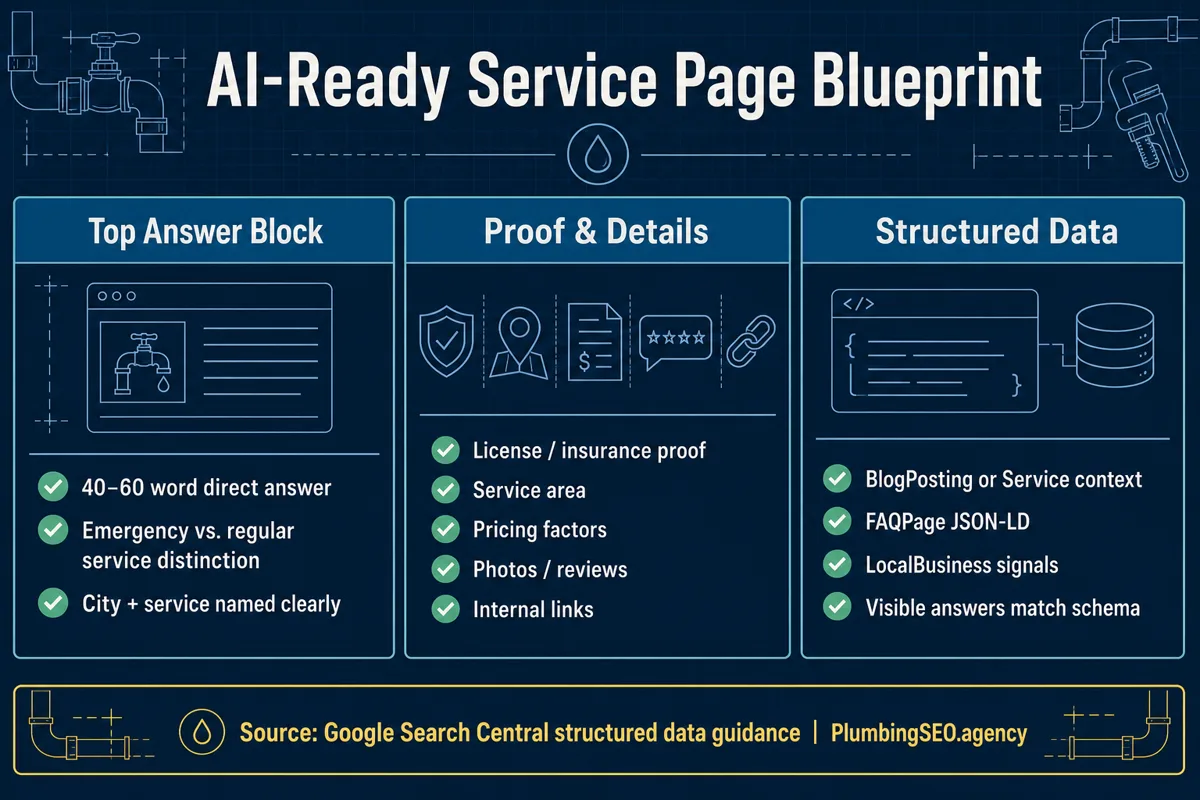
A service page becomes easier to quote when the answer, proof, and markup all describe the same real plumbing service.
Think of it like a service ticket. If dispatch writes "leak somewhere," the tech has to guess. If the ticket says "slab leak suspected, north Dallas, water meter spinning, customer hears running water near hall bath," the crew starts with better information. Your service page should give search systems that same clean job ticket.
That does not mean stuffing every page with the same FAQ block. It means each service page answers the questions tied to that job. A drain cleaning page should handle clog symptoms, emergency timing, camera inspection, and prevention. A water heater page should handle repair versus replacement, fuel type, permit basics, and same-day limits.
The First 60 Words Matter More Than Most Owners Think
The opening answer should be plain enough for a customer and specific enough for a machine. Do not start with company history. Do not start with "we are committed to excellence." Start with the job, the area, and what the customer can expect.
Here is a better pattern for a service page opening:
Example: We repair and replace tankless water heaters for homeowners in Austin and nearby service areas. If your unit shows an error code, runs cold, leaks, or will not ignite, our plumbers can inspect the system, explain repair versus replacement options, and help you book the right next step.
That paragraph gives the service, symptoms, location, process, and call path. It does not guarantee a ranking. It does give search systems and customers something useful to work with before they bounce to another shop.
Fix Pages in the Same Order a Good Dispatcher Thinks
Do not start by arguing about schema types while the actual page still says almost nothing. Fix the business answer first, then the proof, then the markup, then the measurement. Boring order wins here. Flashy order wastes afternoons.
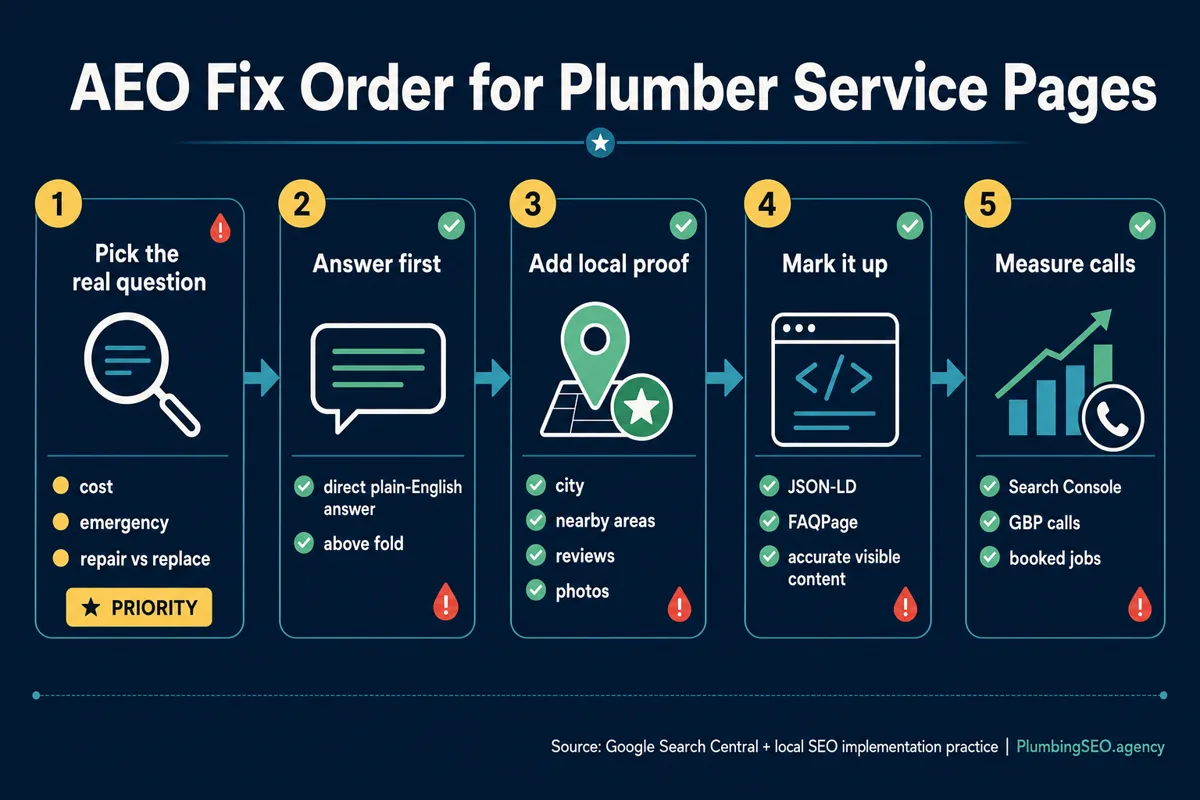
The right order keeps the page useful for homeowners before it tries to become useful for answer engines.
1. Pick the question that leads to a booked job
Start with one real service question. "Do you repair sewer lines in Plano?" is better than "best plumbing solutions." "Should I repair or replace my water heater?" is better than "water heater content." Owners know these questions because customers ask them on calls every week.
2. Answer first, then explain
Put a short answer near the top. Then use headings, examples, and supporting details underneath. If the page makes a tired homeowner scroll through three screens before learning whether you do the work, another company may get the call.
3. Add local proof
Answer systems need trust signals, but so do people. Show service areas, review snippets, job photos, license and insurance language where appropriate, and a clear way to call or request help. If you serve several cities, be honest about that. Do not pretend every city is a separate office.
4. Mark up only what the page actually shows
Use JSON-LD for article or service context, organization details, breadcrumbs, and visible FAQs when it fits. Google's FAQ structured data documentation also notes that FAQ rich results are limited mostly to well-known government and health sites. That does not make visible FAQs useless. It means the customer value and page clarity come first.
5. Measure the phone, not just the chart
Search Console, rankings, and crawl data matter. For a plumbing company, the final test is better calls from the right service area. Track forms, phone calls, booked jobs, and bad-fit calls. A page that brings traffic but not work still needs tightening.
What to Put on Each AEO-Ready Service Page
Use this as a working checklist for high-value plumbing services. You do not need every detail on every page, but the big items should be covered before you worry about advanced AI search language.
| Page Element | What It Should Answer | Owner-Side Reason |
|---|---|---|
| Direct answer block | What service do you provide, where, and what happens next? | Stops the customer from guessing and gives AI systems a clean summary. |
| Symptoms and fit | When should the customer call for this service? | Pre-qualifies urgent jobs and cuts down on wrong-service calls. |
| Pricing factors | What changes the cost, even if you cannot quote the job online? | Builds trust without promising a price sight unseen. |
| Local proof | Do you really serve this area and do this work? | Supports rankings, trust, and conversion at the same time. |
| FAQ section | What questions block the customer from calling? | Turns common objections into plain answers before the phone rings. |
| Structured data | Can search systems classify the page and match visible facts? | Reduces ambiguity and helps technical SEO without hiding anything. |
Trust Signals That Help AI Answers and Homeowners
A lot of AEO talk sounds like it was written for software, not service companies. Plumbing is different. A homeowner is not just buying information. They are deciding who gets inside the house, near the water line, under the sink, or beside the water heater. Trust has to show up fast.
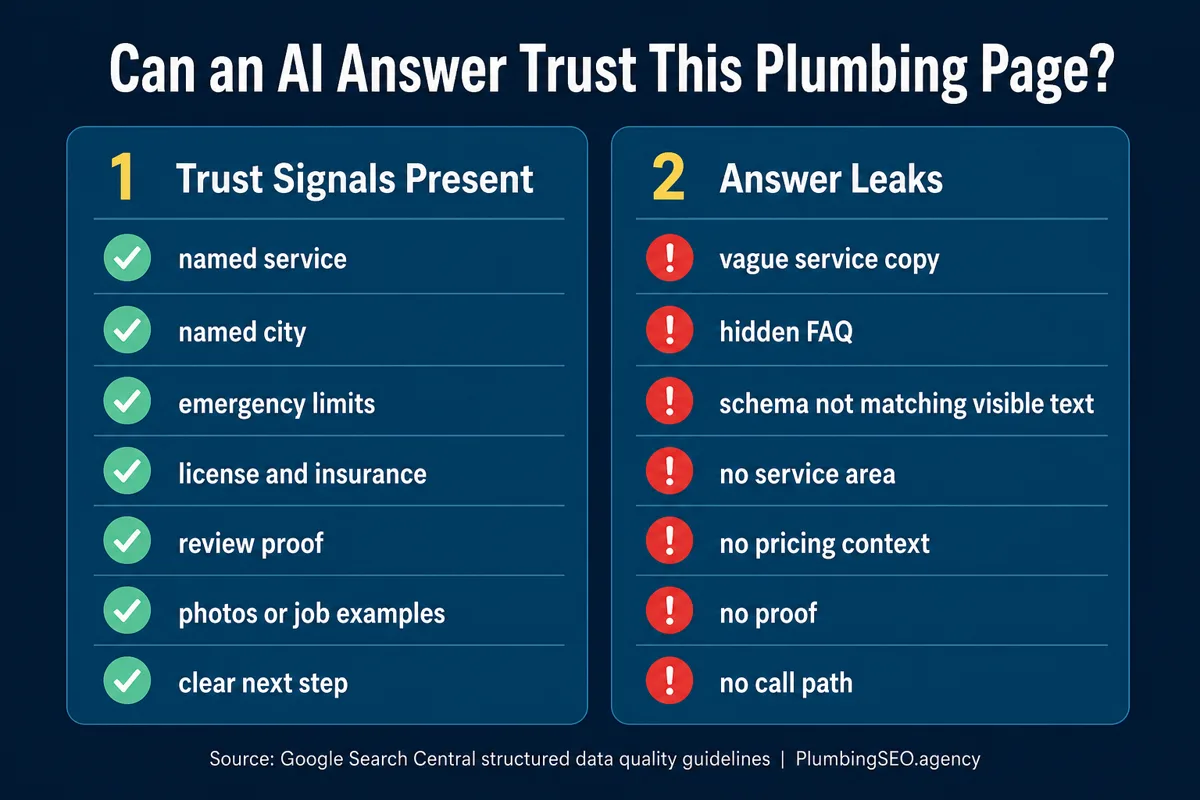
If a person would not trust the page, do not expect an answer system to treat it like the best source.
The biggest leak is vague service copy. "Quality plumbing solutions" tells nobody what you fix. Strong pages say the service, the limits, the area, and the next step. If you only offer emergency work during certain hours, say that. If estimates require an inspection, say that. Honesty can convert better than overpromising, and it creates fewer angry callbacks.
AEO Does Not Replace Local SEO for Plumbers
The way I see it, AEO sits on top of local SEO. It does not replace your Google Business Profile, reviews, citations, links, service pages, speed, or tracking. If the foundation is cracked, the fancy answer layer will not save it.
Pair this work with a broader SEO for plumbers plan and a clean local strategy. If you are still building the basics, our guide to advanced local SEO for plumbers explains how service areas, city relevance, reviews, and internal links work together.
For many shops, the best first project is not "optimize for every AI tool." It is choosing five money pages and making each one clearer than the competitor above you. Drain cleaning, water heater repair, sewer line repair, slab leak detection, and emergency plumbing are good places to start because those pages can connect directly to calls and booked jobs.
Common AEO Mistakes on Plumbing Websites
- Writing for robots first: If a homeowner cannot understand the answer, the page is not ready.
- Using the same FAQ everywhere: Repeated generic answers make service pages feel thin and unhelpful.
- Adding schema for hidden facts: Markup should describe visible page content, not facts you were afraid to publish.
- Ignoring the call path: A quoted answer still needs a visible phone number, button, form, or booking step.
- Measuring only impressions: Watch calls, booked jobs, service-area fit, and close quality.
Bad AEO is like labeling every drawer in the truck while the tools are still missing. The label helps only after the real work is there.
Simple 30-Day Rollout Plan
Keep the rollout small enough to finish. Pick one service page per week, fix the answer and proof, then validate the markup. After four weeks, compare impressions, clicks, calls, and booked jobs for those pages.
- Week 1: Pick one high-value service page. Rewrite the top answer block and add service-area clarity.
- Week 2: Add proof, symptoms, pricing factors, job photos, and internal links.
- Week 3: Add visible FAQs and matching JSON-LD. Validate the page before pushing live.
- Week 4: Watch Search Console, call tracking, GBP actions, and booked jobs. Keep what helps. Fix what does not.
If you want another set of eyes on the pages that matter most, start with a free plumbing SEO leak check. We will look for the places your service pages are losing trust, calls, and local visibility.