
- A long-tail keyword is a specific search phrase. For plumbers, it usually names the job, location, urgency, or customer problem, not just the word "plumber."
- The win is better intent, not bigger volume. A phrase like "same day water heater leak repair Austin" can bring fewer visitors but better calls than a broad keyword.
- Map every money keyword to one page. Service pages, city pages, FAQs, and blog posts should each have a job instead of fighting each other.
If your phone is quiet, a broad keyword report will not fix it by itself. A plumbing company does not need to be visible for every possible search. It needs to show up when the right homeowner has the right problem in the right service area and is close to calling.
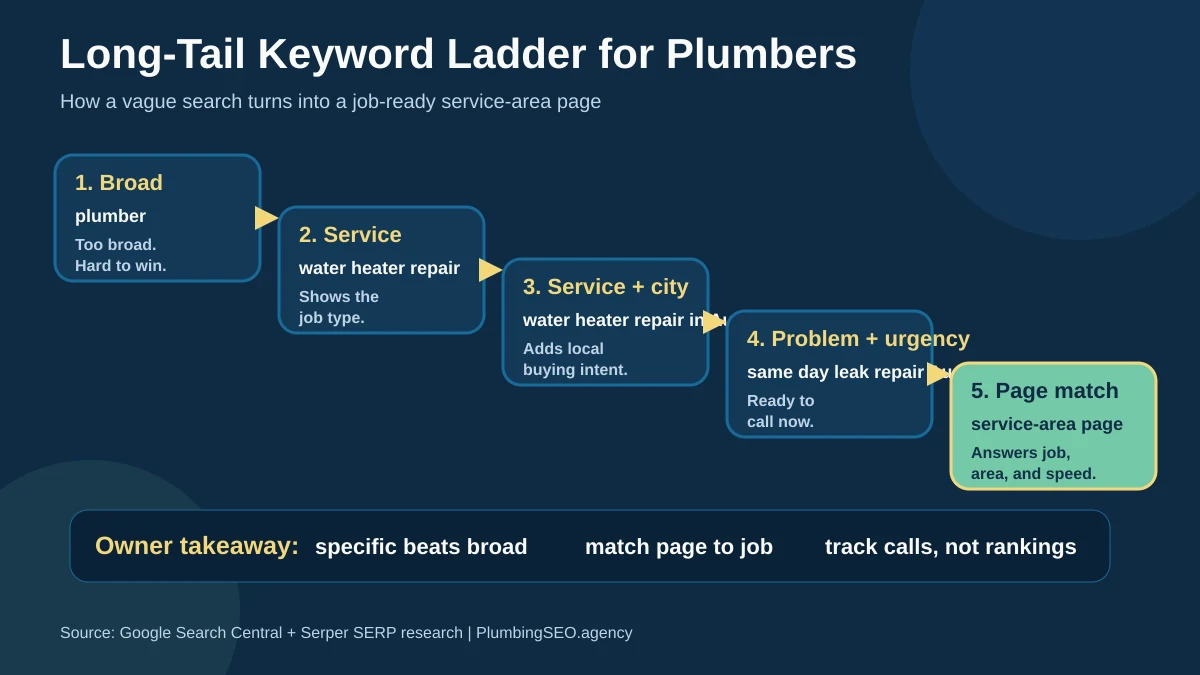
That is where long-tail keywords come in. In plain English, a long-tail keyword is a longer, more specific search phrase. For a plumber, it might be "emergency drain cleaning in Dallas", "tankless water heater repair cost", or "licensed gas line plumber Queens". It is not fancy. It is just the way real customers search when they already know what hurts.
The way I see it, long-tail SEO is not about chasing tiny keywords for the sake of a report. It is about matching your website to real jobs. Google says basic SEO can have a noticeable impact when pages are useful and easy to understand, and its people-first content guidance pushes site owners to create helpful pages for users, not search engines alone. That matters for plumbing because a homeowner with water on the floor does not want a marketing essay. They want to know if you fix this, where you work, how fast you can come out, and whether they can trust you.
What a long-tail keyword means for a plumbing company
A long-tail keyword is not always long because it has many words. It is long-tail because it is specific. Search tools and SEO guides usually describe these phrases as lower volume and lower competition, but the more useful point for an owner is this: the phrase tells you what the customer needs.
Compare these two searches:
| Search | What it tells you | Best page type |
|---|---|---|
| plumber | Could mean anything. The searcher may want a job, a definition, a company, or a local pro. | Homepage or broad local landing page |
| same day water heater leak repair Austin | The job, urgency, and location are clear. | Water heater repair service page with local proof |
The second search gives your dispatcher more useful information before the customer even lands on the site. It tells you the type of job, the city, and the likely pressure behind the call. That is why long-tail keywords are useful for plumbing SEO services. They help you build pages around real buyer intent instead of stuffing one page with every word you can think of.
What the generic SEO posts miss for plumbers
The competitor gap here is simple. Most generic long-tail keyword articles explain the definition, then give software examples. They rarely explain how a plumbing owner should turn a keyword into a page, a call path, and a job on the board.
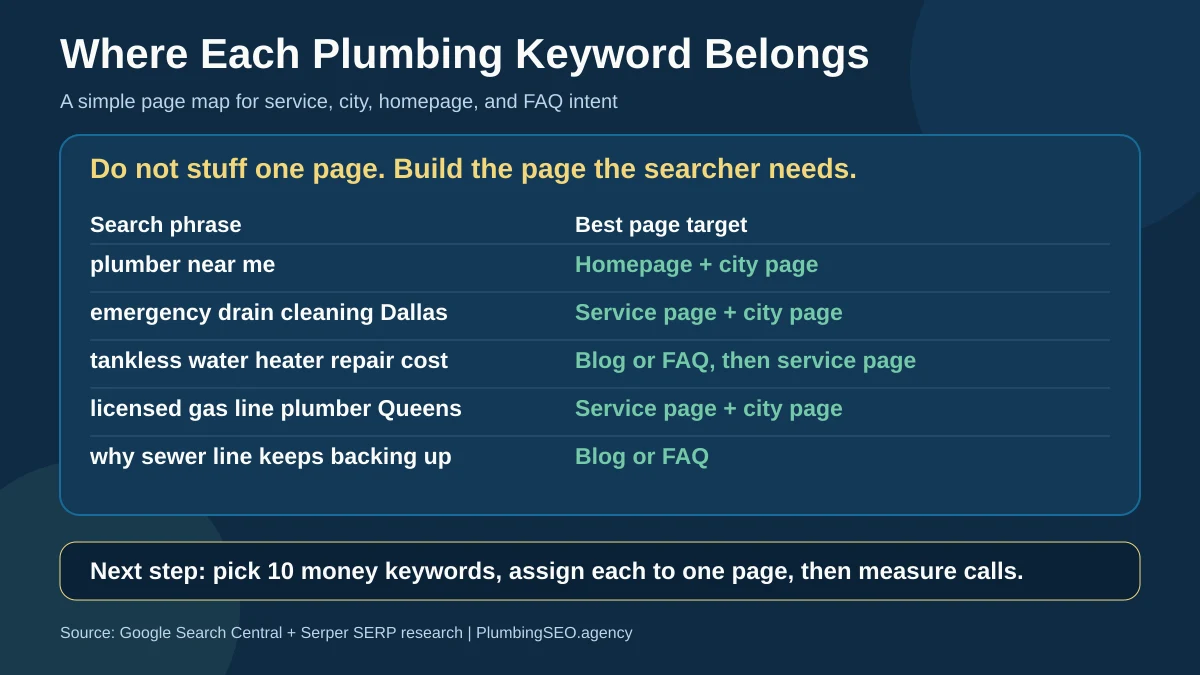
For a plumbing company, a keyword is not just a phrase. It is a routing decision. Does this belong on the homepage, a service page, a service-area page, a blog post, a FAQ, or a Google Business Profile update? If that decision is wrong, you can get impressions and still miss calls.
Plumber-specific examples you can use
Here are long-tail keyword patterns that make sense for plumbing companies. Use your own city, service area, and real services. Do not add services you do not want to sell. That sounds obvious, but plenty of websites rank for the wrong work and then wonder why the phones are full of tire-kickers.
| Pattern | Example | Owner note |
|---|---|---|
| Service + city | drain cleaning in Phoenix | Good fit for a dedicated service page or city-service section. |
| Emergency + service + city | emergency sewer backup plumber Tampa | Needs fast phone CTA, trust proof, and clear availability. |
| Problem question | why does my toilet keep clogging | Good blog or FAQ topic that should point to drain or toilet repair. |
| Cost + service | tankless water heater repair cost | Good for a pricing explainer with a service CTA. |
| Credential + job + area | licensed gas line plumber near me | Needs licensing, safety, proof, and service-area clarity. |
Search research for this draft turned up the same themes across plumber keyword pages, local SEO articles, and community search results: specific service phrases, city modifiers, problem questions, and urgency terms are where the useful intent sits. A Google SEO starter guide source is useful here because it keeps the work grounded. Make pages easy for users and search engines to understand. Do not hide the answer under a pile of agency words.
How to build a long-tail keyword list without overthinking it
Start with your real services, not a tool. Write down the jobs that keep the company healthy. Drain cleaning. Sewer line repair. Water heater replacement. Leak detection. Repiping. Gas line repair. Sump pump work. Commercial plumbing if you actually want it.
Then add the pieces that make a search specific:
- Location: city, suburb, neighborhood, county, or service area.
- Urgency: emergency, same day, after hours, weekend, 24 hour.
- Problem: leaking, backing up, no hot water, clogged, low pressure, burst pipe.
- Customer type: residential, commercial, restaurant, landlord, property manager.
- Trust signal: licensed, insured, local, near me, bonded where relevant.
- Decision question: cost, repair or replace, how long it takes, who to call.
Now combine them. You do not need 500 ideas. You need the first 20 that match real money. If your crew is best at water heaters and drain work, build that cluster first. If emergency work keeps trucks moving, build those pages before you write ten soft blog posts. Bad SEO is like a slow drain. You can ignore it for a while, but eventually it backs up somewhere ugly.
Put each keyword in the right place
This is the step most owners miss. Long-tail keywords do not all belong in the same type of content. A cost question may belong in a blog or FAQ. A same-day service phrase belongs on a service page. A city search may need a service-area page with local proof.
If you already have a local SEO foundation, connect this work to your maps and service-area strategy. Our guide to advanced local SEO for plumbers goes deeper on service-area architecture, GBP tuning, and review signals. The short version here is simple: one clear search intent, one clear page, one clear next action.
A 30-day implementation checklist
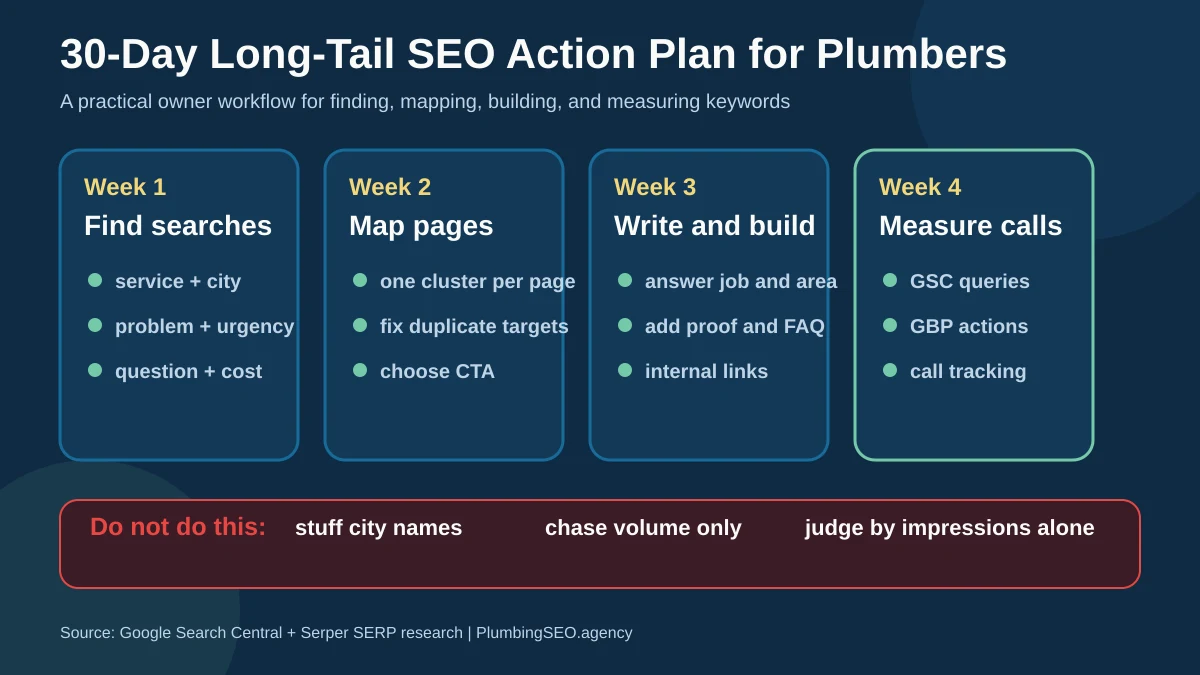
Here is how I would handle this for a plumbing company that wants movement without turning the owner into a full-time SEO person.
Week 1: Find the searches that match real jobs
Pull your top services, top cities, and top customer problems. Check Google autocomplete, People Also Ask, Google Search Console if you have it, and competitor pages. Research tools like Semrush explain that long-tail phrases are usually more precise and can bring higher quality traffic, but do not let any tool boss you around. If a keyword does not match a job you want, leave it alone.
Week 2: Map one cluster to one page
Pick one primary phrase and a few natural supporting phrases per page. For example, a water heater page might target "water heater repair in Austin" and naturally include "same day water heater repair," "no hot water," and "leaking water heater." Do not create three thin pages that all say the same thing. That splits your strength and confuses the customer.
Week 3: Build or improve the page
The first screen should answer the job, area, and speed. Add proof like reviews, licenses, photos, process steps, financing if relevant, and a simple CTA. If the query is informational, write a useful blog post and link it naturally to the correct service page. The Google people-first content guidance is clear enough for this: make content for people, not just for search engines.
Week 4: Measure calls and tighten the route
Check Search Console queries, GBP actions, form fills, and phone calls. Rankings are useful, but the phone tells the truth. If a page gets impressions but no clicks, fix the title and meta description. If it gets clicks but no calls, fix the above-the-fold message, trust proof, and CTA. If it gets calls from the wrong area, fix the service-area language.
Common mistakes with long-tail keywords
- Chasing volume only. A broad keyword with big volume can look impressive while bringing poor-fit traffic.
- Stuffing city names. A service page should read like a real page, not a map covered in pins.
- Making one page target everything. Drain cleaning, sewer repair, and water heaters should not all fight for the same title tag.
- Ignoring the call path. A page can rank and still fail if the customer cannot quickly call, text, or request help.
- Publishing thin city pages. A city page needs service-area proof, useful local context, and real reasons to trust you.
How long before results show up?
Long-tail keyword work is usually easier to measure in stages. First, Google discovers or reprocesses the page. Then impressions appear for more specific queries. Then some queries move up. Then the better ones start bringing calls. In a less competitive market, useful page improvements can show early signs in a few weeks. In a tough metro, expect a few months of steady building, linking, and review work before the graph looks meaningful.
In my opinion, the best early metric is not traffic. It is whether the right queries are starting to match the right pages. If Search Console shows your water heater page earning impressions for water heater searches in your service area, the route is being built. If it shows random DIY questions with no buyer intent, you may need a blog post, not a sales page.
When should a plumber hire help?
You can do the first pass yourself. Write down your services, areas, and common customer questions. Map them to pages. Fix obvious page titles. Add clear FAQs. That alone can clean up a lot of leaks.
Hire help when the site has too many pages fighting each other, when you need city and service architecture built correctly, when tracking is missing, or when you are spending on ads because organic traffic is not producing enough qualified calls. A good agency should be able to show you the keyword map, page plan, internal links, and call tracking setup. If all they show is a ranking report, keep your wrench handy.
If you want a practical outside look, start with a free plumbing SEO audit. The useful question is not "how many keywords can we rank for?" It is "which searches are most likely to put the right jobs on the board?"
Frequently Asked Questions
It helps the website match real customer intent. A phrase like same day water heater repair in Austin tells you the service, location, and urgency. That gives the page a better chance to attract a customer who is closer to calling than someone searching only for plumber.
Examples include emergency drain cleaning in Dallas, tankless water heater repair cost, licensed gas line plumber Queens, and why does my sewer line keep backing up. Each phrase gives more context than a broad term like plumber or plumbing services.
Yes. Start with your services, cities, common problems, and urgency words. Then map each phrase to the right page. Hire help when pages overlap, tracking is missing, or the site needs a full service-area and internal-linking plan.
It depends on intent. A buyer phrase such as emergency sewer repair in Tampa belongs on a service page. A research phrase such as why does my drain keep backing up can work as a blog or FAQ that links to the drain cleaning page.
Some page improvements can show early query movement within a few weeks, especially in smaller markets. Meaningful call growth usually takes a few months of page improvements, internal links, reviews, and tracking. Judge progress by relevant queries and qualified calls, not impressions alone.
The biggest mistake is forcing too many services and cities onto one page. That makes the page vague for Google and unhelpful for the customer. One clear search intent should have one clear page and one clear next action.
Want Your Keyword Map Checked?
We will find the service, city, and problem keywords your plumbing site is missing, then show which pages should be built or repaired first.
Run My Free SEO Leak Check